May 26, 2024

Ghosts of Canoe Lake: Marcel Dzama at the McMichael Gallery

As a repository of Canadiana in all its splendour, the McMichael Gallery in Kleinburg does not disappoint. Sited within 100 acres of majestic forests, the gallery building — with its log and barn-board walls, massive, rough hewn field-stone fireplaces and floor to ceiling plate-glass — is a treasure trove of Group of Seven artworks.

Weirdly, six members of the Group of Seven are interred on the grounds of the gallery, at the McMichael cemetery.

Wait…One is missing…Where is Tom Thomson?

No one knows. And that mystery is at the heart of the current show by Marcel Dzama. The show’s title, Ghosts of Canoe Lake, refers to Tom Thomson’s disappearance, which occured while he was paddling on Canoe Lake, in 1917.

“Canoe Lake, Sunset” by Tom Thomson

On entering the gallery, a dreamy triptych, filled with colour and wildly imaginative imagery, announces the themes of the exhibition: Tom Thomson himself, his death and subsequent ascendence as the essential Canadian artist; the vividly alive natural world — flooded and on fire — and the strange cast of surreal creatures and characters that reside within it.

“After the Fire Before the Flood” by Marcel Dzama

Detail of “After the Fire Before the Flood” by Marcel Dzama

Marcel Dzama has declared he is “obsessed with Tom Thomson” and that the show is an homage to the artist who died at the age of 39.

Installation by Marcel Dzama

In the center of the Gallery sits a large tent, festooned with oversized polka dots, imagery which Marcel Dzama has been painting for some time.

“The Tent” by Tom Thompson

It really does reference the beautiful little tent that Tom Thomson painted so long ago, when he worked as a Fire Ranger in Algonquin Park. Of course, Marcel Dzama’s tent is a little more circusy, and within, we are presented with another form of the artist’s work: Film.

Installation view of artwork by Marcel Dzama
Still from “To Live on the Moon (For Lorca)” by Marcel Dzama

The film is fun to look at, featuring a whacky plot where Tom Thomson is dispatched and a riotous funeral parade follows. Hillarious, absurdist, Dadaist, surrealist, and yet, like all the paintings and other objects in the show, completely and uniquely Marcel Dzama!

“Aurora Borealis (or a light in the sky like a bat over the land” by Marcel Dzama

Blue and grinning, looming over the show, is a giant what looks like paper mache moon. It’s so familiar! It’s an image that is repeated in multiple forms in the exhibition. It took me a while to figure out it’s reference to the movie “A Trip to the Moon,” made in the year 1902 by Georges Melies.

Installation view of artwork by Marcel Dzama
“To Live on the Moon (for Lorca)” by Marcel Dzama
Still from film by Marcel Dzama

The show is rife with art historical references. Picasso’s dove makes an appearance, frequently the sky’s are painted like the turbulent Starry Night imagery of Van Gogh, birds behave as they do in M.C. Escher’s work, the famous Lawren Harris portrait of his wife Bess is reinterpreted by Marcel Dzama, and, the artist Garcia Lorca has several pieces dedicated to him in this exhibition.

We can not abandon such beauty” by Marcel Dzama

But it is the Group of Seven, and Tom Thomson in particular, that has transfixed the artist. Maybe Tom Thomson represents that longing to be close to the grandeur of the Canadian landscape, a desire that is so often a function of simply dwelling in this part of the world.

And yet, as Marcel Dzama acknowledges, at this juncture, the world is turned upside down. The show is quite somber. War and corruption are everywhere. The seas are rising and the forests are on fire.

“Lady of Fire” by Marcel Dzama

A book, by Guy Maddin, which accompanies the exhibition, contains the following mournful poem.

When painting the evening,
While the world is unease,
The young northern painter,
Painter of trees.
Your evening has ended,
The moon is out low.
Hit your head upon it,
And sleep in the waters below.
That pale horse rider,
Has come here so soon.
When there’s war on the earth,
And blood on the moon.
— Tom’s Blood Moon, 
Marcel Dzama
May 5, 2024

DECADE: 10 Years of Creation at Youngplace

Beleaguered, in decline, challenged, crumbling, struggling…. These are some of the words used in the local press and social media to describe the current state of the Toronto art scene. There are many reasons: the pandemic screwed everything up, capricious corporations pulled funding, everything is turned into a condo tower, money just keeps flowing upwards, and a glass of wine costs twenty dollars. But is there something more fundamental going on, could it be the nature of Late Stage Capitalism!?

Painting by Ruth Adler
Assemblage by Ruth Adler from “DECADE” at Koffler Centre for the Arts

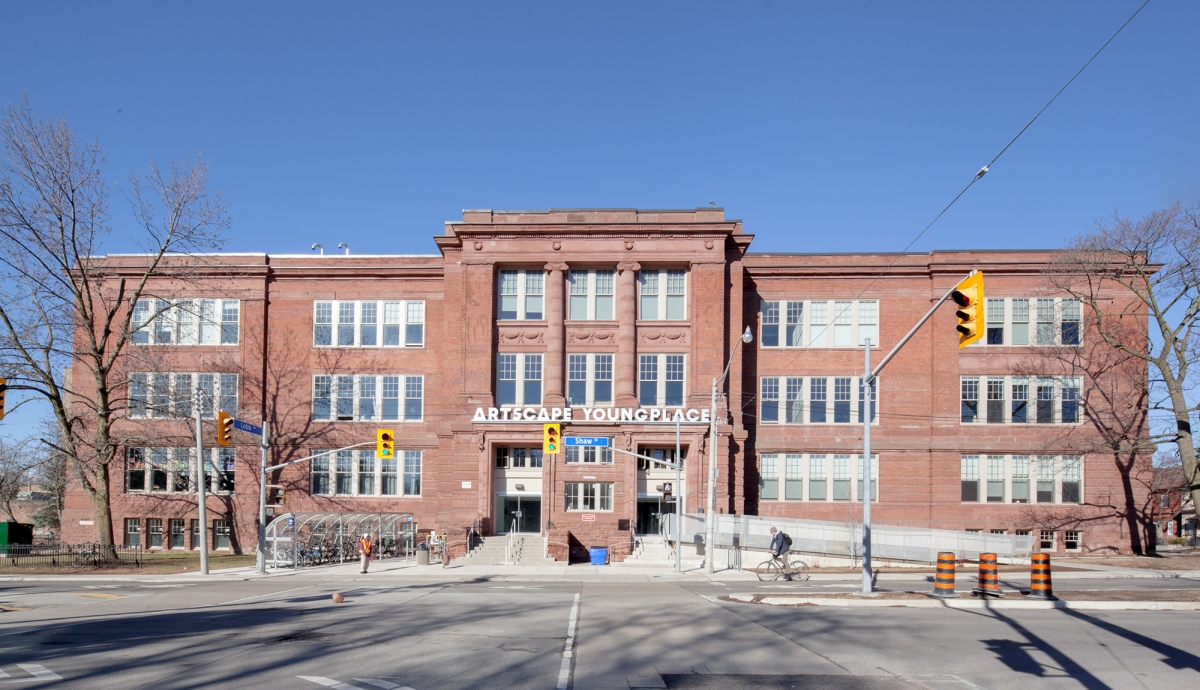
In this context, seeing the exhibition at Koffler Center for the Arts was not just fun, uplifting and hopeful, but also illustrative of the importance of artist’s spaces in this city. The Koffler Center is housed in the Youngplace building, which opened as a cultural center in 2014 and is currently one of the Artscape facilities in Receivership. All the artists in the show are, or were, until recently, part of the Youngplace community.

The stated goal of the exhibition is to shine a light on Youngplace: “this iconic arts hub.”

Painting by Ruth Adler
Assemblage by Ruth Adler

Lining the wall of the entrance to DECADE are fabric and paint assemblages by Ruth Adler. This artwork strikes me as generous, open and approachable. It’s all about surface and shape, colour, pattern and movement. It feels light-hearted and celebratory, and I really like the way this artist repurposes materials.

Ruth Adler has had a studio at Youngplace for 10 years. This fact reminded me of the documentary about Brian Eno I saw this week, at the annual Hot Docs Film Festival. (Actually it was more of a film experience, created using generative technology.) Toward the conclusion of this event Brian Eno talked a lot about the importance of creative ecologies, as opposed to the myth of the solitary genius. I assume this idea of creative community applies to all the artists in this show.

Although she works with many different kinds of materials, Ruth Adler thinks of herself as a painter. Matthew Schofield is another painter in the show. Whenever I see paintings by this artist it feels like he’s tapping into my own memory banks. That’s because he delves into the arena of quirky personal snapshots, family pictures, keepsakes, memorials that are entirely personal, and yet, universal.

Paintings by Matthew Schofield
Painting and detail by Matthew Schofield

These beautiful paintings are tiny, some just 4″x 4.” They are identical in size to the original snapshots. They have a glittering, gemlike quality which is quite mesmerizing. I want to get closer and closer to them, and peer into the captured moments.

Painting by Matthew Schofield

It was very exciting to see the work of Midi Onodera. This artist has some interesting relationships with machines.

Excerpt from Soliliquy bny Midi Onodera

The excerpt above is a hilarious interaction between the artist and a chatbot named Faux Midi.

There is a lot of literature on line these days about how chatbots and GPT entities are prone to all kinds of malfeasance. They are liars, people pleasers who will say anything just to keep talking. They are prone to hallucinations. They can easily be hypnotised to spout misinformation. In other words, these things can’t be trusted! Some of the exchanges between Midi Onodera and Faux Midi make this fact abundantly clear.

The other piece by Midi Onodera was produced especially for the exhibition and weaves together colorized, moving mages of the corridors and stairways of the Youngplace site at 180 Shaw Street. It was wonderful to look at until I started feeling seasick.

Excerpt of 2397 by Midi Onodera

Speaking of weaving, textiles played a big role in the DECADE show.

I was obliged to read the catalogue to know what I was looking at when I viewed the elegant, attenuated weavings by Shabnam K. Ghazi. In fact, these wall hangings are composed of shredded paper which has been woven into a fragile, delicate fabric. The recombined paper contains screenprinted depictions of the artist’s writings, describing her earliest memories.

Wall hangings
Artwork by Shabnam K. Ghazi

In this convoluted, painstaking process the artist has found a way to physically manifest her language and her earliest recollections.

Two pieces by Barbara Astman are in the show. One is a lovely tapestry in muted tones. It takes a while to recognize the fragments of contemporary glamour, fashion and advertising imagery in this piece. The form of tapestry, a traditionally female pursuit, originated in Ancient Egypt. Tapestry weave pieces, using linen, were found in the tombs of both Thutmose IV (d. 1391 or 1388 BC) and Tutankhamen (c. 1323 BC.)

Tapestry
Tapestry by Barbara Astman
“Daily Collage” by Barbara Astman

The other piece by this artist is a collage using news feed type imagery. I really like the way Barbara Astman uses the pictures we are relentlessly bombarded with everyday and repurposes them for her own amusement.

Detail of “Daily Collage” by Barbara Astman

Massive quilts by Carolyn Murphy are on display. They take quilting, another so-called feminine art, into the realm of spare and airy abstraction. These quilts have a Russian Constructivist vibe. The very appealling texture is created by the dense stitching which ambles every which way in curving patterns. It was a good move by the Koffler gallery to place a large sign nearby, stating the obvious: Do Not Touch.

Quilt by Carolyn Murphy

Among my favourite artworks in this show were the paintings by Gillian Iles. She has created a sprawling installation composed of about eight separate paintings, produced on Tyvek and other materials, tied and stretched haphazardly. The installation resembles a temporary dwelling or encampment, ramshackle, derelict and unsafe.

“All and Nothing” by Gillian Iles
Detail of installation by Gillian Iles

Within this structure, Gillian Iles has strewn intense images: Light blasts a tiny, vulnerable tent under the arch of a heavy black night sky; a wrecked, abandoned vehicle is overgrown with random vegetation; a fire nearly out of control towers over onlookers; and — is it dawn or more flames? — something is blazing fiercely through a hidden path in the woods.

Detail of “All and Nothing” by Gillian Iles

Detail of All and Nothing by Gillian Iles
Detail of installation by Gillian Iles

David Liss, the esteemed director/curator of MOCCA, curated the exhibition. In a video loop playing in the gallery he talks about how interacting with art — not on line but in real life — is essential to the human experience. He invites visitors to the show to celebrate Artscape Youngplace and the decade since it was founded, and to “consider and imagine what the next decade will look like.”