February 21, 2025

The Culture: Hip Hop and Contemporary Art in the 21st Century, at the AGO

It is definitely fun to wander through the AGO’s big, bold show about Hip Hop. The organizers illuminate multiple forms of expression, trying to get at some central defining aspect of what is described as a “musical and pop cultural movement.”

“Black Power ” by Hank Willis Thomas

Clearly, that central something is Black culture, and the overturning of Eurocentric ideas of what can be culturally significant.

Hip Hop, in all its manifestations, may now be global, digital and corporate (absorbed and marketed so heavily, it is, like the show’s title, The culture) and yet, some unique vitality, dynamically expressed by Black, Latine, and Afro-Caribbean youth, in 1970s Bronx, endures to this day. Hip Hop continues to transform, explode and multiply, even against the backdrop of today’s bizarre political denial.

The Culture is organized around six themes: Language, Brand,
Adornment, Tribute, Pose, and Ascension.

Language

Hip-hop is intrinsically an art-form about language: the visual
language of graffiti, a musical language that includes scratching
and sampling, and, of course, the written and spoken word.

— Extracts from exhibition text

The Culture Exhibition

Language, in this show, starts with the spoken word. “Call and-response chants, followed by rap rhymes and lyrics overlaid on tracks, are the foundations of hip-hop music.” (Quote from the exhibition text.)

Music is playing at a decent volume throughout the AGO’s fifth floor.

You can check out the AGO playlist below:

“The Culture” Playlist is available on Spotify

The shows is sprawling, and some of the objects are traditional museum fare.

Art work by Adam Pendleton

The painting by Adam Pendleton (above) has an old school graffiti feel, as per language inscribed on the street. Weirdly, there is no mention of graffiti on the Pace website showcasing the work of Adam Pendleton. His visual art is included in prestigous collections around the world and often described as relating to “process and abstraction.”

“Six Bardos: Transmigration” by Julie Mehretu

More paintings in the show, like that of Julie Mehretu (above) don’t actually contain legible language, but here too, the debt to graffiti is clear. Julie Mehretu’s dealer is the Mariam Goodman Gallery and on the Mariam Goodman website we read about the artist’s “visual articulation of contemporary experience.”

I like the way this show schools us in how to look at certain art, particularly a contemporary painting like those above, i.e they are connected to graffiti.

The Brand, Adornment and Pose sections of the exhibition get a bit intertwined, in my view. They are all about how an individual uses technological communication to define themselves in the public sphere.

Snoop Dog 213 by Craig Boyko

Hip Hop has been around for a long time! Snoop Dog was once the personification of the cool, west coast version of the genre. He went on to host a cooking show with Martha Stewart, and recently performed at Donald Trump’s inauguration.

It’s hard to even remember a time when baggy sweatpants and sneakers were not worn everywhere, by everyone.

Outfit by Too Black Guys

In fact, you could walk through any shopping mall in North America and find an endless assortment of gear attributable to some Hip Hop connection. How about that hoodie I got on sale at Old Navy?

Cardi B
“Cardi B Unity” by Hassan Hajjaj

Cardi B, the reigning Queen of Rap, is the recipient of a vast number of accolades, awards, firsts, and mosts. In this photograph by Hassan Hajjaj she confronts the camera with supreme confidence, portrayed as the “international blend of music, fashion and consumer culture” that she is.

I liked the way the show approaches the matter of pose in the hip hop, particularly as it applies to the women in this arena. Endorsements are power for women, just like for their male counterparts.

Maya Jacket by Moncler

And who can forget the iconic red jacket from Drake’s “Hotline Bling” video? Apparently, the inclusion of this so-called Maya Jacket, by Moncler, in the famous video, locked in the brand’s connection to hip hop culture.

I think I prefer the more unexpected, even daring items in the show, as opposed to the merely manufactured. The piece (below) by Lauren Halsey is a good example.

“auntie fawn on tha 6” by Lauren Halsey

Composed of layers of synthetic hair, in brilliant shades, it has an intensity and power that strikes me as so of the moment and at the same time so reminiscent of some ancient adornment.

I found one piece in the adornment section shocking.

two men seated in room
“Nation” by Deana Lawson
man with dental decoration
Detail of “Nation” by Deana Lawson

This photograph by Deama Lawson contains an inset of George Washington’s false teeth, which were made from the teeth of enslaved Black people. The cheek retractor looks like a kind of torture object me, as repellant as the set of teeth. But that’s not how Deana Lawson sees it.

There is a nobility and majesty of a lot of gold that’s worn, and how it’s appropriated in hip-hop, and how I think hip-hop actually channels ancient kingdoms.

— Deana Lawson, exhibition notes

Ascension

And, of course, you can’t talk about Hip Hop without mentioning the deathiness that hovers on the sidelines and occasionally takes center stage.

“Street Shrine 1: A Notorious Story (Biggie)” by Robert Lugo

This funerary urn featuring a graphic depiction of the Rapper Notorious BIG captures the glamourization of violent death that has haunted the world of hip hop.

Biggie Smalls was murdered in 1997 at the age of 24. According to Wikipedia, Wallace’s funeral was held at the Frank E. Campbell Funeral Chapel in Manhattan on March 18. There were more than 350 mourners at the funeral, including Lil’ Cease, Queen LatifahFlavor FlavMary J. BligeLil’ KimRun-D.M.C.DJ Kool HercBusta RhymesSalt-N-PepaDJ SpinderellaFoxy Brown, and Sister Souljah.  David Dinkins and Clive Davis also attended the funeral.  After the funeral, his body was cremated at the Fresh Pond Crematory in Fresh Pond, Queens, and the ashes were given to his family.

February 1, 2025

Design TO Festival – Net Positive

In these dark times it was uplifting to sit in the luxurious Ace Hotel and listen to one presentation after another on how to solve the most critical issues we face concerning the environment, society and the global economy.

Young, attractive, well-dressed people can do it! They have ideas! They have deep pockets!

Even the tagline for the Design TO Festival — “Designing for a sustainable, just, and joyful future” — is like a jolt of sunshine in an otherwise bleak February, as across this country we wait for our economy to tumble off a cliff, and on the other side of the continent LA lay in smoldering ruin, under the relentless California sunshine.

Ace Hotel

Design TO is Toronto’s huge design festival. Net Positive is the name of just one out of dozens of events. Net Positive consists of a series of presentations by a diverse group of sustainability enthusiasts. (What does Net Positive even mean, I wondered? Answer: For an enterprise to become “net positive”—it has to give more to the world than it takes.)

Here are some slim summaries of a few of the presentations I heard that day:

Juan Erazo is a member of Culturans, a Mexico City organization which “uses art, culture and social innovation to imagine and create sustainable cities.”

Juan Erazo told us all about chinampas, a centuries-old agricultural system that was once used throughout Mesoamerica and parts of South America. I was stunned to learn that chinampas endure to this day, even in the southern part of Mexico City.

Chinampas are an articulated set of floating artificial islands built in a traditional way. They are an ancient method of sustainable agricultural, still in use in Mexico City and elsewhere.

Roughly 700 years ago the megalopolis which is now CDMX was once a small city beside a lake. At that time the chinampas were thriving, fed everyone and exported food. Unfortunately, the lake was drained, paved over, and 25 million people moved in. Now, Mexico City has almost no water — everything liquid has to be imported — and that was one point of the presentation. “You have a lake in Toronto.” Juan Erazo warned. “Don’t throw it away!”

Aaron Budd is another exciting presenter. He works on a project close to my heart: The Ontario Line!

Aaron Budd is employed by SvN — the architecture/planning enterprise engaged in building the new subway — and he leads the company’s Regenerative Practice. He quoted Kate Raworth , stating the phrase: “Great places are social. Great places are ecological.”

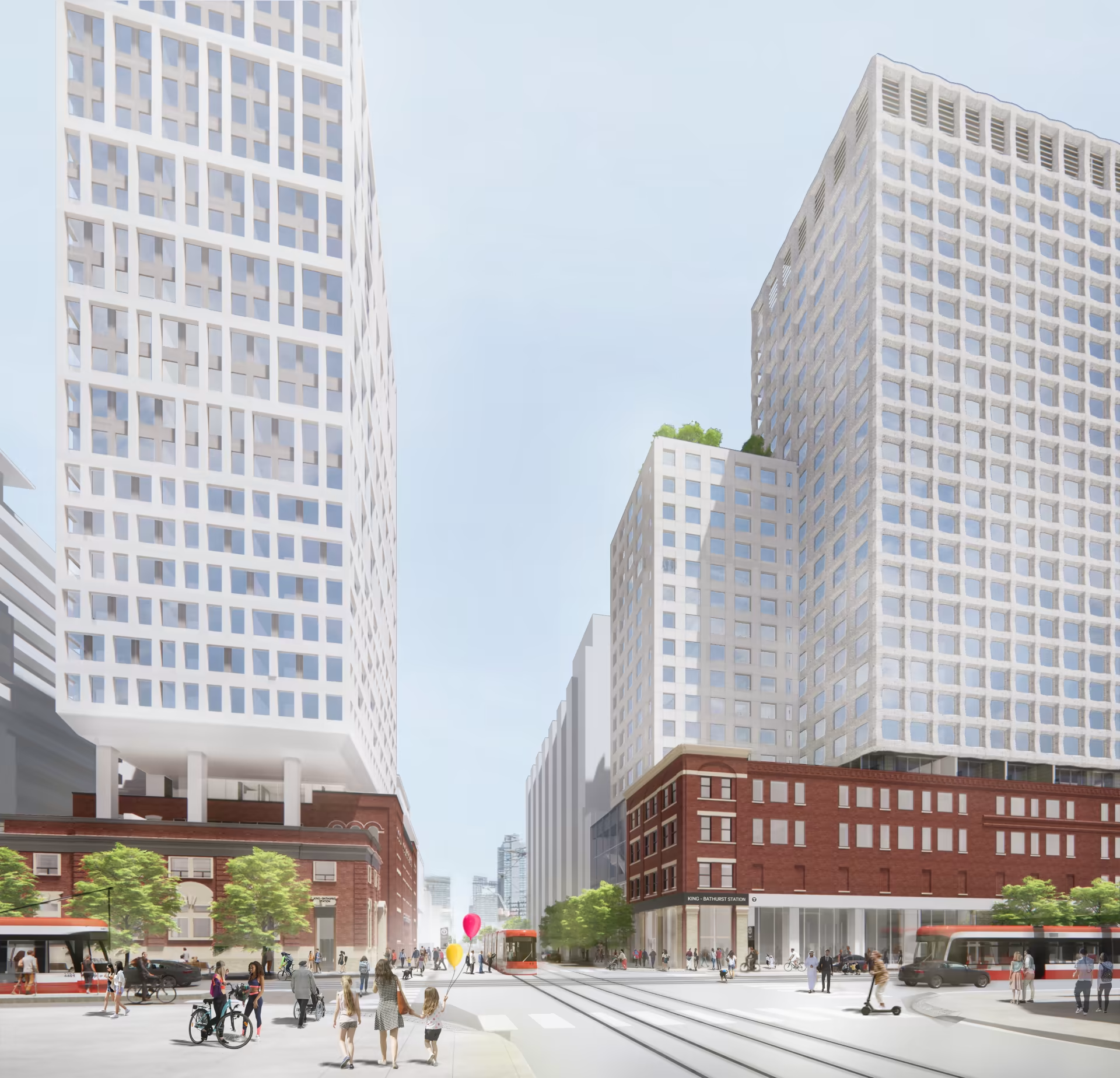
I was very excited to learn that the Ontario Line is being constructed to provide the infrastructure for 30 story residential structures above each subway stop. The Ontario Line will provide housing in transit oriented communities to more than 227,000 people.

King and Bathurst Station Rendering
Rendering of the future King-Bathurst Transit Oriented Community

Because we live in Toronto we can become mired in a skeptical mindset. We might wonder: Will I live long enough to see these majestic towers over the new, fully functional, Ontario Line? It’s hard to say. But in the meantime, it was great to listen to Aaron Budd describe these communities and to let us know that through his work at SvN he “strives toward the creation of new housing, public spaces and delivering positive social and ecological change.”

April Barrett is a young woman who spoke to us about her interest in Speculative Design, which explores future possibilities and societal impacts of emerging technology and shifting cultural and social trends.

One of her projects concerns the socio-environmental impact of Data Centers and their waste heat use potential. Specifically, April Barrett visited the Dublin suburb of Tallaght, where the heat generated by the Amazon Data Center — a gloomy, featureless edifice — heats the town, including hospitals, university and public buildings, commercial enterprises, and apartment towers.

Maybe we could do the same thing in Toronto?

This Data Center, a former Loblaws, is located in Brampton, Ontario.

April Barrett talked a lot about Anna Tsing and her book “The Mushroom at the End of the World.”

I googled Anna Tsing and found her ideas so applicable to our current situation vis a vis our neighbour to the south. I’m going order the book, but not from Amazon.

Precarity is the condition of being vulnerable to others. Unpredictable encounters transform us; we are not in control, even of ourselves. Unable to rely on a stable structure of community, we are thrown into shifting assemblages, which remake us as well as our others. We can’t rely on the status quo; everything is in flux, including our ability to survive. 

— quote from Anna Tsing “The Mushroom at the End of the World”

April Barrett is looking for alternatives to Big Tech. She told us all about Low Tech Magazine, degrowth as a technological heuristic, ultra-lite web design, letting go of scalability, and finally, she mentioned “The Solar Do Nothing Machine,” created by Charles and Ray Eames, in 1957, which is just kind of fun.

The Solar Do Nothing Machine by Ray and Charles Eames

Netami Stuart is a landscape architect at Waterfront Toronto. The project — the Port Lands — has been a massive undertaking for her, as she manages collaborative teams and multi-million dollar budgets.

Currently, 290 hectares of southeastern downtown – including parts of the Port Lands, South Riverdale, Leslieville, and the East Harbour development site – are at risk of flooding from the Don River and can’t be revitalized until they are flood protected. The Port Lands flood protection project will protect these lands, allowing them to be redeveloped. It involved building a new river valley though the Port Lands, which has created a new island called Ookwemin Minising (formerly known as Villiers Island), and re-naturalizing the mouth of the river.

— Description of the Port Lands project from Waterfront Toronto website

Earlier in the Port Lands project

Netami Stuart talked about building 1,000 meter of new river channel and flood plain, 13 hectars of new coastal wetland, and 4 hectars of terrestrial habitat, basically fashioning a new Don River flowing into Lake Ontario. After seven years of work Netami Stuart was excited to let us know the end is in sight. The new parks are opening in the spring and summer of 2025 and housing development is to follow.

$1.25 billion in municipal, provincial, and federal funding was awarded to the Port Lands Flood Protection project in 2017.

I walked through the Port Lands site several times last summer and fall. Spectacular! The winding river, the hills and valleys, the red and yellow bridges.

There was so much to feel good about at the Design TO Net Positive event. At least for a few hours to share the optimism of the designers of a sustainable, just, and joyful future.

It was a way to shake off — at least temporarily — that sinking feeling I’ve had since I came across a picture of what some cynics among us are calling the “painting of the year.”

Painting executed January 29, 2025

This photo depicts a wall at the FBI Academy in Quantico, Virginia as it is painted with grey semi-gloss to cover what were previously known as the core values of the FBI: Respect, Accountability, Leadership, Diversity, Compassion, Fairness, Rigorous Obedience to the Constitution and Integrity.