October 19, 2023

Inter/Access:

Remember Tomorrow – A Telidon Story

There was a warm, fuzzy feeling at Inter/Access on the evening of October 19, 2023. The organization was celebrating 40 years as a center dedicated to expanding the cultural significance of art and technology.
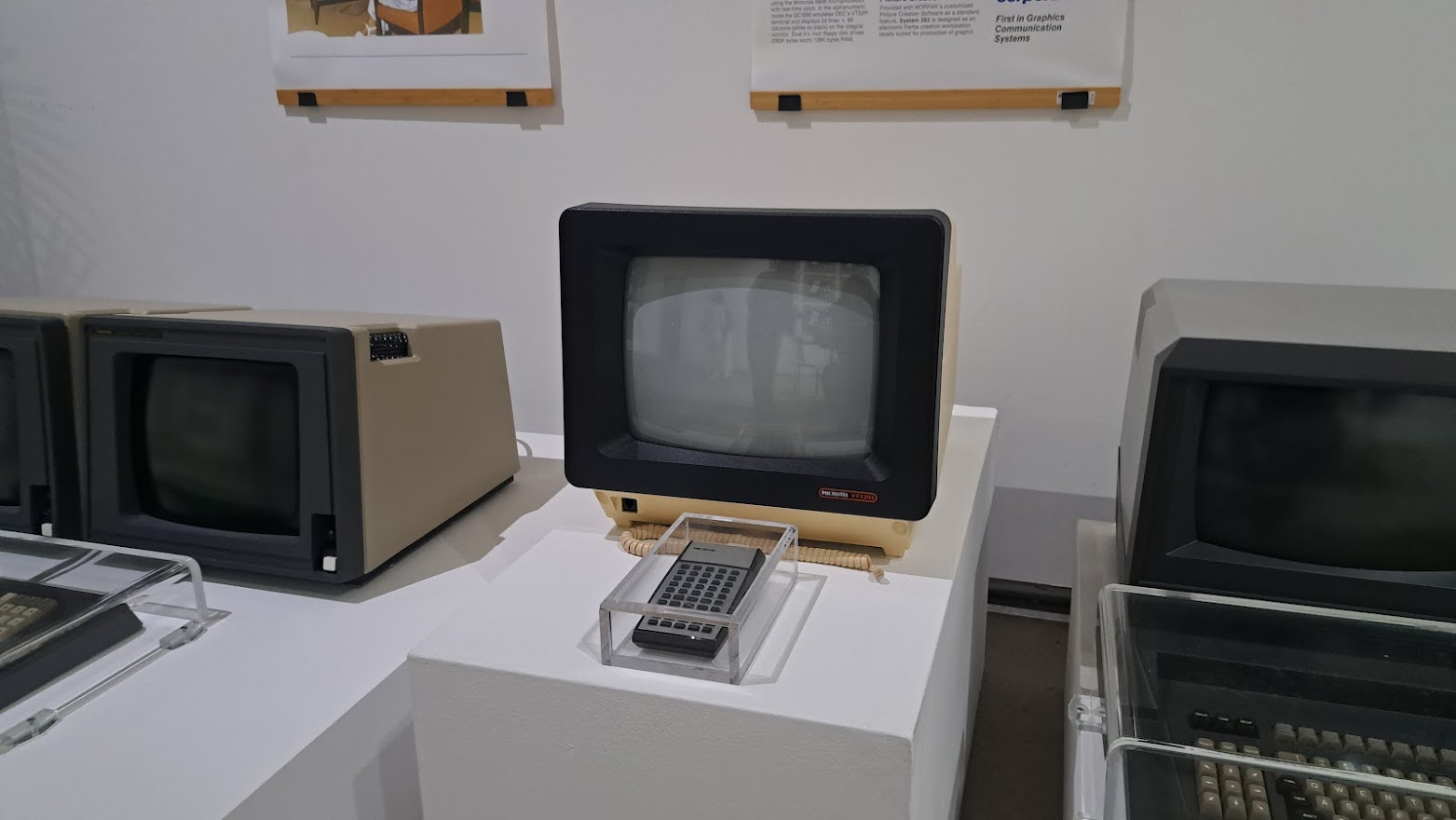
Installation view of “Remember Tomorrow: A Telidon Story” at Inter/Access.

Before that evening I did not know that Inter/Access was originally named Toronto Community Videotex or TCV, and that it was first set up as a non-profit, artist run corporation to provide tools for artists using Telidon.

Yes, Telidon. The Telidon program, a television-based information-sharing system that allowed users to browse computer databases, was developed by the long gone Canadian government department called the CRC (Communications Research Center.) The program began officially on August 15, 1978 and ended on March 31, 1985.
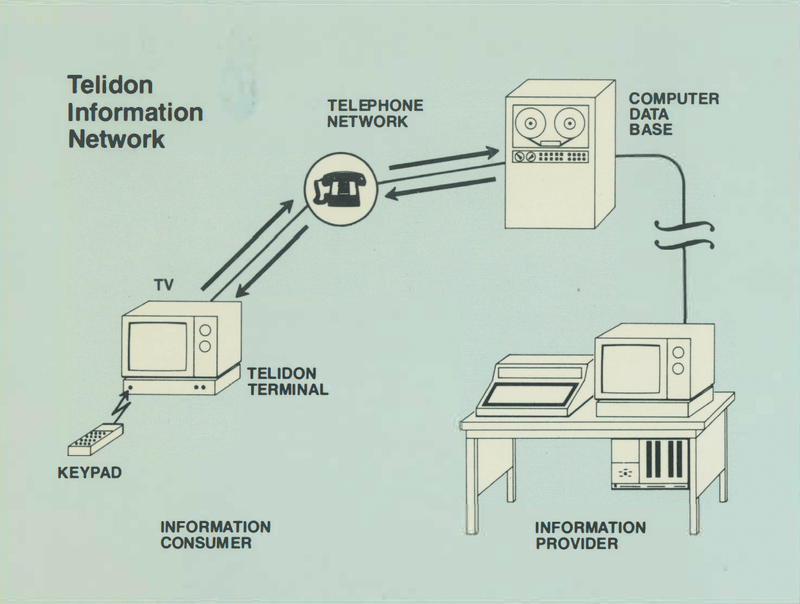
“Transmitting Information over Telephone Lines,” diagram from Inter/Access website.

Wandering around the show I got the feeling the Telidon developers were so close to something, groping around in the virtual landscape — blindly, unable to quite make it happen — but knowing, absolutely, they were there, at the beginning of something.

A Telidon Terminal

Telidon was a proto-type for the Internet. It was a 24/7 source for information. All you needed, as a user, was a Telidon terminal and a keypad. It was interactive! I think it was the interactivity part that really got the original Telidon artists hooked.

Detail of “She Seemed to be in Transit” by Johanne Daoust, produced using Telidon

The concept of simultaneity was another idea that was intoxicating to artists. Toronto gallerist Paul Petro, one of the original founders of TCV and an artist using Telidon, spoke during the evening about the excitement of hosting an art opening in three different cities, at the same time!

An early “selfie” created with Telidon by Paul Petro

The images created with Telidon have a blythe, cheerful, pop art look. They are rendered in time as layers load and intersect in a satisfying, somewhat hypnotic, display.

Installation view of “Remember Tomorrow – A Telidon Story” at Inter/Access

This exhibition explores the allure of Eighties hardware and, well, I guess you could call it lifestyle. Big television sets that look like credenzas, potted palms and wow, orange shag have been lovingly installed in the Inter/Access gallery.
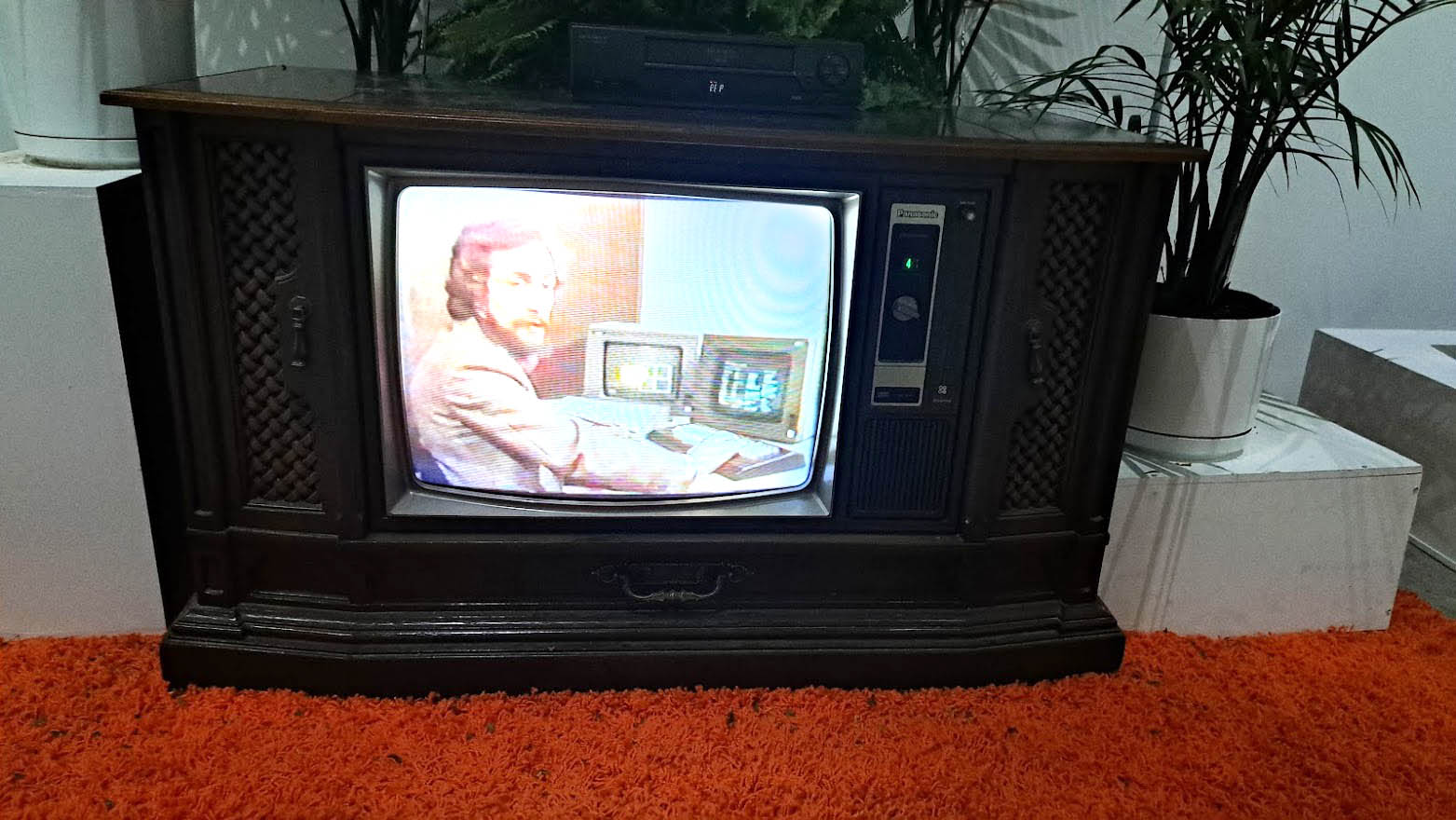
Installation view of “Remember Tomorrow – A Telidon Story” at Inter/Access

Lots of obsolete hardware is on display. By lifting a telephone receiver and pressing “rewind” and then “play” on a tape deck the gallery visitor can listen to interviews with participating artists. (Unfortunately several of the taped interviews had been inadvertently erased during the exhibition because users were unaware of the lost art of “removing the tab” from a cassette tape to prevent just this type of mishap.)

Installation View of “Remember Tomorrow – A Telidon Story” at Inter/Access

The exhibition catalog, put together by curator Shauna Jean Doherty, contains the most endearing story about the Telidon artworks selected for the Venice Biennale of 1986. Created on a series of floppy disks and “playable only using specialized hardware” the artworks were indeed shipped to Italy for the big show, but because of technical difficulties they were never put on view, and instead sat in a cardboard box for four decades.

The whole show has a sort of elegiac feel to it. Maybe it’s about mourning the loss of innocence in regard to technology.

The past is but the beginning of a beginning, and all that is or has been is but the twilight of the dawn…”

Douglas Parkhill, one of the father’s of Telidon, quoting HG Wells in a report chronicling Telidon’s history, from the exhibition catalogue.

The developers definitely did have a romantic view of that brief, Telidon moment. There were some catchy words and phrases that picked up the “beginning of the beginning” vibe and quickly rose and fell: Whatever happened to “informatics,” “Instant World,” “Telematic Culture” or the “Information Paradigm?”

Detail of Installation view, “Tomorrow Remembered – A Telidon Story” at Inter/Access

But it hasn’t all disappeared. Thanks to John Durno, head of Library Systems at the University of Victoria, an operational Telidon decoder does exist and numerous Telidon artworks have been restored and are ready to be returned to Venice for a conference this year.

Detail of Telidon image by Rob Flack

“Sherry” Telidon image by Glen Howarth
“Telidon Commercial,” Telidon image by Don Lindsay

1983..1983…1983…? To be honest, I can’t recall anything specific about that fateful year. Fortunately we now have the Internet to fill in the blanks:

  •  In 1983:
  • The metric system of weights and measures was officially adopted by the Canadian federal government.
  • 25 Red Brigades were sentenced to life for kidnapping and murdering Italian Christian Democrat politician Aldo Moro in 1978.
  • Singer and drummer of The Carpenters, Karen Carpenter, died from complications caused by eating disorder anorexia nervosa, age 32.
  • Though already available in Japan and Europe, Sony and Philips released their CD players in the US and Canada. Though a compact disc player costs over $1000, they prove to be extremely popular.
  • Michael Jackson’s Thriller went to number 1 in the US 200 Billboard album charts for 37 weeks, setting a world record for the amount of time an album stays at number 1.
  • Astronauts Peterson and Musgrave perform the first spacewalk of the shuttle program during NASA’s STS-6 mission. The spacewalk lasts over four hours.
  • Israel and Lebanon sign an agreement to take a step towards peace.
  • The Internet took a step towards its creation as ARPANET (Advanced Research Projects Agency Network) was moved to TCP/IP (Transmission Control Protocol and Internet Protocol).
  • Arcade game Mario Bros. was released in Japan. The arcade game, produced by Nintendo paved the way for future Mario games to become one of Nintendo’s greatest creations.

March 26, 2023

MOCA/NOT MOCCA

MOCA is the Museum of Contemporary Art Toronto. It was, previously, the Museum of Contemporary Canadian Art (MOCCA), located for more than 12 years on once trendy (now pandemic battered) Queen Street West. Going back further, MOCCA was founded on the Art Gallery of North York, which originated in 1999. MOCCA went dormant from 2015 to 2018 after which time it emerged as MOCA, at 158 Sterling Road, in a former auto parts factory, and there, it identified itself with the globalized world of the 21st century.

MOCA, Museum of Contemporary Art, Toronto

Remediation – Kapwani Kiwanga

Kapwani Kiwanga‘s exhibition at MOCA, (see above) titled “Remediation,” is original, playful, uplifting to visit and a breath of fresh air. (This is something we desperately need as spring is so far not arriving.)

Installation view of “Remediation” exhibition by Kapwani Kiwanga

The botanical world has a role in most of the pieces in this show. In fact, one definition of remediation is a way to cleanse soil of toxins, specifically using plant life.

The large, see-through, feather-light, air-filled shapes the artist created are also about plants. She calls them vivariums. I was informed that Kapwani Kiwanga is referencing vivariums in their historical role, as methods to transport life, particularly plant life, from one place to another. This could be a metaphor with all kinds of ominous connotations, but the thing about this artist’s work is that it’s not heavy-handed/didactic. The visitor can just enjoy looking at these strange and surprising objects amid the ponderous concrete pillars that dominate the second floor at MOCA.

One of Kapwani Kiwanga’s Vivariums
Installation view of Vivarium by Kapwani Kiwanga. The variums are named as follows: Vivarium: Cytomixis, Vivarium: Adventitious, Vivarium: Apomixis. The names reference botanical anatomy.

 Originally The Vivarium, I learned on Wikipedia, was the name for the enclosures where ancient Romans kept living things used in their entertainments. Various wild animals, mainly imported from Africa and the Middle East, like tigers, crocodiles, ostriches, elephants and aurochs waited in The Vivarium for their cue. Gladiators waited elsewhere.

“The Marias” installation view of work by Kapwani Kiwanga
Detail of The Maria by Kapwani Kiwanga

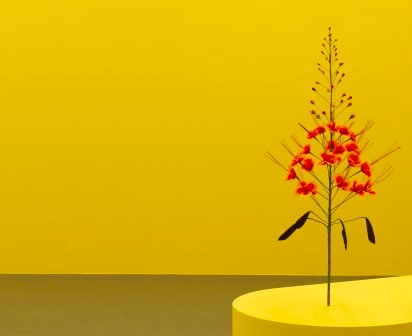
This artist doesn’t flinch from using a range of materials in her work. These delicate paper flowers — the piece is called “The Marias” — are surrounded by dazzling yellow plinths and walls. They’re pretty enough, but the artist has created them because of their unique properties and historical function.

…the flower on show, native to Latin America, was known by the locals for its abortive powers. The chemicals in the flower were used by enslaved women to break the reproduction of servitude.

from “Remedition” exhibition booklet

On the main floor of MOCA Kapwani Kiwanga has produced a massive installation composed almost entirely of sisal. She has said that she “considers how various natural materials become witnesses to history. ” Sisal, for example, played a big economic role in Tanzania. When the prices plummeted because of synthetic immitations, the country suffered.

Art work by Kapwani Kiwanga

The material, in the form in which the artist uses it, has a fascinating colour, texture and the unique, undulating lightness which the artist uses to create artfully draped, other-worldly environments. It’s so hard to refrain from touching it!

Sisal recently rebounded on the world markets. The roll above is availabe at Canadian Tire for about $5.00

A video piece included in the show, was shot in Tanzania, where soil is a reddish colour and coats everything in the dry season. We see the artist cleaning the lush roadside vegetation in a gesture of maybe aesthetic intervention or perhaps its a symbolic, sishyphean act of appreciation.

Detail of “Vumbi” by Kapwani Kiwanga

I like the fact that this mesmerizing piece is open to interpretation.

I know so little about Tanzania: an East African country with vast wilderness areas. They include the plains of Serengeti National Park, a safari mecca populated by elephants, lions, leopards, buffalos, rhinos, and Kilimanjaro National Park, home to Africa’s highest mountain. Offshore lie the tropical islands of Zanzibar, with Arabic influences, and Mafia, with a marine park home to whale sharks and coral reefs

Giraffe in Lake Manyara National Park, Tanzania

Trade Show – Susan for Susan

Trade Show is another exhibition presently on display at MOCA. Susan for Susan is the name of the design collaboration between Kevin Watts and John Watts. (One of the MOCA volunteers at the show told me the mother of John and Kevin Watts is the Susan in question. Nice.)

How brutalist would it be to have a concrete table in your kitchen, hanging from the ceiling by thick chains? I did not realize it was something I always wanted. That would be a place to have some serious conversation, espcially with the right lighting, a battery of flourescents maybe.

Detail of “Trade Show” installation by Susan for Susan

Susan for Susan has created an installation that gestures toward the idea of an apartment, employing industrial materials in a coarse state. I think they are trying to get at a return to “truth to materials.”

Something called a gantry (which is a bridge-like overhead structure with a platform supporting equipment such as a crane) pulls the whole thing together. This gadget gives the installation an overarching absurdist twang which is very appealing.

Detail of “Trade Show” installation by Susan for Susan

The mirror has an amusing quality. It’s like one of those magnifying mirrors, sometimes screwed into the bathroom wall, except the”accordian” attachments are oversized which means the whole thing can be pulled out and adjusted as required to get the right view.

Detail of installation by Susan for Susan

My favourite is the vase, evidently created from a medical device used to set extreme fractures.

Ouch.