January 3, 2015

The festive torpor has come to an end and the galleries along Tecumseh Street are now open.

Sleet.

Birch Contemporary – Janice Gurney, Renee Van Halm

Janet Gurney 1

Punctuation in Translation, (Marcus Aurelius meditation 10.17 translation by Meric Casaubon, 1634) by Janice Gurney

20150103_135430

Artwork by Janice Gurney

The snapshot above actually functions as a continuation of the conceptual art piece, called Translations & Alliances, by Janice Gurney, on display at the Birch Gallery.

And now for the explanation:

Janice Gurney begins with an ancient text by Marcus Aurelius. She isolates the punctuation in various English translation of the text.   She literally makes paintings of the punctuation marks. Then she lends the paintings, framed and under glass, to colleagues. The colleagues place the paintings in offices somewhere and Janice Gurney photographs the original paintings in their new context, including incidental reflections on the glass and adjacent objects. Then the photograph of one of the paintings is included in a show and Janice Gurney photographs the photograph of the original painting in a new context, including incidental reflections on the glass and adjacent objects…..and on and on, like a hall of mirrors.


Janet Gurney 3

Reflection: Production Still (ArtLAB Gallery, 2009) by Janice Gurney
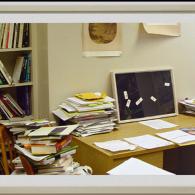
Janet Gurney 2

Meditation in Your Office, (M. C.’s office, University of Toronto, 2006) by Janice Gurney

This piece is initially mystifying and would remain rather opaque without an understanding of the back story.  For example, what are the numbers near the floor, beneath the paintings (and photographs of paintings)?

20150103_135639

In fact 1634 is the date of the translation, the punctuation of which is depicted in the painting.

I found that putting the effort into figuring out this work is worthwhile. Through all the commotion with the photographs, punctuation marks, reflective glass and whatnot a real sense of this haunting piece of poetry and its journey through history emerges. The delicate idea of how a translator hundreds of years ago decides to place a comma stays with me. The words – a meditation – are about the brief and fleeting nature of any one thing. Paradoxically this one thing, an intangible idea, has endured.

The original 1634 translation of the Marcus Aurelius text is below:

XIX. Ever to represent unto thyself; and to set before thee, both the general age and time of the world, and the whole substance of it. And how all things particular in respect of these are for their substance, as one of the least seeds that is: and for their duration, as the turning of the pestle in the mortar once about.

In the handout that accompanies the show Janice Gurney provides complete texts of the subsequent translations through time. Excerpted below are a few examples of various translations of the original “turning of the pestle in the mortar” phrase:

1701 “turning of a Wimble”

1747 ‘”twinkling of an eye”

1862 “turning of a gimlet”

2002 “twist of a tendril”

2009 “one brief turning in air”

I wonder if the band Kansas was thinking about Marcus Aurelius when they wrote their 1978 hit “Dust in the Wind”?

Kansas

Kansas, in the seventies


Concurrently on display at Birch Contemporary is a show of paintings, called Depth of Field, by Renee Van Halm.

It’s an interesting pairing of artists:  Whereas Janice Gurney’s show explores elusive concepts of past and present Renee Van Halm’s paintings are all about the visual  “now.”

Renee 1

Complex Curves by Renee Van Halm

renne 1

Tongue & Groove by Renee Van Halm

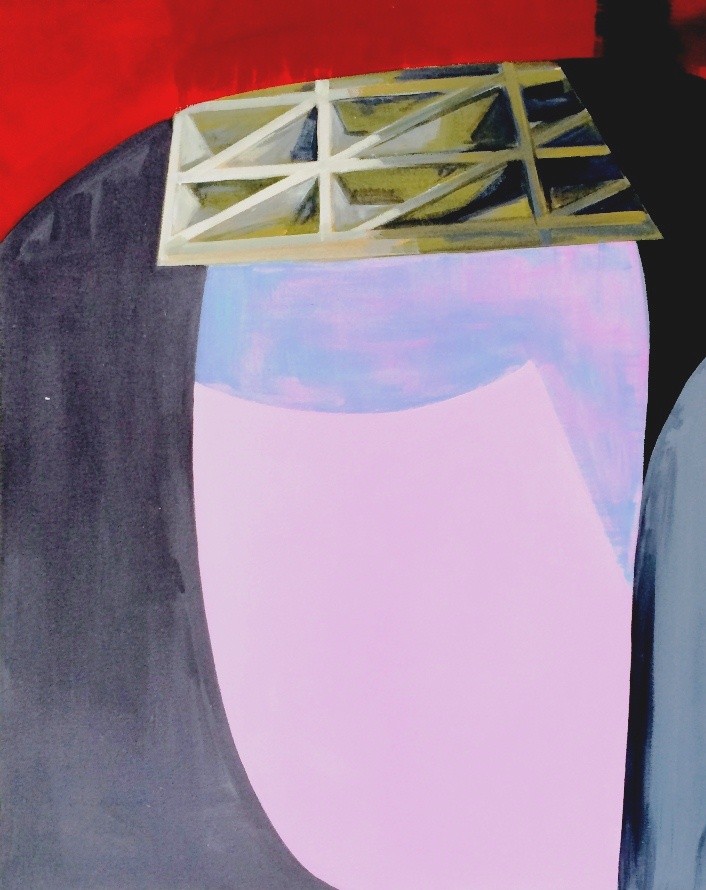
The paintings consist of pure, intense swaths of colour enclosed in sensuous curves on a background of fragmented depictions of interiors.  Renee Van Halm is on top of the language of desirable objects and she plays with the fracturing and recombining of those conventions with delicious success.  In fact, I immediately wanted to take one home, hang it over a white Carrara marble fireplace…maybe there would be an Italian greyhound slumbering in front….I’d be wearing Prada and a vintage Jaguar would be parked out front…
Renne 4

Rose by Rene Van Halm

October 8, 2014

Hart House

Nestled in the U of T campus, just off University Circle, is Hart House, a student activity center which contains a gym and the Justina M. Barnicke Gallery, among other facilities.

John G. Hampton, the curator of the current exhibition at Hart House, titled “Why Can’t Minimal,” for some reason decided to illuminate the lighter side of the Sixties art movement known as Minimalism. (Incidently, when searching for a good Minimalism site I stumbled upon a whole new meaning of the term. Yes, there is, in fact, a second type of Minimalism: it’s an entirely contemporary social movement which advises people on how to get rid of the excess stuff in their lives in order to make room for the essentials.)

Carl Andre, Donald Judd, Sol LeWitt, Dan Flavin, Frank Stella (for his minimalist Black Paintings) are a few of the artists associated with Minimalism. Carl Andre, the ultimate American Minimalist sculptor, likes to say “It’s all the materials… there are no ideas hidden under those plates. You can lift them up but there is nothing there.” No hidden ideas and therefore nothing funny… about zinc plates or a pile of bricks or massive oak cubes.

Rather than actually finding the humour in Minimalism what the curator did was round up some Conceptual artists who commented on utterly humourless Minimalist standards. The result has a particular off-key, dry wit (verging on absurdity) so close to the heart of the Conceptual artist.

Some of the works in this show are delightful: John Boyle-Singfield’s Untitled (Coke Zero) references the Hans Haacke Condensation Cube of 1962, replacing water with Coke Zero. The Coke Zero does create condensation but it has also undergone a gross transformation, breaking down into its elemental components: On top, an evil looking red liquid and below, a suspicious powdery substance.

coke zero

Ken Nicol created Carl Andre Drawer Piece and got into the spirit of “truth to materials” by typing the Carl Andre quote “If a thing is worth doing once, it’s worth doing again” on 1611 index cards.

File piece

I always associate John Baldessari with Cal Arts and a particular brand of flat humour that came out of that school. In his video Baldessari “sings” each of Sol LeWitt’s 35 “Sentences on Conceptual Art” to the tune of popular songs. It must have been Christmas when he made this video because the tune sounds distinctly like a holiday carol.

JB

There is a certain slyness to John Marriott’s various sized cubes surfaced with pigeon-proofing strips. They also achieve a cool elegance in an incidental, i.e. Minimalist, manner.

See below for an installation view and a close up of the pigeon-proofing strips.

cube and spikesspikes


University of Toronto Art Center (UTAC)

A few steps from Hart House is UTAC and an exhibition of the photographs of Allen Ginsberg (1926-1997) called “We are Continually Exposed to the Flashbulb of Death.” This is a fascinating show for anyone with an interest in the Beat Generation.

A recording of Allen Ginsberg reading his 1955 poem “Howl” can be heard throughout the gallery’s rooms.

20141008_155630

It is, of course, primarily as a poet that Allen Ginsberg is known. These photographs however attest to his skill as a photographer (he was mentored in this ability by Robert Frank) and moreover they document a life profoundly rich in relationships, friendships and experiences.

Below, William Burroughs in 1953:

20141008_155046

20141008_155745

Gregory Corso, Paul Bowles and Burroughs in 1961.

From Gary Snyder, Peter Orlovsky, Jack Kerouac and Paul Bowles to Kathy Acker, Rene Ricard, and Michael McLure the pictures in this show depict so many of the literary and intellectual luminaries of the past four of five decades. Each picture includes a description, hand-written by Allen Ginsberg, identifying the subject, the date, the place and the circumstances.

20141008_160458 20141008_155945  20141008_16042220141008_160300

An essay by Louis Kaplan in the exhibition catalogue quotes Ginsberg as follows: “The poignancy of the photograph comes from looking back to a fleeting moment in a floating world.” Captured here in black and white, the humble New York diners and living rooms of the fifties have disappeared forever. This show provides a glimpse of this vanished world and its inhabitants.