
Inter/Access:
Remember Tomorrow – A Telidon Story
There was a warm, fuzzy feeling at Inter/Access on the evening of October 19, 2023. The organization was celebrating 40 years as a center dedicated to expanding the cultural significance of art and technology.
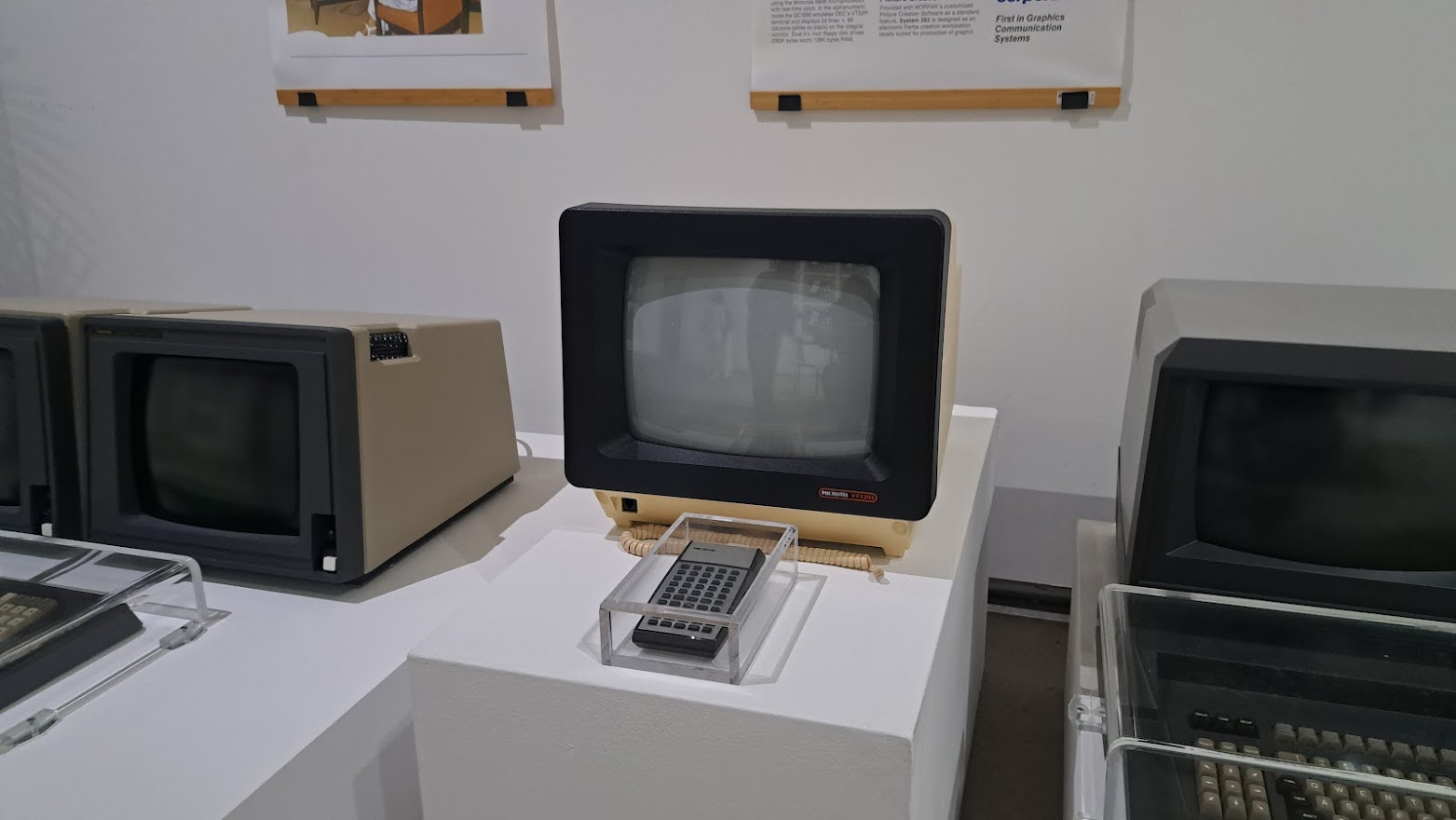
Before that evening I did not know that Inter/Access was originally named Toronto Community Videotex or TCV, and that it was first set up as a non-profit, artist run corporation to provide tools for artists using Telidon.
Yes, Telidon. The Telidon program, a television-based information-sharing system that allowed users to browse computer databases, was developed by the long gone Canadian government department called the CRC (Communications Research Center.) The program began officially on August 15, 1978 and ended on March 31, 1985.
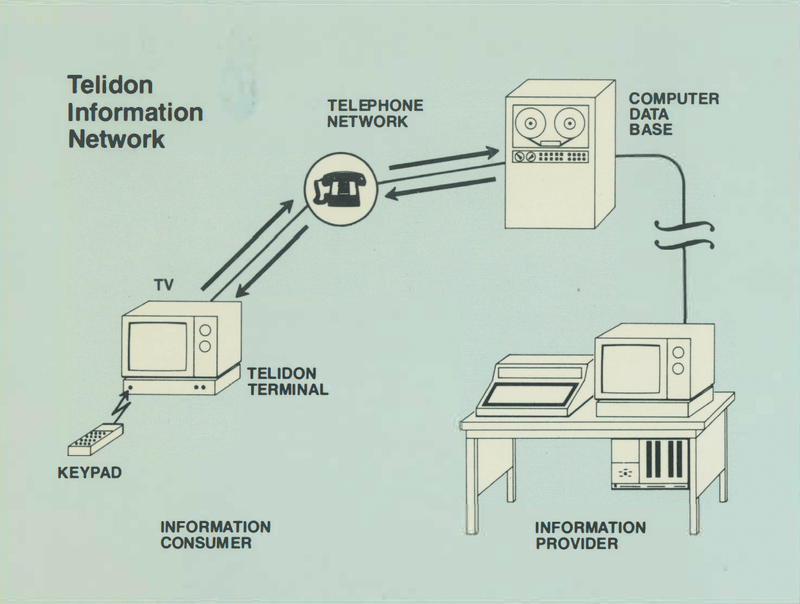
Wandering around the show I got the feeling the Telidon developers were so close to something, groping around in the virtual landscape — blindly, unable to quite make it happen — but knowing, absolutely, they were there, at the beginning of something.

Telidon was a proto-type for the Internet. It was a 24/7 source for information. All you needed, as a user, was a Telidon terminal and a keypad. It was interactive! I think it was the interactivity part that really got the original Telidon artists hooked.

The concept of simultaneity was another idea that was intoxicating to artists. Toronto gallerist Paul Petro, one of the original founders of TCV and an artist using Telidon, spoke during the evening about the excitement of hosting an art opening in three different cities, at the same time!

The images created with Telidon have a blythe, cheerful, pop art look. They are rendered in time as layers load and intersect in a satisfying, somewhat hypnotic, display.
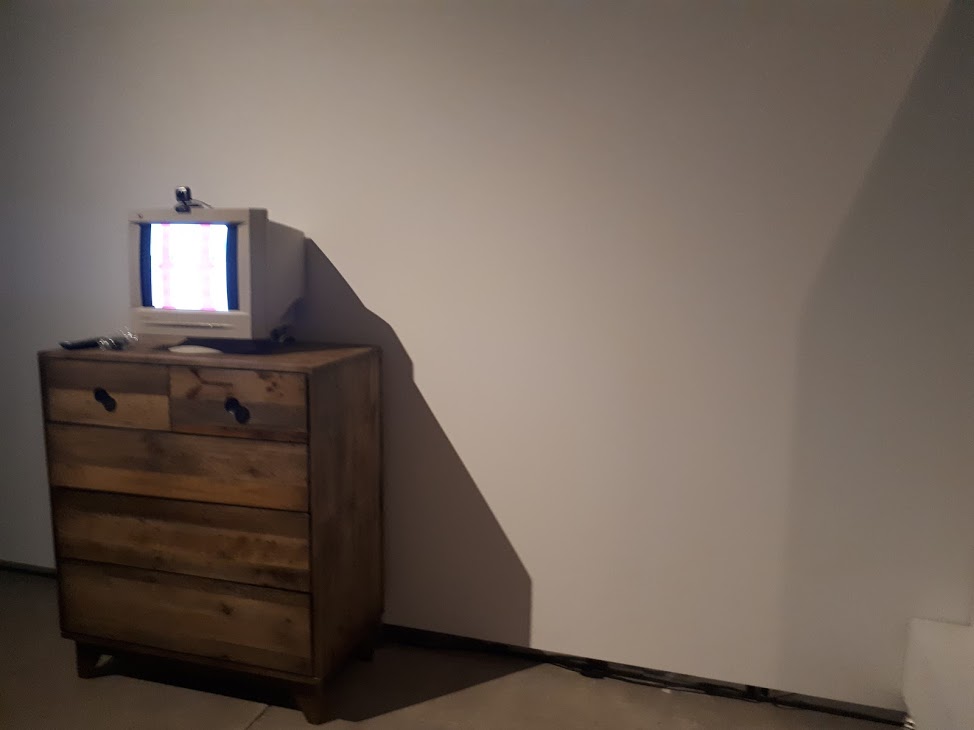
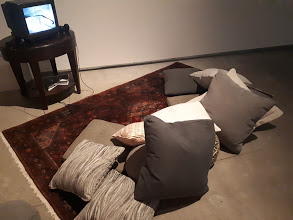
This exhibition explores the allure of Eighties hardware and, well, I guess you could call it lifestyle. Big television sets that look like credenzas, potted palms and wow, orange shag have been lovingly installed in the Inter/Access gallery.
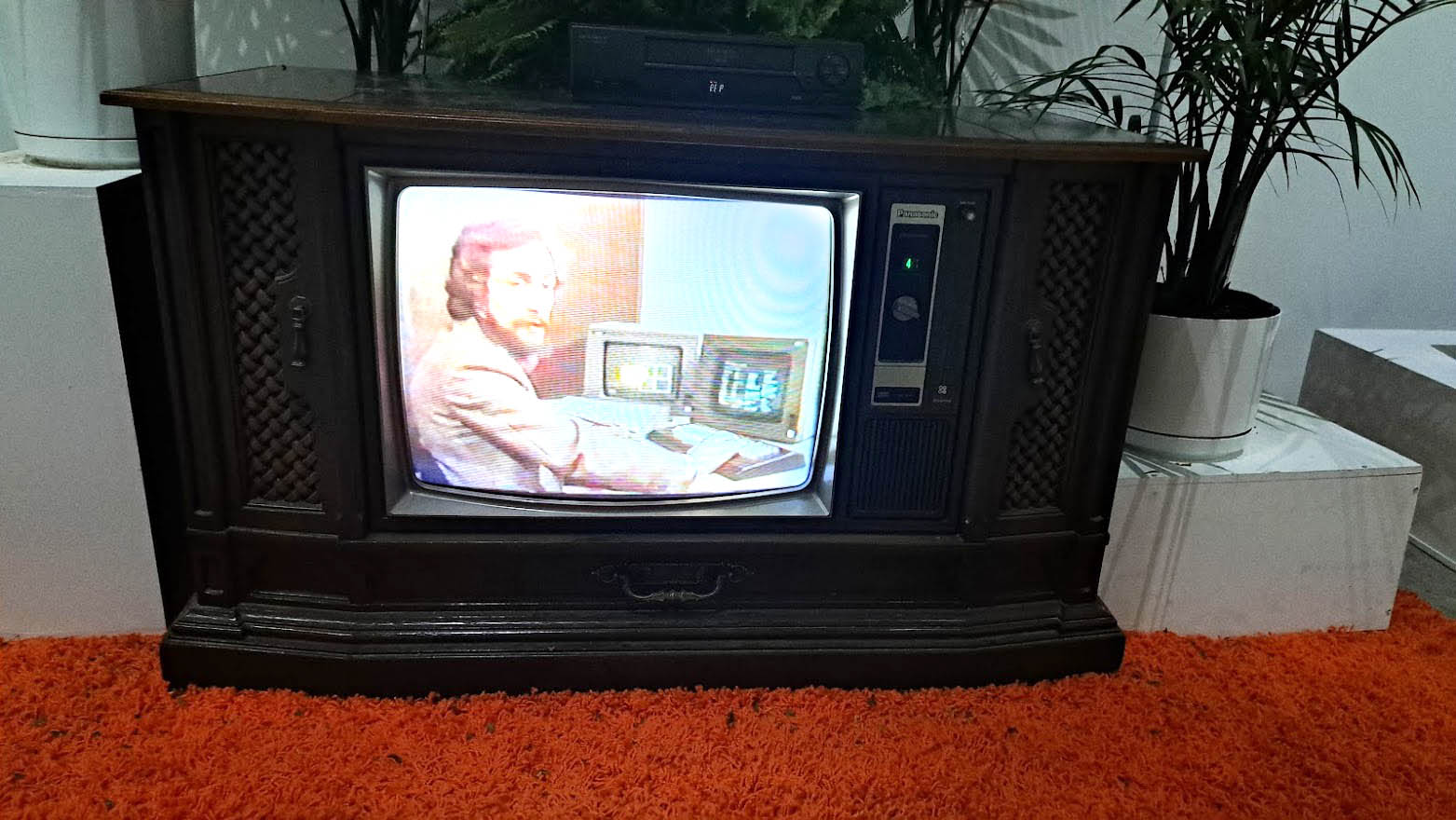
Lots of obsolete hardware is on display. By lifting a telephone receiver and pressing “rewind” and then “play” on a tape deck the gallery visitor can listen to interviews with participating artists. (Unfortunately several of the taped interviews had been inadvertently erased during the exhibition because users were unaware of the lost art of “removing the tab” from a cassette tape to prevent just this type of mishap.)

The exhibition catalog, put together by curator Shauna Jean Doherty, contains the most endearing story about the Telidon artworks selected for the Venice Biennale of 1986. Created on a series of floppy disks and “playable only using specialized hardware” the artworks were indeed shipped to Italy for the big show, but because of technical difficulties they were never put on view, and instead sat in a cardboard box for four decades.
The whole show has a sort of elegiac feel to it. Maybe it’s about mourning the loss of innocence in regard to technology.
The past is but the beginning of a beginning, and all that is or has been is but the twilight of the dawn…”
Douglas Parkhill, one of the father’s of Telidon, quoting HG Wells in a report chronicling Telidon’s history, from the exhibition catalogue.
The developers definitely did have a romantic view of that brief, Telidon moment. There were some catchy words and phrases that picked up the “beginning of the beginning” vibe and quickly rose and fell: Whatever happened to “informatics,” “Instant World,” “Telematic Culture” or the “Information Paradigm?”

But it hasn’t all disappeared. Thanks to John Durno, head of Library Systems at the University of Victoria, an operational Telidon decoder does exist and numerous Telidon artworks have been restored and are ready to be returned to Venice for a conference this year.


1983..1983…1983…? To be honest, I can’t recall anything specific about that fateful year. Fortunately we now have the Internet to fill in the blanks:
- In 1983:
- The metric system of weights and measures was officially adopted by the Canadian federal government.
- 25 Red Brigades were sentenced to life for kidnapping and murdering Italian Christian Democrat politician Aldo Moro in 1978.
- Singer and drummer of The Carpenters, Karen Carpenter, died from complications caused by eating disorder anorexia nervosa, age 32.
- Though already available in Japan and Europe, Sony and Philips released their CD players in the US and Canada. Though a compact disc player costs over $1000, they prove to be extremely popular.
- Michael Jackson’s Thriller went to number 1 in the US 200 Billboard album charts for 37 weeks, setting a world record for the amount of time an album stays at number 1.
- Astronauts Peterson and Musgrave perform the first spacewalk of the shuttle program during NASA’s STS-6 mission. The spacewalk lasts over four hours.
- Israel and Lebanon sign an agreement to take a step towards peace.
- The Internet took a step towards its creation as ARPANET (Advanced Research Projects Agency Network) was moved to TCP/IP (Transmission Control Protocol and Internet Protocol).
- Arcade game Mario Bros. was released in Japan. The arcade game, produced by Nintendo paved the way for future Mario games to become one of Nintendo’s greatest creations.






 annetteandquebec