December 9, 2025

Tim Whiten at Olga Korper Gallery

The title of Tim Whiten’s exhibition at the Olga Korper Gallery is “Transpire.”

What does it mean?

After spending time at the gallery, on a snowy, darkening, late Tuesday afternoon, I decided it must mean something is happening or has happened, and these things I’m looking at, are the residue.

So, what is happening? Well…life. And, Tim Whiten reminds us, life is finite. Our days are numbered. Human skulls, reliquaries, coffins and remnants of the past are scattered about the show, to keep us in the right mindset.

Detail of Reliquaire III by Tim Whiten

Observing the human skull — clearly real and covered in gold leaf — near the entrance to the Olga Korper Gallery, was unsettling. Resting in a scalloped-edged, glass bowl, the grinning object appears to wear a ruff collar, like some Valesquez subject from the 1600s.

Installation view of Reliquaire III by Tim Whiten

The bowl is placed on a purple base, supported by yet another ornate object, an elaborate sconce, with a lot of brass flourishes.

This tableau made me think of the glamorous monster in Guillermo del Toro’s Frankenstein, in particular, the scene where he solemnly reads the poem by Percy Bysshe Shelley, about Ozymandias. (“My name is Ozymandias, King of Kings: Look on my works, ye Mighty, and despair!)

In Guillermo del Toro’s Frankenstein the monster resembles a Swedish runway model.

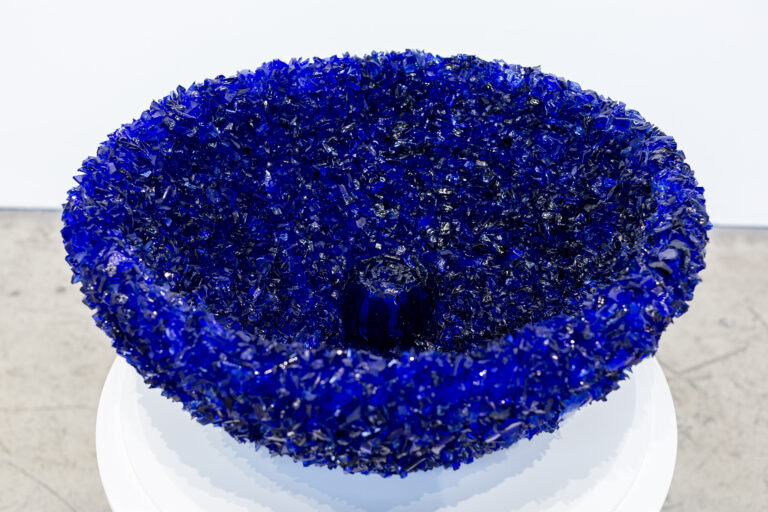
Death imagery is everywhere in this exhibition. An object resembling a house rests on the floor, bristling with crushed cobalt blue glass. It has walls, and a peaked roof, and a chimney, but there is no entrance to this house, and there is no exit. Aha, it’s a coffin. And it’s closed.

Respite by Tim Whiten

The piece below is a corn broom, coated in glittering, blue light. It’s a humble object, possibly once owned, used and touched by a departed presence and now, elevated to the status of a spiritual relic, a tangible memorial.

One, One, One (3) by Tim Whiten

The cobalt blue that Tim Whiten uses throughout the show is deep and radiant.
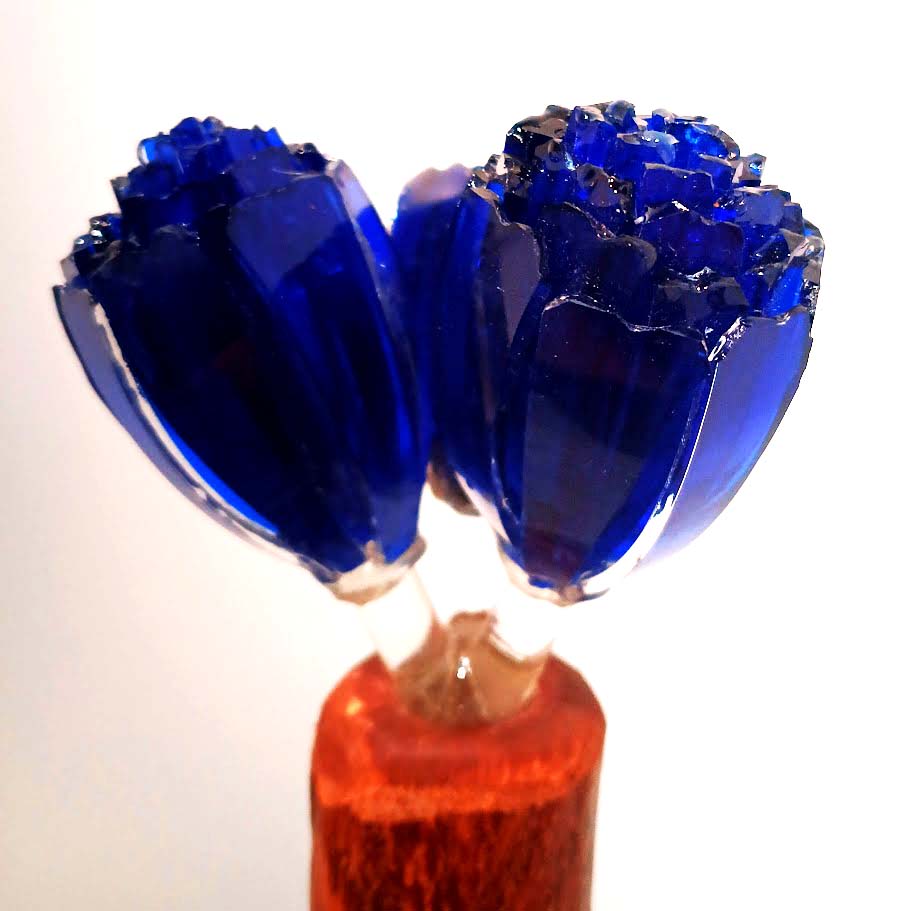
Detail of Stave by Tim Whiten

In many cultures, deep blue, has significance. The Turkish Nazar Boncugu (Evil Eye amulet), for example, is a talisman that can protect against evil spirits.

 The nazar boncuğu is most often used in a glass bead that is pinned on the clothing of children or hung on walls of buildings or inside of cars or other possessions to protect them.

In Catholic churches the Virgin Mary is depicted in blue glass as the pure and tranquil “light of heaven.”

The Virgin Mary in the stained glass window at Chartres Cathedral

In Africa, deep blue glass was used to mark graves. Enslaved people brought this tradition to the United States.

“When African slaves arrived in the U.S., they created bottle trees from dead trees or large limbs next to their quarters and adorned them with glass bottles scavenged from garbage piles,” Doreen Howard wrote on Almanac.com. “Blue bottles were coveted, because they repelled evil and trapped night spirits to be destroyed by the rising sun. Many Milk of Magnesia bottles ended up on trees!”

“The Southern Legend of Blue Window Panes” by KellyKazek.com
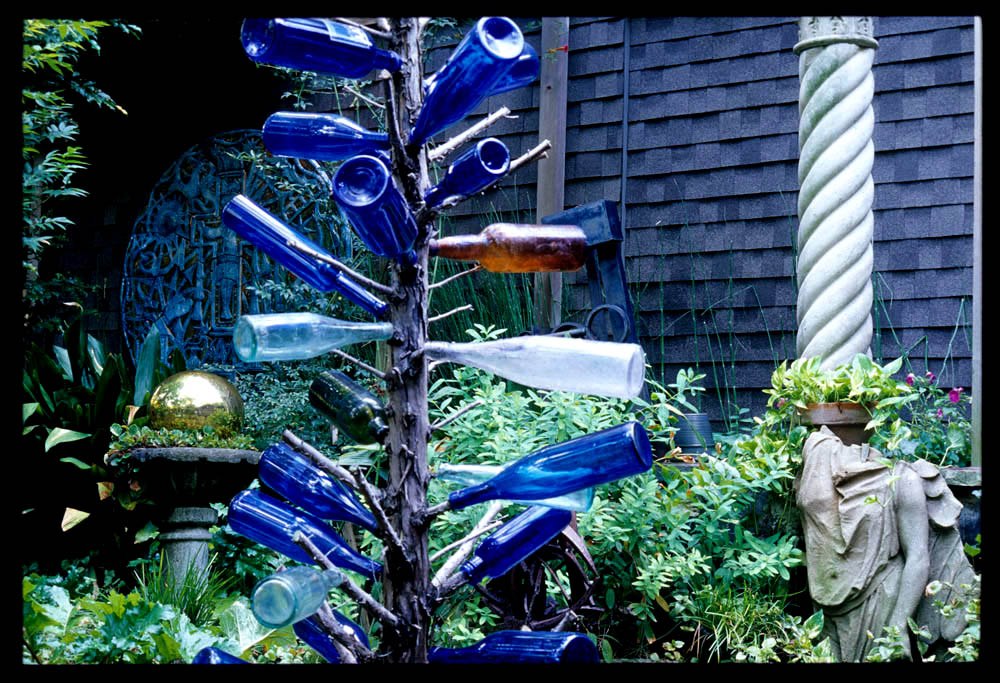
Bottle trees are used to honor the dead, with blue bottles capturing the energy and memories of ancestors in a beautiful and meaningful way.

Blue is also linked to deep meditation, spiritual awakening, and a connection with higher realms. And, in this show, the objects and the sizzling blue, not only refer to death and decay. They also provide an escape to the infinite, manifest in portals, flying carpets, spiritual secrets, and meditative drawings.

A twisted spiral staircase leads to another house. This one is an exquisite, etched glass temple It has a slightly open door. It is nearly vibrating with vivid blue light.
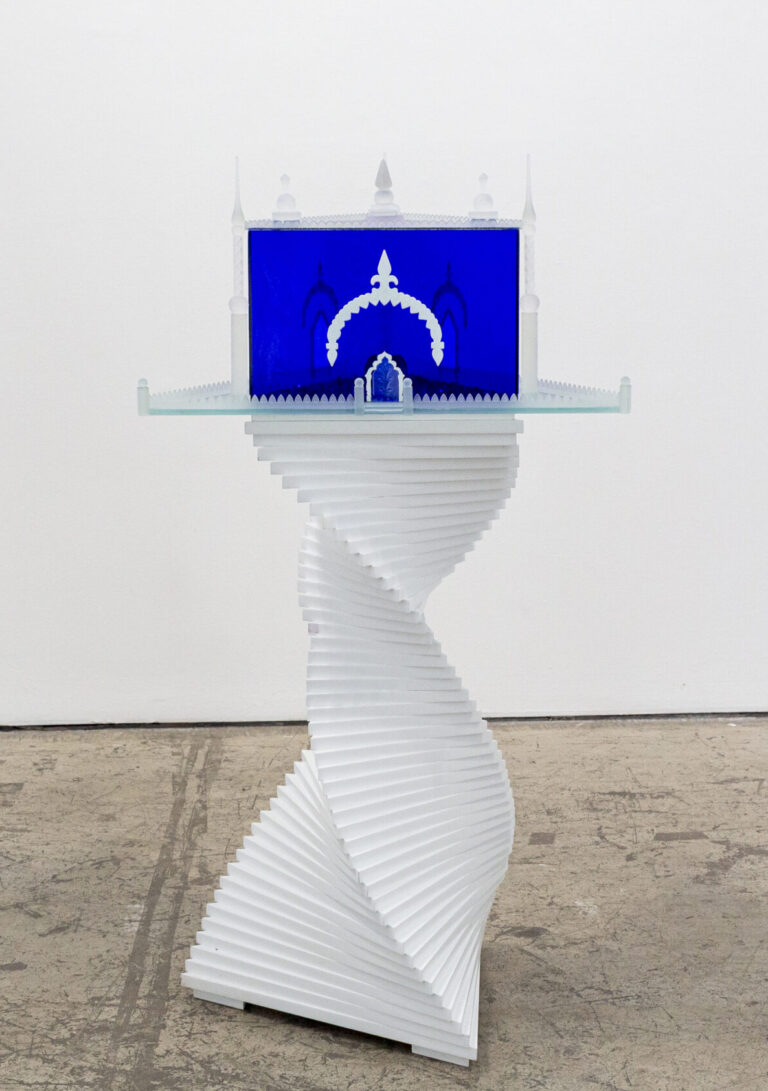
Spirit House by Tim Whiten
Detail of “Spirit House” by Tim Whiten

The shape of a book is composed of milky, etched glass, and within is cobalt coloured glass. So maybe the blue glass is knowledge and knowledge is light?

Book of Light II by Tim Whiten

I was informed that Tim Whiten chooses not to call himself an artist. He identifies as a maker of cultural objects. I’m not sure what the difference is. To me, the obsessive exploration and experimention, and the unique and beautiful objects he creates, are very much in line with notions of the contemporary artist.

Some of the drawings make me think of Process Art from the 1960s and 70s. Just picturing how they had to be made makes me nervous. Tim Whiten would have to be walking a meditative tightrope to create these flawless images.

Saying His Name, Beyond Fire, Water, Cloud-All, Portal by Tim Whiten
Saying His Name, Harmonics II by Tim Whiten

One of my favourite pieces in the show is displayed on the floor, like a colourful, molten carpet. But it’s not quite flat on the floor. It is slightly elevated and arrayed as a very subtle S-curve. Yes, it appears to be flying!
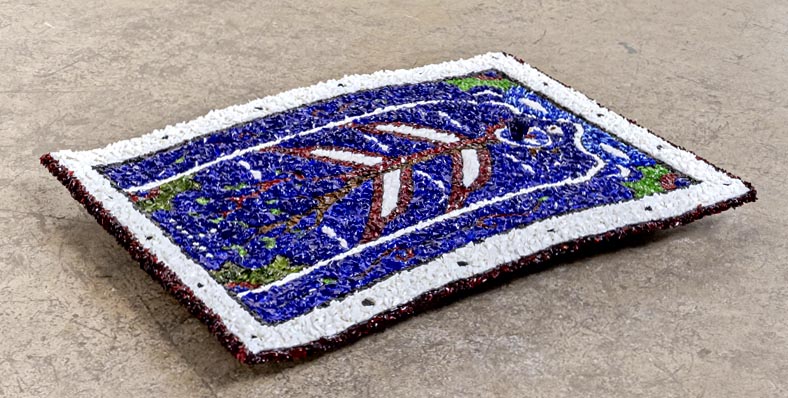
Search Reach Release by Tim Whiten

September 13, 2014

On this cold, overcast afternoon I walked south on Dundas toward Roncesvalles, skipped the Polish Festival, and headed for the clutch of galleries on Morrow Street.

Gerald Ferguson paintings are on exhibit at the Olga Korper Gallery.

This artist taught at the Nova Scotia College of Art & Design (NSCAD) from 1968 to 2004 and his work embodies the cool, dispassionate aesthetic that defined the school as the nexus of Conceptual Art.  These are paintings in which the idea is paramount and the actual framed objects are merely resulting detritus.  Composition, allusion, color, form, symbol were all rigorously ignored, and yet, the paintings are entirely contemporary, powerful and complex.

005

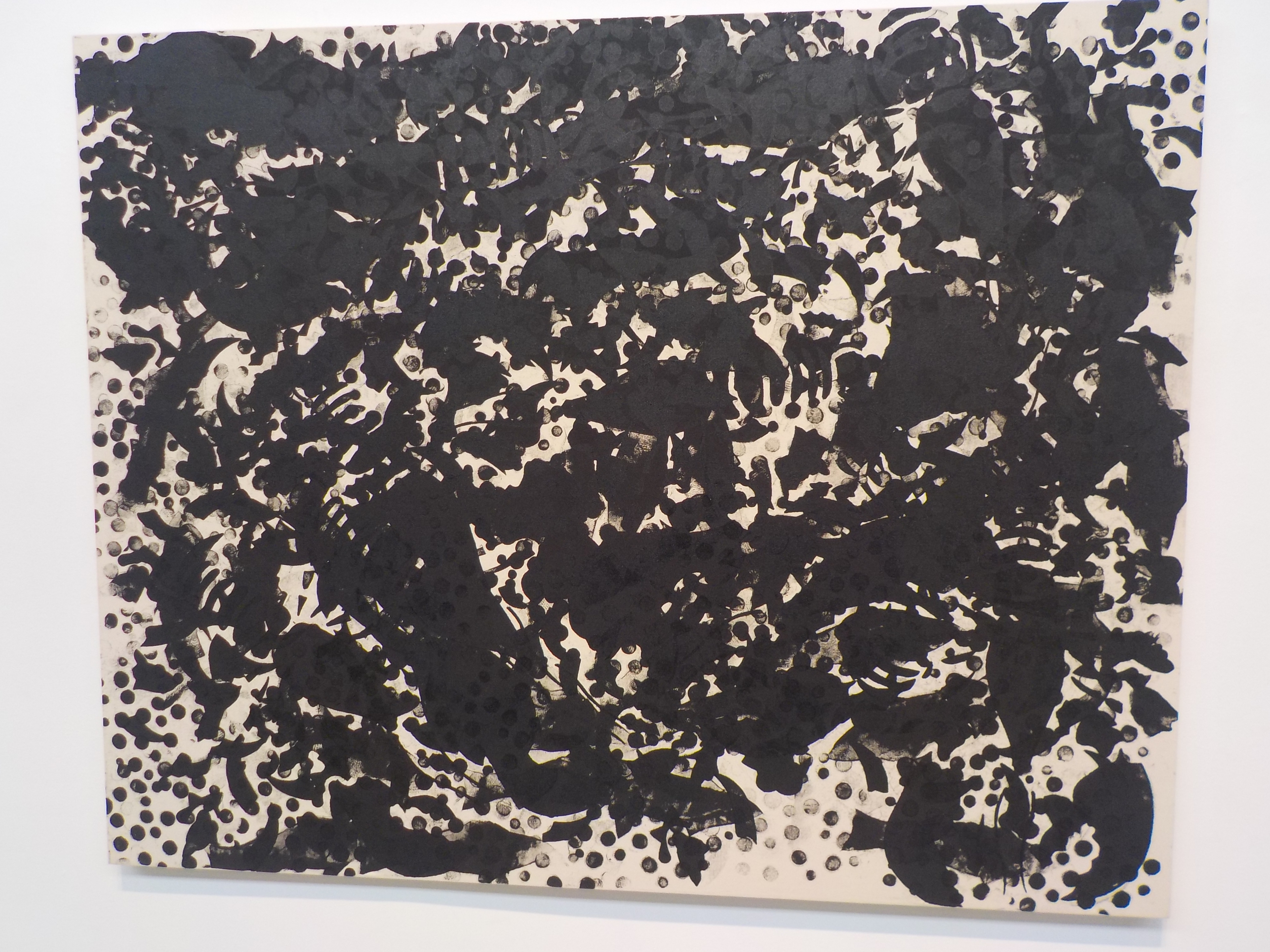
I particularly liked seeing the “Dropcloth” paintings.  Gerry picked up dropcloths strewn around the worksite of commercial painters.  He then had them framed and stretched.  They are subtle and suggestive, like a Cy Twombly or maybe even a Jackson Pollack…but wait a minute, they are dropcloths!  The idea lingers, inhabiting a sensuous formality, but it remains pure.

This show is particularly successful in its display of the range of work as it skips through various decades and series to give a sense of the breadth Jerry Ferguson achieved.  Using frottage, rollers, stencils, found objects, spray paint and various mundane, utilitarian objects he never flinched in exploring and manifesting the concepts that appealed to him.

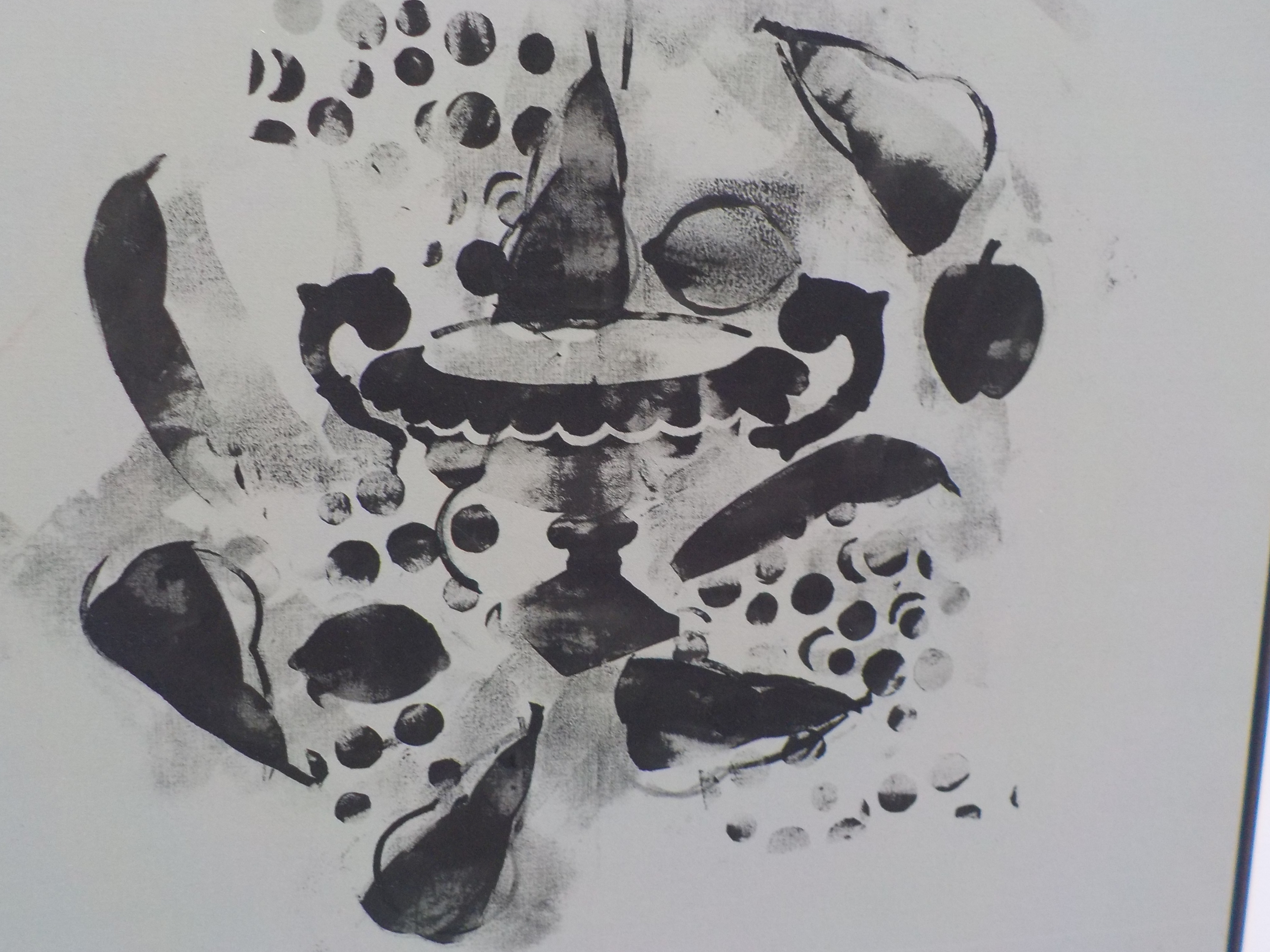
Below is a snapshot of Gerry Ferguson’s take on still life: a stenciled urn and rubbing of cast iron fruit.

007

Gerald Ferguson died in 2008.  This was a great loss for the Halifax art community and his friends, colleagues and former students everywhere.  Gerry was a true artist and a catalyst for so many.

Across the courtyard is the Christopher Cutts Gallery

The multi-media artist Simone Jones was standing outside the Gallery.  It was her work that was on display and she looked a little uneasy.  She warned me as I was about to enter that it was very dark and could be disorienting.  She was right.

The large gallery was divided in half and each half was displaying a large screen format video.  On one side, in the center of the space, there was a low-to-the-ground robotic ramp on which the video projector slowly travelled backwards and forwards in relation to the projected image.  Definitely a tripping hazard.

I positioned myself in the center of the divided space and watched the two synchronized videos.  A guy in period costume, trailed by a wolf, tramped through a snowy landscape.  On the other screen a woman in period costume clacked out a message on an ancient manual typewriter.  A shot rang out and the guy collapsed and lay in the snow.  The woman cried. The wolf looked menacing.  I felt like I was at a tennis match.  There was some elegiac music but no dialogue.  The woman at the front desk, who had to sit in the dark all day, mentioned Tom Thompson and his mysterious death.  (I decided not to tell her that he was not shot in the snow.  He died in Canoe Lake.)

simone014

This piece, for all the imposition for the audience and difficulty in presentation, was strangely lacking in ambition.  I assume this artist will go on to develop more deeply the ideas she has hinted at here.  On the other hand, bravo to Christopher Cutts Gallery for supporting her and showing the piece.  A Gallery is a business just like any other.  How a media installation will generate revenue for this gallery is as mysterious to me as the death of Tom Thompson.