June 11, 2025

Report from New York

Jack Whitten: The Messenger

The towering 53rd Street Atrium of the Museum of Modern Art seemed less crowded than during prior visits.  The galleries less packed with frantic visitors.  In fact, the streets themselves seemed less grid-locked and less raucous.  Maybe it’s the “congestion pricing” impact?  Or maybe it’s the policies of the current Administration?

Whatever the reason for the relative tranquillity, it was truly uplifting to wander through the show called Jack Whitten: The Messenger without feeling jostled, and to appreciate the achievements of this artist and more broadly, the achievements of so many American artists, caught now — like the rest of us –in this period of fear and dismay.

 “Black Monolith II (Homage to Ralph Ellison The Invisible Man),” by Jack Whitten

“Acryclic, onion, eggshell, molasses, copper, salt, herbs, rust, coal, ash, chocolate and razor blade.” These are a list of the substances Jack Whitten used to create the painting “Black Monolith II (Homage to Ralph Ellison The Invisible Man”), shown above. The painting, and many others of this period, is composed of hundreds of tiles, cut from sheets of dried acryclic embedded with varied ingredients and assembled into a painting. Jack Whitten called this invented technique “acrylic tesserae.” “Each tesserae is a piece of light,” he said, “The message is coded into the process.”

A lush jazz soundtrack (John Coltrane, Miles Davis and Thelonious Monk and others) plays throughout the show’s galleries, referencing Jack Whitten‘s love of jazz.

Installation view “Jack Whitten: The Messenger” at the Museum of Modern Art

Many of the tributes and dedications he attached to his work honor the black musicians, writers and artists that impacted him during his six decades of living in New York City and making art, which he invariably viewed as experimental.

“Homecoming for Miles Davis” by Jack Whitten
Closer detail of “Homecoming for Miles Davis” by Jack Whitten

Shown above, “Homecoming for Miles Davis” was also made of hardened acrylic tiles, which in this case he spattered with white paint, a la Jackson Pollock, and put together into this dazzling painting, described by the artist as a “cosmic net attempting to capture Miles’ soul.”

“Atopolis: for Eduourd Glissant” by Jack Whitten
Detail of “Atopolis: for Édouard Glissant” by Jack Whitten

The tiles in the painting shown above, named for Édouard Glissant, the French writer, poet, philosopher, and literary critic from Martinique, were infused with metallic, phosporescent and organic materials from aluminum to anthracite.

Repeatedly, this artist states he is interested in innovation. He wants to make abstract art that changes the course of painting.

Trained as a cabinet maker, Jack Whitten, made specialized tools to apply paint. He painted standing up for decades, smoothing paint in layers with a rake-like tool which is on display at the Museum.

Tool used by Jack Whitten to paint
Jack Whitten at work in Studio in the 1970s, using “The Developer”

He called the rake-like tool “The Developer.” He added layer upon layer of paint, raking and merging the color until he had the effect he wanted, which was “sheets of light.”

“Tripping” by Jack Whitten

The photograph above doesn’t convey the startling, glowing, gem-like quality that some of Jack Whitten’s paintings hold. He “combed” the layers of paint to create colours found nowhere else and experimented like an alchemist, adding  recycled glass, pulverized mylar, gold dust and numerous other substances to the paint to get the effect he was after.

In some paintings, the artist would bury items into the gallons of paint he poured onto wood panels. These items — bits of wire or wood, staples, insects, floor sweepings — he called “Disruptors,” since through the raking process they disrupted the smoothed surface to reveal transformations below.

Installation view of “Siberian Salt Grinder” by Jack Whitten
Detail of “Siberian Salt Grinder” by Jack Whitten

I couldn’t help thinking about the giant squeegee paintings by Gerhard Richter. Like Jack Whitten, Gerhard Richter explored the relationship between painting and ph0tography in his earlier works. Later, the element of unpredictability was major in both of these artist’s big beautiful paintings of sweeping horizontals.

“Abstract Painting (726)” by Gerhard Richter

Political turmoil was a factor in the creative development of both men. Gerhard Richter was born in 1932 in Dresden, Germany, into the mayhem of WWII and its aftermath. Jack Whitten was born in 1939 in Bessemer, Alabama, at the height of Jim Crow. He grew up in Civil Rights movement and the era of political assasinations in the USA and, of course, the Vietnam War.

“Black Table Setting (Homage to Duke Ellington)” by Jack Whitten

I particularly liked looking at Jack Whitten’s paintings of screens, or screen-like images.

“Khee II” by Jack Whitten

The painting above is part of his Greek Alphabet Series. It has a mysterious quality of movement, as remote images seem to shift and rearrange themselves from within, like poor reception in an analog TV screen.

“Gamma Group I” by Jack Whitten

Jack Whitten said every colour carries ” a lot of psychological meaning” and he sought to avoid the “story telling” that automatically occured by using colour. His black and white paintings from the Greek Alphabet series of paintings, resemble a flickering screen, dissolving into abstraction.

I say to people, “Take everything you have ever felt, everything you have ever smelled, every sound you have ever heard, every sensation you have ever had that you have felt through your fingertips. Take all of that and compress it.” You would get an understanding of abstraction. – quote from Jack Whitten in the MOMA exhibition notes.

His sculptural work, on the other hand, tells a lot of stories:

Sculptural works by Jack Whitten

…stories about the African diaspora, the history of art in the Mediterranean, trash and found junk, labour and work and many other topics.

Some of his paintings too, are depictions of fragments of a changing world. His painting shown below, which suggests apps on a screen, was made in honour of Obama’s election.

“Apps for Obama” by Jack Whitten

The showstopper, however, for many of the New Yorkers on that relatively quiet day at the Museum of Modern Art, has to be the painting titled “9.11.01.” Jack Whitten witnessed the World Trade Center’s destruction and produced an enormous painting in honour of the victim’s of that event.

“9.11.01” by Jack Whitten
Detail of “9.11.01” by Jack Whitten

I spent some very somber moments in front of this painting, recalling not just the appalling catastrophe of that moment, but the following days and months, when the country, and indeed much of the world, was so unified in the shared shock and horror at that violent act. It seems like a long time ago.

February 21, 2025

The Culture: Hip Hop and Contemporary Art in the 21st Century, at the AGO

It is definitely fun to wander through the AGO’s big, bold show about Hip Hop. The organizers illuminate multiple forms of expression, trying to get at some central defining aspect of what is described as a “musical and pop cultural movement.”

“Black Power ” by Hank Willis Thomas

Clearly, that central something is Black culture, and the overturning of Eurocentric ideas of what can be culturally significant.

Hip Hop, in all its manifestations, may now be global, digital and corporate (absorbed and marketed so heavily, it is, like the show’s title, The culture) and yet, some unique vitality, dynamically expressed by Black, Latine, and Afro-Caribbean youth, in 1970s Bronx, endures to this day. Hip Hop continues to transform, explode and multiply, even against the backdrop of today’s bizarre political denial.

The Culture is organized around six themes: Language, Brand,
Adornment, Tribute, Pose, and Ascension.

Language

Hip-hop is intrinsically an art-form about language: the visual
language of graffiti, a musical language that includes scratching
and sampling, and, of course, the written and spoken word.

— Extracts from exhibition text

The Culture Exhibition

Language, in this show, starts with the spoken word. “Call and-response chants, followed by rap rhymes and lyrics overlaid on tracks, are the foundations of hip-hop music.” (Quote from the exhibition text.)

Music is playing at a decent volume throughout the AGO’s fifth floor.

You can check out the AGO playlist below:

“The Culture” Playlist is available on Spotify

The shows is sprawling, and some of the objects are traditional museum fare.

Art work by Adam Pendleton

The painting by Adam Pendleton (above) has an old school graffiti feel, as per language inscribed on the street. Weirdly, there is no mention of graffiti on the Pace website showcasing the work of Adam Pendleton. His visual art is included in prestigous collections around the world and often described as relating to “process and abstraction.”

“Six Bardos: Transmigration” by Julie Mehretu

More paintings in the show, like that of Julie Mehretu (above) don’t actually contain legible language, but here too, the debt to graffiti is clear. Julie Mehretu’s dealer is the Mariam Goodman Gallery and on the Mariam Goodman website we read about the artist’s “visual articulation of contemporary experience.”

I like the way this show schools us in how to look at certain art, particularly a contemporary painting like those above, i.e they are connected to graffiti.

The Brand, Adornment and Pose sections of the exhibition get a bit intertwined, in my view. They are all about how an individual uses technological communication to define themselves in the public sphere.

Snoop Dog 213 by Craig Boyko

Hip Hop has been around for a long time! Snoop Dog was once the personification of the cool, west coast version of the genre. He went on to host a cooking show with Martha Stewart, and recently performed at Donald Trump’s inauguration.

It’s hard to even remember a time when baggy sweatpants and sneakers were not worn everywhere, by everyone.

Outfit by Too Black Guys

In fact, you could walk through any shopping mall in North America and find an endless assortment of gear attributable to some Hip Hop connection. How about that hoodie I got on sale at Old Navy?

Cardi B
“Cardi B Unity” by Hassan Hajjaj

Cardi B, the reigning Queen of Rap, is the recipient of a vast number of accolades, awards, firsts, and mosts. In this photograph by Hassan Hajjaj she confronts the camera with supreme confidence, portrayed as the “international blend of music, fashion and consumer culture” that she is.

I liked the way the show approaches the matter of pose in the hip hop, particularly as it applies to the women in this arena. Endorsements are power for women, just like for their male counterparts.

Maya Jacket by Moncler

And who can forget the iconic red jacket from Drake’s “Hotline Bling” video? Apparently, the inclusion of this so-called Maya Jacket, by Moncler, in the famous video, locked in the brand’s connection to hip hop culture.

I think I prefer the more unexpected, even daring items in the show, as opposed to the merely manufactured. The piece (below) by Lauren Halsey is a good example.

“auntie fawn on tha 6” by Lauren Halsey

Composed of layers of synthetic hair, in brilliant shades, it has an intensity and power that strikes me as so of the moment and at the same time so reminiscent of some ancient adornment.

I found one piece in the adornment section shocking.

two men seated in room
“Nation” by Deana Lawson
man with dental decoration
Detail of “Nation” by Deana Lawson

This photograph by Deama Lawson contains an inset of George Washington’s false teeth, which were made from the teeth of enslaved Black people. The cheek retractor looks like a kind of torture object me, as repellant as the set of teeth. But that’s not how Deana Lawson sees it.

There is a nobility and majesty of a lot of gold that’s worn, and how it’s appropriated in hip-hop, and how I think hip-hop actually channels ancient kingdoms.

— Deana Lawson, exhibition notes

Ascension

And, of course, you can’t talk about Hip Hop without mentioning the deathiness that hovers on the sidelines and occasionally takes center stage.

“Street Shrine 1: A Notorious Story (Biggie)” by Robert Lugo

This funerary urn featuring a graphic depiction of the Rapper Notorious BIG captures the glamourization of violent death that has haunted the world of hip hop.

Biggie Smalls was murdered in 1997 at the age of 24. According to Wikipedia, Wallace’s funeral was held at the Frank E. Campbell Funeral Chapel in Manhattan on March 18. There were more than 350 mourners at the funeral, including Lil’ Cease, Queen LatifahFlavor FlavMary J. BligeLil’ KimRun-D.M.C.DJ Kool HercBusta RhymesSalt-N-PepaDJ SpinderellaFoxy Brown, and Sister Souljah.  David Dinkins and Clive Davis also attended the funeral.  After the funeral, his body was cremated at the Fresh Pond Crematory in Fresh Pond, Queens, and the ashes were given to his family.

October 26, 2024

Art Toronto – Canada’s Art Fair

This year’s Art Toronto — the 25th Anniversary event — exuded confidence, sophistication and depth. It was great to wander the vast expanse of the Metro Toronto Convention Center and get lost in the labyrinths and eddies of unfettered display.

There were more than 100 exhibitors. Galleries from across the country were represented. I also noticed some European and South American galleries, as well as a number from our friends in the USA.

There were many people-watching opportunities!

This vivacious, well-dressed group attended last year’s Art Toronto and were expected to return again this year, although, sadly, I did not spot them.

This exhibition has the feeling of an exciting shopping mall. What follows is a tiny and utterly subjective view of the tumult of art and commerce that is Art Toronto.

I was definitely happy to see work by favourite artists, from Toronto and elsewhere.

Carol Wainio, in her signature faded, dreamy palette, continued her exploration of haunting folklore from the distant past.

“Direction Home” by Carol Wainio was presented by Paul Petro Contemporary Art
Detail of “Direction Home” by Carol Wainio

There was some Witch Queer Volcanology on display in the form of one of the spectacular Fastwurms textile pieces.

“Sundoro” by Fastwurms was presented at Paul Petro Contemporary Art

I liked looking at the mysterious weapon, lifting off into the mist, by Wanda Koop.

“Seeway – Green with Lights” by Wanda Koop presented by Blouin Division

There were many artist’s works I had not encountered previously. I had questions.

I was trying to figure out what drew the artist, Nicholas Crombach, to this particular shade of red flocking, in his wildly complex sculptural piece. Maybe its a particular representation of vitality? Or maybe he’s referencing the way precious items are sometimes tucked away in red velvet?

Weisels by Nicholas Crombach

I enjoyed the desolate emptiness created by the painter Ulf Puder, in this large work hovering between geometry and realism.

“Sand” by Ulf Puder, shown by Bonne Choice Gallery

The photo piece below, by Kris Munsya, has a cinematic feel of futuristic mutation occuring in a lush, tropical site. I want to know more!

“Airplane Mode – Genetic Bomb” by Kris Munsya exhibited by Galerie Robertson Ares

I was in awe of this extra large lino cut print, produced on hand-made gampy paper. The giant print, by Alex Kumiko Hatanak, was part of an installation at the McMichael Gallery booth.

“Faultines and Loneliness” by Alex Kumiko Hatanaka
Detail of “Faultines and Loneliness” by Alex Kumiko Hatanaka

This photo of a house was fascinating. It looked a lot like a green monopoly piece. I learned it was part of something called the Lenora Drive Project, in which a Willowdale developer allowed artists to get creative with a half dozen condemmed bungalows.

“Title Deed” by An Te Liu presented by Bonne Choice

It took me a while to figure out that An Te Liu, the artist responsible for “Title Deed,” is the same artist who makes the very appealing sculptures, shown at Blouin Division last year.

“Broken Window” by Anahita Norouzi shown by Nicholas Roberts Gallery

Anahita Norouzi‘s photo piece made me want to know more about this barren landscape and the spectacular explosion implanted there.

Detail of “Broken Window” by Anahita Norouzi

There were some special shows put together by individual curators, including a “Focus Exhibition” titled ‘the place to which we return.’ It was described as engaging viewers with ideas of “home” and what that notion means to them.

“Regrounding” by Marigold Santos

The painting above, by Marigold Santos, was part of the “Focus Exhibition.” It was quite stunning to stand before this painting and bask in the field of yellow. The painting of a corpse dissolving into a landscape, although fascinating and intricate, is almost incidental to this powerful sweep of colour.

Detail of “Regrounding” by Marigold Santos
Artwork by Renee Condo presented by Blouin Division

Another piece in the Focus Exhibit is this one by Renee Condo. I’d seen the big, beautiful beadwork pieces by Renee Condo before, at the Blouin Division space. They have a joyful, high-octane buzz and effectively pull beadwork into a contemporary space.

“There Are No Footprints Where I go” by Meryl McMaster

In many indigenous cultures crows are valued for their intelligence and spiritual significance. They are seen as messengers from the spirit world, holders of universal wisdom, and protectors against evil forces.

This piece by Meryl McMaster, also part of the Focus Exhibition, has a quiet power and mystery.

Detail of “There Are No Footprints Where I go” by Meryl McMaster

See more about crows here.

September 22, 2024

Gallery Weekend is Over

Gallery weekend is over. You missed it.

But the glorious weather continues. This has been a September filled with perfect moments of honey coloured light, warm and caressing sunshine spreading long shadows across beautiful late afternoons, floral displays, sumptuous and extravagant, lingering on toward that perfect, pivot moment where they edge into autumnal decay and death. Everything more cherished and more precious, because we all know how quickly, and how soon, it will end.

September 2024

Gallery Weekend took place from the 19th to the 22nd September.

Gallery Weekend is run by an organization known as the Contemporary Art Galleries Association (AGAC). It’s mandate is to develop the recognition and prosperity of the contemporary art market in Canada. Laudible!

Thanks to Gallery Weekend I was directed to some spaces unfamiliar to me: Franz Kafka, Zalucky Contemporary and many more, are all on the Gallery Weekend map.

Franz Kafka – Jennifer Carvalho – “Ghost”

The address for Franz Kafka is 1485 Dupont, but the entrance is on 300 Campbell, upstairs, down a long, slightly Kafkaesque hallway.

Jennifer Carvalho‘s exhibition, called Ghost, is somber, ethereal and strangely timely.

Oil painting by Jennifer Carvalho

The gestures and expressions are so familiar from art history survey courses, maybe referencing Flemish painting from the 15th century, maybe Italian Rennaissance or possibly a combination of influences from these and other distant schools of art.

It must be the depictions of grief, particularly female grief, that makes the paintings so affecting. They are in low key colours, dull greys, rusting reds, dim blues and pale, watery flesh tones. Even the images of jewels are muted.

From gold to brush (study of optics and splendour) by Jennifer Carvahlo

Are ghosts not reminders for the living as to who has been lost? Haunting dark corners to prove they once held court here, too. They remind us of their presence, with a shell of their past power.”

– Marlow Granados, from a handout at Jennifer Carvalho’s exhibition “Ghost”

I appreciated the stillness and meditative quality of this exhibition. The artist’s concerns are with images emerging from the past. It’s as if she is presenting a window into another set of priorities. With a fixed and sober gaze, we see the past and are invited to contemplate how it led to the present.

An archive of gestures (hands and architecture with domestic interior) by Jennifer Carvalho

Zalucky Contemporary – Tyshan Wright – “Gumbe”

A little further west, on Dundas, in The Junction, is Zalucky Contemporary and an exhibition by Tyshan Wright.

Tyshan Wright is an artist who also probes the past. But in his case he locates his own ancestry and celebrates and explores those connections.

Artwork by Tyshan Wright

The artist is a descendant of the Maroons of Jamaica. Composed of African populations originally brought to the New World by the Spanish, most Maroon communities, in the smaller Caribbean Islands, disappeared by the early 1700s. But in Jamaica, the Maroons are, to this day, largely autonomous and separate from Jamaican society.

Examples of the gumbe, exhibited by the National Museum Jamaica

The story of how the gumbe, which is a drum, was created in Jamaican Maroon communities, and went on to became important in the music of Sierra Leone and other west African countries, is so interesting. One element of this story is the forced migration of more than 500 Jamaican Maroons to Halifax in 1796. Most did not stay. In fact, they moved back across the wide ocean to settle mainly in Freetown, and they brought their music with them.

Artwork by Tishan Wright

Tyshan Wright uses materials from Jamaica, Nova Scotia and the African diaspora to construct these beautiful objects. He notes they function as “diasporic talismans,” providing spiritual sustenance to the Maroon people through their centuries of displacement.

You can watch a mash-up reel of gumbe music here:

It was a memorable afternoon.

August 14, 2024

Portraits as Portals: Psychic Mediums Read Unknown Artists

A Project by Jennifer Fisher and Jim Drobnick at Art Windsor-Essex

I have learned that we are all psychic to some degree. Call it premonition, gut feeling, hunch, sixth sense, intuition — we all have it. A medium, however, is a psychic person who has special abilities, in particular, the ability to communicate with beings on the other side of life, i.e. they function as a door or portal to those residing in the spirit world.

Jennifer Fisher and Jim Drobnick, also known as the collaborative entity DisplayCult, go deep into the world of the psychic medium to explore the etheric energy that resides in an artwork. Rummaging through their own collection as well as distant corners of the basement of Art Windsor-Essex (AWE) the artists selected seven portraits by unknown artists and presented them to psychic mediums for a “reading.”

What ensues is a sort of Russian doll series of portraits.

Portrait by Unknown Artist from the Art Windsor-Essex collection. This was one of the portraits used in the exhibition Portraits as Portals. This portrait, in particular, had a disturbing impact on more than one of the psychic mediums.

First, we have the actual portraits. These pictures are at various levels of skill and sophistication. They are mostly oil paintings on canvas or board. There is at least one embroidery, shown below.

Portrait by Unknown Artist from the Art Windsor-Essex collection. This was one of the portraits used in the exhibition Portraits as Portals.

All the portraits share a certain charm, as well as poignancy. Perhaps it’s because of their status as abandoned, forgotten works. Like all art, they hold a power, a tightly coiled energy, as they encapsulate a physical remnant of an individual’s creative journey, no matter how distant in time.

Portrait by Unknown Artist from the Art Windsor-Essex collection. This was one of the portraits used in the exhibition Portraits as Portals.

The second set of portraits is provided through the psychic medium’s descriptions of the artists, the creators of these unknown items.

Installation view of Portraits as Portals exhibition, shows a psychic medium and the portrait she is reading.

We might learn what the artist looked like, what they were wearing, their state of mind, their reasons for doing this particular work, where they were physically, and, where they were in terms of their place in society. We might learn about their feelings and various problems, like depression or debt, or any combination of the preceding.

How a psychic medium acquires or develops these skills is baffling to me.

Excerpt of video of psychic medium, from Portraits as Portals exhibition

The psychic medium gazes at a portrait, with intensity, and soon enough, a message, or a vision, is received. We learn, for example, “…he may have used alcohol to avoid his feelings coming up..,” or, “…he actually didn’t want to do this…”

Show above is one of the psychic mediums from the Portraits as Portals exhibition. “This individual had a very strong political stance,” she notes.

Concurrently, the viewer is looking at the video portraits of the psychic mediums themselves.

I suppose the group of psychic mediums depicted here, is fairly average, in terms of looks, dress and demeanour. My sense is, this could be any random twelve people on the Dufferin bus, at rush hour.

Show above is one of the psychic mediums from the Portraits as Portals exhibition. This woman was distraught because various dark feelings she picked up from one of the portraits.

The videos are definitely a spectacular element of this exhibition. Giant, ultra high resolution, flat screen monitors are placed vertically, snug against the gallery walls, each displaying a mesmerizing, nearly life-size, image of a psychic medium against a dark background. The psychic medium’s voice emerges from directional speakers placed in the ceiling, so that the viewer, seated on a low bench, is enveloped by sound and image.

Installation view “Portals as Portraits: Psychic Mediums Read Unknown Artists”

And finally, we have the largest Russian doll, the fourth portrait, the meta portrait, which suggests a society in transition and upheaval, one recoiling from the spectacle of war, fearful of looming climate change, technological transformation, and one where an interest in psychics, and all manner of paranormal gifts, is on the rise. This interest in psychic phenomenon was particularly strong during the pandemic and continues today.

I was very excited to get to this absorbing exhibition and to think about the lasting power of objects. The Arts Windsor-Essex, new to me, is a true contemporary art venue. On another floor was an exhibition called Love Languages with works by Erika de Frietas and David Bobier among others and I was fortunate to take that in too.

Installation view of Love Languages, detail of piece by Erika deFreitas

Just across the river, of course, lies the Detroit Institute for the Arts, and the stunning Diego Rivera murals, room upon room filled with Picassos, Cezannes and Van Goghs, a sprawling current show of work by Tiff Massey. And just a few blocks away is the Museum of Contemporary Art Detroit (MOCAD,) which currently has a show by the US-based, Botswana-born artist and educator Meloko Megosi.

Space of Subjection: Black Painting V, 2022 by Meloko Megosi

It’s a four hour drive.

May 26, 2024

Ghosts of Canoe Lake: Marcel Dzama at the McMichael Gallery

As a repository of Canadiana in all its splendour, the McMichael Gallery in Kleinburg does not disappoint. Sited within 100 acres of majestic forests, the gallery building — with its log and barn-board walls, massive, rough hewn field-stone fireplaces and floor to ceiling plate-glass — is a treasure trove of Group of Seven artworks.

Weirdly, six members of the Group of Seven are interred on the grounds of the gallery, at the McMichael cemetery.

Wait…One is missing…Where is Tom Thomson?

No one knows. And that mystery is at the heart of the current show by Marcel Dzama. The show’s title, Ghosts of Canoe Lake, refers to Tom Thomson’s disappearance, which occured while he was paddling on Canoe Lake, in 1917.

“Canoe Lake, Sunset” by Tom Thomson

On entering the gallery, a dreamy triptych, filled with colour and wildly imaginative imagery, announces the themes of the exhibition: Tom Thomson himself, his death and subsequent ascendence as the essential Canadian artist; the vividly alive natural world — flooded and on fire — and the strange cast of surreal creatures and characters that reside within it.

“After the Fire Before the Flood” by Marcel Dzama

Detail of “After the Fire Before the Flood” by Marcel Dzama

Marcel Dzama has declared he is “obsessed with Tom Thomson” and that the show is an homage to the artist who died at the age of 39.

Installation by Marcel Dzama

In the center of the Gallery sits a large tent, festooned with oversized polka dots, imagery which Marcel Dzama has been painting for some time.

“The Tent” by Tom Thompson

It really does reference the beautiful little tent that Tom Thomson painted so long ago, when he worked as a Fire Ranger in Algonquin Park. Of course, Marcel Dzama’s tent is a little more circusy, and within, we are presented with another form of the artist’s work: Film.

Installation view of artwork by Marcel Dzama
Still from “To Live on the Moon (For Lorca)” by Marcel Dzama

The film is fun to look at, featuring a whacky plot where Tom Thomson is dispatched and a riotous funeral parade follows. Hillarious, absurdist, Dadaist, surrealist, and yet, like all the paintings and other objects in the show, completely and uniquely Marcel Dzama!

“Aurora Borealis (or a light in the sky like a bat over the land” by Marcel Dzama

Blue and grinning, looming over the show, is a giant what looks like paper mache moon. It’s so familiar! It’s an image that is repeated in multiple forms in the exhibition. It took me a while to figure out it’s reference to the movie “A Trip to the Moon,” made in the year 1902 by Georges Melies.

Installation view of artwork by Marcel Dzama
“To Live on the Moon (for Lorca)” by Marcel Dzama
Still from film by Marcel Dzama

The show is rife with art historical references. Picasso’s dove makes an appearance, frequently the sky’s are painted like the turbulent Starry Night imagery of Van Gogh, birds behave as they do in M.C. Escher’s work, the famous Lawren Harris portrait of his wife Bess is reinterpreted by Marcel Dzama, and, the artist Garcia Lorca has several pieces dedicated to him in this exhibition.

We can not abandon such beauty” by Marcel Dzama

But it is the Group of Seven, and Tom Thomson in particular, that has transfixed the artist. Maybe Tom Thomson represents that longing to be close to the grandeur of the Canadian landscape, a desire that is so often a function of simply dwelling in this part of the world.

And yet, as Marcel Dzama acknowledges, at this juncture, the world is turned upside down. The show is quite somber. War and corruption are everywhere. The seas are rising and the forests are on fire.

“Lady of Fire” by Marcel Dzama

A book, by Guy Maddin, which accompanies the exhibition, contains the following mournful poem.

When painting the evening,
While the world is unease,
The young northern painter,
Painter of trees.
Your evening has ended,
The moon is out low.
Hit your head upon it,
And sleep in the waters below.
That pale horse rider,
Has come here so soon.
When there’s war on the earth,
And blood on the moon.
— Tom’s Blood Moon, 
Marcel Dzama

February 28, 2024

Judy Chicago: HERSTORY at the New Museum, NYC

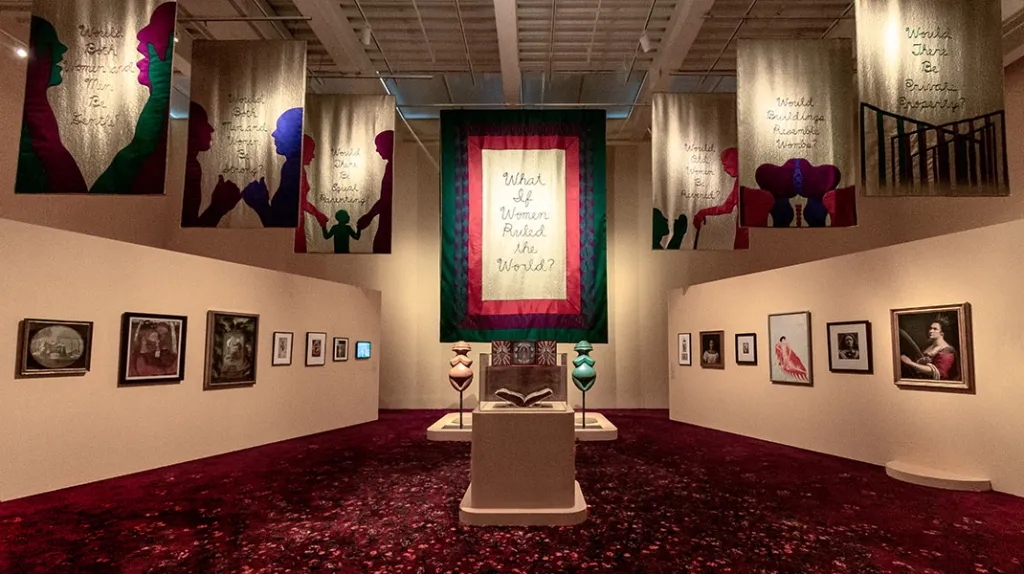
In one of the pieces from her massive retrospective at the New Museum — covering sixty years of art making — Judy Chicago invites us to consider a simple question: What if Women Ruled the World? The responses are compiled in a sprawl of hopeful texts, manifest in needlework, that most feminine of forms.

“There would be no wars.” “The Earth would be saved by humanity instead of being destroyed by it.” “The first step would be to abolish gender norms and deconstruct the entire hetero-patriarchal, racist and classist system that surrounds us.” “Not one mass shooter in the US was female.” “There is no need for violence when we use our hearts.”

In anyone else’s hands this piece might come off as naive or reductive, but there is something about Judy Chicago’s method — what she refers to as “call and response” collaboration — through which she is able to harnass an outpouring of honesty from many participants. The result is that the artwork has a powerful impact. It is urgent and exciting.

Installation view of “What If Women Ruled the World” by Judy Chicago
Detail of “What if Women Ruled the World” by Judy Chicago

This is a big show, going all the way back to painted car hoods Judy Chicago produced in the mid sixties.

Installation view of Herstory by Judy Chicago

And then there were the wonderful smoke performances from the seventies.

Immolation by Judy Chicago

But these early artworks are not the reason for Judy Chicago’s giant retrospective at the New Museum.

“Herstory” will showcase Chicago’s tremendous impact on American art and highlight her critical role as a cultural historian claiming space for women artists previously omitted from the canon.

New Museum description of Judy Chicago: Herstory

It is this role as a cultural historian which Judy Chicago fully inhabits in her artwork called “City of Ladies.” The piece is a show-within-a-show in which nearly ninety artworks by notable women from history are on display.

Installation view “The City of Ladies” by Judy Chicago
Hilma af Klint, Group IX/UW, The dove, no.2 (1915) from “The City of Ladies”
Gluck (Hannah Gluckstein), Portrait of Miss E.M. Craig (1920) from “The City of Ladies”

In an interview about “The City of Ladies” Judy Chicago often mentions a certain “Christine.” It took me a while to figure out she meant Christine de Pizan, who wrote “The Book of the City of Ladies” in 1404. Christine de Pizan lived from 1365 to 1430 and is thought to be the author of some of the very first feminist pieces of literature.

From compendium of Christine de Pizan’s works.
Shows the author lecturing to a group of men. Created in her scriptorium in Paris in 1413.

A brochure provided by the New Museum is a compendium of the women included in the show, and contains a short but detailed biography of each: Hilma af Klint, Claude Cahun, Leonora Carrington, Elizabeth Catlett, Emily Dickinson, Artemisia Gentieschi, Zora Neale Hurston…among many others.

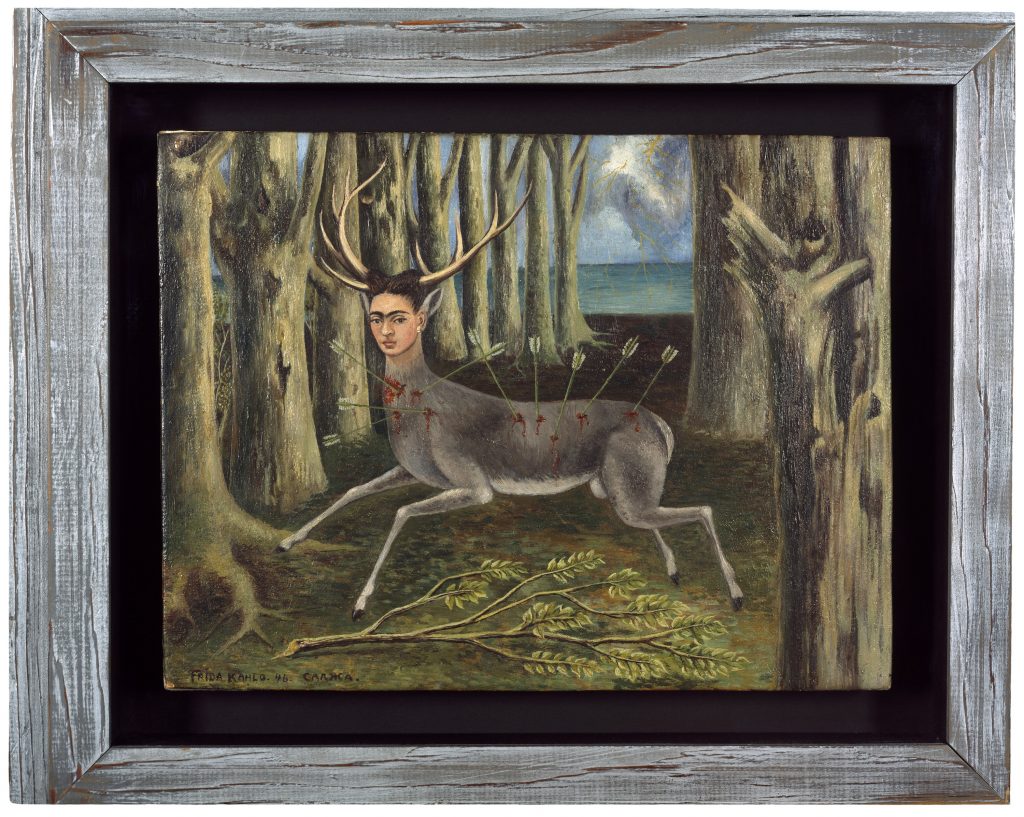
Wounded Deer, by Frida Kahlo (1946) from “The City of Ladies”

As Judy Chicago says: “If you bring Judy Chicago into the museum, you bring women’s history into the museum.”

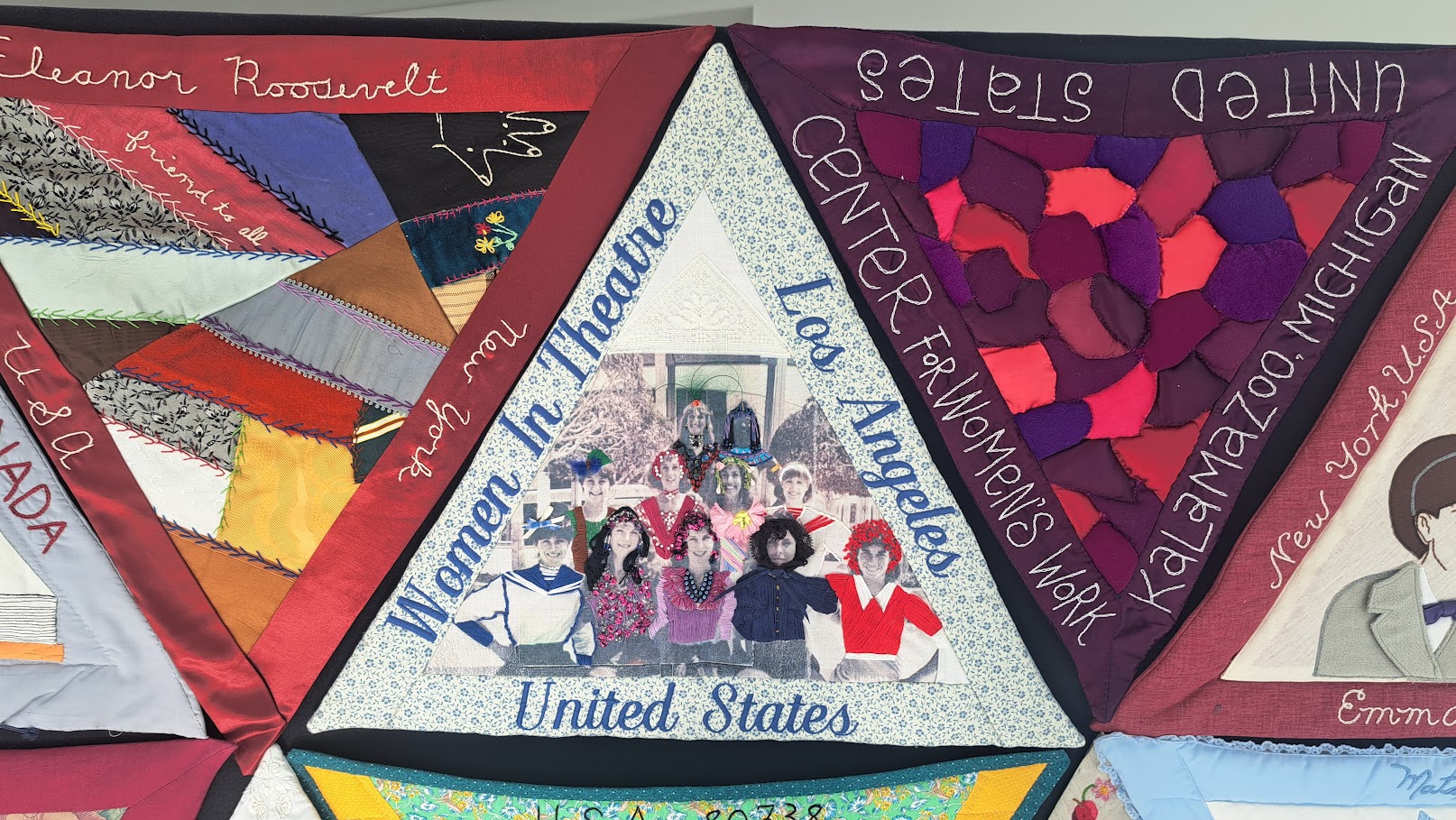
“The International Honor Quilt,” another “call and response” project,  is composed of 539 individual triangular quilts, produced by women from around the world. Each triangle celebrates a woman, a women’s group or a feminist issue, and together they create a joyful depiction of global female solidarity.

Installation view “The International Honor Quilt” by Judy Chicago
Detail of “The International Quilt of Honor” by Judy Chicago

Mostly global icons, like Queen Elizabeth II, are represented, but there are also lots of obscure women’s groups and a few mythological, religious, fictional women make the cut, for example: Deborah, Demeter, Eve, Isis, Nancy Drew, Persephone, Virgin Mary and, weirdly, the Loch Ness Monster.

Depiction of Nessie

Parts of the show seem too binary. Are all women good because they can give birth and all men are evil warmongers? That part of the show — despite the beauty of the massive collaborative tapestries — struck me as an illustration of the limits of second wave feminism.

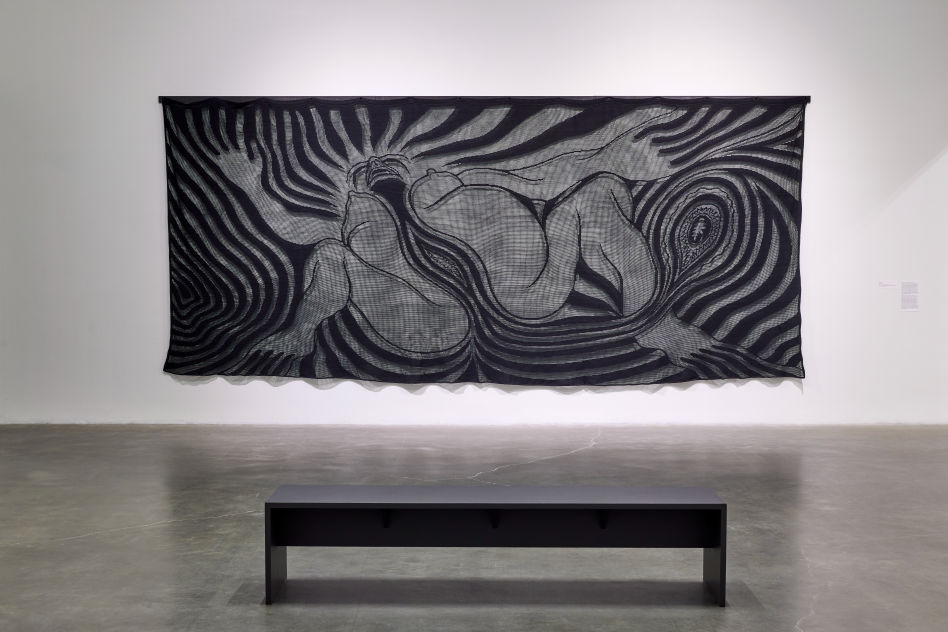
Tapestry by Judy Chicago

I prefered looking at her most recent work, where she meditates on death and the climate crisis.

Artwork by Judy Chicago

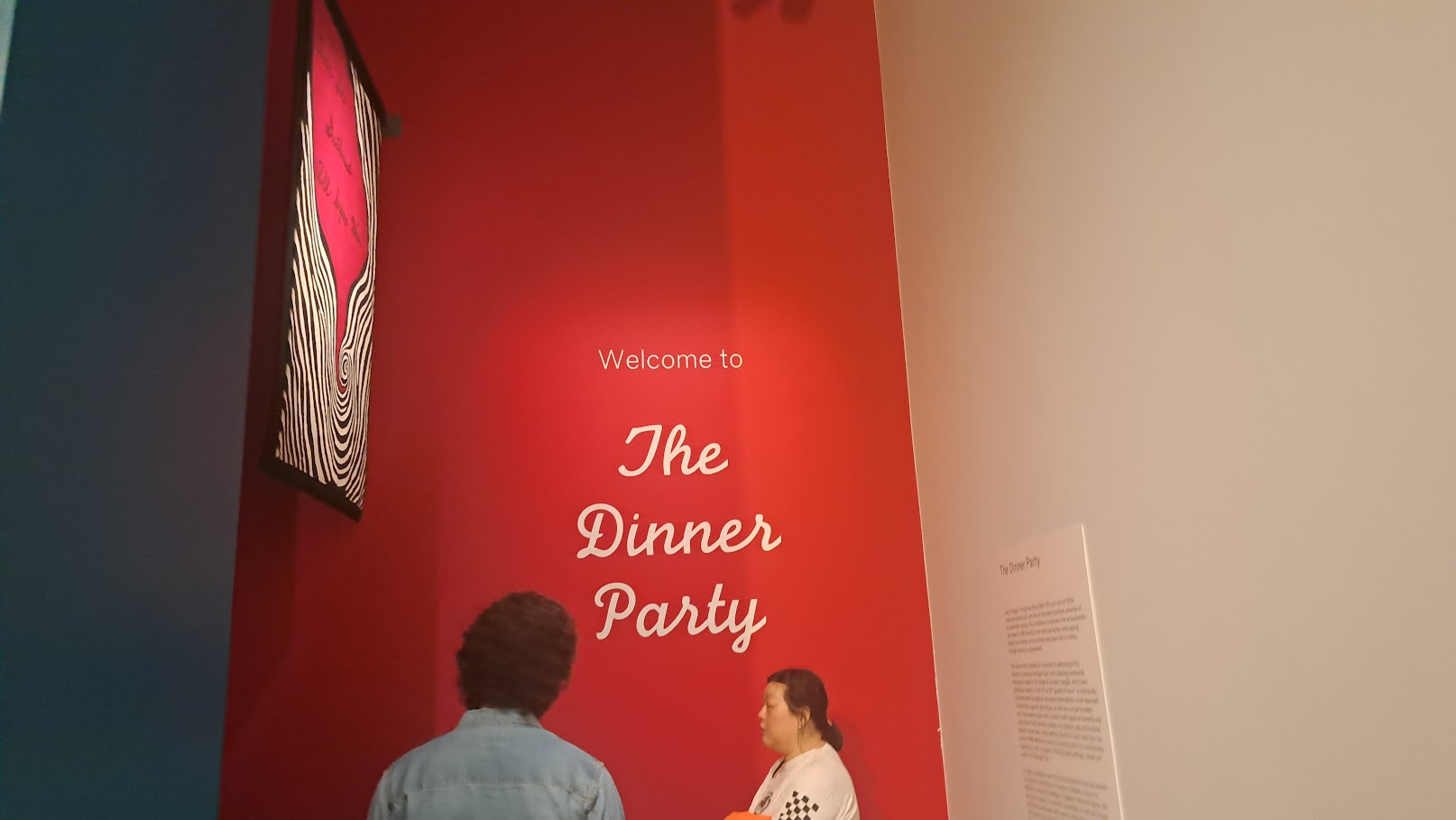
But wait, the big thing, the thing I heard about for decades, the thing that defines Judy Chicago — “The Dinner Party” — was not there. It was a ghostly presence throughout, constantly referenced, but absent.

I was obliged to journey to Brooklyn, change to the 2/3 at Hoyt, past Grand Army Plaza and The Botanic Gardens, onward, to Eastern Parkway and the stately Brooklyn Museum, where Judy Chicago’s famous work is permanently lodged.

Entrance to “The Dinner Party” by Judy Chicago at the Brookly Museum

“The Dinner Party” by Judy Chicago
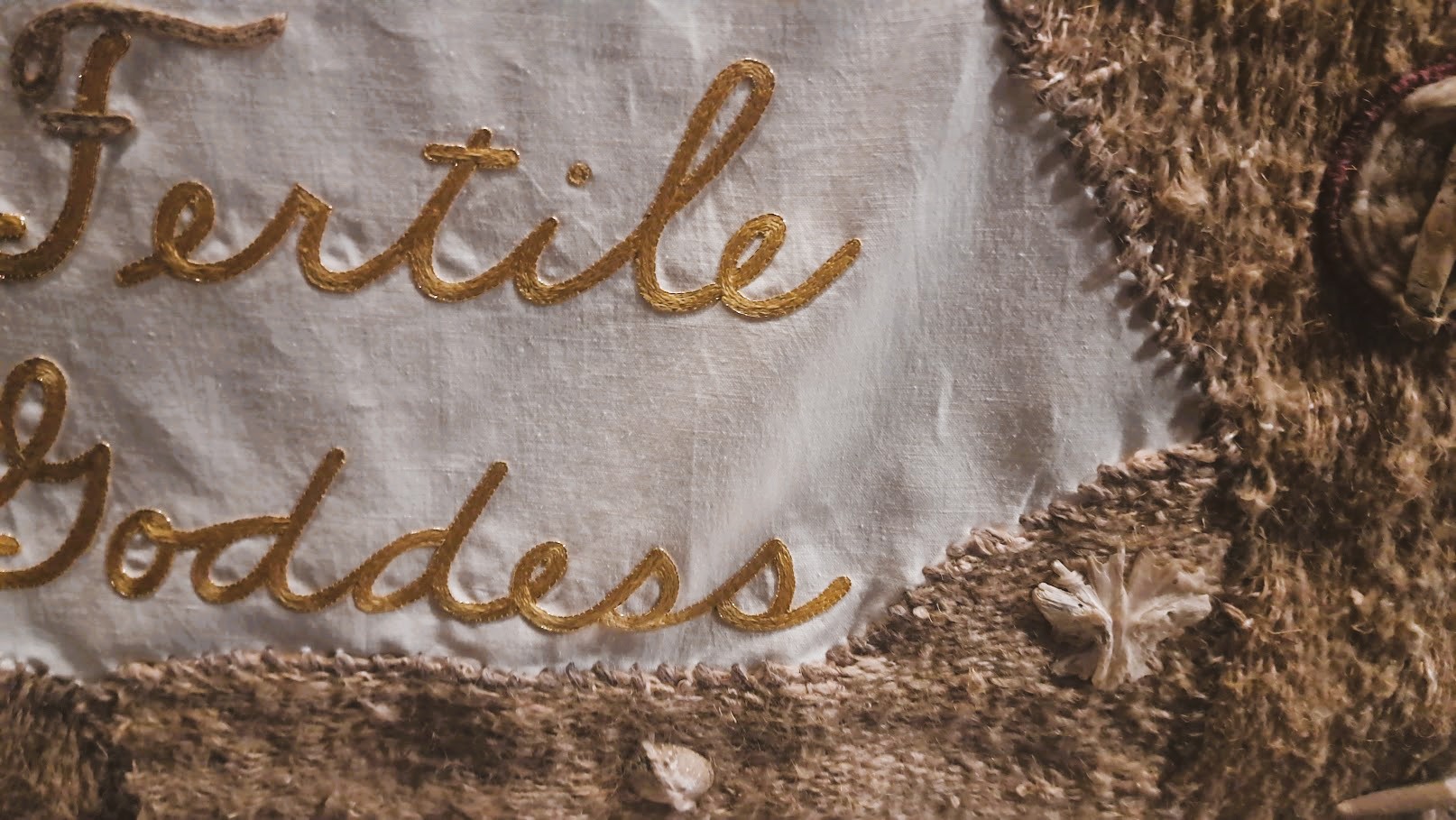
Detail of “The Dinner Party” by Judy Chicago

It was a long trip, but it was worth it.

January 13, 2024

Ron Giii – “The Effect of Temperature”

at Paul Petro Contemporary Art

It’s mid-January and winter has arrived on Queen Street. As I round the corner from Ossington and walk east, the scene is windswept, bleak and grey. Not so, however, within Paul Petro Contemporary Art. Paintings and works on paper by Ron Giii are on display, and suddenly I am in an atmosphere suffused with life, heat and light.

“Volume and Heat” by Ron Giii
Installation view “The Effect of Temperature” by Ron Giii

The title of the exhibition, “The Effect of Temperature,” points to the climate crisis which looms over us all. Many of the names of the small works — The Hot Sun, The Melting Greenland Glaciers, Somali Famine — overtly reference the global menace of our heating planet.

Here’s a quote about the climate threat, from the artist, which is posted on the gallery website:

This exhibit is humbly aware of a greater nature the laws of nature have, and climate change is the reality we have designated. My small paintings cannot cry at the dangers coming amidst the deluge.

Ron Giii

The small works on paper, which have a powerful intensity, make me think of those NASA photographs from the Webb Telescope, of distant suns, dying or being born. On the other hand, they are reminiscent of infinitesimally small things too. Cells for instance or pictures of mitochondria itself.

“Time is the Daughter of Space” by Ron Giii
Installation view “The Effect of Temperature” by Ron Giii

A few of the small paintings on paper appear to have been ripped apart and put back together with strips of clear tape.  According to Paul Petro these artworks “… were destroyed by the artist during a bipolar disorder episode last year following which the artist attempted to repair the works by puzzling them back together and taping the tears. In conversation, it was agreed that these works would be consolidated with archival tapes on the verso, with the assistance of a paper conservator, to stabilize them, and that these works would be shown in order to provide a level of transparency that would welcome his disability into the conversation.  Giii has subsequently referenced the Japanese kintsugi concept of repair, and finding the beauty in the broken in this work. He has lived with the challenges posed by bipolar disorder, and an original misdiagnosis of schizophrenia, for most of his adult life.”

“Fusiona” by Ron Giii

In talking about his work Ron Giii acknowledges the influence of various philosophers, of geometry, of his long term interest in quantum physics and, most recently, of the writings of the British evolutionary biochemist Nick Lane.

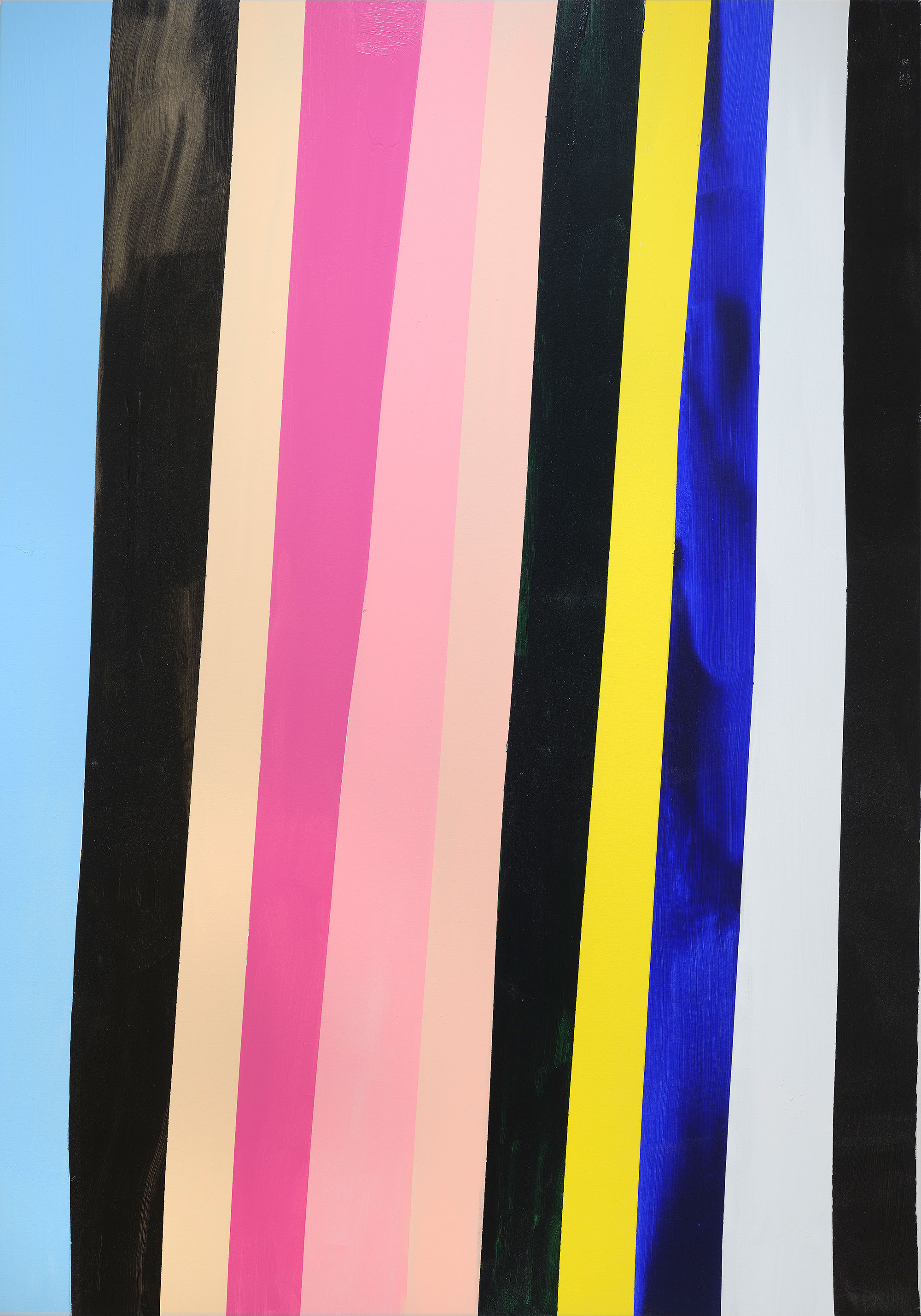
“Parallel Membranes 2” by Ron Giii

For Ron Giii, it was Nick Lane’s research into the origins of life and his descriptions of various electrochemical processes that directly inspired the striped paintings, which he calls parallel membranes, a phrase that turns up in Nick Lane’s book Transformer: The Deep Chemistry of Life and Death. 

Stripes are a thing for many artists. Here are just a few examples:

Danel Buren used colored stripes, in site-specific situations, as a way of relating art to its setting. As a Frenchman, he was comfortable with the classic French fabric motif.

“Suspended Painting” by Danel Buren

Canadian artist, Guido Molinari, sought pure abstraction in his work. To that end he completely eliminated the horizontal from his canvases, and thus any suggestion of depth.

“Untitled” by Guido Molinari

Frank Stella was also looking to eliminate by using stripes. In his case, it was emotion. The stripes did it. They got rid of all that messy action painting splatter and opened the door to minimalism.

“The Marriage of Reason and Squalor” by Frank Stella

And just upstairs from the Ron Giii is an exhibition of ink washes by Francesco De la Barra.  Here, the artist deploys stripes as a unifying motif in this dreamy suite of sensuous, poolside imagery. 

“Chemise B 12” by Francesco De la Barra

So far, Ron Giii’s stripes are my favourite.

January 4, 2022

Robert Houle: Red Is Beautiful at the AGO

One of the many large, elegant paintings by Robert Houle, in his retrospective at the Art Gallery of Ontario, is particularly arresting. An Indigenous man sits alone on an outcropping of rock, contemplating the shoreline and beyond. He is beautiful and calm; tatooed and tranquil in a bucolic, parklike setting, with broad, green lawns. He is looking east, to Europe, and evidently, he knows what’s coming.

“O-ween du muh waun (We Were Told)” by Robert Houle

The image has a sorrowful quality, like an invented perfect childhood, or the idea of heaven, where a dead loved one might now reside.

It made me think of the video piece by New Zealand artist Lisa Reihana — which I was able to watch numerous times at the AGO. One could think of Lisa Reihana’s piece as a moment later in this perfect, imaginary time. The tranquil Indigenous are no longer alone. The British have landed, and they have disembarked.

Still from “In Pursuit of Venus (Infected) by Lisa Reihana

And I was also reminded of Robert Hughes and his book “The Fatal Shore” in which he reflects upon the shattering of perfection, as the British first sailed into Botany Bay.

“One may liken this moment to the breaking open of a capsule. Upon the harbor the ships were now entering, European history had left no mark at all. Until the swollen sails and curvetting bows of the British fleet round South Head, there were no dates. The Aborigines and fauna around them had possessed the landscape since time immemorial, and no other human eye had seen them. Now the protective glass of distance, broke, in an instant, never to be restored.”

The Fatal Shore, by Robert Hughes

But this is just one painting in an immense exhibition, covering many decades and using many different media, in a career spanning more than fifty years.

This is the kind of show you might want return to again and again. But that is not possible because the Gallery is now closed due to the Omicron variant.

Entrance to Robert Houle Exhibition “Red Is Beautiful” at the AGO

Robert Houle takes the viewer on a journey; often it’s personal. The painting shown below is entitled Sandy Bay and refers to a residential school in Manitoba attended by the artist. Photographs of the school building, an image of Robert Houle’s sister, and other photographs are included in the painting.

For me, the gorgeous formal aspects of this work exalts its intense emotional weight. It’s a very powerful piece.

“Sandy Bay” by Robert Houle

Many of Robert Houle’s paintings explore the history of Indigenous struggles in Canada as they explore, with equal intensity, the sensuality of paint.

Detail of “Premises for Self Rule: Constitution Act, 1982” by Robert Houle
“Premises for Self Rule: Constitution Act, 1982” by Robert Houle

The painting above is part of a series which extracts texts from Canadian historical documents (The Royal Proclamation, 1763; the British North American Act, 1867; Treaty 1, 1871; and the Indian Act, 1876 and the Constitution Act of 1982) and combines it with a contemporary painting and historical photographs.

Robert Houle never loses sight of his subject matter — which in a way is the entire history of this country– but he does not take a didactic tone. It’s more like he is sharing information. We learn a lot.

“Aboriginal Title” by Robert Houle

The Ipperwash Crisis is commemorated, below, in a painting of jolting colour, embedded with meaning.

“Ipperwash” by Robert Houle
Detail of “Ipperwash” by Robert Houle

Painting appears to be a constant for Robert Houle but the show includes works in other media: prints, drawings, sculpture, video and large scale installations including one which features a big, beautiful, buttery yellow, antique Pontiac.

“I will stand in your path until dawn” by Robert Houle

The AGO provided a quote from Robert Houle in connection with the Pontiac piece.

Growing up in the ‘rez in Southern Manitoba in the 1960s, Pontiac was the family car we drove down to the lake. It was not until High School that I read about Pontiac, the Odawa chief who led a confederacy of eighteen nations against the British Army in the summer of 1763 (the year of the Royal Proclamation.)

Robert Houle

In the painting below, Robert Houle memorializes a troupe of dancers who visited Europe in the 1840s.

“Mississauga Portraits (Waubuddick, Maungwudaus, Hannah)” by Robert Houle
Detail from “Mississauga Portraits” by Robert Houle

I really like looking at the portraits of these confident, graceful, imperious performers. The artist has endowed these pictures with haughty vitality and vivid emotional content.

And occaisionally the artist strikes a light-hearted note and it’s just fun to see, like the video below.

Part of a multi media installation “Paris/Ojibwa” by Robert Houle

It was really great to wander through this expansive exhibition and feel colour and light washing over me. And it’s true that timing is everything! I was able to slip into the “Red Is Beautiful” exhibition the afternoon of January 4, just a few hours before the AGO and every other cultural institution in the city pulled the plug and shut their doors to the public. We are back in lockdown.

January 24, 2019

Mickalene Thomas: Femmes Noires

My attitude toward our southern neighbour swings wildly, from: “That hell hole,” to “We have so much to learn from the USA!”  The work of Mickalene Thomas, and her show at the Art Gallery of Ontario (AGO) titled Femmes Noires, makes me truly appreciate the USA and the driving, pure, singular force of innovation that springs up fairly frequently in that turbulent and mesmerizing country.

“Visibility, empowerment, celebration.” That is a quote from Mickalene Thomas, talking about what she wants people to take away from her AGO show.  She succeeds.  It is an exultant display, uplifting to visit.  So many images of queenly, glittering, sumptuous women.  I guess it takes a gay, black woman to shrug off deference to a male art world and let glitter and sequins reign.

The paintings shown in the Femmes Noires exhibition – collages of oil paint, photographs, and other materials – often refer to revered works by male artists from the past, like Picasso, Manet or Ingres. The women that emerge in these paintings have a deep sense of themselves: Their gaze is frank, self-contained, self-knowing and profoundly calm in the center of riotous color and pattern.

The painting titled “Shinique: Now I Know” references the Neo-classical touchstone “Une Odalisque.” This painting, by Ingres, above, was widely reviled when it was first shown. Critics pointed to the elongated curved creature in the painting as anatomically impossible. And yet this picture has endured, sits in the Louvre to this day, and is included in every Art History survey around the world.  Apparently, it had more than anatomical correctness going on.

People respond deeply to Ingres’ painting.  What is it that makes people decide to redo it, or use it in provocative sloganeering, as per the Gorilla Girls famous poster above.  Maybe there is something essentially irritating about “Une Odalisque” itself, that paradigm of “Orientalism.”

The Femmes Noires show is big! There are two massive galleries where the visitor can lounge in a living room environment — with potted plants, comfortable chairs and cushions — browse novels or other works about the black experience, and watch media (some random snippets are included below:)

Video by Mikalene Thomas

It seemed like there was a bit of a disconnect from the present. We see Whitney, Eartha, Pam, Diana and so many other fabulous black women icons from the past but where are today’s powerful black women?  In fact Mickalene Thomas has collaborated with Solange, Beyonce (The Queen!!!) and other contemporary black superstars but that work just doesn’t happen to be included in this exhibition.

portrait-of-solange-thinking-about-you-by-mickalene-thomas-2013-color-photograph-and-paper-collage-on-archival-board--2a4c1af070127b96

I was feeling pretty good about my former homeland by the time I left the Mickalene Thomas exhibition at the AGO.  What an exciting place of invention and possibility!  All the fraught recriminations and anger that characterize this contentious era in the USA don’t really come up at Femmes Noires.  It’s like an invitation to a new world.