October 26, 2024

Art Toronto – Canada’s Art Fair

This year’s Art Toronto — the 25th Anniversary event — exuded confidence, sophistication and depth. It was great to wander the vast expanse of the Metro Toronto Convention Center and get lost in the labyrinths and eddies of unfettered display.

There were more than 100 exhibitors. Galleries from across the country were represented. I also noticed some European and South American galleries, as well as a number from our friends in the USA.

There were many people-watching opportunities!

This vivacious, well-dressed group attended last year’s Art Toronto and were expected to return again this year, although, sadly, I did not spot them.

This exhibition has the feeling of an exciting shopping mall. What follows is a tiny and utterly subjective view of the tumult of art and commerce that is Art Toronto.

I was definitely happy to see work by favourite artists, from Toronto and elsewhere.

Carol Wainio, in her signature faded, dreamy palette, continued her exploration of haunting folklore from the distant past.

“Direction Home” by Carol Wainio was presented by Paul Petro Contemporary Art
Detail of “Direction Home” by Carol Wainio

There was some Witch Queer Volcanology on display in the form of one of the spectacular Fastwurms textile pieces.

“Sundoro” by Fastwurms was presented at Paul Petro Contemporary Art

I liked looking at the mysterious weapon, lifting off into the mist, by Wanda Koop.

“Seeway – Green with Lights” by Wanda Koop presented by Blouin Division

There were many artist’s works I had not encountered previously. I had questions.

I was trying to figure out what drew the artist, Nicholas Crombach, to this particular shade of red flocking, in his wildly complex sculptural piece. Maybe its a particular representation of vitality? Or maybe he’s referencing the way precious items are sometimes tucked away in red velvet?

Weisels by Nicholas Crombach

I enjoyed the desolate emptiness created by the painter Ulf Puder, in this large work hovering between geometry and realism.

“Sand” by Ulf Puder, shown by Bonne Choice Gallery

The photo piece below, by Kris Munsya, has a cinematic feel of futuristic mutation occuring in a lush, tropical site. I want to know more!

“Airplane Mode – Genetic Bomb” by Kris Munsya exhibited by Galerie Robertson Ares

I was in awe of this extra large lino cut print, produced on hand-made gampy paper. The giant print, by Alex Kumiko Hatanak, was part of an installation at the McMichael Gallery booth.

“Faultines and Loneliness” by Alex Kumiko Hatanaka
Detail of “Faultines and Loneliness” by Alex Kumiko Hatanaka

This photo of a house was fascinating. It looked a lot like a green monopoly piece. I learned it was part of something called the Lenora Drive Project, in which a Willowdale developer allowed artists to get creative with a half dozen condemmed bungalows.

“Title Deed” by An Te Liu presented by Bonne Choice

It took me a while to figure out that An Te Liu, the artist responsible for “Title Deed,” is the same artist who makes the very appealing sculptures, shown at Blouin Division last year.

“Broken Window” by Anahita Norouzi shown by Nicholas Roberts Gallery

Anahita Norouzi‘s photo piece made me want to know more about this barren landscape and the spectacular explosion implanted there.

Detail of “Broken Window” by Anahita Norouzi

There were some special shows put together by individual curators, including a “Focus Exhibition” titled ‘the place to which we return.’ It was described as engaging viewers with ideas of “home” and what that notion means to them.

“Regrounding” by Marigold Santos

The painting above, by Marigold Santos, was part of the “Focus Exhibition.” It was quite stunning to stand before this painting and bask in the field of yellow. The painting of a corpse dissolving into a landscape, although fascinating and intricate, is almost incidental to this powerful sweep of colour.

Detail of “Regrounding” by Marigold Santos
Artwork by Renee Condo presented by Blouin Division

Another piece in the Focus Exhibit is this one by Renee Condo. I’d seen the big, beautiful beadwork pieces by Renee Condo before, at the Blouin Division space. They have a joyful, high-octane buzz and effectively pull beadwork into a contemporary space.

“There Are No Footprints Where I go” by Meryl McMaster

In many indigenous cultures crows are valued for their intelligence and spiritual significance. They are seen as messengers from the spirit world, holders of universal wisdom, and protectors against evil forces.

This piece by Meryl McMaster, also part of the Focus Exhibition, has a quiet power and mystery.

Detail of “There Are No Footprints Where I go” by Meryl McMaster

See more about crows here.

January 13, 2024

Ron Giii – “The Effect of Temperature”

at Paul Petro Contemporary Art

It’s mid-January and winter has arrived on Queen Street. As I round the corner from Ossington and walk east, the scene is windswept, bleak and grey. Not so, however, within Paul Petro Contemporary Art. Paintings and works on paper by Ron Giii are on display, and suddenly I am in an atmosphere suffused with life, heat and light.

“Volume and Heat” by Ron Giii
Installation view “The Effect of Temperature” by Ron Giii

The title of the exhibition, “The Effect of Temperature,” points to the climate crisis which looms over us all. Many of the names of the small works — The Hot Sun, The Melting Greenland Glaciers, Somali Famine — overtly reference the global menace of our heating planet.

Here’s a quote about the climate threat, from the artist, which is posted on the gallery website:

This exhibit is humbly aware of a greater nature the laws of nature have, and climate change is the reality we have designated. My small paintings cannot cry at the dangers coming amidst the deluge.

Ron Giii

The small works on paper, which have a powerful intensity, make me think of those NASA photographs from the Webb Telescope, of distant suns, dying or being born. On the other hand, they are reminiscent of infinitesimally small things too. Cells for instance or pictures of mitochondria itself.

“Time is the Daughter of Space” by Ron Giii
Installation view “The Effect of Temperature” by Ron Giii

A few of the small paintings on paper appear to have been ripped apart and put back together with strips of clear tape.  According to Paul Petro these artworks “… were destroyed by the artist during a bipolar disorder episode last year following which the artist attempted to repair the works by puzzling them back together and taping the tears. In conversation, it was agreed that these works would be consolidated with archival tapes on the verso, with the assistance of a paper conservator, to stabilize them, and that these works would be shown in order to provide a level of transparency that would welcome his disability into the conversation.  Giii has subsequently referenced the Japanese kintsugi concept of repair, and finding the beauty in the broken in this work. He has lived with the challenges posed by bipolar disorder, and an original misdiagnosis of schizophrenia, for most of his adult life.”

“Fusiona” by Ron Giii

In talking about his work Ron Giii acknowledges the influence of various philosophers, of geometry, of his long term interest in quantum physics and, most recently, of the writings of the British evolutionary biochemist Nick Lane.

“Parallel Membranes 2” by Ron Giii

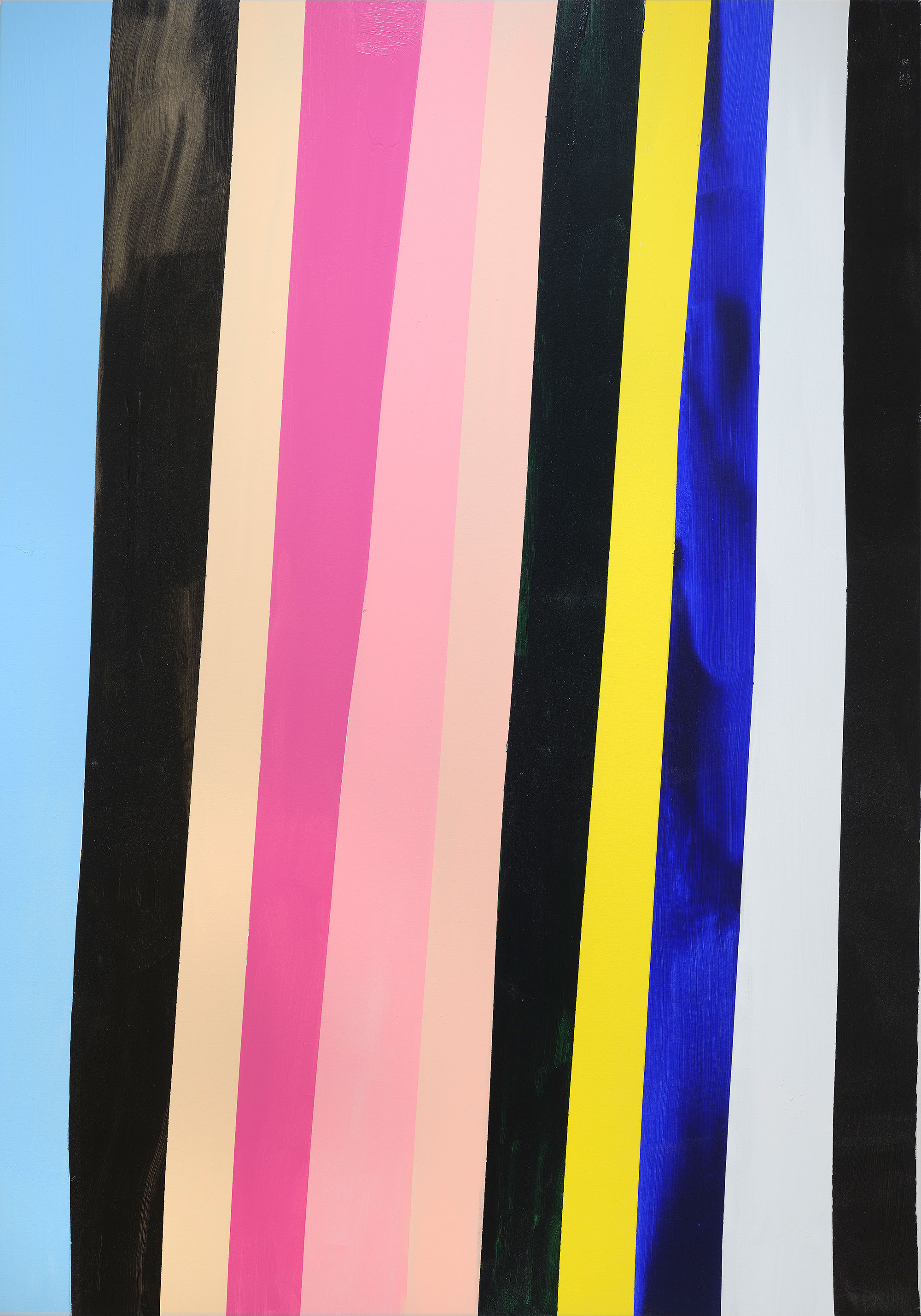
For Ron Giii, it was Nick Lane’s research into the origins of life and his descriptions of various electrochemical processes that directly inspired the striped paintings, which he calls parallel membranes, a phrase that turns up in Nick Lane’s book Transformer: The Deep Chemistry of Life and Death. 

Stripes are a thing for many artists. Here are just a few examples:

Danel Buren used colored stripes, in site-specific situations, as a way of relating art to its setting. As a Frenchman, he was comfortable with the classic French fabric motif.

“Suspended Painting” by Danel Buren

Canadian artist, Guido Molinari, sought pure abstraction in his work. To that end he completely eliminated the horizontal from his canvases, and thus any suggestion of depth.

“Untitled” by Guido Molinari

Frank Stella was also looking to eliminate by using stripes. In his case, it was emotion. The stripes did it. They got rid of all that messy action painting splatter and opened the door to minimalism.

“The Marriage of Reason and Squalor” by Frank Stella

And just upstairs from the Ron Giii is an exhibition of ink washes by Francesco De la Barra.  Here, the artist deploys stripes as a unifying motif in this dreamy suite of sensuous, poolside imagery. 

“Chemise B 12” by Francesco De la Barra

So far, Ron Giii’s stripes are my favourite.

November 21, 2014


The paintings by Carol Wainio on display at Paul Petro Contemporary Art quickly drew me into their dense, tangled layers of imagery.
These paintings are so visually deep.  A dark, gnarly, ancient-looking forest landscape is the middle ground.  Far in the distance are winsome pastel vistas.  Strangely patterned birds, maybe pheasants, charge about the forest floor, heading for clearings and stone pathways through the old growth.  Numerous disparate objects, creatures, little people, symbols of all types and sometimes words are found embedded in the welter of images.  In the foreground, bold, simple line drawings and fat polka dots create a closer surface, as though we are looking through glass into another world.
Carol-Wainio-Les-Cailloux-Blancs
Les Cailloux Blancs

20141121_134234

20141121_134307

Detail from Les Cailloux Blancs

Accompanying the show, titled Dropped from the Calendar, is a long text written by Carol Wainio in which she suggests the nature of modern life has resulted in certain losses such as the creative luxury of boredom, certain notions of enchantment, reliable shared memories and rhythms of the seasons.  The phrase “dropped from the calendar” refers to the pages of traditional holiday calendars which were once reserved for personal recollections.  Are these blank pages no longer necessary since recollections are manufactured and provided for us now?

Carol-Wainio-Lost

Lost

20141121_134404

One Evening

Frequently the outline of a transparent fawn, like the familiar twinkly Christmas lawn ornament, turns up in the paintings.  Could be that Carol Wainio is connoting our feeble and sentimental link with the natural world through this image.

20141121_134653

Renderings of children, definitely from another period in history, also recur in the paintings.  For some reason I thought of the Hummel figurines my mother-in-law in New Jersey used to collect.  They seemed beyond kitsch — the height of manufactured nostalgia –  to me.  Maybe that is what Carol Wainio is getting at, i.e. that our private nostalgia has been hijacked and sold back to us.

It is a pleasure to look at these paintings which are both visually and metaphorically deep and to spend some time speculating on the connections and references within them.

In the accompanying text Carol Wainio quotes Walter Benjamin’s talking about fairy tales in the modern age: “This is how today it is becoming unraveled at all its ends after being woven thousands of years ago in the ambience of the oldest forms of craftsmanship.’   I was thinking about these ancient tales and how they helped people in perilous times when I came across an announcement about the release of some long lost Grimms’ Fairy Tales.  One of the stories is summarized below:

“Once there was a father who was slaughtering a pig in the yard,  His two sons saw him do this, and they decided to play slaughtering. One of the brothers became the pig, and the other became the slaughterer and he slit the throat of the younger brother. In the meantime, the mother was watching upstairs from a window and saw what had happened. She ran downstairs and took the knife out of the boys throat and, out of fury, she stabbed the older boy in the heart. And then she realized the baby was upstairs, and in the meantime the baby had died and drowned in the tub. She was so remorseful she committed suicide. The father, he was so dismayed that after two years he wasted away.”
Farm Boy
Hummel Figurine “Farm Boy”

September 6, 2014

The purpose of this blog is to write about Art in Toronto.  What’s going on in art in Toronto right now?  I intend to start this project by taking a walk every Saturday, visiting some galleries, taking a few pictures and recording my impressions and thoughts here.  I am not sure where this project will take me. Galleries might be just the beginning.  I admit I don’t know where the art scene is at this time.  I hope to find out.

On Saturday, September 6th, I walked down Ossington Street.  It felt like the last breath of a short, cool summer.   The street was lively and colorful.
ossington Streetossingstreet

First stop: O’Born Contemporary

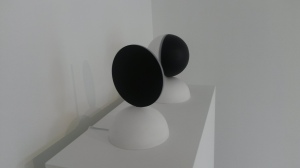
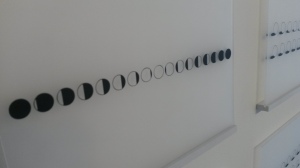
Callum Schuster’s exhibition is all about limits: He uses only the sphere and only in black and white.  Any evidence of the human hand has been expunged from the work.  Numerous spheres were created in various media.  Each sphere is divided in half: one half a dense matte black and the other half dazzling matte white.  The sphere’s were twirling, white sphere’s becoming black spheres, they were lined up, tilted, embedded in frosted plexiglass, some larger, some smaller, all extremely controlled, modulated, calm.  The artist made animated films and sculptures of black and white spheres spinning in the same steady, controlled way.  The work had the feel of an architectural or maybe mathematical model; pristine, artfully constructed, and indeed, the artist has stated he is interested in measurement.  It is dry, cool, extremely clean – bordering on obsessively clean – work.

The tall, elegant co-director of O’Born Contemporary, Rachel Anne Farquharson, was very gracious.  I scanned the artist’s statement and asked her what is the meaning of “praxis.”  (The context was the “praxis of painting.”)  She told me it means “practice” in Greek.  I didn’t know what to make of that.  She mentioned the artist’s cleanliness, obsessiveness, tidiness etc. and has also been quite taken with his intelligence.
20140906_131835More dots

The overwhelming sense of this show is how removed the work is from the anything that’s going on just outside the white gallery cube.  I can relate to that specific focus and can understand that someone might not want to even read a newspaper in the ghastly summer of 2014.

Next up: Angell Gallery

I really like Jamie Angell.  He is truly an art enthusiast, and no one can work a room like him.

Jamie’s main artist, i.e. the one that keeps the gallery financially solvent, is Kim Dorland but Jamie takes risks on all kinds of other artists and always has something unusual to look at.  The current show in the large gallery is by Daniel Hutchinson.  What do you know?  This artist is all about limits and is extremely intelligent!  This is what the lovely young gallery assistant told me.  I’m detecting a trend.

Daniel uses only black, although he under paints in color. The color sometimes bleeds through but the viewer is not quite sure if it’s a hallucination or some kind of afterglow that occurs from staring at the profoundly black paintings.  From my perspective they were hard to look at.  The black was so shiny and sticky looking, like old liquorice, tar or pumped up rubber, industrial stair treads.  The artist added glare by strategically placed neon tubes next to the paintings

.jamie angell
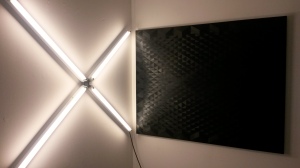
Daniel is interested in cosmology, dark matter and various themes from contemporary physics.  In the statement heavy hitters like Malevich and Ad Reinhardt are referenced.  Clearly Daniel Hutchinson is a serious and ambitious painter.

Incidentally, this morning on CBC a scientist was talking about the Higgs boson particle.  I knew it was a big deal to find this particle but I was not really sure why.  According to the scientist this is a happy story because it means we are not surrounded by a lonely vacuum as was previously surmised.  We are in a soup of matter and the discovery of the Higgs boson proves it.  This particle is the building block of everything, hence, it is called the “God Particle.”  The details are a little hazy for me but as Daniel Hutchinson seems to suggest aspects of physics such as the Higgs boson are mysterious and compelling and provide rich inspiration for visual art.

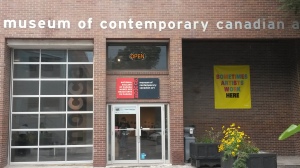
Onward… to the Museum of Contemporary Canadian Art (MOCCA)
MOCCA

What would we do without MOCCA?  Who would provide a venue for STAG Library’s mugwort recipes and eloquent documentation on “relanding.”  (“Relanding” is the word used by Gina Badger and cheyanne turions, the two individuals who make up STAG Library,  to describe an attempt to reconcile the violent past of original European settlement in North America.)

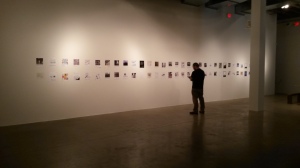
Also in the main space was an exhibition called TBD which is focused on reimaging the Museum.  It consisted of numerous ideas for exploding the conventional museum and dispersing the contents in inventive, original ways.  The ideas are so amusing: Think of the possibility of a temporary museum in the construction hoardings around new buildings.
mocca big show

There was lots of standing around reading at MOCCA, which doesn’t really work for me.  A certain amount of reading is okay but maybe this exhibition should have been a magazine or a book?

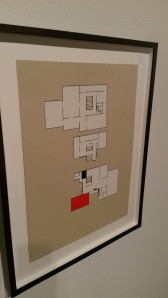
The prints of Museum floorplans were stylish objects and they would definitely look good in a corporate boardroom.
mocca 3

Sometimes MOCCA’s installations are so subtle that I just miss them totally.  Apparently there is a sound installation by Mark Soo currently on display.  It’s called “House is a Feeling” but  I couldn’t really get a beat on it even though I was wandering in the main gallery for 10 minutes or more.  How I missed it I do not know.  Maybe that installation had something to do with the intermittent drilling that finally drove me out of there and into the adjoining exhibition.

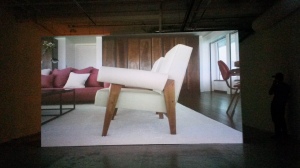
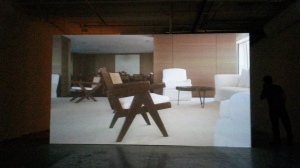
The highlight of the MOCCA visit for me was the 2013 film entitled “Provenance” by Amie Siegel.

The piece explores the fetishism around certain mid-century modernist furniture.  In this case, chairs and other items designed by Le Corbusier and Pierre Jeanneret are documented being packed up, travelling across the ocean, expertly marketed and sold for hefty prices, eventually to take their places in a succession of glamorous contemporary settings.  These objects turn up in all the right places and they seem to become more beautiful and desirable as the film progresses, invariably captured in slow tracking shots in a muted palette as the context screams Understatement! Taste! Money!
mocca chair 2mocca chair

The back story on these chairs is so interesting.  Chandigarh is a city in India designed by Le Corbusier and Pierre Jenneret in the middle of the last century.  This furniture is apparently the everyday office chairs and desks that the inhabitants of this dreamed up city would use.

And finally: Paul Petro Contemporary Art

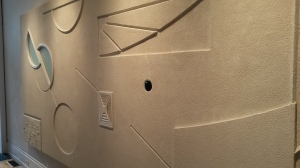
The downstairs gallery features an exhibition by Morley Shayuk.  I would like to get to know this artist and ask him to accompany me to Home Depot or Rona sometime.  He seems to really know his way around hardware and building materials.  He creates massive wall reliefs incorporating all the latest polymer variants.  They have an off-hand grandeur and would have looked great in the (now bulldozed) former Winnipeg International Airport.
Paul Petro

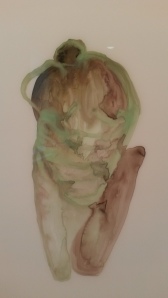
Upstairs was an arresting show by Shelagh Keeley.  What I really liked about her paintings (on Mylar) was their uncomplicated sophistication.  No handout required: It is all there in the paintings.  They are lush, meditative, succinct and that works for me.
Paul Petro 2Paul Petro 1

Clotilda was texting me to meet her at Starbucks.  I concluded my first Toronto art blog walk with a feeling of calm and optimism.