August 6, 2016

The McMichael Art Collection – Sarah Anne Johnson

In terms of the perpetuation of the species and the human life span, the period between 15 and 25 is the really crucial one.  This is the period of maximum fertility and all its attendant characteristics: the fierce courage, idealism and passion that belong only to the young; and of course, on the dark side, the selfishness, fecklessness and brutality that hopefully dissipates with maturity. Looking back to this era in one’s own lifetime can produce feelings of awe and possibly an overriding sense of good fortune that we even survived at all.  Sometimes we barely recognize our former selves and are obliged to murmur, almost inaudibly: “Was that idiot me?”

Sarah Anne Johnson wanders into this territory of youthful enthusiasm and misadventure in her exhibition called Field Trip, at the McMichael Collection.
Sarah_Anne_Johnson_Yellow_Dinosaur_2015_7037_417

Yellow Dinosaur by Sarah Anne Johnson

The “trip” Sarah Anne Johnson takes the viewer on is deep and quixotic, at times hilarious, contemplative and hopeful, and then suddenly frightening and grim.  I really liked looking at this show.  For me the dazzling images conjure up a sense of how perception is shared, how my own perceptions conform to contemporary custom and how they change.

ZombieDanceCprint28x42_2015_edited-1

Zombie Dance by Sarah Anne Johnson

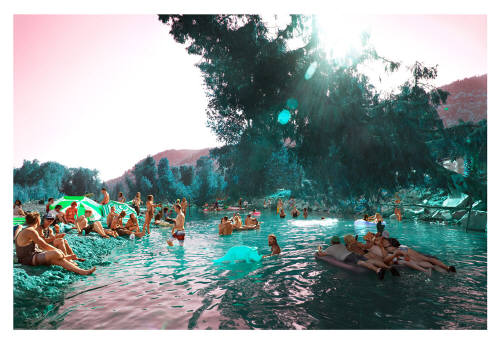
I’ve been reading a book by Jenny Diski called The Sixties.  She writes:  “We were …a bunch of dissolute, hedonistic druggies.  We lay around and got stoned, had sex, listened to music that exalted lying around, getting stoned, having sex, and hymned our good times.”  It seems that fifty years later this is the same crowd that Sarah Anne Johnson has photographed. In her book Jenny Diski goes on to chronicle how the sixties became the Reagan years and turned into ” that beast: the Me generation.”  Time will tell.

Chillin’ at the Void by Sarah Anne Johnson
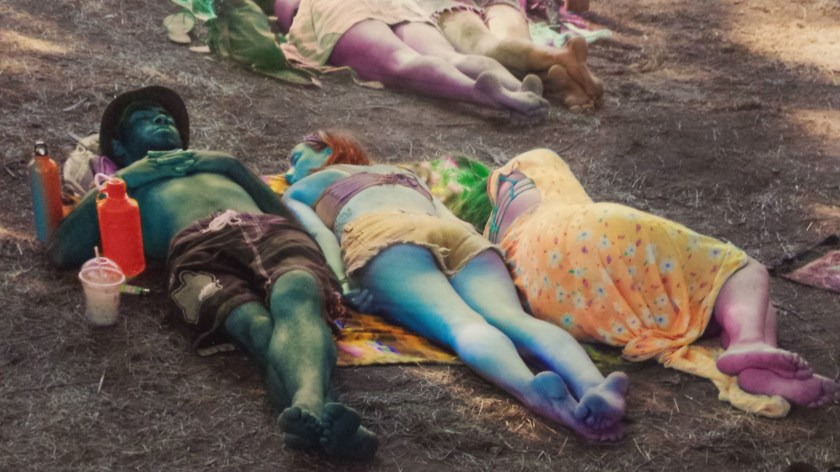
20160806_145630

Detail of Chillin’ at the Void by Sarah Anne Johnson

Sarah Anne Johnson intertwines so many interesting threads of thinking. The detail of Chillin’ at the Void depicts a new crop of “dissolute, hedonistic druggies.”   It makes me think of a different kind of chill: a cold and dreadful chill, of how marketing and propaganda ease each  generation through its own very special, unique and individual journey.

GroupPortraitCprintOilstick28x42_20131

Group Portrait by Sarah Anne Johnson

In the piece entitled “Group Portrait” Sarah Anne Johnson captures the joy and satisfaction of belonging, so critical for the young.  The individuals are obliterated with dopey masks and transformed in an instant to exotic creatures that have banded together.   We will always be together!!  We celebrate our originality!  We defend our tribe!!  It’s such a brief sentiment.  Maybe only an afternoon or two.  That weekend at Bird’s Hill Park.

Sarah Anne Johnson’s trip includes some dark alleys, strewn with garbage, seriously dangerous drugs and stoners slipping over the edge.

BlobCprint14x20_20151

Blob by Sarah Anne Johnson

The lurid, day-glow monsters of nightmare and death are observed with nonchalance.  This is an ability of the very young and very stoned, and a feature of their passage into the humdrum adult world….if all goes well.
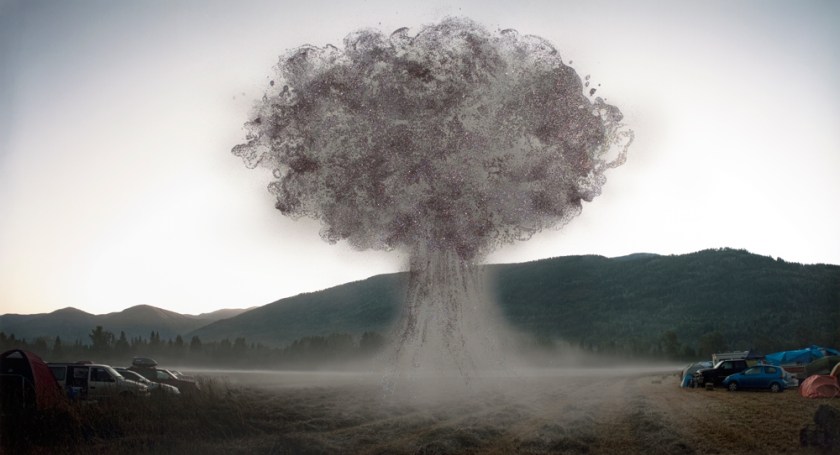
sarah-anne-johnson-2014-glitterbomb

Glitter Bomb by Sarah Anne Johnson
May 26, 2016

Here’s something you may or may not know: say your laptop gets wet, due to an unfortunate incident.  You dry it out for a day or two and suddenly it comes back to life.  All is well!  These things happen, after all.  Six months later it won’t turn on and when you take it back to Best Buy you learn it is filled with rust and useless.  You have to buy a new one.

Alison Milne Gallery Dean West

The Alison Milne Gallery, tucked away on Osler Street above Bloor, is a cool, stylish oasis in the urban summer and the current show, part of the city-wide CONTACT Photography Festival, brings a note of self-possessed LA glamour to the Junction.

I couldn’t help wondering if Dean West is a made up name.  Maybe its because the photographs are all about surface, artifice and style.  In this exhibition, titled The Painted Photograph, people and objects populate hyper-art directed environments.

There is not a trace of the messiness of life in these sumptuous art works.

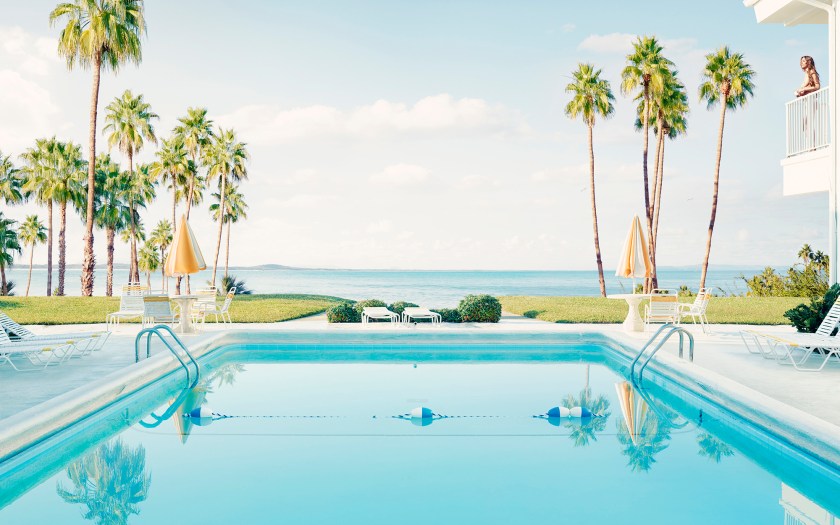
OwYmiTpDPSUKJkxEBGanbr98

St. Pete Beach by Dean West

This vista is so pristine it does appear to be kicked up a notch on the realness scale and hence painted.  Possibly there is an Instagram filter that creates such a vivid blue.  Maybe X-Pro II or…Mayfair?

Some colours are owned by certain artists.  I guess David Hockney lays claim to this particular shade of aqua, so much so that Dean West placed him poolside, in the photo shown below, looking relaxed, enjoying a smoke and the view.

IVTBgb6qOGPcwYphKMdEaNes

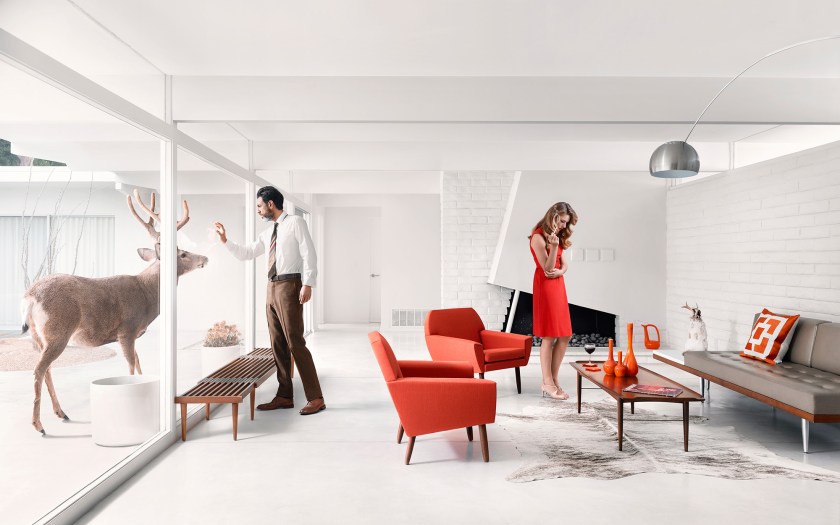
Palm Springs #2 by Dean West

My favourite piece in this show has to be the domestic interior: the red and white, the fireplace, the bizarre presence of a reindeer, the oppressive tension, the eerily disconnected couple, all these elements work together to create a updated Surrealist Christmas card for the moment.

PHg6p7EVfXIFLYCiB1Z4yQqb

Palm Springs #1 by Dean West

Imagine hanging out with these two, in this sterile room, with a low ceiling.  I like the way Dean West takes a fashion shoot type concept it makes it suffocating and ghastly.

detail dean west

Detail of Orient Point Ferry by Dean West

When is a celebrity not a celebrity?  I think in this Dean West photograph the celebrity is used more as a signifier of artifice than for any typical celebrity points. (Of course this guy does not present like a standard celebrity.  He has a somewhat clownish demeanor.  He is overweight and he wears a pained expression rarely seen on a celebrity.)  And whereas normally celebrities in art are tiresome in this case it really works.  The idea of cast of characters is pumped up to constitute another element along with the colours, the angles of gaze, the perfect light and the flawless sea.

Our culture is so saturated with these larger than life figures that seeing one used in this context was refreshing.  But … generally I’m tired of celebrities and their feckless antics and I was happy to read the recent article in the New York Times defending Gawker and their “opposition to the triumph of celebrity culture.”  Down with the mono-culture!  Long live Gawker!


May 9, 2015

….More Scotiabank CONTACT Photography Festival

There are CONTACT exhibitions everywhere in Toronto this month; a coffee shop around the corner from me on Dundas West, the local organic supermarket even!  Hard to get a good look at them through the vegetable misters, but they are there.

Bau-Xi Photo – Chris Shepherd

Chris_Shepherd_Kennedy_Station_Platform_Bench_Toronto___20225_360

Kennedy Station Platform by Chris Shepherd

Is the essential character of a city reflected in its transportation systems or do the systems help to create the character?  Think of the glamour of Montreal’s metro; its bold graphic styling and silently approaching trains, or the romance of New York’s subway, permanently embedded like its famous black and white, art deco tiles.  Relatively, Toronto’s underground transportation has seemed somewhat mundane, workaday and all about function.

Chris_Shepherd_Pape_Exit_Hallway_Toronto___Edition_of_1_20649_360

Pape Exit by Chris Shepherd

Chris Shepherd gets at the heart of the form and function connection in his exhibition at Bau Xi Photo.  (I am actually the owner of some subway shots Chris Shepherd and I think it is because of looking at these photographs that I began to appreciate the aesthetic of Toronto’s subway.)  Sadly, it is not glamour or romance that is at the core of Toronto; it is work.  And the Toronto subway is in total harmony.  The photographs of Chris Shepherd show us the modest pathways to our daily grind and reveal their perfection.

From BlogTO I learned the following:

The colours were chosen to discourage rowdy behaviour and loitering rather than for aesthetic reasons.  Consequently, they have that institutional quality of hospital or penitentiary walls.  For many years, Torontonians grumbled that their subway stations looked like public washrooms.  But now, decades later, the remaining designs have become Modernist classics.

There has been a recent flurry of TTC projects to improve and concurrently embellish the existing underground system.  It’s exciting to see a little civic preening going on in this city so focused on dogged achievement.

At Dufferin Station, Winnipeg artists Eduardo Aquino and Karen Shaski (of spmb) add blooms of pure colour, and big pixilated images to transform one of the most heavily used and rundown station of the Bloor line.  Chris Shepherd documents this unrestrained use of colour so well.  We can only hope it does not lead to loitering or rowdiness.

Chris_Shepherd_Dufferin_Station_Mezanine_Toronto___Edit_24360_360

Dufferin Station by Chris Shepherd

And finally the hoardings have come down at Union Station.  Big, messy,  sketchbook style line drawings by Stuart Reid are revealed.  The drawings, depicting TTC riders, have been blown up and transposed onto glass panels.  They are fresh, unexpected, thoughtful, sensitive and kind of a shock relative to the relentless TTC grids and tiles.

20150506_122538 20150506_122552 20150507_084647

Union Station panels by Stuart Reid

My current work address is near the Ferry terminal at the bottom of Bay Street.  Wandering around the area at lunch time gives me the feeling the plastic wrap is coming off.  Everything is shiny, clean and has that new car smell.

Across the street from me, draping the exterior of the Westin Harbour Castle Conference Center at 11 Bay Street is a public installation (also part of the Scotiabank CONTACT Photography Festival) titled Best Beach by Sarah Anne Johnson.  The piece is particularly stunning when seen from within the Waterpark food court at mid-day.  At that time the whole place is flooded with light and Sarah Anne Johnson’s piece looms over the oblivious diners, glowing and shimmering in the daylight.

20150520_131037 20150520_131000

Views of Sarah Anne Johnson’s piece Best Beach from the Waterpark food court at 10 Bay Street

It is a huge photograph and it sweeps across the entire end of the food court’s massive plane of windows like some giant playground graffiti, messy, dripping, flourescent and joyful.

20150508_124420

Best Beach by Sarah Anne Johnson

MOCCA  – Part Picture

The exhibition at MOCCA, called Part Picture, is also associated with the Scotiabank CONTACT event.  On entering the show there is a statement clarifying the curatorial rationale for the pieces included.  The artists in this exhibition, declares the statement, must be:

  1. young
  2. reacting against digital photography, and,
  3. combining photographs with another creative medium, like painting or sculpture

Why Jan Groover is included I do not know?  She was born in 1943 and became well known in the 1970s for close up, vaguely feminist, domestic interiors.  Maybe its because they are truly painterly and reminiscent of a Braque still life in purples, greens and reds?  In any case I appreciated seeing these beautiful photos.

20150509_141628

Untitled by Jan Groover

Painterly too are the photos by James Welling.  It’s interesting that James Welling has worked for Brioni (the Italian fashion conglomerate) because these prints resemble nothing so much as pretty dress fabric.

20150509_141649

14Y by James Welling

Works by Ryan Foerster are more in line with the stated intentions of the show and truly take photography into another realm.  Eschewing the tradition of pristine craftsmanship in a dust free darkroom, Ryan Foerester uses mangled photo plates, chance and accidents of light, dirt and debris to create wonderfully expressionist pieces with a particular Petri-dish gore appeal that reads as post apocalyptic.

20150509_141537

Artwork by Ryan Foerster

Ellen Carey’s Mourning Wall is composed of spent Polaroid plates.  They have a dreary, grey, funerary look and are arranged in the finest tradition of minimalist sculpture.  This piece made me think about the brief flowering of unique technologies.  (How exciting Polaroid once was!  Why did I throw my Commodore 64 in the trash?!)  Ellen Carey extends the metaphor of obsolescence, death and decay with the Rust Belt aesthetic of this work.

20150509_141904

Mourning Wall by Ellen Carey

Slick reams of photo paper tumble in heaps; snapshots sprout cables or have little blanket covers attached; but more typically, in this show, photographs take on a more painterly look, moving away from documentation, the traditional province of photography, and closer to objecthood, and marketability.

20150509_142545

68 by Mariah Robertson

May 7, 2015

May is like a door opening to the pleasures of summer.  May!  April is so last month.

Scotiabank CONTACT Photography Festival

Photographic images are so utterly ubiquitous in art — and everywhere — and so wildly diverse in their intent and content that I just don’t think of photography as a singular medium with a singular historical trajectory.  However, since the Scotiabank CONTACT Photography Festival, on from May 1 to 31, declares itself a “celebration of photography” I am playing along and thinking photography first, art second.

Ryerson Image Center

At the Ryerson Image Center I was transfixed before Phil Solomon’s eight channel piece called Empire X 8.  All eight screens of the Salah J. Bashir New Media Wall display the same direct view of the Empire State Building, but the time of day is different, and evolving, on each.  The continually changing environments — inky night where the building glitters like a jewel in the black sky, desperate grey dawn where scraps of garbage flutter on updrafts around the famous icon, rippling sunsets of orange and pink backlighting the building — play off one another, within the sleek matte grid of images.

20150507_124904

Installation shot of Empire x 8 by Phil Solomon

The static shots are from uptown, facing toward lower Manhattan, but the peripheral landmarks seem wrong.  The World Trade Center is gone and there is no sign of the Freedom Tower — so we have a time frame — but gone too is the World Financial Center, and hmmm, instead of the Hudson River banked by the shores of New Jersey, there appears to be a hulking military bargelike installation floating near the west side of the island.  Small planes and choppers roam the sky.  The soundtrack is weather only: wind, rain, rumbling thunder.

20150507_124300

Still of single channel of Empire x 8 by Phil Solomon

For anyone who has been even mildly hooked on Grand Theft Auto this is familiar terrain; it’s a real (unreal) image, manufactured in some digital sweatshop somewhere, from one of the Liberty City Series.  The images are so smooth, dense and controlled, endlessly fascinating to view, and like Andy Warhol’s famous 8 hour Empire movie of 1964, are a blank slate upon which so much meaning can be heaped.

CRI_106679

Still from Empire 16 mm film by Andy Warhol

Also at the Ryerson Image Center are the photographs of Mark Rowedel, this year’s winner of the Scotiabank photography award.  At first look the photographs of Mark Rowedel appear to be traditional fine art photography in the style of maybe Ansell Adams: technically masterful, documenting nature’s grandeur, black and white (mostly), devoid of humans or animals, deep, meditative.

image

Photograph by Mark Rowedel

Coming a little closer and the formal and compositional elements are seen to be bold and radical, particularly the use of deep black swaths of shadow enveloping the foreground, dramatic arcs, gaps and crosses.

ea0092ad1dc251618c51768b16861735

Nevada Test Site Aluminum Bunker by Mark Rowedel

Closer still and these photographs release their emotional impact; often creating a sense of folly, loneliness, despair.

Ruwedel-camper

Oh-My-God Hot Springs #6 by Mark Rowedel

th

Central Pacific #18 from the Series “Westward the Course of Empire”

The stylized titled printed in pencil are sometimes hilarious.  Could there really be a churned up expanse of desert known as ” The Devil’s Golf Course?”

The Devil's Golf Course

The Devil’s Golf Course by Mark Rowedel

In other works Mark Rowedel gives a nod to Robert Smithson and Ed Ruscha adding another layer of interest to these intense photographs.  They are in dialogue with important art of the recent past.

January 22, 2015

The weather softened as I traversed Dundas Square and crowds spilled out of the Eaton Centre to mill about aimlessly in the late afternoon light. Rounding the corner, the approach to the Ryerson Image Centre has a gloomy, underpass feel and the clatter of hockey sticks and shouted taunts echoes up and down Gould Street.

20150123_155049

Ryerson Image Centre

Even in the vestibule area of the Ryerson Image Centre glamour is front and center.  The Salah J. Bachir Media Wall continuously plays a loop of thirteen vignettes by Alex Prager.  The piece, commissioned by The New York Times Magazine and called A Touch of Evil, is all high production values and top shelf Hollywood talent as Brad Pitt, Jessica Chastain, George Clooney, Mara Rooney, Mia Wasikowski and others get all campy, ironic and self-referentially post modern to portray peak Noire moments. It’s kind of fun to take in the special effects, lavish colour and tension enducing music, like watching movie trailers or some patische put together for Oscar night, but I couldn’t help feeling that I’m tired of celebrities and their faces.

20150123_155817

20150123_155557

Stills from Alex Prager piece, A Touch of Evil

The world is the playpen of this gang of mega stars and now it seems they have insinuated themselves into every aspect of life; even romping into the art world with a knowing wink. (I wish Tilda Swinton would stop doing performance art too.)

Burn with Desire: Photography and Glamour

Thinking about the fire theme I recalled the Is Toronto Burning? show which opened in September of this year at the Art Gallery of York University.  Whereas the York show, curated by Philip Monk, examined an intense period in the creative history of this city, the show at Ryerson Image Centre, curated by Gaëlle Morel, is a longing gaze mostly at Hollywood.

We all know the lovely goddesses of the past, with arched spines and eyebrows captured in satiny black and white,  especially Marilyn Monroe.  In this show there is definitely a surfeit of Marilyn pictures and yet somehow, new angles and unfamiliar expressions are revealed.  How is that possible when the woman’s image is available in every cut-rate t-shirt shop on Yonge Street?

Manfred Linus

Manfred Linus, Untitled [Marilyn Monroe], date and location unknown. BS.2005.190119/113-1226. The Black Star Collection, Ryerson Image Centre.

We also see Brigette, Sofia, Natalie, Gloria and others, all swanning about in the glory of mid century USA.  (Below is an incendiary Ava Gardner.)

Ava

Burn with Desire: Photography and Glamour (installation view), 2015 © Eugen Sakhnenko, Ryerson Image Centre

Vanity Fair’s celebrated pull-out covers by Annie Liebovitz work the time-tested glamour signals.  With only minor adjustments to old Hollywood style the images capture throngs of interchangeable starlets with bare shoulders, limpid expressions and more satin.
Annie
Burn with Desire: Photography and Glamour (installation view), 2015 © Eugen Sakhnenko, Ryerson Image Centre

The show gets more interesting and the understanding of glamour broadens with the inclusion of a bit of authentic counter culture from the late sixties. The Kenneth Anger film Puce Moment is totally loopy and delightful.  (Click on the link to view it on Vimeo.)

Puce Moment

Burn with Desire: Photography and Glamour (installation view), 2015 © Eugen Sakhnenko, Ryerson Image Centre

There is also a hilarious Richard Avedon film from 1973, actually an ad for a Japanese Fragrance, in which Lauren Hutton, Anjelica Huston. Jean Shrimpton and Avedon himself send up the whole glamour enterprise.  The short piece, which predates MTV by about ten years, has a frothy, giddy excitement to it that might be impossible to achieve in this more cynical era.

The giant colour portraits of black women by Mickalene Thomas add gravitas to the exhibition.  One of the few that are not actual celebrities, the image below depicts an utterly self-absorbed beauty, shimmering and adorned and posed for maximum impact in a kind of trance of narcissism.

Mickalene

Burn with Desire: Photography and Glamour (installation view), 2015 © Eugen Sakhnenko, Ryerson Image Centre


There is picture of Kim Kardashian in the exhibition; nude shots with Barbara Kruger’s trademark red and black bands of confrontational texts strategically placed.  What occurred to me was the following: Why do I know so much about Kim Kardashian?  I have never watched her reality tv show nor really read anything about her and yet…and yet I possess numerous facts and impressions about the woman.  Was it like this when Marilyn was ascendent?  What about the future?   Will the Google glass have a filter?

October 8, 2014

Hart House

Nestled in the U of T campus, just off University Circle, is Hart House, a student activity center which contains a gym and the Justina M. Barnicke Gallery, among other facilities.

John G. Hampton, the curator of the current exhibition at Hart House, titled “Why Can’t Minimal,” for some reason decided to illuminate the lighter side of the Sixties art movement known as Minimalism. (Incidently, when searching for a good Minimalism site I stumbled upon a whole new meaning of the term. Yes, there is, in fact, a second type of Minimalism: it’s an entirely contemporary social movement which advises people on how to get rid of the excess stuff in their lives in order to make room for the essentials.)

Carl Andre, Donald Judd, Sol LeWitt, Dan Flavin, Frank Stella (for his minimalist Black Paintings) are a few of the artists associated with Minimalism. Carl Andre, the ultimate American Minimalist sculptor, likes to say “It’s all the materials… there are no ideas hidden under those plates. You can lift them up but there is nothing there.” No hidden ideas and therefore nothing funny… about zinc plates or a pile of bricks or massive oak cubes.

Rather than actually finding the humour in Minimalism what the curator did was round up some Conceptual artists who commented on utterly humourless Minimalist standards. The result has a particular off-key, dry wit (verging on absurdity) so close to the heart of the Conceptual artist.

Some of the works in this show are delightful: John Boyle-Singfield’s Untitled (Coke Zero) references the Hans Haacke Condensation Cube of 1962, replacing water with Coke Zero. The Coke Zero does create condensation but it has also undergone a gross transformation, breaking down into its elemental components: On top, an evil looking red liquid and below, a suspicious powdery substance.

coke zero

Ken Nicol created Carl Andre Drawer Piece and got into the spirit of “truth to materials” by typing the Carl Andre quote “If a thing is worth doing once, it’s worth doing again” on 1611 index cards.

File piece

I always associate John Baldessari with Cal Arts and a particular brand of flat humour that came out of that school. In his video Baldessari “sings” each of Sol LeWitt’s 35 “Sentences on Conceptual Art” to the tune of popular songs. It must have been Christmas when he made this video because the tune sounds distinctly like a holiday carol.

JB

There is a certain slyness to John Marriott’s various sized cubes surfaced with pigeon-proofing strips. They also achieve a cool elegance in an incidental, i.e. Minimalist, manner.

See below for an installation view and a close up of the pigeon-proofing strips.

cube and spikesspikes


University of Toronto Art Center (UTAC)

A few steps from Hart House is UTAC and an exhibition of the photographs of Allen Ginsberg (1926-1997) called “We are Continually Exposed to the Flashbulb of Death.” This is a fascinating show for anyone with an interest in the Beat Generation.

A recording of Allen Ginsberg reading his 1955 poem “Howl” can be heard throughout the gallery’s rooms.

20141008_155630

It is, of course, primarily as a poet that Allen Ginsberg is known. These photographs however attest to his skill as a photographer (he was mentored in this ability by Robert Frank) and moreover they document a life profoundly rich in relationships, friendships and experiences.

Below, William Burroughs in 1953:

20141008_155046

20141008_155745

Gregory Corso, Paul Bowles and Burroughs in 1961.

From Gary Snyder, Peter Orlovsky, Jack Kerouac and Paul Bowles to Kathy Acker, Rene Ricard, and Michael McLure the pictures in this show depict so many of the literary and intellectual luminaries of the past four of five decades. Each picture includes a description, hand-written by Allen Ginsberg, identifying the subject, the date, the place and the circumstances.

20141008_160458 20141008_155945  20141008_16042220141008_160300

An essay by Louis Kaplan in the exhibition catalogue quotes Ginsberg as follows: “The poignancy of the photograph comes from looking back to a fleeting moment in a floating world.” Captured here in black and white, the humble New York diners and living rooms of the fifties have disappeared forever. This show provides a glimpse of this vanished world and its inhabitants.

September 20, 2014

The weather did a U-turn and suddenly it was mid-summer again. I exited the hot, packed Dufferin Bus at Queen Street and headed east.

Katharine Mulherin Contemporary Art Projects

Throngs of people crowded the sidewalks as the sudden heat created a carnival atmosphere on this Saturday afternoon. The feeling carried through to the Patrick Lundeen’s exhibition at Katharine Muherin Contemporary Art Projects.

036037

038

The paintings and assemblages in the show appear to reference African or Australian aboriginal art in their careful application of dots and stripes of color but more certainly the work is all about pop culture. In this case the artist is in Stephen King territory. You can almost here the screams behind the fun-house laughter as he explores the pyschological potholes of clowns, extra pointy fingernails, crumpled asses and howling faces. This artist is very skilled at conjuring up uncomfortable feelings.

Down the street (the gallery space kind of meanders, featuring three separate storefronts) was another installation by Mr. Lundeen entitled “Chefs.”

046

Two other artist’s work was on display at Katharine Mulherin:

Lively, inventive drawings by Balint Zsako are displayed in the storefront.

045041

And, in a secondry room are Michael Harrington’s beautiful oil paintings which depict men statically posed beside their possessions: a rusty looking trailer, a shiny new SUV, a mysteriously glowing couch. Drink in hand, these guys are caught between pride and despair as they consider their material achievements.

044

042

Stephen Bulger Gallery

Duane Michals is a celebrated artist shown in prestigious institutions around the world. I was thrilled to see the narrative series “The Fallen Angel” from 1968. This sequence of photographs, and another from 1969 titled “The Moments Before the Tragedy”, read like the best kind of short story: filled with emotional complexity, intelligence and beauty.051 049

I checked the price list and found that a snapshot size photo of Andy Warhol by Duane Michals goes for 50,000 CAD.

047

I suppose an item like this approximates a Christian relic, like a splinter from the True Cross. It’s a piece of history and is valued as such. (When I was an art student we all read Walter Benjamin’s “The Work of Art in the Age of Mechanical Reproduction” and its interesting to consider it now in the context of all that is free on the internet and the astronomical prices of authenticated objects.)

The Ryerson Image Center

The streetcar ride downtown took forever amid the sunshine drunk crowds and I was too late for more than a cursory view of  Dispatch: War Photographs in Print 1854-2008

There is a fascinating piece, however, in the foyer of the exhibition by Public Studio.  It’s called “Drone Wedding” and it consists of eight channels of video commissioned for the Salah J. Bachir Media Wall.  A traditional montage of a radiant bride and groom and a few dozen guests during a ceremony in some verdant, tranquil Western setting is interspersed with the “negative” images of the event: ghostly blue infrared surveillance footage, a crackling military jargon soundtrack, eerie targetting and identification technology are all on display. How often have we heard a news snippet about an Afghani or Iraqi wedding party slaughtered when a drone mistakenly went in for the kill?  Drones are the univited guests at this happy occasion. The artists comprising Public Studio, Elle Flanders & Tamira Sawatzky (and sometimes others), have stated they aim “to provoke conversations about surveillance and warfare” and they have created a chilling piece on those topics.

drone1 drone 2