December 9, 2025

Tim Whiten at Olga Korper Gallery

The title of Tim Whiten’s exhibition at the Olga Korper Gallery is “Transpire.”

What does it mean?

After spending time at the gallery, on a snowy, darkening, late Tuesday afternoon, I decided it must mean something is happening or has happened, and these things I’m looking at, are the residue.

So, what is happening? Well…life. And, Tim Whiten reminds us, life is finite. Our days are numbered. Human skulls, reliquaries, coffins and remnants of the past are scattered about the show, to keep us in the right mindset.

Detail of Reliquaire III by Tim Whiten

Observing the human skull — clearly real and covered in gold leaf — near the entrance to the Olga Korper Gallery, was unsettling. Resting in a scalloped-edged, glass bowl, the grinning object appears to wear a ruff collar, like some Valesquez subject from the 1600s.

Installation view of Reliquaire III by Tim Whiten

The bowl is placed on a purple base, supported by yet another ornate object, an elaborate sconce, with a lot of brass flourishes.

This tableau made me think of the glamorous monster in Guillermo del Toro’s Frankenstein, in particular, the scene where he solemnly reads the poem by Percy Bysshe Shelley, about Ozymandias. (“My name is Ozymandias, King of Kings: Look on my works, ye Mighty, and despair!)

In Guillermo del Toro’s Frankenstein the monster resembles a Swedish runway model.

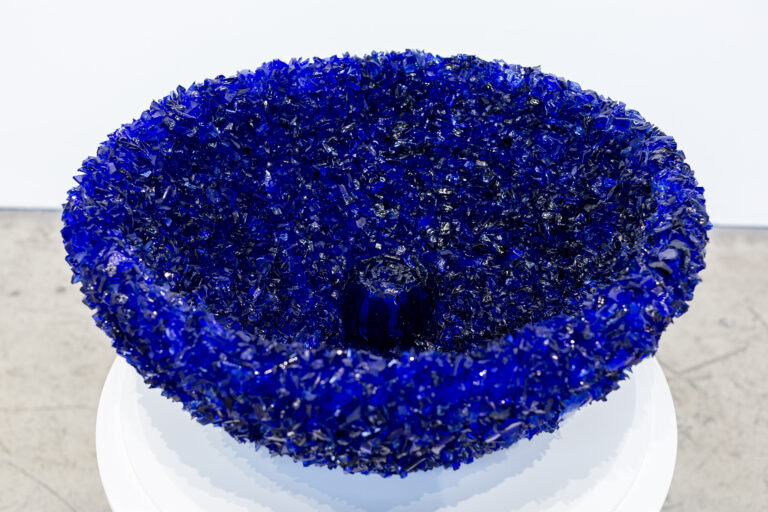
Death imagery is everywhere in this exhibition. An object resembling a house rests on the floor, bristling with crushed cobalt blue glass. It has walls, and a peaked roof, and a chimney, but there is no entrance to this house, and there is no exit. Aha, it’s a coffin. And it’s closed.

Respite by Tim Whiten

The piece below is a corn broom, coated in glittering, blue light. It’s a humble object, possibly once owned, used and touched by a departed presence and now, elevated to the status of a spiritual relic, a tangible memorial.

One, One, One (3) by Tim Whiten

The cobalt blue that Tim Whiten uses throughout the show is deep and radiant.
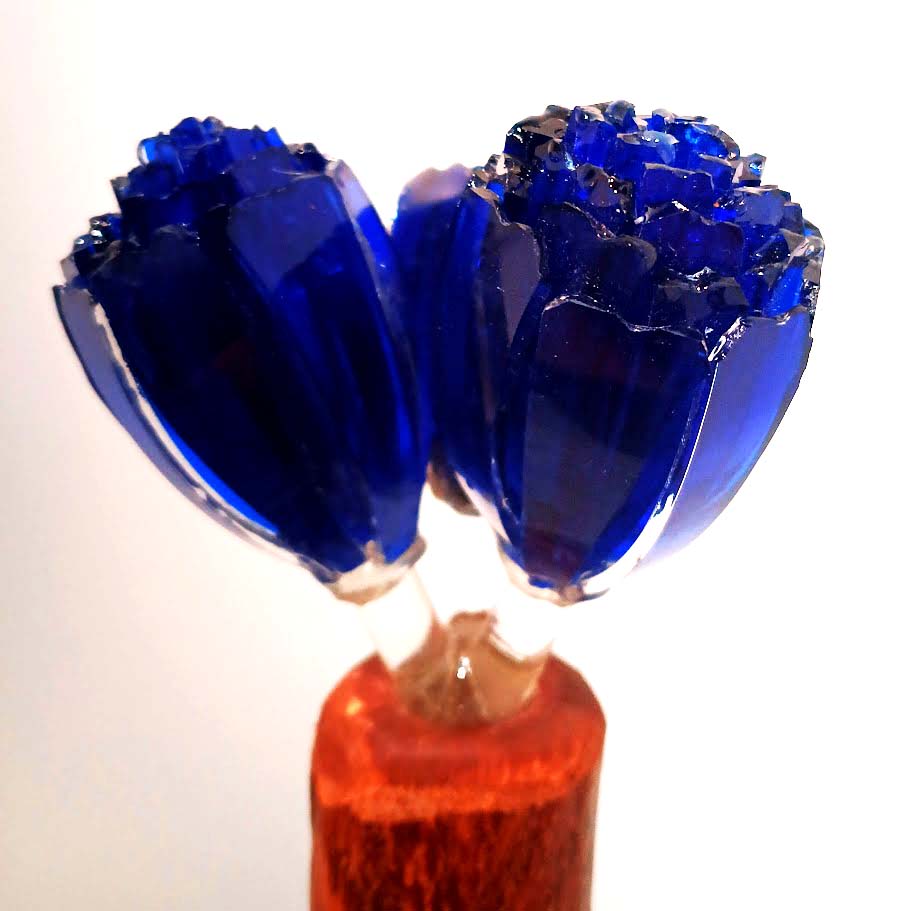
Detail of Stave by Tim Whiten

In many cultures, deep blue, has significance. The Turkish Nazar Boncugu (Evil Eye amulet), for example, is a talisman that can protect against evil spirits.

 The nazar boncuğu is most often used in a glass bead that is pinned on the clothing of children or hung on walls of buildings or inside of cars or other possessions to protect them.

In Catholic churches the Virgin Mary is depicted in blue glass as the pure and tranquil “light of heaven.”

The Virgin Mary in the stained glass window at Chartres Cathedral

In Africa, deep blue glass was used to mark graves. Enslaved people brought this tradition to the United States.

“When African slaves arrived in the U.S., they created bottle trees from dead trees or large limbs next to their quarters and adorned them with glass bottles scavenged from garbage piles,” Doreen Howard wrote on Almanac.com. “Blue bottles were coveted, because they repelled evil and trapped night spirits to be destroyed by the rising sun. Many Milk of Magnesia bottles ended up on trees!”

“The Southern Legend of Blue Window Panes” by KellyKazek.com
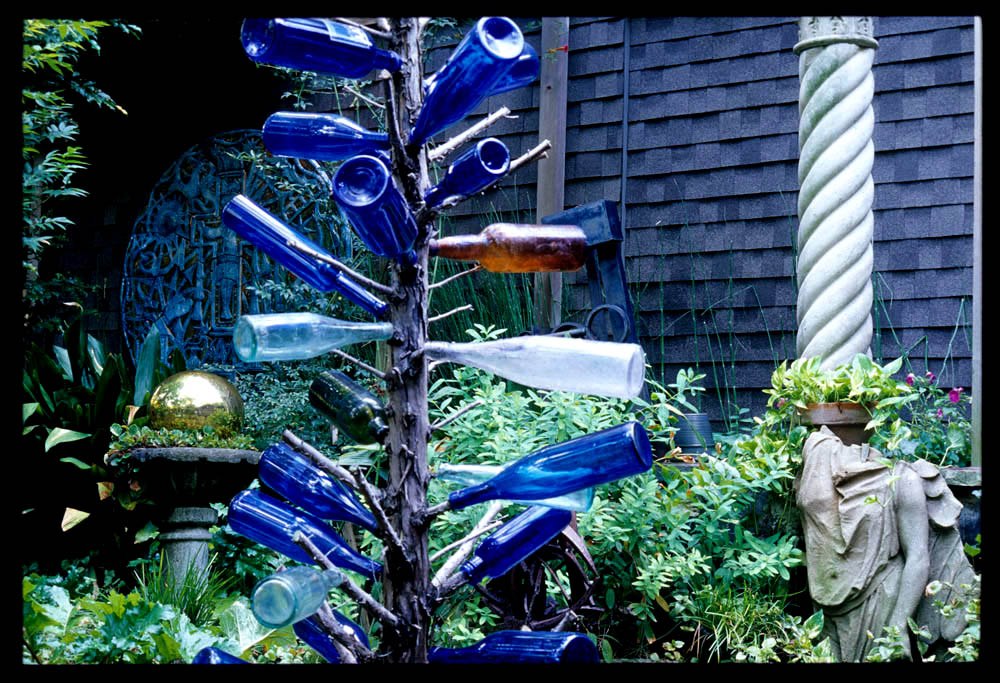
Bottle trees are used to honor the dead, with blue bottles capturing the energy and memories of ancestors in a beautiful and meaningful way.

Blue is also linked to deep meditation, spiritual awakening, and a connection with higher realms. And, in this show, the objects and the sizzling blue, not only refer to death and decay. They also provide an escape to the infinite, manifest in portals, flying carpets, spiritual secrets, and meditative drawings.

A twisted spiral staircase leads to another house. This one is an exquisite, etched glass temple It has a slightly open door. It is nearly vibrating with vivid blue light.
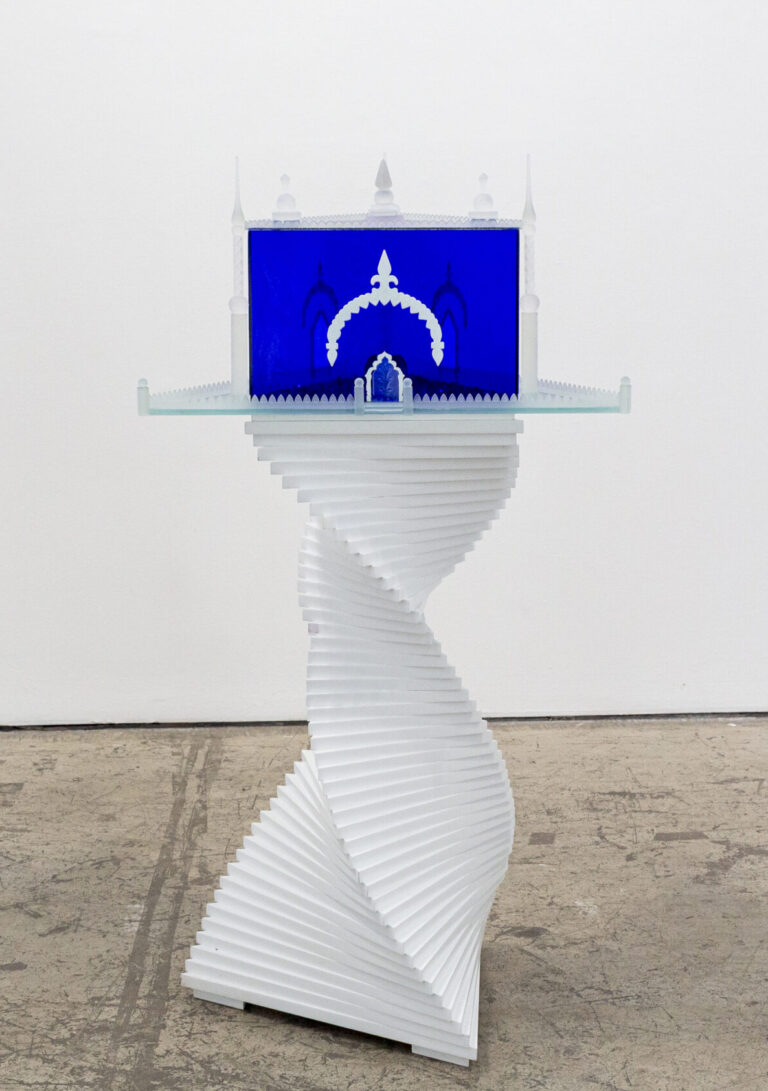
Spirit House by Tim Whiten
Detail of “Spirit House” by Tim Whiten

The shape of a book is composed of milky, etched glass, and within is cobalt coloured glass. So maybe the blue glass is knowledge and knowledge is light?

Book of Light II by Tim Whiten

I was informed that Tim Whiten chooses not to call himself an artist. He identifies as a maker of cultural objects. I’m not sure what the difference is. To me, the obsessive exploration and experimention, and the unique and beautiful objects he creates, are very much in line with notions of the contemporary artist.

Some of the drawings make me think of Process Art from the 1960s and 70s. Just picturing how they had to be made makes me nervous. Tim Whiten would have to be walking a meditative tightrope to create these flawless images.

Saying His Name, Beyond Fire, Water, Cloud-All, Portal by Tim Whiten
Saying His Name, Harmonics II by Tim Whiten

One of my favourite pieces in the show is displayed on the floor, like a colourful, molten carpet. But it’s not quite flat on the floor. It is slightly elevated and arrayed as a very subtle S-curve. Yes, it appears to be flying!
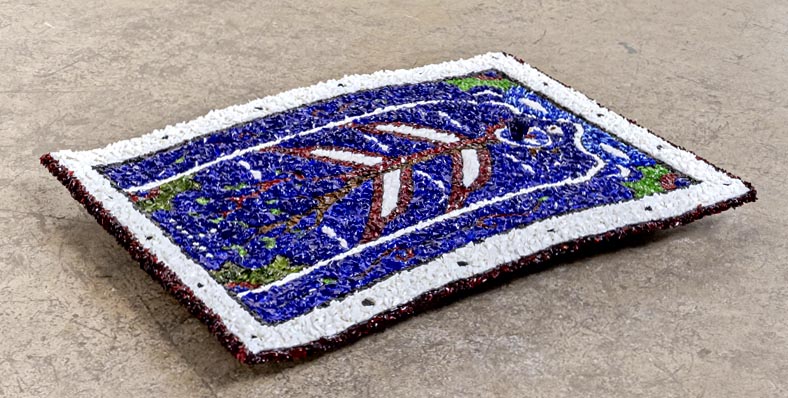
Search Reach Release by Tim Whiten

June 11, 2025

Report from New York

Jack Whitten: The Messenger

The towering 53rd Street Atrium of the Museum of Modern Art seemed less crowded than during prior visits.  The galleries less packed with frantic visitors.  In fact, the streets themselves seemed less grid-locked and less raucous.  Maybe it’s the “congestion pricing” impact?  Or maybe it’s the policies of the current Administration?

Whatever the reason for the relative tranquillity, it was truly uplifting to wander through the show called Jack Whitten: The Messenger without feeling jostled, and to appreciate the achievements of this artist and more broadly, the achievements of so many American artists, caught now — like the rest of us –in this period of fear and dismay.

 “Black Monolith II (Homage to Ralph Ellison The Invisible Man),” by Jack Whitten

“Acryclic, onion, eggshell, molasses, copper, salt, herbs, rust, coal, ash, chocolate and razor blade.” These are a list of the substances Jack Whitten used to create the painting “Black Monolith II (Homage to Ralph Ellison The Invisible Man”), shown above. The painting, and many others of this period, is composed of hundreds of tiles, cut from sheets of dried acryclic embedded with varied ingredients and assembled into a painting. Jack Whitten called this invented technique “acrylic tesserae.” “Each tesserae is a piece of light,” he said, “The message is coded into the process.”

A lush jazz soundtrack (John Coltrane, Miles Davis and Thelonious Monk and others) plays throughout the show’s galleries, referencing Jack Whitten‘s love of jazz.

Installation view “Jack Whitten: The Messenger” at the Museum of Modern Art

Many of the tributes and dedications he attached to his work honor the black musicians, writers and artists that impacted him during his six decades of living in New York City and making art, which he invariably viewed as experimental.

“Homecoming for Miles Davis” by Jack Whitten
Closer detail of “Homecoming for Miles Davis” by Jack Whitten

Shown above, “Homecoming for Miles Davis” was also made of hardened acrylic tiles, which in this case he spattered with white paint, a la Jackson Pollock, and put together into this dazzling painting, described by the artist as a “cosmic net attempting to capture Miles’ soul.”

“Atopolis: for Eduourd Glissant” by Jack Whitten
Detail of “Atopolis: for Édouard Glissant” by Jack Whitten

The tiles in the painting shown above, named for Édouard Glissant, the French writer, poet, philosopher, and literary critic from Martinique, were infused with metallic, phosporescent and organic materials from aluminum to anthracite.

Repeatedly, this artist states he is interested in innovation. He wants to make abstract art that changes the course of painting.

Trained as a cabinet maker, Jack Whitten, made specialized tools to apply paint. He painted standing up for decades, smoothing paint in layers with a rake-like tool which is on display at the Museum.

Tool used by Jack Whitten to paint
Jack Whitten at work in Studio in the 1970s, using “The Developer”

He called the rake-like tool “The Developer.” He added layer upon layer of paint, raking and merging the color until he had the effect he wanted, which was “sheets of light.”

“Tripping” by Jack Whitten

The photograph above doesn’t convey the startling, glowing, gem-like quality that some of Jack Whitten’s paintings hold. He “combed” the layers of paint to create colours found nowhere else and experimented like an alchemist, adding  recycled glass, pulverized mylar, gold dust and numerous other substances to the paint to get the effect he was after.

In some paintings, the artist would bury items into the gallons of paint he poured onto wood panels. These items — bits of wire or wood, staples, insects, floor sweepings — he called “Disruptors,” since through the raking process they disrupted the smoothed surface to reveal transformations below.

Installation view of “Siberian Salt Grinder” by Jack Whitten
Detail of “Siberian Salt Grinder” by Jack Whitten

I couldn’t help thinking about the giant squeegee paintings by Gerhard Richter. Like Jack Whitten, Gerhard Richter explored the relationship between painting and ph0tography in his earlier works. Later, the element of unpredictability was major in both of these artist’s big beautiful paintings of sweeping horizontals.

“Abstract Painting (726)” by Gerhard Richter

Political turmoil was a factor in the creative development of both men. Gerhard Richter was born in 1932 in Dresden, Germany, into the mayhem of WWII and its aftermath. Jack Whitten was born in 1939 in Bessemer, Alabama, at the height of Jim Crow. He grew up in Civil Rights movement and the era of political assasinations in the USA and, of course, the Vietnam War.

“Black Table Setting (Homage to Duke Ellington)” by Jack Whitten

I particularly liked looking at Jack Whitten’s paintings of screens, or screen-like images.

“Khee II” by Jack Whitten

The painting above is part of his Greek Alphabet Series. It has a mysterious quality of movement, as remote images seem to shift and rearrange themselves from within, like poor reception in an analog TV screen.

“Gamma Group I” by Jack Whitten

Jack Whitten said every colour carries ” a lot of psychological meaning” and he sought to avoid the “story telling” that automatically occured by using colour. His black and white paintings from the Greek Alphabet series of paintings, resemble a flickering screen, dissolving into abstraction.

I say to people, “Take everything you have ever felt, everything you have ever smelled, every sound you have ever heard, every sensation you have ever had that you have felt through your fingertips. Take all of that and compress it.” You would get an understanding of abstraction. – quote from Jack Whitten in the MOMA exhibition notes.

His sculptural work, on the other hand, tells a lot of stories:

Sculptural works by Jack Whitten

…stories about the African diaspora, the history of art in the Mediterranean, trash and found junk, labour and work and many other topics.

Some of his paintings too, are depictions of fragments of a changing world. His painting shown below, which suggests apps on a screen, was made in honour of Obama’s election.

“Apps for Obama” by Jack Whitten

The showstopper, however, for many of the New Yorkers on that relatively quiet day at the Museum of Modern Art, has to be the painting titled “9.11.01.” Jack Whitten witnessed the World Trade Center’s destruction and produced an enormous painting in honour of the victim’s of that event.

“9.11.01” by Jack Whitten
Detail of “9.11.01” by Jack Whitten

I spent some very somber moments in front of this painting, recalling not just the appalling catastrophe of that moment, but the following days and months, when the country, and indeed much of the world, was so unified in the shared shock and horror at that violent act. It seems like a long time ago.

March 19, 2025

Yann Pocreau “The Lapse in Between” at Division Gallery

Yann Pocreau is a photographer who is not really into taking pictures. In his show at the Blouin Division Gallery, he seems so over it: the pointing and clicking to capture a moment in time. In fact, you get the feeling, looking at much of the work of Yann Pocreau, that he has decided there are more than enough photographs in this world.

“A Light Shift 01” by Yann Pocreau

Yann Pocreau often uses found imagery — maybe he rummages through boxes of old snaps and negatives at vintage purveyors — and then he adjusts. He crops what he finds, blows it up, prints on reactive surfaces, floods with zones of subtle colour, double exposes, amplifies flaws and creases.

Detail of “les décalages 01-06” by Yann Pocreau

The result is a tension between form and content that hovers insistently in an appealing and unresolved push and pull. The absence of context creates a new kind of object, simultaneously empty and full of meaning. The piece shown above, for example: What is it all about? Are the family members triumphant survivors of Europe in ruins? Or, are they contented boaters on Lake Simcoe, heading to a summer of cottage renovations? Are the embedded brass diagonals defining the creases of a treasured snapshot — carried for years by someone — honoring a single happy moment prior to disaster? Or, are we shown the brass lines to emphasis the powerful, pictorial composition?

Installation view of “les décalages 01-06” by Yann Pocreau

The title of the artworks above is “les décalages.” The word “décalage” means shift. (“Découpage” is something else entirely. Don’t mix it up.) Lacking context, meaning shifts, gaze shifts and attention shifts.

“The found landscapes (stained views” by Yann Pocreau

The “found landscapes” above are washed lightly with a pale sepia. Otherwise, they are basically unaltered. There is a certain nostalgia inspired by these pictures, and an innocence around imagery. They make me think about family rituals of my childhood, where film was developed, following an outing or vacation, and the snapshots — all of them, no matter how banal — were carefully mounted and labeled in a oversized photo album with a thickly padded cover.

“The lapse (the pool)” by Yann Pocreau

No amount of Photoshop editing or Instagram filters could manufacture this pair of images so rich in narrative potential, and embodying the brief summer of adolescence.

“A light shift 05” by Yann Pocreau

Other works are printed on surface so gleaming, slick and metallic that the original image is impossible to discern (as above.)

“Serendipity” by Yann Pocreau

One of the pieces, titled “Serendipity,” above, is composed of six brass plates under plexiglass. Who knew that brass could be so dense and luxurious?

When brass corrodes, it can undergo dezincification, a process in which zinc is lost and copper is left behind. Mild dezincification may simply cause a cosmetic change, namely, the colour of the surface turning from yellow to pink, but severe dezincification can lead to the weakening of brass and even its perforation. 

— Preventing and Treating the Dezincification of Brass – Canadian Conservation Institute (CCI) Notes 9/13

A slight, shifting glimpse of fushia, emanating from the painted backs of the copper plates, is caught in the plexi. Maybe we are being reminded of the potential for dezincification?

Detail of “fantasme colores – tropicalia” by Yann Pocreau

In a small room at the far end of the gallery were some examples of earlier work by Yann Pocreau. In this tropical dreamscape (above) the image content is a set up for the depiction of light and colour, and the evolution of the work of this artist.

Yann Pocreau “Toward the Light” at The Image Center (Toronto Metropolitan University)

In his show at The Image Center Yann Pocreau moves even further away from what we think of as photography and slips into a kind of reverie on light itself. Subjects disappear entirely and only light is captured and admired.

“Entre le bleu la nuit: Cyanotypes exposed with lunar and solar light (9.5 hours and 45 minutes)” by Yann Pocreau

In this composition in shades of blue, Yann Pocreau uses an early percursor to photography: the cyanotype, in which various iron compounds are exposed to light and fixed with water. (Cyanotypes were used to create industrial blueprints up until very recently.)

“Les Plates Aveugle” (The Blind Plates) by Yann Pocreau

“The Blind Plates” is described as an “inkjet print with applied gold leaf.” In this case it seems irrelevant to use photography at all. It could be a minimalist painting. Why not?

Detail of “Reconciliations (Spectrums)” by Yann Pocreau

The image above was printed on silk. It shimmered very slightly when a passing viewer created a nearly imperceptible breeze.

Installation view of “Lumière 01” by Yann Pocreau

The gallery is dark and the sound of an old fashioned slide projector adds an ASMR element to the show. The slides are simply layers of light and go to the heart of this dreamlike exhibition. I really wished there was somewhere to take a nap in the deserted space.

Detail of “Les Impermanents” by Yann Pocreau

A installation of “pierced cabinet cards” arrayed on an extended light table is another large piece at The Image Center exhibition.

According to Wikipedia “The cabinet card was a style of photograph that was widely used for photographic portraiture after 1870.”

These fascinating cards — pictures of individuals who lived over a hundred years ago, posed with grave formality — have been pierced to display images of stellar constellations, shining through the paper in the darkened gallery. Poetic and empathetic, this piece connects on many levels.

Yann Pocreau explains it best:

My journey over the last few years has been punctuated by exhibitions whose driving force is cosmic vertigo, this new relationship to the world and its phenomena, from the Universe to the center of the Earth. Between a simple dialogue with science, with a certain existentialism, I think and produce projects that attempt to address the macro and micro links that shape and design our environment, our way of understanding it.

— Yann Pocreau

November 20, 2024

It was surprising to find myself entirely alone in the the center of one of the world’s largest cities. There were a few birds chirping and in the distance a security guard was eating his lunch, but otherwise, the sculpture garden at the Museo de Arte Moderno in Mexico City’s Chapultepec Park, was entirely deserted.

Bougainvillea growing along the fence surrounding the sculpture garden.

This sculpture garden functions as a repository of historical works. It also includes some contemporary pieces.

Detail of “Ovi” by Hersúa
“Ovi” by Hersúa, gives the impression it will topple over at any second.

Hersúa, also known as Manuel Hernández Suárez, made this piece, above, in 1986. It seems that all around the world, modernist sculpture of a certain period, had a similar look. 1986 was long before the Internet flashed every damn thing to every corner of the globe, and yet, this piece could have been shown in Toronto or New York or Mexico City at the same time. Clearly, artists are open-minded and responsive to the zeitgeist.

Richard Serra had a huge show at the Museum of Modern Art in 1986 and looking at those long ago installation pictures made me think of the piece by Hersúa.

Installation view of Richard Serra show at MOMA 1986

Whether in Mexico or New York, it takes a lot of confidence to make giant, perilously balanced artworks, out of cement or cast iron.

“El Corazon Sangrante (The Bleeding Heart)” by Fernando González-Gortázar

I really liked being the only viewer of this artwork by Fernando González-Gortázar, who died a couple years ago. He was an important architect in Mexico. This piece, in the midst of the tranquil park, the surroundings littered with dry, dusty leaves, was so vivid and lively … and so extremely red.

“La Gran Puerta (The Big Gate)” by Fernando González-Gortázar

The artwork above, also by Fernando González-Gortázar, is an enormous gate to a park in Guadalajara, made in 1969.

“El Barco Mexico 68” by Manuel Felguérez
Detail of “El Barco Mexico 68” by Manuel Felguérez

I did not know about the Mexican post war art movment that broke away from the realism of Diego Rivera and his crowd. It was called the Generación de la Ruptura and Manuel Felguérez was part of it. According to Manuel Felguérez the idea was to make Mexican art more abstract, and hence, universal.

Two sculptures by Manuel Felguérez: “Puerto 1808” and “El Cabillito” in the background.

Apparently, Manuel Felguérez was supportive of the Cuban Revolution. News of those sympathies reached his few American collectors and any sales he had in the US took a nose dive. I can see the impact of Russian Constructivism in his massive sculpture above, made in honor of the 200th anniversary of Mexico’s independence from Spain. It’s strange to think about how cultural currents flow around the world.

“Tunel Plegado” by Alberto Castro Leñero

This piece, by Alberto Castro Leñero, looks strikingly contemporary. There is a good reason for that. It was created in 2022. It’s a bold, inventive structure, hinting at all kinds of ambiguous subject matter (craft objects, religious iconography, scientific models) and yet, pleasingly, unfixed.

I did find a couple of pieces by Mexican woman artists in the sculpture garden.

“Mujer Sentada (Woman Sits)” by Rosa Castillo

Anything I read about Rosa Castillo first mentions her brother, who was a more well-known and successful artist. Rosa Castillo was born in 1910, in a rural village, and mainly worked as her brother’s helper. This sculpture I found very affecting. All over Mexico City you can women with a similar mein, setting up shop on the sidewalk, making delicious food and keeping the whole place running.

“Mujer reclinada o recostada (Woman reclining or Lying down) by Tosia Malamud

Tosia Malamud arrived in Mexico at age 4 when her family fled the Soviet government in Ukraine. Like Manuel Felguérez, her interests ran counter to the muralist movement which was popular when she graduated from art school. She also found it too nationalistic, and too dominated by men.

She was another Mexican artist who sought a more abstract, universal theme, however, there is something mysteriously circular in the way that pre-Columbian Mexican art influenced her work. The sculpture below, for example, is graceful, semi-abstract and blithly devoid of nationalism.

This is a “Chac mool” figure from Chichen Itza, excavated by Augustus Le Plongeon. It is thought to have first appeared in Mezoamerican in the 9th century.

“Somos Fragmentos (We are Fragments)” by Maribel Portela

This giant purple head by Maribel Portela, another female artist, was really enjoyable to look at and think about. For me, it was a signal: start practising meditation!

“Bosque desnudo (Naked Forest)” by Ricardo Rendon

One of the interesting things about the piece above, is that it is made from the seized trunks of illegally logged trees. Ricardo Rendon, one of the younger artists whose work is included in the garden, states that he is interested in the dematerialization of the object. I can imagine this fragile forest gradually wearing away to nothing in the copious rain, sun and diesal fumes of Mexico City.

“El Temple del Deseo (The temple of desire)” by Kiyoto Ota

This giant solitary breast rising from a gently sloping expanse of dry leaves and grass is a bit unsettling. Kiyoto Ota is presently working on a Uterus series. He decided to visit Mexico in the 1980s. He left his native Japan and never went back.

I passed a few, very pleasant hours in this lovely sculpture garden and I soon found, as I went on wandering around, that sculpture is everywhere in CDMX.

Pre-Columbian….

Pyramid of the Sun at Teotihuacan

…and post.

The Virgin of Guadalupe, the Patron Sain of Mexico

September 22, 2024

Gallery Weekend is Over

Gallery weekend is over. You missed it.

But the glorious weather continues. This has been a September filled with perfect moments of honey coloured light, warm and caressing sunshine spreading long shadows across beautiful late afternoons, floral displays, sumptuous and extravagant, lingering on toward that perfect, pivot moment where they edge into autumnal decay and death. Everything more cherished and more precious, because we all know how quickly, and how soon, it will end.

September 2024

Gallery Weekend took place from the 19th to the 22nd September.

Gallery Weekend is run by an organization known as the Contemporary Art Galleries Association (AGAC). It’s mandate is to develop the recognition and prosperity of the contemporary art market in Canada. Laudible!

Thanks to Gallery Weekend I was directed to some spaces unfamiliar to me: Franz Kafka, Zalucky Contemporary and many more, are all on the Gallery Weekend map.

Franz Kafka – Jennifer Carvalho – “Ghost”

The address for Franz Kafka is 1485 Dupont, but the entrance is on 300 Campbell, upstairs, down a long, slightly Kafkaesque hallway.

Jennifer Carvalho‘s exhibition, called Ghost, is somber, ethereal and strangely timely.

Oil painting by Jennifer Carvalho

The gestures and expressions are so familiar from art history survey courses, maybe referencing Flemish painting from the 15th century, maybe Italian Rennaissance or possibly a combination of influences from these and other distant schools of art.

It must be the depictions of grief, particularly female grief, that makes the paintings so affecting. They are in low key colours, dull greys, rusting reds, dim blues and pale, watery flesh tones. Even the images of jewels are muted.

From gold to brush (study of optics and splendour) by Jennifer Carvahlo

Are ghosts not reminders for the living as to who has been lost? Haunting dark corners to prove they once held court here, too. They remind us of their presence, with a shell of their past power.”

– Marlow Granados, from a handout at Jennifer Carvalho’s exhibition “Ghost”

I appreciated the stillness and meditative quality of this exhibition. The artist’s concerns are with images emerging from the past. It’s as if she is presenting a window into another set of priorities. With a fixed and sober gaze, we see the past and are invited to contemplate how it led to the present.

An archive of gestures (hands and architecture with domestic interior) by Jennifer Carvalho

Zalucky Contemporary – Tyshan Wright – “Gumbe”

A little further west, on Dundas, in The Junction, is Zalucky Contemporary and an exhibition by Tyshan Wright.

Tyshan Wright is an artist who also probes the past. But in his case he locates his own ancestry and celebrates and explores those connections.

Artwork by Tyshan Wright

The artist is a descendant of the Maroons of Jamaica. Composed of African populations originally brought to the New World by the Spanish, most Maroon communities, in the smaller Caribbean Islands, disappeared by the early 1700s. But in Jamaica, the Maroons are, to this day, largely autonomous and separate from Jamaican society.

Examples of the gumbe, exhibited by the National Museum Jamaica

The story of how the gumbe, which is a drum, was created in Jamaican Maroon communities, and went on to became important in the music of Sierra Leone and other west African countries, is so interesting. One element of this story is the forced migration of more than 500 Jamaican Maroons to Halifax in 1796. Most did not stay. In fact, they moved back across the wide ocean to settle mainly in Freetown, and they brought their music with them.

Artwork by Tishan Wright

Tyshan Wright uses materials from Jamaica, Nova Scotia and the African diaspora to construct these beautiful objects. He notes they function as “diasporic talismans,” providing spiritual sustenance to the Maroon people through their centuries of displacement.

You can watch a mash-up reel of gumbe music here:

It was a memorable afternoon.

May 26, 2024

Ghosts of Canoe Lake: Marcel Dzama at the McMichael Gallery

As a repository of Canadiana in all its splendour, the McMichael Gallery in Kleinburg does not disappoint. Sited within 100 acres of majestic forests, the gallery building — with its log and barn-board walls, massive, rough hewn field-stone fireplaces and floor to ceiling plate-glass — is a treasure trove of Group of Seven artworks.

Weirdly, six members of the Group of Seven are interred on the grounds of the gallery, at the McMichael cemetery.

Wait…One is missing…Where is Tom Thomson?

No one knows. And that mystery is at the heart of the current show by Marcel Dzama. The show’s title, Ghosts of Canoe Lake, refers to Tom Thomson’s disappearance, which occured while he was paddling on Canoe Lake, in 1917.

“Canoe Lake, Sunset” by Tom Thomson

On entering the gallery, a dreamy triptych, filled with colour and wildly imaginative imagery, announces the themes of the exhibition: Tom Thomson himself, his death and subsequent ascendence as the essential Canadian artist; the vividly alive natural world — flooded and on fire — and the strange cast of surreal creatures and characters that reside within it.

“After the Fire Before the Flood” by Marcel Dzama

Detail of “After the Fire Before the Flood” by Marcel Dzama

Marcel Dzama has declared he is “obsessed with Tom Thomson” and that the show is an homage to the artist who died at the age of 39.

Installation by Marcel Dzama

In the center of the Gallery sits a large tent, festooned with oversized polka dots, imagery which Marcel Dzama has been painting for some time.

“The Tent” by Tom Thompson

It really does reference the beautiful little tent that Tom Thomson painted so long ago, when he worked as a Fire Ranger in Algonquin Park. Of course, Marcel Dzama’s tent is a little more circusy, and within, we are presented with another form of the artist’s work: Film.

Installation view of artwork by Marcel Dzama
Still from “To Live on the Moon (For Lorca)” by Marcel Dzama

The film is fun to look at, featuring a whacky plot where Tom Thomson is dispatched and a riotous funeral parade follows. Hillarious, absurdist, Dadaist, surrealist, and yet, like all the paintings and other objects in the show, completely and uniquely Marcel Dzama!

“Aurora Borealis (or a light in the sky like a bat over the land” by Marcel Dzama

Blue and grinning, looming over the show, is a giant what looks like paper mache moon. It’s so familiar! It’s an image that is repeated in multiple forms in the exhibition. It took me a while to figure out it’s reference to the movie “A Trip to the Moon,” made in the year 1902 by Georges Melies.

Installation view of artwork by Marcel Dzama
“To Live on the Moon (for Lorca)” by Marcel Dzama
Still from film by Marcel Dzama

The show is rife with art historical references. Picasso’s dove makes an appearance, frequently the sky’s are painted like the turbulent Starry Night imagery of Van Gogh, birds behave as they do in M.C. Escher’s work, the famous Lawren Harris portrait of his wife Bess is reinterpreted by Marcel Dzama, and, the artist Garcia Lorca has several pieces dedicated to him in this exhibition.

We can not abandon such beauty” by Marcel Dzama

But it is the Group of Seven, and Tom Thomson in particular, that has transfixed the artist. Maybe Tom Thomson represents that longing to be close to the grandeur of the Canadian landscape, a desire that is so often a function of simply dwelling in this part of the world.

And yet, as Marcel Dzama acknowledges, at this juncture, the world is turned upside down. The show is quite somber. War and corruption are everywhere. The seas are rising and the forests are on fire.

“Lady of Fire” by Marcel Dzama

A book, by Guy Maddin, which accompanies the exhibition, contains the following mournful poem.

When painting the evening,
While the world is unease,
The young northern painter,
Painter of trees.
Your evening has ended,
The moon is out low.
Hit your head upon it,
And sleep in the waters below.
That pale horse rider,
Has come here so soon.
When there’s war on the earth,
And blood on the moon.
— Tom’s Blood Moon, 
Marcel Dzama

February 28, 2024

Judy Chicago: HERSTORY at the New Museum, NYC

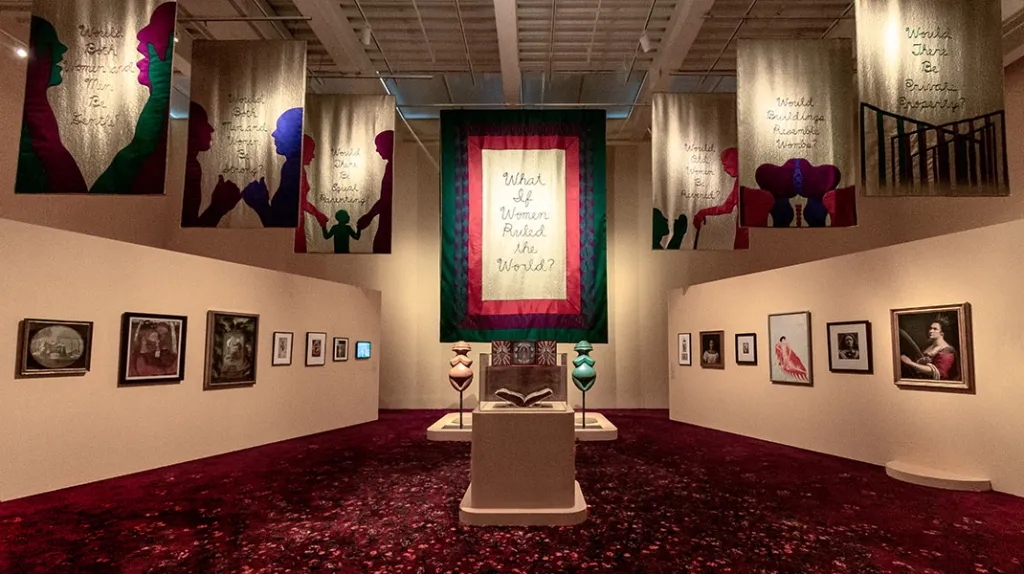
In one of the pieces from her massive retrospective at the New Museum — covering sixty years of art making — Judy Chicago invites us to consider a simple question: What if Women Ruled the World? The responses are compiled in a sprawl of hopeful texts, manifest in needlework, that most feminine of forms.

“There would be no wars.” “The Earth would be saved by humanity instead of being destroyed by it.” “The first step would be to abolish gender norms and deconstruct the entire hetero-patriarchal, racist and classist system that surrounds us.” “Not one mass shooter in the US was female.” “There is no need for violence when we use our hearts.”

In anyone else’s hands this piece might come off as naive or reductive, but there is something about Judy Chicago’s method — what she refers to as “call and response” collaboration — through which she is able to harnass an outpouring of honesty from many participants. The result is that the artwork has a powerful impact. It is urgent and exciting.

Installation view of “What If Women Ruled the World” by Judy Chicago
Detail of “What if Women Ruled the World” by Judy Chicago

This is a big show, going all the way back to painted car hoods Judy Chicago produced in the mid sixties.

Installation view of Herstory by Judy Chicago

And then there were the wonderful smoke performances from the seventies.

Immolation by Judy Chicago

But these early artworks are not the reason for Judy Chicago’s giant retrospective at the New Museum.

“Herstory” will showcase Chicago’s tremendous impact on American art and highlight her critical role as a cultural historian claiming space for women artists previously omitted from the canon.

New Museum description of Judy Chicago: Herstory

It is this role as a cultural historian which Judy Chicago fully inhabits in her artwork called “City of Ladies.” The piece is a show-within-a-show in which nearly ninety artworks by notable women from history are on display.

Installation view “The City of Ladies” by Judy Chicago
Hilma af Klint, Group IX/UW, The dove, no.2 (1915) from “The City of Ladies”
Gluck (Hannah Gluckstein), Portrait of Miss E.M. Craig (1920) from “The City of Ladies”

In an interview about “The City of Ladies” Judy Chicago often mentions a certain “Christine.” It took me a while to figure out she meant Christine de Pizan, who wrote “The Book of the City of Ladies” in 1404. Christine de Pizan lived from 1365 to 1430 and is thought to be the author of some of the very first feminist pieces of literature.

From compendium of Christine de Pizan’s works.
Shows the author lecturing to a group of men. Created in her scriptorium in Paris in 1413.

A brochure provided by the New Museum is a compendium of the women included in the show, and contains a short but detailed biography of each: Hilma af Klint, Claude Cahun, Leonora Carrington, Elizabeth Catlett, Emily Dickinson, Artemisia Gentieschi, Zora Neale Hurston…among many others.

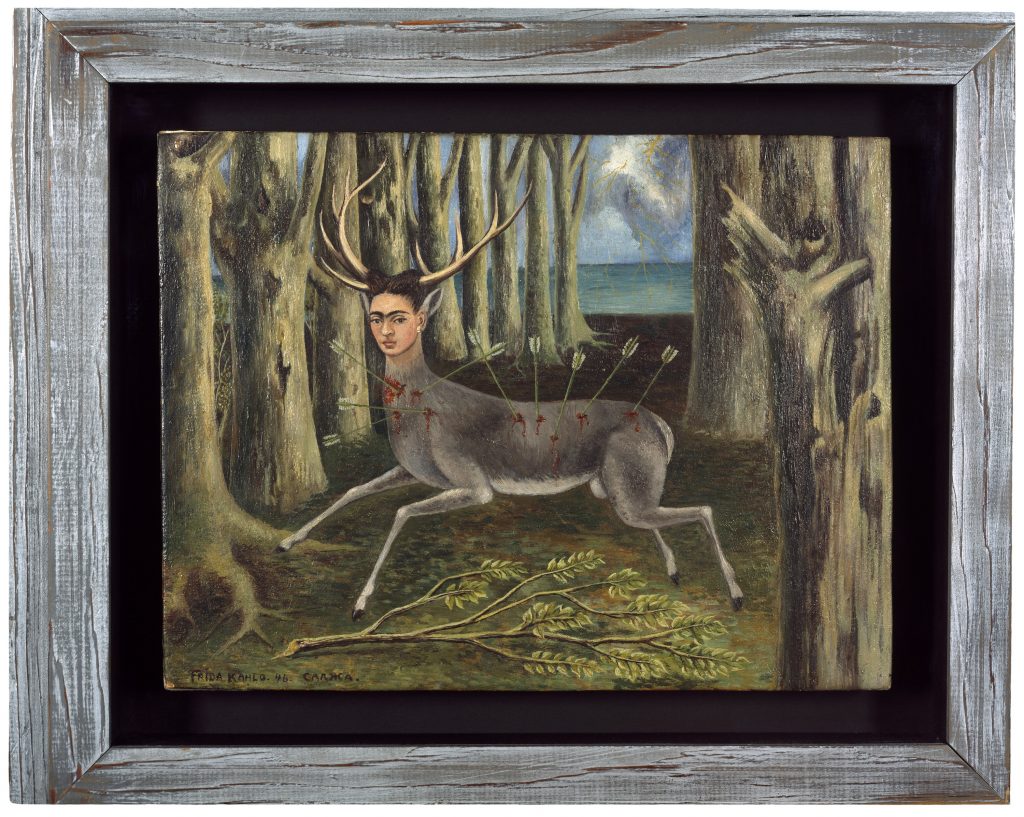
Wounded Deer, by Frida Kahlo (1946) from “The City of Ladies”

As Judy Chicago says: “If you bring Judy Chicago into the museum, you bring women’s history into the museum.”

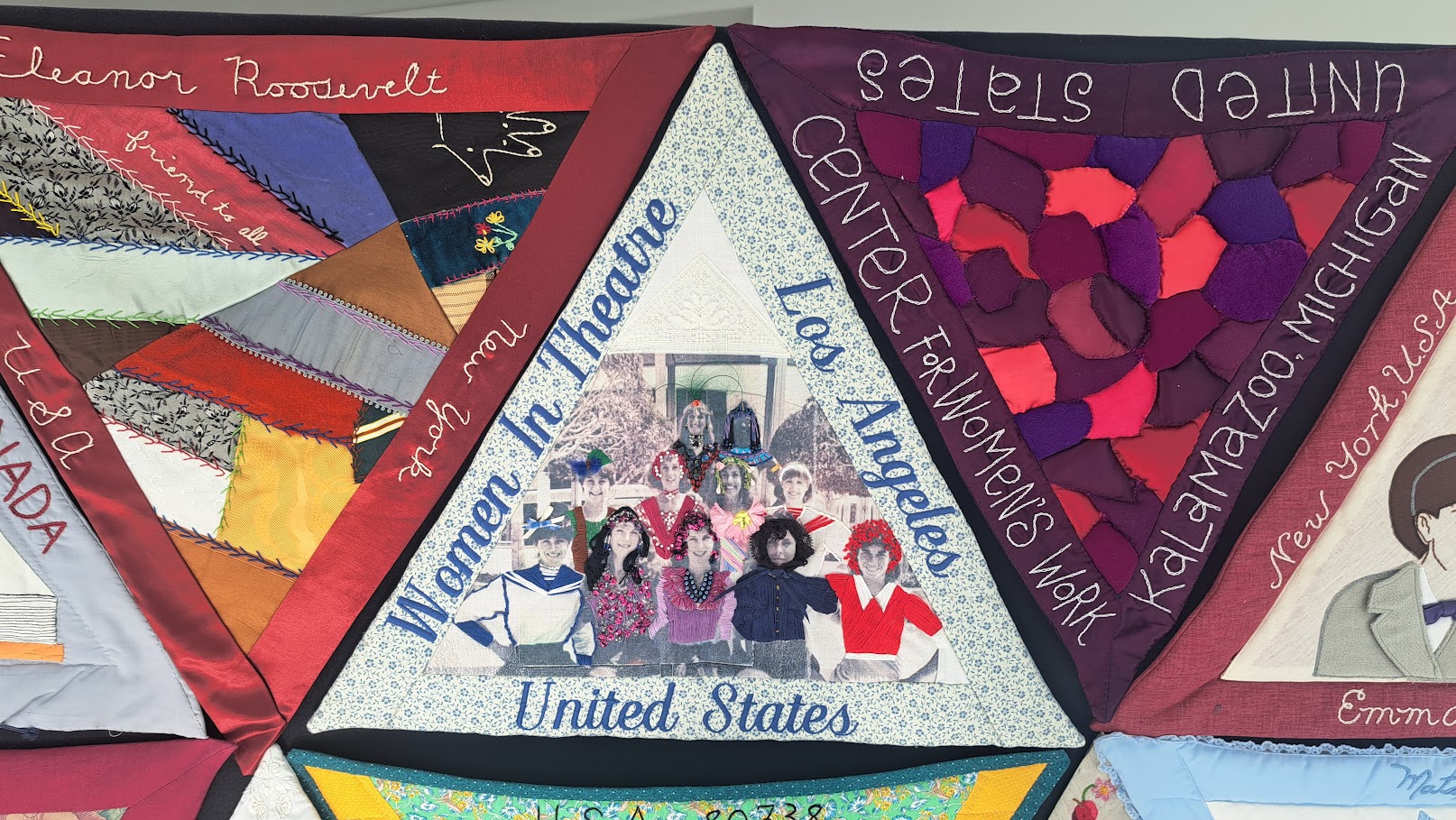
“The International Honor Quilt,” another “call and response” project,  is composed of 539 individual triangular quilts, produced by women from around the world. Each triangle celebrates a woman, a women’s group or a feminist issue, and together they create a joyful depiction of global female solidarity.

Installation view “The International Honor Quilt” by Judy Chicago
Detail of “The International Quilt of Honor” by Judy Chicago

Mostly global icons, like Queen Elizabeth II, are represented, but there are also lots of obscure women’s groups and a few mythological, religious, fictional women make the cut, for example: Deborah, Demeter, Eve, Isis, Nancy Drew, Persephone, Virgin Mary and, weirdly, the Loch Ness Monster.

Depiction of Nessie

Parts of the show seem too binary. Are all women good because they can give birth and all men are evil warmongers? That part of the show — despite the beauty of the massive collaborative tapestries — struck me as an illustration of the limits of second wave feminism.

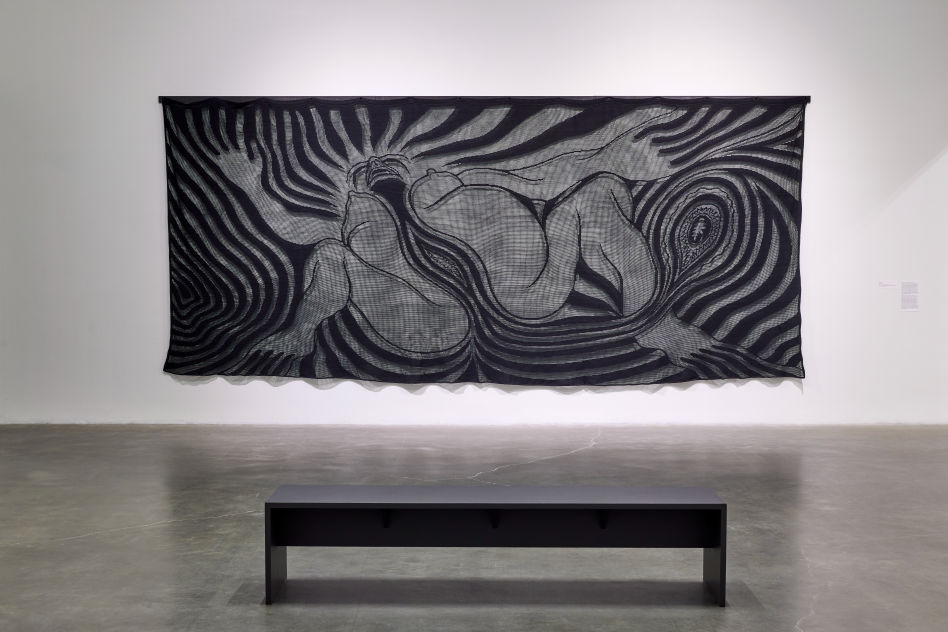
Tapestry by Judy Chicago

I prefered looking at her most recent work, where she meditates on death and the climate crisis.

Artwork by Judy Chicago

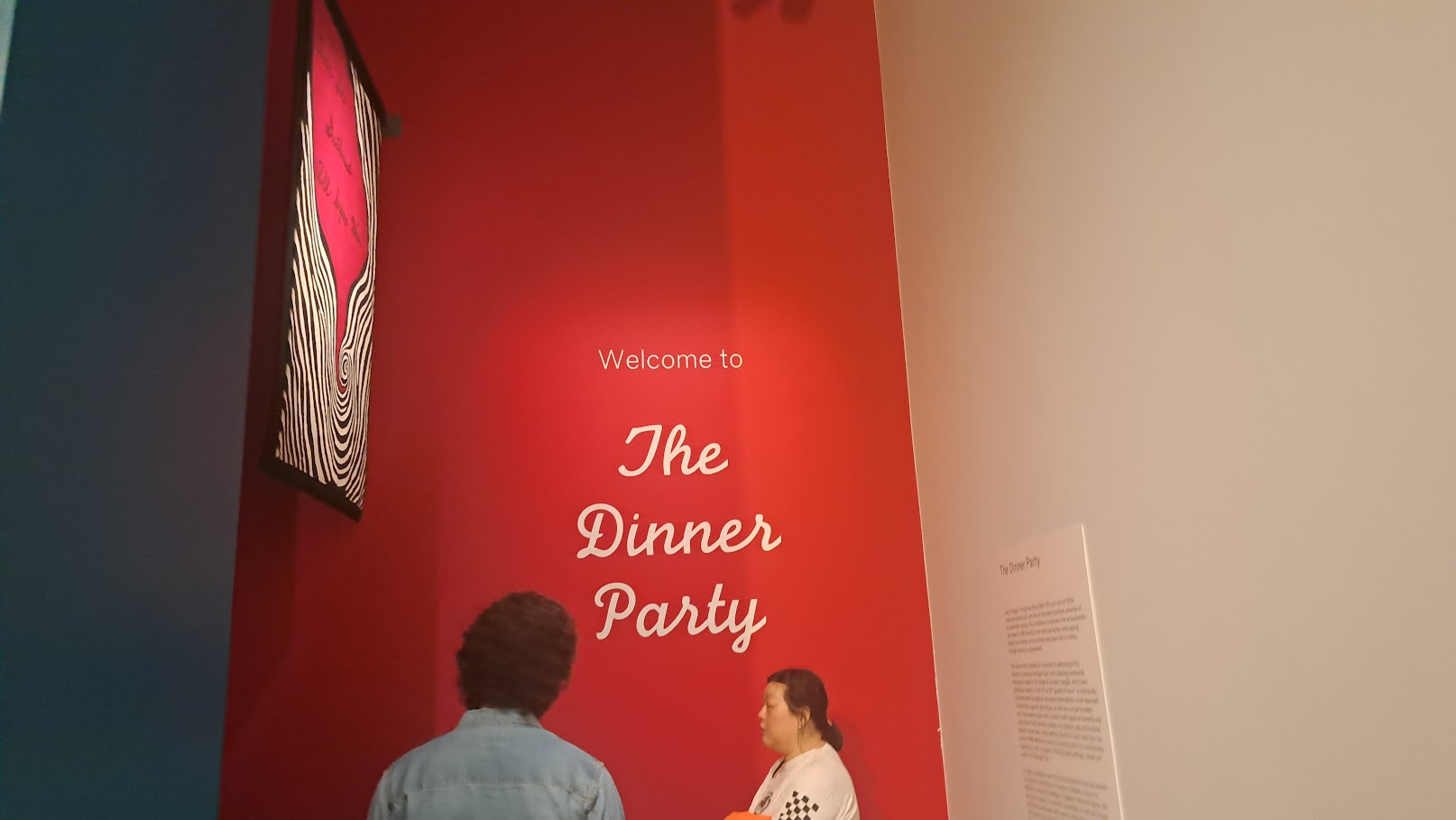
But wait, the big thing, the thing I heard about for decades, the thing that defines Judy Chicago — “The Dinner Party” — was not there. It was a ghostly presence throughout, constantly referenced, but absent.

I was obliged to journey to Brooklyn, change to the 2/3 at Hoyt, past Grand Army Plaza and The Botanic Gardens, onward, to Eastern Parkway and the stately Brooklyn Museum, where Judy Chicago’s famous work is permanently lodged.

Entrance to “The Dinner Party” by Judy Chicago at the Brookly Museum

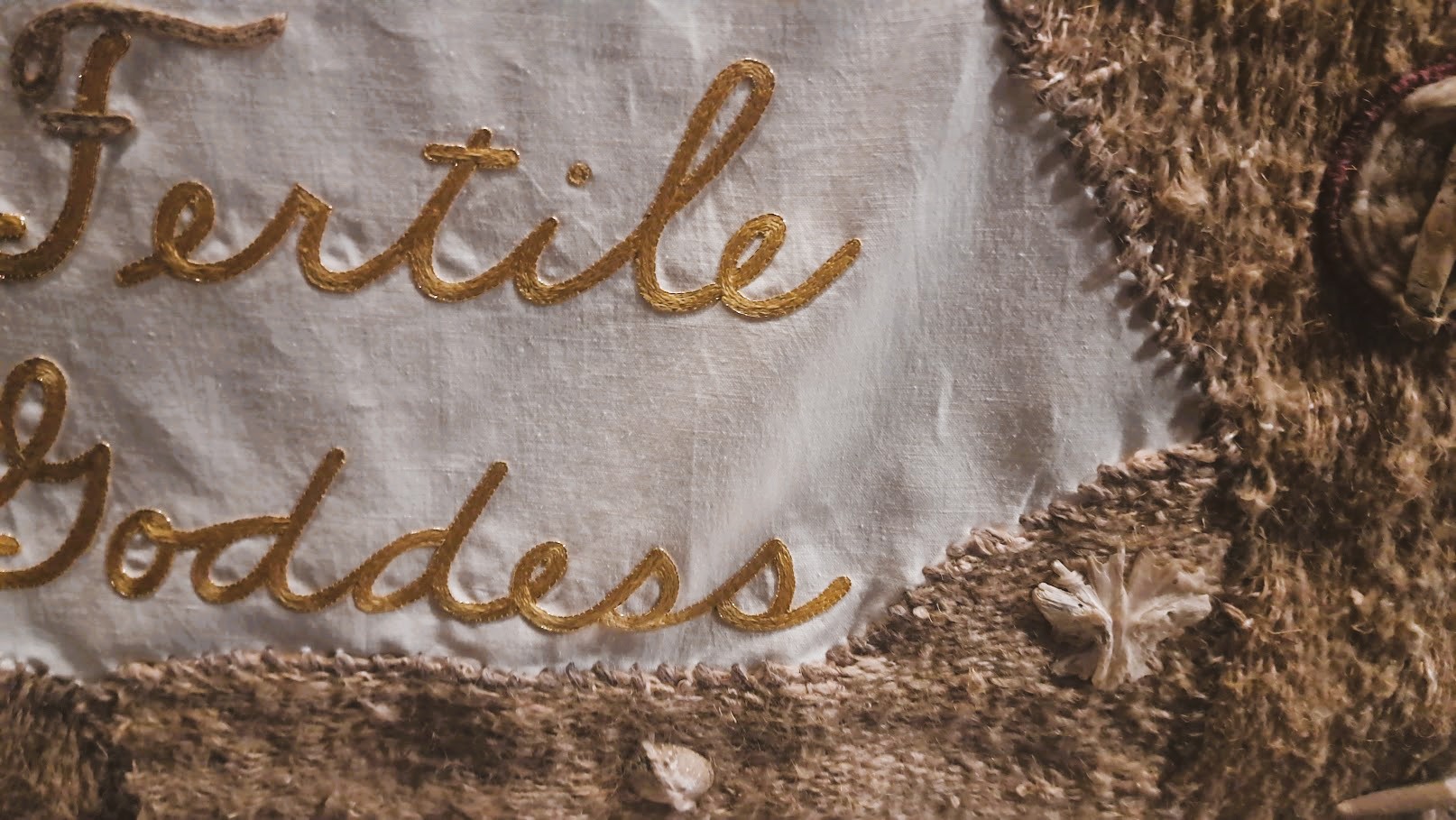
“The Dinner Party” by Judy Chicago
Detail of “The Dinner Party” by Judy Chicago

It was a long trip, but it was worth it.

September 18, 2023

Liz Magor at MOCA: “The Separation”

What about all the forgotten items? What about the stacks of coffee lids, the candy wrappers, the plastic bags in soft pastels, the crenillated foil cups, and sparkly bits of paper stuffed in a gift bags, the trays — presenting so many things! — artfully coated in silver or gold? What about the big gulp holders — the really big ones — with plastic straws poking out the top? What about the hard — infuriating, practically unbreakable — plastic encasements for purchased items? What about the cigarette butts, the liquor bottles, the beer cans, the unwanted toys, empty bottles, scattered gravel, moldy cookies, moth eaten blankets, matted fake fur, dead animals, shells, gum, junk, garbage, trash?

We’re talking about the metier of Liz Magor, in her exhibition titled The Separation, on view at MOCA.

On entering the exhibition the viewer is faced with an expanse of shiny, hard mylar boxes. The boxes are brightly lit from above. They sparkle. They attract.

Installation view of “The Separation” by Liz Magor

The lighting fixtures are kind of hilarious and create a bit of a fun house atmosphere.

Details of installation by Liz Magor

I wander through the box array, anticipating. I don’t know what exactly — but something — something that is going to be exciting, in some way. And that is where everything starts to slow down.

Detail of installation “The Separation” by Liz Magor

Liz Magor presents the material that slips by us moment to moment, all the stuff that we ignore. As she does that, we are obliged to consider a lot of things, but mostly transience and permanence, and, as strange as it may sound, the whole idea of time rushing by.

Detail of installation “The Separation” by Liz Magor

Many of her sculptures, protected in their big, clear boxes, are casts of the original objects they represent. They are facsimiles, removed from their original function, context and incidental narrative, to exist in another realm altogether. Maybe that’s what she is referring to in the exhibition title (“The Separation.”) She has removed these bits of our material lives and “separated” them from their predictable stream of existence.

Artwork by Liz Magor
Art work by Liz Magor

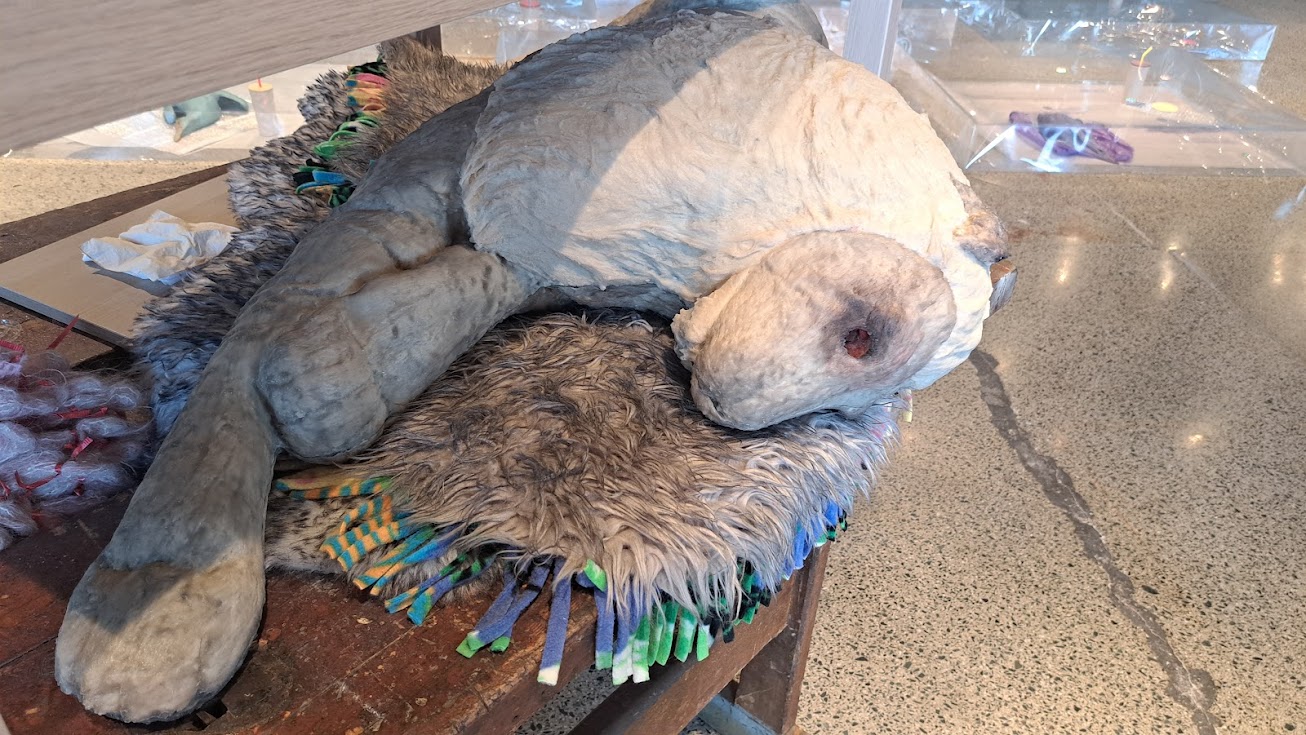
There are a few structures on the pheriphery, — hammered together Ikea and antique, worn work tables — holding cast sculptures of stuffed (or sometimes just dead) animals, lying in sympathetic poses, insisting on our attention.

Art work by Liz Magor

(In fact, I may have won this lion creature, above. It was some years ago, at the ex, prior to the pandemic. Yes, it was a shooting game! Oh god, look at him now.)

Artwork by Liz Magor
Details of sculpture by Liz Magor
Artwork by Liz Magor

There are lots of video’s online featuring Liz Magor talking about her work. She has a very calm, amused presence, although she always seems to be talking about being a “worrier.”

Something I got from watching one of the videos is her connection to minimalism. She is drawing our attention to particular objects. Don’t start looking for some allegory, metaphor or moral. She’s not hectoring us about being consumers, urging us the Save the Whales, or read Wittgenstein. She’s all about: “What you see is what you see,” as Frank Stella famously said.

The videos are worthwhile. I definitely liked watching her make stuff and talk about her interest in death.

Liz Magor at Susan Hobbs: “Style”

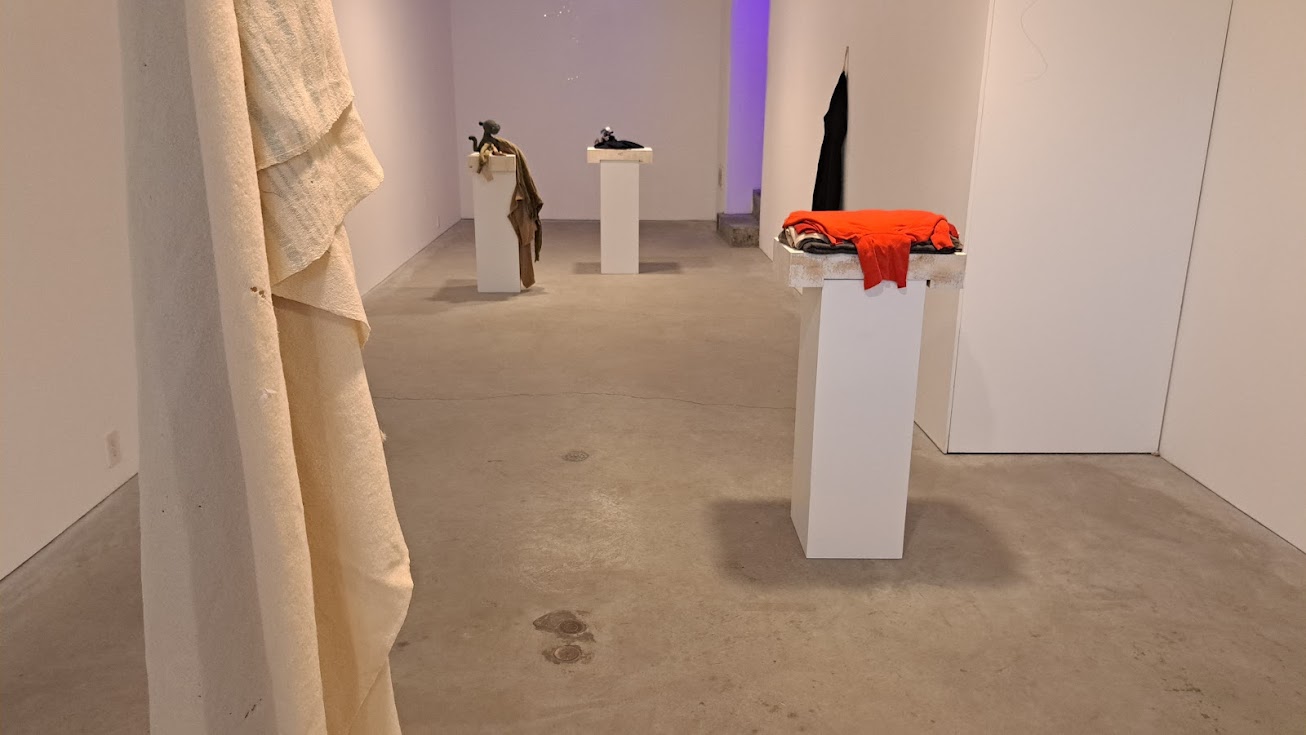
More work by Liz Magor can be seen at Susan Hobbs. The show, titled “Style,” is really beautiful and concise, comprised mainly of clothes slightly eaten by moths. Found objects — mostly stuffed animals, also possibly moth eaten — attend the garments, embrace them and present them for our viewing.

Sculpture by Liz Magor
Installation view of Liz Magor show “Style” at Susan Hobbs

The gallery has helpfully provided some instructions on dealing with moths. I know from experience this has been a problem over the past few years in my Toronto neighborhood.

Clean your closet, combine sunlight with vigorous brushing, heat-treat woollen items in an oven set to the lowest heat, freezing (but only if the change from warm to cold is abrupt) for at least 72 hours, hide the rest of your clothes in compression bags. In executing some of the solutions above, the garment is stripped of its function and tended to as an object that needs our intervention. Our attempt to fix the problem only adds to our conception that we hold control, but all things have a lifespan with and without us.

from Susanhobbs.com
Details of sculpture by Liz Magor

The artwork of Liz Magor strikes me as so efficient! As in “The Separation” at MOCA, in viewing “Style” we are obliged to consider the limits of our possessions, the past and future of our prized wearable items, and so too of our own limits. Hmmmm.

Sculpture by Liz Magor

March 26, 2023

MOCA/NOT MOCCA

MOCA is the Museum of Contemporary Art Toronto. It was, previously, the Museum of Contemporary Canadian Art (MOCCA), located for more than 12 years on once trendy (now pandemic battered) Queen Street West. Going back further, MOCCA was founded on the Art Gallery of North York, which originated in 1999. MOCCA went dormant from 2015 to 2018 after which time it emerged as MOCA, at 158 Sterling Road, in a former auto parts factory, and there, it identified itself with the globalized world of the 21st century.

MOCA, Museum of Contemporary Art, Toronto

Remediation – Kapwani Kiwanga

Kapwani Kiwanga‘s exhibition at MOCA, (see above) titled “Remediation,” is original, playful, uplifting to visit and a breath of fresh air. (This is something we desperately need as spring is so far not arriving.)

Installation view of “Remediation” exhibition by Kapwani Kiwanga

The botanical world has a role in most of the pieces in this show. In fact, one definition of remediation is a way to cleanse soil of toxins, specifically using plant life.

The large, see-through, feather-light, air-filled shapes the artist created are also about plants. She calls them vivariums. I was informed that Kapwani Kiwanga is referencing vivariums in their historical role, as methods to transport life, particularly plant life, from one place to another. This could be a metaphor with all kinds of ominous connotations, but the thing about this artist’s work is that it’s not heavy-handed/didactic. The visitor can just enjoy looking at these strange and surprising objects amid the ponderous concrete pillars that dominate the second floor at MOCA.

One of Kapwani Kiwanga’s Vivariums
Installation view of Vivarium by Kapwani Kiwanga. The variums are named as follows: Vivarium: Cytomixis, Vivarium: Adventitious, Vivarium: Apomixis. The names reference botanical anatomy.

 Originally The Vivarium, I learned on Wikipedia, was the name for the enclosures where ancient Romans kept living things used in their entertainments. Various wild animals, mainly imported from Africa and the Middle East, like tigers, crocodiles, ostriches, elephants and aurochs waited in The Vivarium for their cue. Gladiators waited elsewhere.

“The Marias” installation view of work by Kapwani Kiwanga
Detail of The Maria by Kapwani Kiwanga

This artist doesn’t flinch from using a range of materials in her work. These delicate paper flowers — the piece is called “The Marias” — are surrounded by dazzling yellow plinths and walls. They’re pretty enough, but the artist has created them because of their unique properties and historical function.

…the flower on show, native to Latin America, was known by the locals for its abortive powers. The chemicals in the flower were used by enslaved women to break the reproduction of servitude.

from “Remedition” exhibition booklet

On the main floor of MOCA Kapwani Kiwanga has produced a massive installation composed almost entirely of sisal. She has said that she “considers how various natural materials become witnesses to history. ” Sisal, for example, played a big economic role in Tanzania. When the prices plummeted because of synthetic immitations, the country suffered.

Art work by Kapwani Kiwanga

The material, in the form in which the artist uses it, has a fascinating colour, texture and the unique, undulating lightness which the artist uses to create artfully draped, other-worldly environments. It’s so hard to refrain from touching it!

Sisal recently rebounded on the world markets. The roll above is availabe at Canadian Tire for about $5.00

A video piece included in the show, was shot in Tanzania, where soil is a reddish colour and coats everything in the dry season. We see the artist cleaning the lush roadside vegetation in a gesture of maybe aesthetic intervention or perhaps its a symbolic, sishyphean act of appreciation.

Detail of “Vumbi” by Kapwani Kiwanga

I like the fact that this mesmerizing piece is open to interpretation.

I know so little about Tanzania: an East African country with vast wilderness areas. They include the plains of Serengeti National Park, a safari mecca populated by elephants, lions, leopards, buffalos, rhinos, and Kilimanjaro National Park, home to Africa’s highest mountain. Offshore lie the tropical islands of Zanzibar, with Arabic influences, and Mafia, with a marine park home to whale sharks and coral reefs

Giraffe in Lake Manyara National Park, Tanzania

Trade Show – Susan for Susan

Trade Show is another exhibition presently on display at MOCA. Susan for Susan is the name of the design collaboration between Kevin Watts and John Watts. (One of the MOCA volunteers at the show told me the mother of John and Kevin Watts is the Susan in question. Nice.)

How brutalist would it be to have a concrete table in your kitchen, hanging from the ceiling by thick chains? I did not realize it was something I always wanted. That would be a place to have some serious conversation, espcially with the right lighting, a battery of flourescents maybe.

Detail of “Trade Show” installation by Susan for Susan

Susan for Susan has created an installation that gestures toward the idea of an apartment, employing industrial materials in a coarse state. I think they are trying to get at a return to “truth to materials.”

Something called a gantry (which is a bridge-like overhead structure with a platform supporting equipment such as a crane) pulls the whole thing together. This gadget gives the installation an overarching absurdist twang which is very appealing.

Detail of “Trade Show” installation by Susan for Susan

The mirror has an amusing quality. It’s like one of those magnifying mirrors, sometimes screwed into the bathroom wall, except the”accordian” attachments are oversized which means the whole thing can be pulled out and adjusted as required to get the right view.

Detail of installation by Susan for Susan

My favourite is the vase, evidently created from a medical device used to set extreme fractures.

Ouch.

December 28, 2022

The lingering effects of the Covid-19 pandemic have heightened anxiety over matters largely out of the control of the individual. It’s hard to even know what to believe these days. I have the sense I am being manipulated by propaganda coming from many directions. Here’s my latest mantra in trying to cope: STOP DOUG FORD!

Karine Giboulo at The Gardiner Museum

( FYI: The Gardiner Museum is open until 9:00 pm on Wednesday nights, and after 5:00 pm it’s Free!)

From March of 2020 to March of 2022 Covid-19 was in full control. Karine Giboulo spent those distressing years confronting the unfolding catastrophes she saw all around her. She did so by creating a sculptural approximation of her own living space and the mental minefield it contained. Her exhibition at The Gardiner Museum, titled Housewarming includes the layout of a typical North American home with a kitchen, living room, bedrooms and so on. It also contains over 500 individual clay sculptures, mostly figures of tiny, expressive humans.

We quickly get the sense Karine Giboulo can’t escape the misery just outside her door. Entering the kitchen, we see on the counter, a long, bedraggled line of hungry humans, waiting to retreive something to eat from the local food bank.

Detail of Housewarming by Karine Giboulo

At the other end of the counter, an open oven door displays a ghastly tableau of “death by global warming,” i.e. an animal carcass embedded in baked earth.

Detail of Housewarming by Karine Giboulo

Want a sandwich? Looking around for a jar of mayonnaise in the fridge, we are reminded of the horrors of factory farming, via a scene tucked into one of the crisper drawers.

Details from Housewarming by Karine Giboulo

In the psyche of Karine Giboulo no aspect of our lives are free from suffering and attendant guilt. The top drawer of her innocuous pink dresser reveals a soul-destroying shift at H&M in Kolkata, or some other distant locale, where young women can be hired for the low wages that make fast fashion possible.

Detail of Housewarming by Karine Giboulo

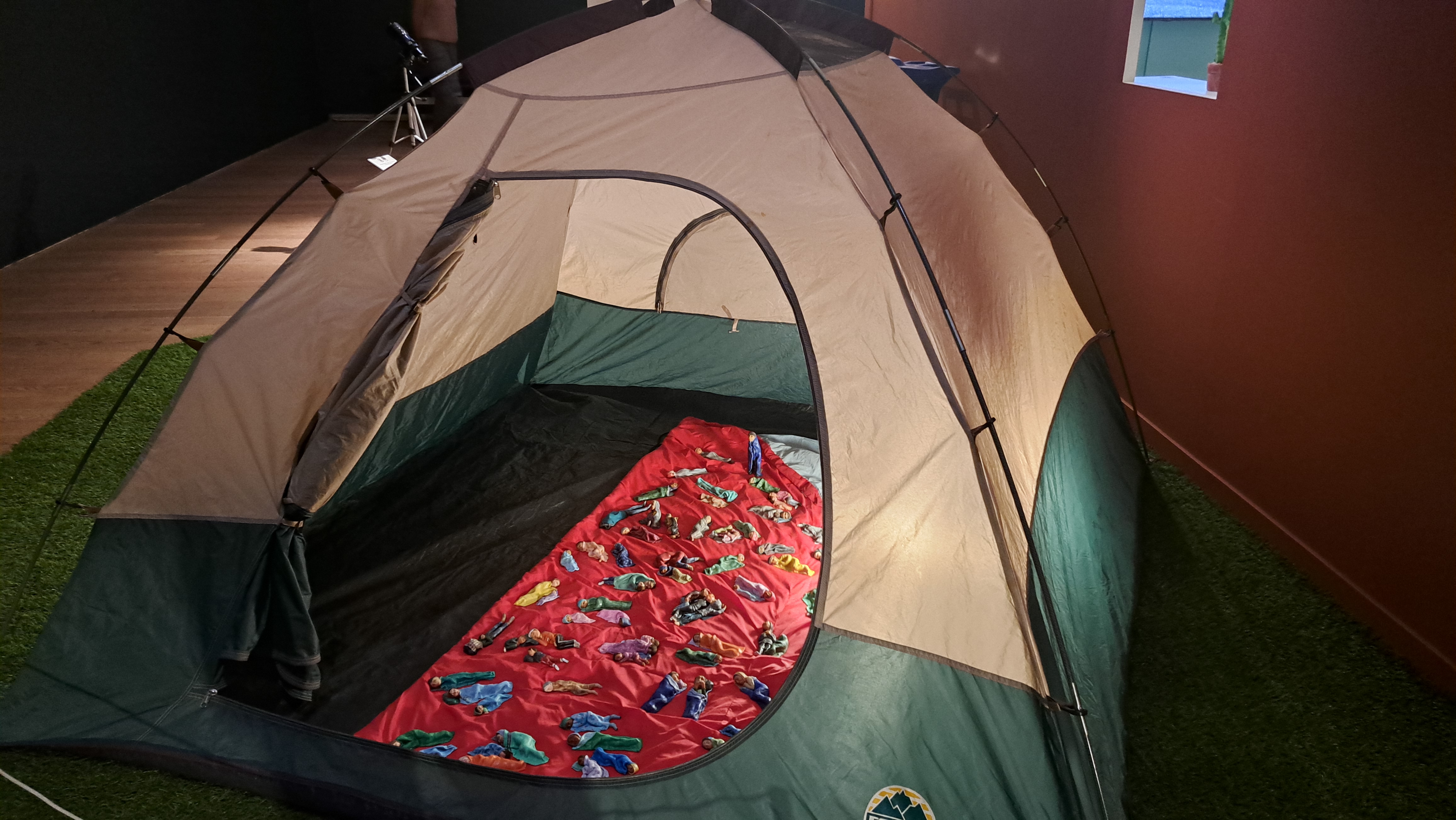
A pup tent in the backyard loses its innocence and becomes a grim reminder of the those who endure homelessness.

Detail of Housewarming by Karine Giboulo

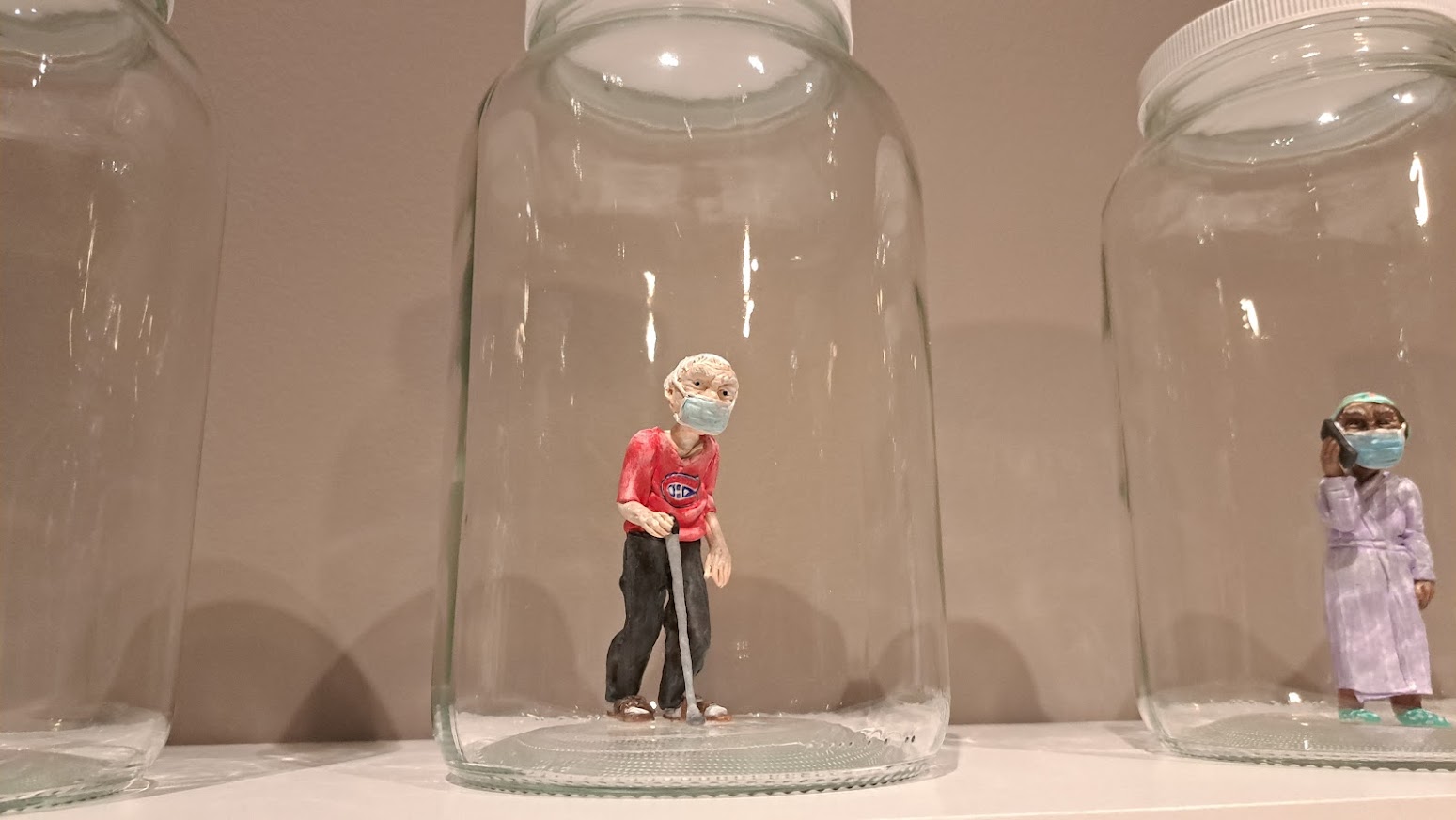
The elderly suffered the most during the pandemic. In the bedroom of the Housewarming installation, Karine Giboulo arranged numerous belljars on shelves, airless isolation chambers, each holding a solitary patient or caregiver.

Details from Housewarming by Karine Gibouli

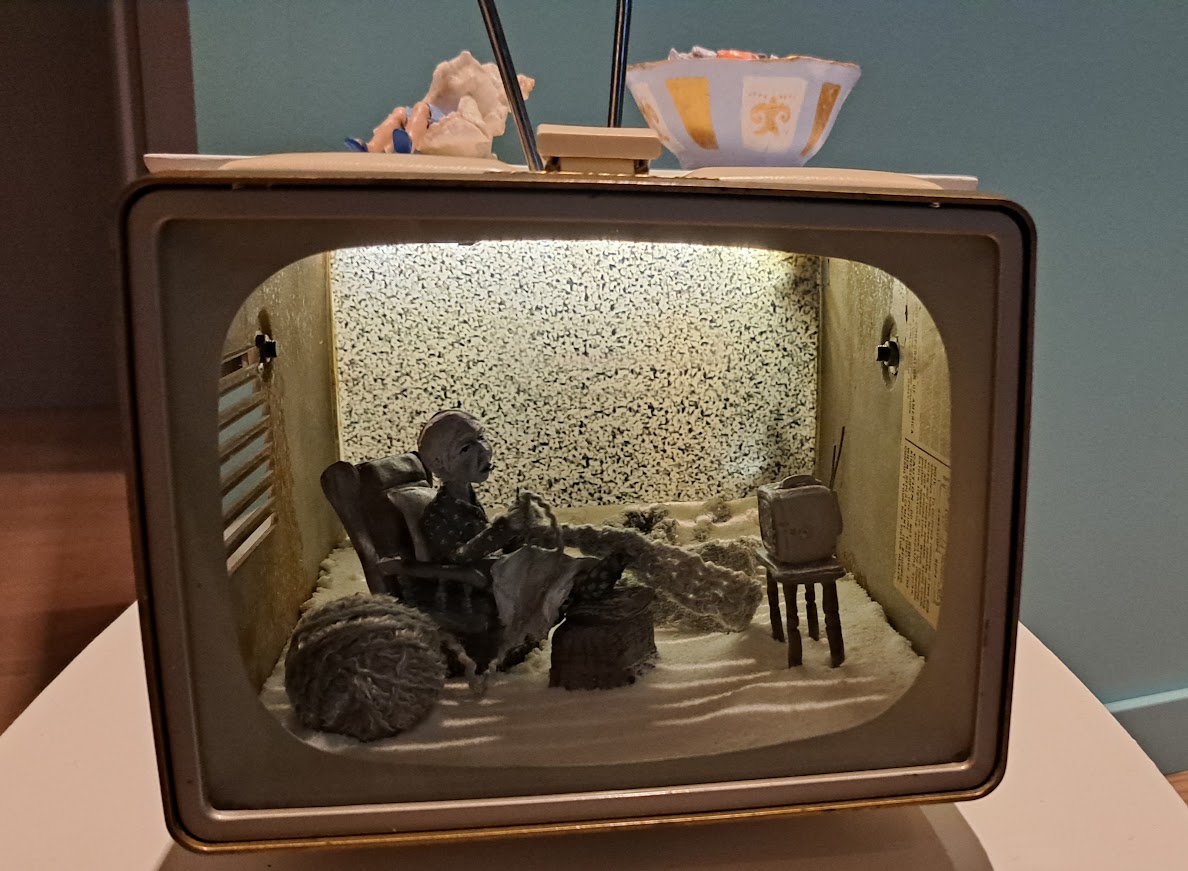
Some of the dioramas are more ambiguous and I like those the best. Is this elderly knitter, encased in the Zenith portable, seeking revenge like a contemporary Madame Defarge, who, during the French Revolution, used “yarn to measure out the life of a man, and cut it to end it?”

Or the ominous clock diorama, presumably containing a self portrait of the artist herself, poring over her phone as sleep eludes her.

Details from Housewarming by Karine Giboulo

Wandering through this fictional house we encounter environmental degradation, threats to wildlife through the climate crisis and tourism, exploitation of the vulnerable, the lure of addictive technology, greed and idiocy among the captains of industry, in fact the whole trainwreck of current human blunders is on display.

Texts that accompany the exhibition introduce Karine Giboulo with an emphasis on the fact that she is a “self-taught” artist. This struck me as peculiar, almost like a slightly apologetic explanation for her earnest engagement with the huge social problems that impact us all. The “self-taught” moniker felt like a wink and a nudge indicating that this isn’t quite typical contemporary art. There is no layer of obsfucation for intellectual play and invention. Karine Giboulo doesn’t want to risk losing her audience in obscure, abstract or metaphysical currents, so she plays it straight and lays it out as she sees it.

Maybe this idea is also there to let the viewer know that Karine Giboulo is not a global superstar just hitching a ride on the pain of others.

Ai Weiwei, for example, was slammed for posing to replicate the death of a three-year-old Syrian refugee Aylan Kurdi who died on a European beach while attempting to flee the war with his family. The photograph shot around the world as a viral meme, but it wasn’t always received well.

Ai Weiwei’s controversial photograph that mimics the pose of a drowned Syrian refugee boy Aylan Kurdi

Opportunistic, careerist, callous, tasteless victim porn, crude, thoughtless and egotistical are some of the reactions to this piece by Ai Weiwei.

Of course, these artists — Ai Weiwei and Karine Giboulo — are different in so many ways it doesn’t make sense to compare except to note that Karine Giboulo approaches her subject matter with a sense of tenderness and humility and that is evident throughout the exhibition.

Details from Housewarming by Karine Giboulo

One of the workshops being held at the Gardiner, in connection with this show is called: Micro meets Macro: Taking Action on Food Insecurity and Housing Instability. The workshop will apparently explore a report by Daily Bread Food Bank “examining trends in food bank use and food insecurity in Toronto.”

It takes place on February 1, 2023.