August 14, 2024

Portraits as Portals: Psychic Mediums Read Unknown Artists

A Project by Jennifer Fisher and Jim Drobnick at Art Windsor-Essex

I have learned that we are all psychic to some degree. Call it premonition, gut feeling, hunch, sixth sense, intuition — we all have it. A medium, however, is a psychic person who has special abilities, in particular, the ability to communicate with beings on the other side of life, i.e. they function as a door or portal to those residing in the spirit world.

Jennifer Fisher and Jim Drobnick, also known as the collaborative entity DisplayCult, go deep into the world of the psychic medium to explore the etheric energy that resides in an artwork. Rummaging through their own collection as well as distant corners of the basement of Art Windsor-Essex (AWE) the artists selected seven portraits by unknown artists and presented them to psychic mediums for a “reading.”

What ensues is a sort of Russian doll series of portraits.

Portrait by Unknown Artist from the Art Windsor-Essex collection. This was one of the portraits used in the exhibition Portraits as Portals. This portrait, in particular, had a disturbing impact on more than one of the psychic mediums.

First, we have the actual portraits. These pictures are at various levels of skill and sophistication. They are mostly oil paintings on canvas or board. There is at least one embroidery, shown below.

Portrait by Unknown Artist from the Art Windsor-Essex collection. This was one of the portraits used in the exhibition Portraits as Portals.

All the portraits share a certain charm, as well as poignancy. Perhaps it’s because of their status as abandoned, forgotten works. Like all art, they hold a power, a tightly coiled energy, as they encapsulate a physical remnant of an individual’s creative journey, no matter how distant in time.

Portrait by Unknown Artist from the Art Windsor-Essex collection. This was one of the portraits used in the exhibition Portraits as Portals.

The second set of portraits is provided through the psychic medium’s descriptions of the artists, the creators of these unknown items.

Installation view of Portraits as Portals exhibition, shows a psychic medium and the portrait she is reading.

We might learn what the artist looked like, what they were wearing, their state of mind, their reasons for doing this particular work, where they were physically, and, where they were in terms of their place in society. We might learn about their feelings and various problems, like depression or debt, or any combination of the preceding.

How a psychic medium acquires or develops these skills is baffling to me.

Excerpt of video of psychic medium, from Portraits as Portals exhibition

The psychic medium gazes at a portrait, with intensity, and soon enough, a message, or a vision, is received. We learn, for example, “…he may have used alcohol to avoid his feelings coming up..,” or, “…he actually didn’t want to do this…”

Show above is one of the psychic mediums from the Portraits as Portals exhibition. “This individual had a very strong political stance,” she notes.

Concurrently, the viewer is looking at the video portraits of the psychic mediums themselves.

I suppose the group of psychic mediums depicted here, is fairly average, in terms of looks, dress and demeanour. My sense is, this could be any random twelve people on the Dufferin bus, at rush hour.

Show above is one of the psychic mediums from the Portraits as Portals exhibition. This woman was distraught because various dark feelings she picked up from one of the portraits.

The videos are definitely a spectacular element of this exhibition. Giant, ultra high resolution, flat screen monitors are placed vertically, snug against the gallery walls, each displaying a mesmerizing, nearly life-size, image of a psychic medium against a dark background. The psychic medium’s voice emerges from directional speakers placed in the ceiling, so that the viewer, seated on a low bench, is enveloped by sound and image.

Installation view “Portals as Portraits: Psychic Mediums Read Unknown Artists”

And finally, we have the largest Russian doll, the fourth portrait, the meta portrait, which suggests a society in transition and upheaval, one recoiling from the spectacle of war, fearful of looming climate change, technological transformation, and one where an interest in psychics, and all manner of paranormal gifts, is on the rise. This interest in psychic phenomenon was particularly strong during the pandemic and continues today.

I was very excited to get to this absorbing exhibition and to think about the lasting power of objects. The Arts Windsor-Essex, new to me, is a true contemporary art venue. On another floor was an exhibition called Love Languages with works by Erika de Frietas and David Bobier among others and I was fortunate to take that in too.

Installation view of Love Languages, detail of piece by Erika deFreitas

Just across the river, of course, lies the Detroit Institute for the Arts, and the stunning Diego Rivera murals, room upon room filled with Picassos, Cezannes and Van Goghs, a sprawling current show of work by Tiff Massey. And just a few blocks away is the Museum of Contemporary Art Detroit (MOCAD,) which currently has a show by the US-based, Botswana-born artist and educator Meloko Megosi.

Space of Subjection: Black Painting V, 2022 by Meloko Megosi

It’s a four hour drive.

March 26, 2023

MOCA/NOT MOCCA

MOCA is the Museum of Contemporary Art Toronto. It was, previously, the Museum of Contemporary Canadian Art (MOCCA), located for more than 12 years on once trendy (now pandemic battered) Queen Street West. Going back further, MOCCA was founded on the Art Gallery of North York, which originated in 1999. MOCCA went dormant from 2015 to 2018 after which time it emerged as MOCA, at 158 Sterling Road, in a former auto parts factory, and there, it identified itself with the globalized world of the 21st century.

MOCA, Museum of Contemporary Art, Toronto

Remediation – Kapwani Kiwanga

Kapwani Kiwanga‘s exhibition at MOCA, (see above) titled “Remediation,” is original, playful, uplifting to visit and a breath of fresh air. (This is something we desperately need as spring is so far not arriving.)

Installation view of “Remediation” exhibition by Kapwani Kiwanga

The botanical world has a role in most of the pieces in this show. In fact, one definition of remediation is a way to cleanse soil of toxins, specifically using plant life.

The large, see-through, feather-light, air-filled shapes the artist created are also about plants. She calls them vivariums. I was informed that Kapwani Kiwanga is referencing vivariums in their historical role, as methods to transport life, particularly plant life, from one place to another. This could be a metaphor with all kinds of ominous connotations, but the thing about this artist’s work is that it’s not heavy-handed/didactic. The visitor can just enjoy looking at these strange and surprising objects amid the ponderous concrete pillars that dominate the second floor at MOCA.

One of Kapwani Kiwanga’s Vivariums
Installation view of Vivarium by Kapwani Kiwanga. The variums are named as follows: Vivarium: Cytomixis, Vivarium: Adventitious, Vivarium: Apomixis. The names reference botanical anatomy.

 Originally The Vivarium, I learned on Wikipedia, was the name for the enclosures where ancient Romans kept living things used in their entertainments. Various wild animals, mainly imported from Africa and the Middle East, like tigers, crocodiles, ostriches, elephants and aurochs waited in The Vivarium for their cue. Gladiators waited elsewhere.

“The Marias” installation view of work by Kapwani Kiwanga
Detail of The Maria by Kapwani Kiwanga

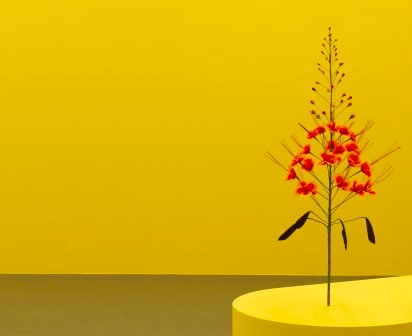
This artist doesn’t flinch from using a range of materials in her work. These delicate paper flowers — the piece is called “The Marias” — are surrounded by dazzling yellow plinths and walls. They’re pretty enough, but the artist has created them because of their unique properties and historical function.

…the flower on show, native to Latin America, was known by the locals for its abortive powers. The chemicals in the flower were used by enslaved women to break the reproduction of servitude.

from “Remedition” exhibition booklet

On the main floor of MOCA Kapwani Kiwanga has produced a massive installation composed almost entirely of sisal. She has said that she “considers how various natural materials become witnesses to history. ” Sisal, for example, played a big economic role in Tanzania. When the prices plummeted because of synthetic immitations, the country suffered.

Art work by Kapwani Kiwanga

The material, in the form in which the artist uses it, has a fascinating colour, texture and the unique, undulating lightness which the artist uses to create artfully draped, other-worldly environments. It’s so hard to refrain from touching it!

Sisal recently rebounded on the world markets. The roll above is availabe at Canadian Tire for about $5.00

A video piece included in the show, was shot in Tanzania, where soil is a reddish colour and coats everything in the dry season. We see the artist cleaning the lush roadside vegetation in a gesture of maybe aesthetic intervention or perhaps its a symbolic, sishyphean act of appreciation.

Detail of “Vumbi” by Kapwani Kiwanga

I like the fact that this mesmerizing piece is open to interpretation.

I know so little about Tanzania: an East African country with vast wilderness areas. They include the plains of Serengeti National Park, a safari mecca populated by elephants, lions, leopards, buffalos, rhinos, and Kilimanjaro National Park, home to Africa’s highest mountain. Offshore lie the tropical islands of Zanzibar, with Arabic influences, and Mafia, with a marine park home to whale sharks and coral reefs

Giraffe in Lake Manyara National Park, Tanzania

Trade Show – Susan for Susan

Trade Show is another exhibition presently on display at MOCA. Susan for Susan is the name of the design collaboration between Kevin Watts and John Watts. (One of the MOCA volunteers at the show told me the mother of John and Kevin Watts is the Susan in question. Nice.)

How brutalist would it be to have a concrete table in your kitchen, hanging from the ceiling by thick chains? I did not realize it was something I always wanted. That would be a place to have some serious conversation, espcially with the right lighting, a battery of flourescents maybe.

Detail of “Trade Show” installation by Susan for Susan

Susan for Susan has created an installation that gestures toward the idea of an apartment, employing industrial materials in a coarse state. I think they are trying to get at a return to “truth to materials.”

Something called a gantry (which is a bridge-like overhead structure with a platform supporting equipment such as a crane) pulls the whole thing together. This gadget gives the installation an overarching absurdist twang which is very appealing.

Detail of “Trade Show” installation by Susan for Susan

The mirror has an amusing quality. It’s like one of those magnifying mirrors, sometimes screwed into the bathroom wall, except the”accordian” attachments are oversized which means the whole thing can be pulled out and adjusted as required to get the right view.

Detail of installation by Susan for Susan

My favourite is the vase, evidently created from a medical device used to set extreme fractures.

Ouch.

April 9, 2022

Many years ago I visited the Venice Biennale and stood around under the hot, white, Venetian sun examining the paintings of Agnes Martin.

“Untitled 16” by Agnes Martin.

I remembered that long ago trip as I downloaded the absolutely free pass to the second occurence of the Toronto Biennale. And later, visiting some of the exhibitions, things felt almost normal.

The Biennale is a breath of fresh air! Wandering around in the early spring sunshine, mask free, I forgot for a short while that we are in the midst of a sixth wave.
Spring comes to Toronto

The exhibition is spread out around the city, but largely clustered in the west end, in an area dotted with construction cranes and debris. 72 Perth Avenue, the site of a future condo complex, now slated for demolition, functioned as a church before it was snagged to host the Biennale. The visitor can appreciate the raised, oratory platform and the long, vertical, stained-glass windows as evidence of its former incarnation as the Praise Sanctuary Ministry, Church of the Firstborn Apostolic and consider the connection between houses of worship throughout history and today’s grand museums; austere, white cube galleries; and newly minted biennales seeking an affordable venue.
Installation titled “Holdings” by Nadia Belerique

Nadia Belerique‘s installation, made of white plastic cargo barrels, anchors the space at 72 Perth, where it functions almost like an alter. The apparent lightness of the materials, their translucent, glowing, jewel-like coloured surfaces, which capture daylight flowing from behind, create the rooms’s focal point with an original sense of monumentality: lightfilled, colourful, airy. Within each barrel Nadia Belerique creates assemblages of found materials which may or may not refer to their original purpose.

Detail of “Hoildings” by Nadia Belerique

 What Water Knows, The Land Remember , is the title of the “curatorial vision” of the Biennale. This vision is highly idealistic, referencing the Toronto region i.e. the Great Lakes and their tributaries, and tying together ideas about ecology and the environment, inheritance and ancestry, relationships and collaboration. I did have a jarring sense of dislocation, faced with these touchingly utopian ideals and scrupulous political correctness, after a steady media diet of fear and despair: brutal war in Europe, global rise of authoritarian leaders, rage of white males, mass extinction and climate meltdown, endless Covid waves of misery. It was great to step away from all that for a few hours!

I was excited to be introduced to the work of Paul Pfeiffer. He did a fascinating, multi-media piece about a pop-star and his billions of fans around the world. In this case: Justin Bieber. He used this utterly contemporary phenomenon to explore the encarnacion-style of woodworking, which originated in sixteenth century Spain, and continues to this day in the Philippines, as a way to produce lifelike icons of religious figures.

Detail of “Incarnator” by Paul Pfeiffer

The artist named Aki Onda created a piece that had an uncanny resemblance to so much work that went on in the seventies. I really like looking at outdated technology, particularly from the seventies and eighties, so his piece called “Nam June’s Spirit Was Speaking To Me,” was a hit for me. The text that accompanies the piece, an oversized booklet, describes the artist’s ongoing attempts to channel Nam June Paik through various garbled radio broadcasts he chances upon.

“Nam June’s Spirit was Speaking to Me” by Aki Onda

Scanning through the station, I stumbled upon what sounded like a submerged voice, and began recording. I concluded this was Paik’s spirit reaching out to me.

Aki Onda, from the booklet “Nam June’s Spirit Was Speaking to Me”

It’s hard to know if Aki Onda is just relating his experiences earnestly, or not. I too have heard strange, submerged voices on the radio, from time to time.

In the gallery. the sound was very low, almost inaudible, but you can listen to Aki Onda’s piece on You Tube.

Lingering at the exhibition made me think that the fact that it takes place in a former church possibly influenced the curators decisions. Many of the pieces referenced spirituality, liturgical items or connections with deceased beings or those of distant generations.

For example, Andrea Carlson shows a sculpture and huge painting, referencing “Man Mound,” which is a 214-foot-tall earthwork in Wisconsin, dating back to between 600 and 900 BC, when it functioned as a burial and ceremonial site.

Detail of Painting titled “Cast a Shadow” by Andrea Carlson

The painting, which is immense, composed of numerous panels, and painted in a joyful mash-up of styles, appears to contain many messages, laments, pleas and warnings from the beyond, or the distant past, or just elsewhere.

Detail of sculpture by Tanya Lukin Linklater titled “Held in the air I never fell (spring lightness sweetgrass song”

Tanya Lukin Linklater‘s sculptural piece has many components. I was very attracted to the drapped scarves that hung from the ceiling, which in keeping with the theme of this show at 72 Perth Avenue, appears to reference liturgical garments, tapestries and shamanistic cloaks.

Kohkom is Cree for grandmother, and for Tanya, the scarves are a way to evoke “women’s intergenerational, embodied, experiential (and sometimes land-based) knowledge.

from Toronto Biennale of Art Website

I dashed over to MOCA — apparently my free pass entitles me to a discount on coffee at the MOCA cafe — which is around the corner on Sterling. The main floor of MOCA is part of the Biennale.

It was very enjoyable to look at the installation by Maria Qamar. This artist strikes me as completely of the moment, freely moving between the worlds of fashion, art and digital stardom.

“Dhamakedar, Superstar!” by Maria Qamar

Strolling into MOCA, and Maria Qamar’s installation, I had left the spiritual realm behind at 72 Perth, and was into a version of the material now: young, glamourous and Desi!

More Maria Qamar

April 7, 2019

Koffler Gallery – Nevet Yitzhak

On the eve of the Israeli election, where the polls are projecting “King Bibi”, it seems like a good idea to check out Israeli artist Nevet Yitzhak and her exhibition, titled WarCraft, at the Koffler Gallery.

Detail of WarCraft video installation by Nevet Yitzhak

When I arrive, Nevet Yitzhak is speaking about her work to a rapt audience of a few dozen. The gallery lights are off, the only illumination of the event comes from the huge, animated digital projections on three sides of the space.

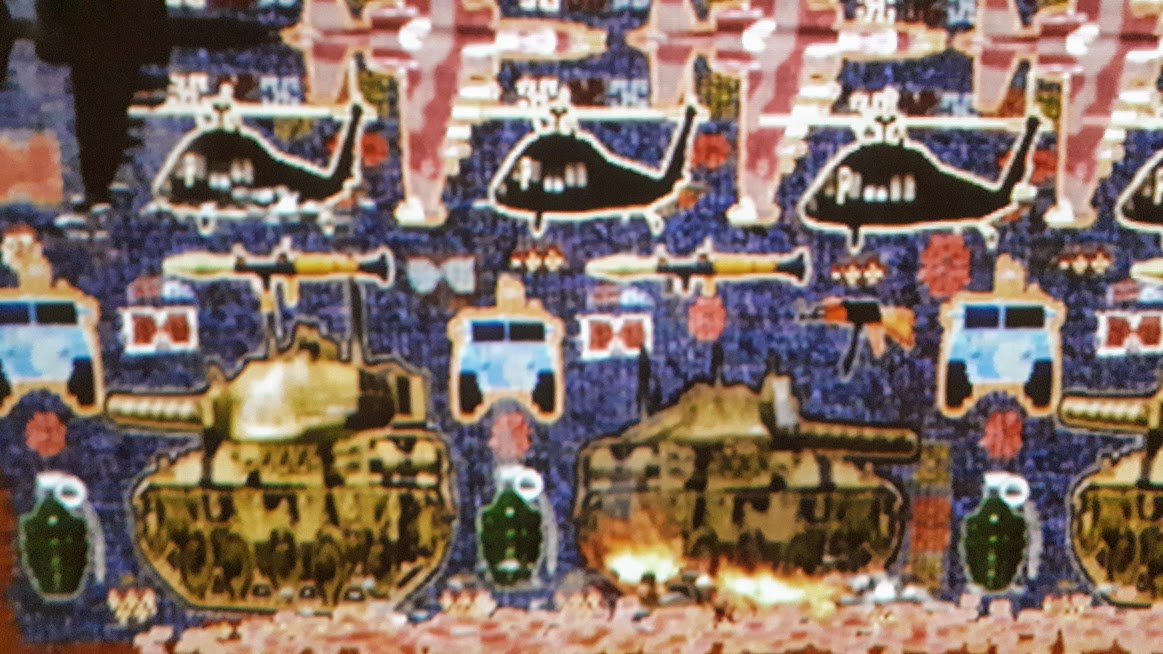
The projections look like very large rugs. They are flat, patterned expanses, with light coloured strips of fringe running down both vertical ends. The projections share the flattened, stylized look of traditional rugs from the Middle East. And they have the same warm palette of reds, ochers and yellows. But traditional subject matter, that of animals, plants and various domestic scenes, has been replaced with something new. In fact they are “war rugs,” – reminiscent of those that emerged during the Afghani conflicts – displaying the implements of contemporary warfare, like choppers, tanks and AK-47s.

Detail from digital video animation by Nevet Yitzhak

And the rugs move. In a rather slow, desultory manner, bombers cruise here and there, missiles are dispatched and explode, helicopters meet dramatic ends and fires continually burn. The slowness and repetition gives the scene a routine, humdrum feel.

Detail of animated digital video by Nevet Yitzhak

Meanwhile in the gallery, the artist is describing her family background, which is Yemeni, Kurdish Iraqi and Syrian. She tells the audience about the Arabic Jewish communities within Israel and their attempts to maintain their cultural identities, and, about her sense of self as an Arabic Jew growing up in a state of continual conflict, where Arabs are the enemy. She tells the audience that she has no hope, her generation has no hope, and, that this artwork is not a metaphor. This artwork reflects reality.

She also talks about Afghani war rugs and how they inspired her. But in this respect Nevet Yitzhak emphasizes the fact that, unlike the Afghani rug producers, she is a citizen of the aggressor state, and, her audience is mainly an Israeli audience.

Afghan war rug from 2002

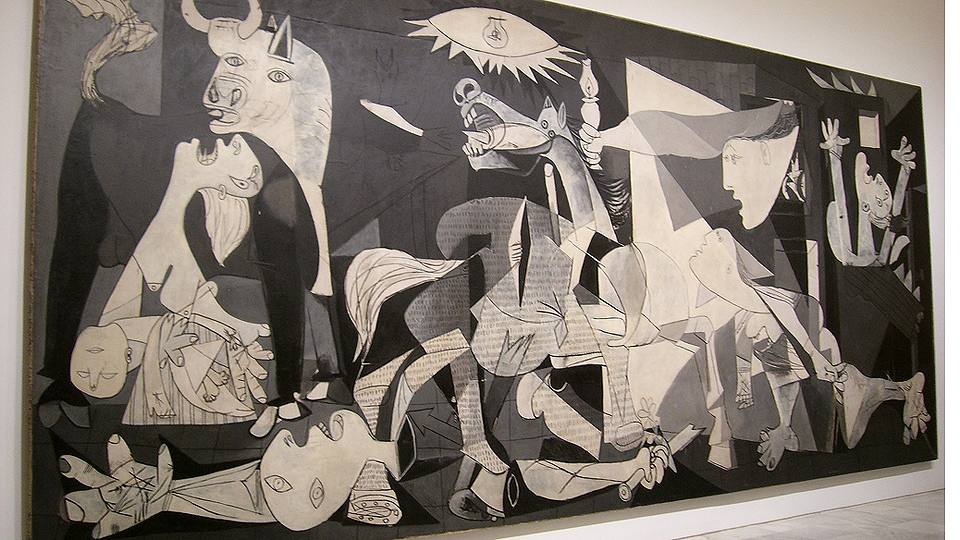
Q & A Period arrives: Someone in the audience suggested that the artist’s work celebrates war. “It is the opposite of Picasso’s Guernica, ” the person complains, “It does not show suffering.”

Detail of Guernica by Pablo Picasso

Nevet Yitzhak responds to the question as follows: She repeats she is an Israeli citizen. She can not show the victims of Israeli aggression, because that is not who she is.

In an aside, the artist mentions that textiles are always political. I never really thought about that before, but, yes, remember the Pussy Hat? It is now a cultural artifact, frequently disparaged.

Pussy Hat is now decried as racist and trans-phobic

Exhibiting concurrently with Nevet Yitzhak’s show is a work by Shaista Latif. Shaista Latif’s video work, called “Learning the Language of my Enemies” (I have to go back and see it!) was created as “an intervention and an attempt at empathetic critique” of the work in the main gallery.

Still from two channel video piece by Shaista Latif

Shaista Latif has a very charming, bubbly personality and she jumps into the rather tense Q & A session with a declaration of herself as working class, Afghani-Canadian and Queer. She somehow gets the assembled group to agree with her that when you are in Toronto it is very important that you identify where you are coming from, what your point of view is and who you are speaking for.

Nevet Yitzhak’s English is a little shaky and in fact, she has a translator with her. Someone in the audience asks her if her work is political. She talks to the interpreter for a few seconds, and then she replies: “Everything in Israel is political.”

Map of Israel and surroundings


September 15, 2019

Loner Culture at Inter/Access

To be a loner today is to raise suspicions.  We know now that Alek Minassian, Adam Lanza, Dylan Klebold, Elliot Roger, and many others, stayed in their rooms, alone, until rage and frustration drove them out, in a frenzy, to commit mayhem.

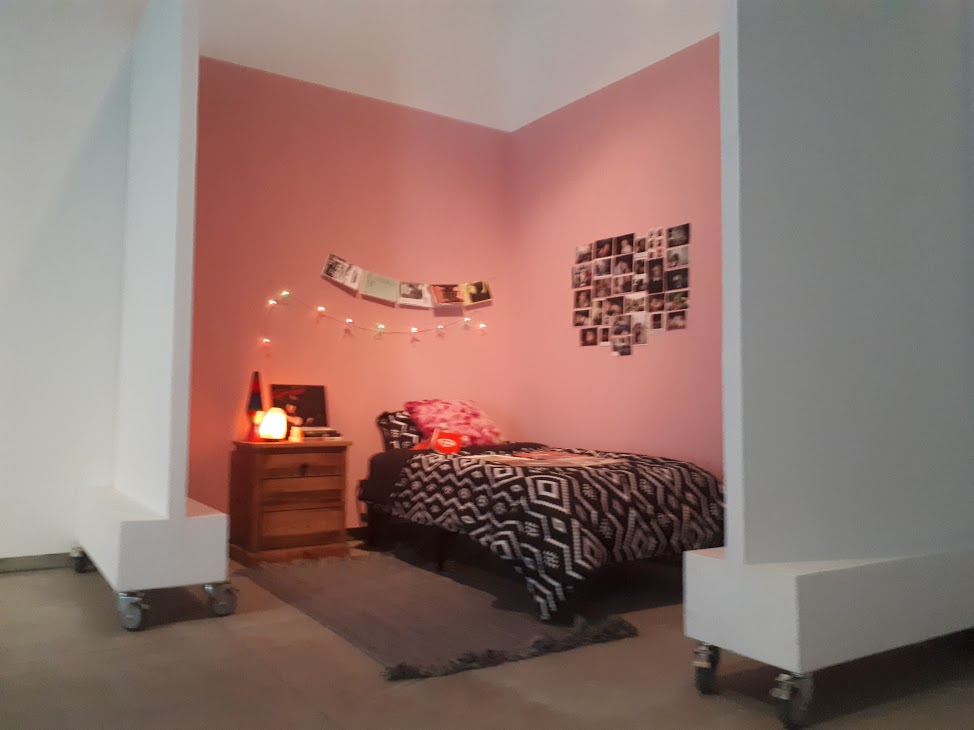
Loner Culture, the exhibition currently on display at Inter/Access is about something else.  It’s about trying to connect.  It’s social.  And weirdly, to be social, is to exclude one group in favour of another.  That’s the human way!  Sometimes the exclusion piece means solitary confinement in a pink bedroom.  But it’s temporary — a brief, high-drama interlude, an emotional eddy on the river towards self-actualization.

The exhibition re-creates vestiges of the long lost bedrooms where the tender, new self was honed and tested.

20180915_140459

Above: Installation at Loner Culture

I chatted with one of the artist’s in the show, Suzanne Kite, through her live link on the Discord Platform.  She described how in her late teens and early twenties she traveled hours on connecting buses to make the scene.  In her case, the scene was an all ages DNB Happy Core Trance House DJ event in some off-the-beaten track warehouse in a remote corner of sprawling LA.  That is dedication!  That is really wanting to be there!  Needing to get it absolutely right and knowing that the others at this event are just like you!

By the way, if you do not know — like me– the difference between DNB (Drums and Base) and Happy Core you can watch a tutorial above:

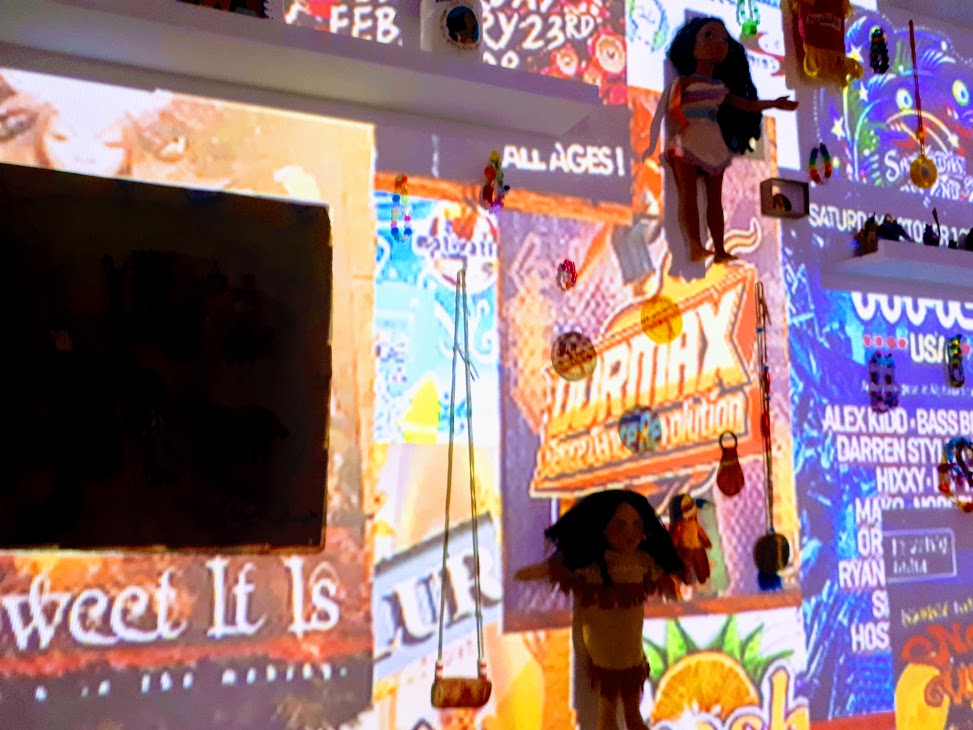
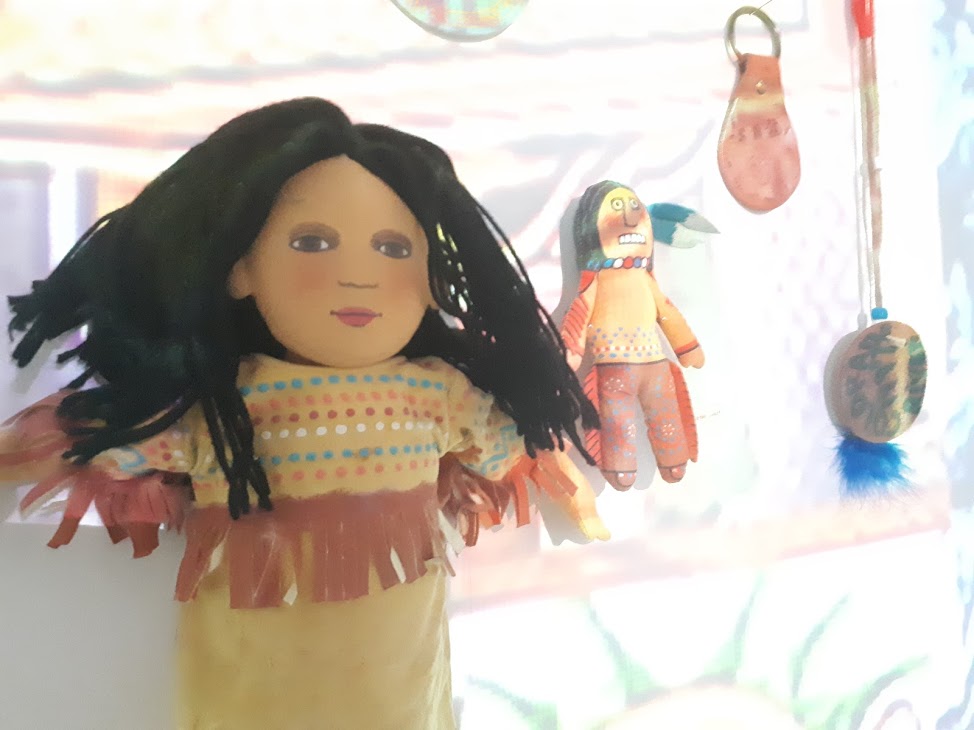
Suzanne Kite identifies herself as a Oglala Lakota performance artist.  When the movie Pocahontas came out in 1995 Suzanne Kite’s parents bought her absolutely every conceivable Pocahontas tie-in item.

According to Wikipedia:

… promotional tie-ins included Burger King distributing 55 million toy replicas of the film’s characters with kids’ meals, Payless Shoes selling a line of moccasins, and Mattel peddling a Barbie-like Pocahontas doll.[93]

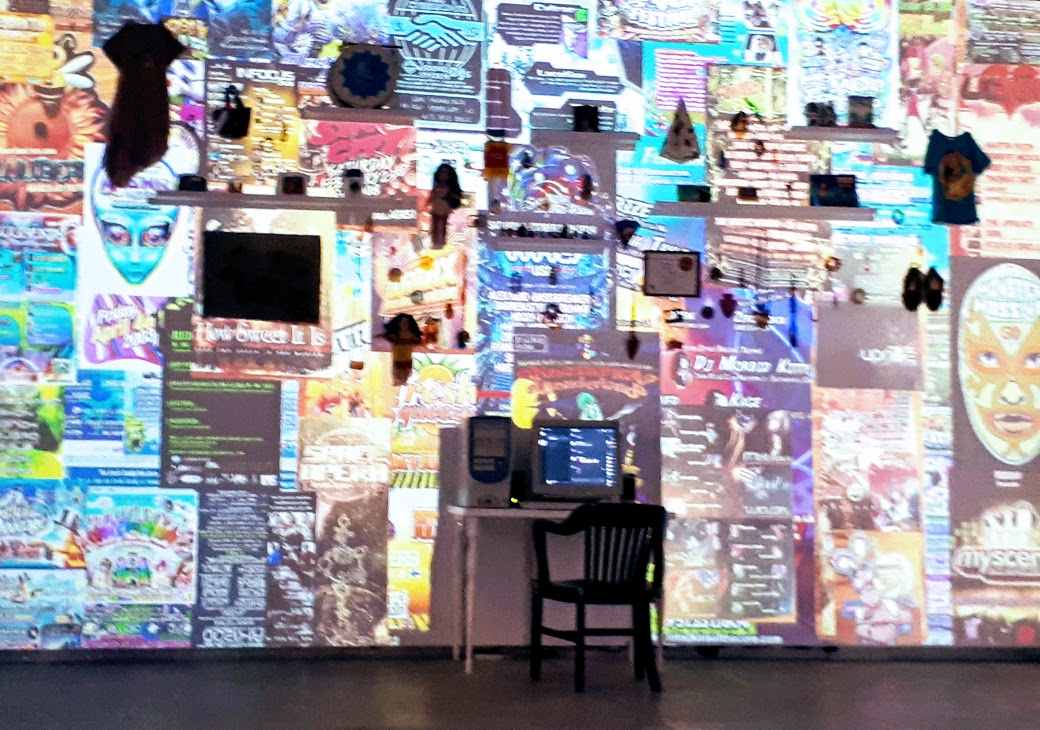
Payless!  Obviously Indigenous youngsters, especially girls, were starved for dolls, toys and anything else Mattel and Payless could come up with that somehow related to them.  Suzanne Kite has carefully saved these items.  They are displayed on the walls of the gallery overlaid with projections of posters from her youthfully intrepid music life.

20180915_142647

Detail of installation by Suzanne Kite titled “Better Off Alone”

20180915_140522

Installation view of Suzanne Kite artwork “Better Off Alone”

Typing on the keyboard filled the large space at Inter/Access with Suzanne Kite’s favourite music from that era:

Video of interactive installation by Suzanne Kite

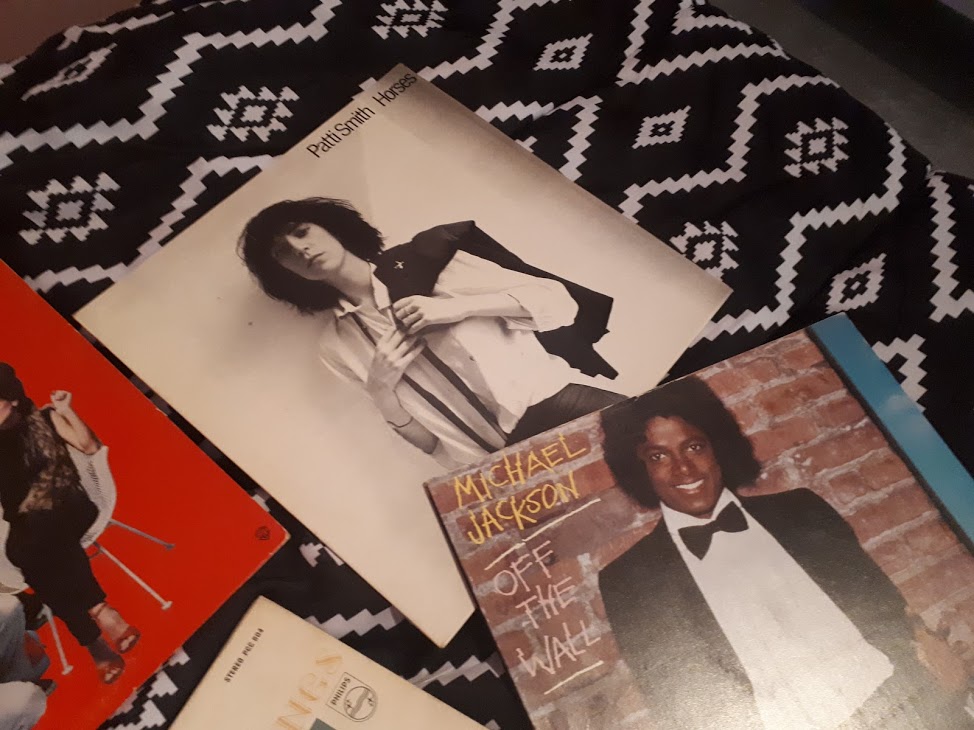
With all the memorializing of the past bedrooms of origin it is hard to keep the decades straight.  Patti Smith, Michael Jackson, Lydia Lunch and B52s must mean late seventies or early eighties.  But no, nostalgia has already kicked in.  This is a moment in the early 2000s where icons from twenty years prior are revered.

20180915_142754

Above: Installation detail from Loner Culture exhibition, re-creating a bedroom from the 2000s.

Both Thirza Jean Cuthand and Fallon Simard presented bedroom-ish settings and both featured monitors.

20180919_192823

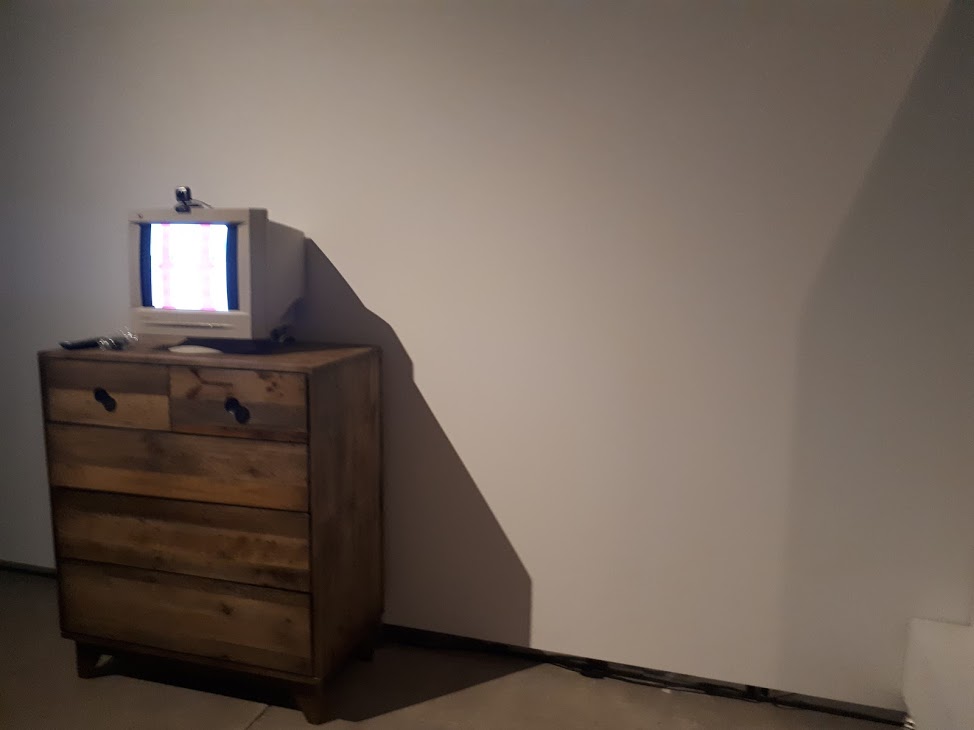
Installation by Fallon Simard

In Fallon Simard’s piece the utterly bland dresser, standing alone in the rather cavernous, grey space, has a bleak feeling.  It is free of knickknacks and/or personal items of any kind, something that might indicate an era or anchor a sensibility. Instead there is a cold sense of isolation and detachment. The monitor displays anti-homophobic/transphobic internet memes with vague, delicate, pastel backgrounds.

1518618934213

Art work by Fallon Simard

A camera is clipped to top of the  monitor in the Fallon Simard piece.  Are we observing or being observed? 

20180919_192729

Installation by Thirza Jean Cuthand

Thirza Jean Cuthand provides a heap of cushions and head phones to kick back and watch videos.   The tapes by Thirza Cuthand have a graceful poetic sensibility throughout.  The artist is fearless: sex, insecurity, fear, sex, mental illness, rage, grief, sex, youth, race, sex.  All the topics that are endlessly pondered in bedrooms around the world are covered here in an inventive and original voice.

May 14, 2016

I was wandering by the Piri Piri Churrasqueira Grillhouse at the corner of Dupont and Campbell and took some time to check out the neighbourhood.  Just a few steps north there is a cluster of no-nonsense, newish buildings.  They look like the kind of place you might go to pick up parts for, say, a malfunctioning Moccamaster or maybe confer with an insurance broker.  But no, in fact, here is a chance to look at art in Toronto.

Richard Rhodes Dupont Projects – David Clarkson

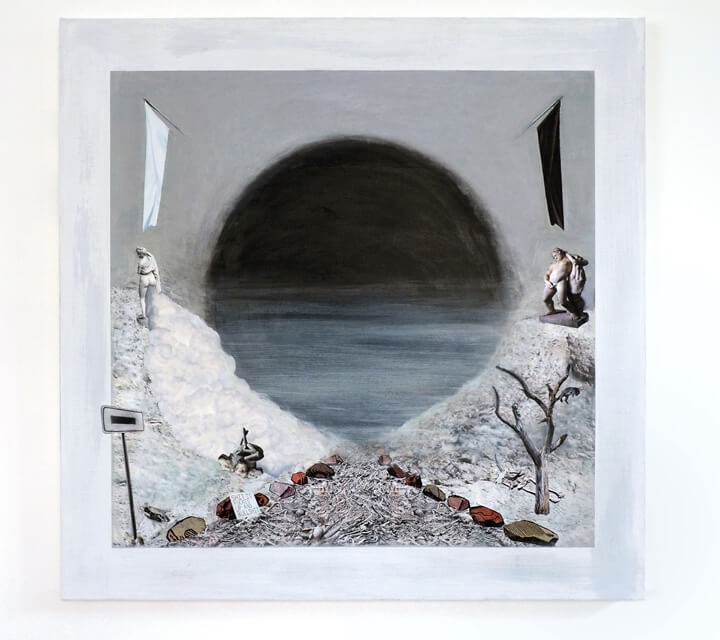
Speleogenesis, I have just learned, means the origin and development of caves.  In the exhibition of paintings by David Clarkson, called Remotes, caves function as formal device, content and metaphor.

Here’s another word you don’t hear often: trippy.

On entering David Clarkson’s show there is a painting by the door.  It depicts a rabbit hole, yes, the pathway that Alice took into the discombobulating environment that made no sense.  In this painting bunnies, giant gems and a perfect oval looking-glass are bathed in a dreamy blue light.  For me this painting set up the whole show with a feeling of philosophical nonchalance.   The viewer is free to descend into a labyrinth of ethereal vistas and subconscious triggers without any kind of didactic price to pay.

20160514_154758

Detail of Rabbits and Mirrors by David Clarkson

The cave imagery is a constant in the show.  Such a potent symbol could be heavy handed but David Clarkson creates unpredictable, droll and imaginative art work that never stumbles into cliche.

2016-04-09 16.18.15

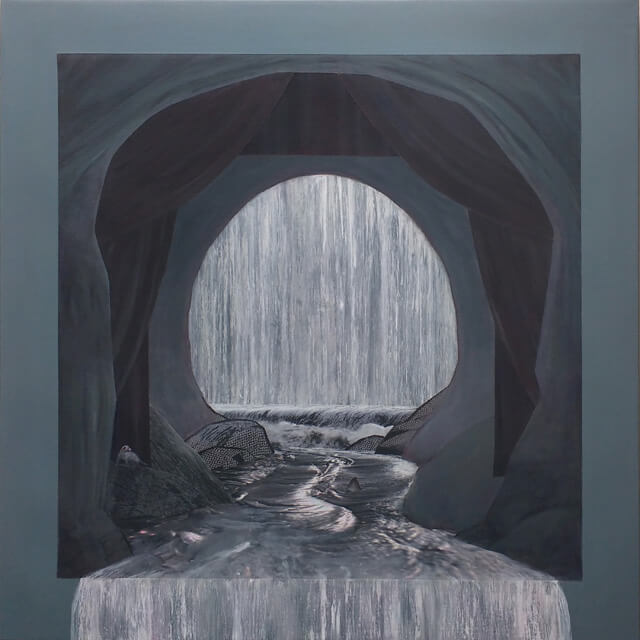
Cascade and Curtain by David Clarkson

Looking at Cascade and Curtain the viewer is in utterly unknown territory, gazing outward through the pictorial plane to glimpse what lies beyond the shimmering veil of liquid.  Which way is the sinuous sluice spilling?  Into the frame or out of it?

The inclusion 0f photographic elements, pop art fragments and tiny renderings of hallucinatory creatures combine to form an otherworldly tableau.  But it is the striking formal aspect – the yawning mouth of the cave – that creates such a powerful image.

moth-and-frog-1x

Moth and Frog by David Clarkson

A sense of claustrophobia dominates the painting above as ice and mist frame a route to open air but no, it is another cave that confronts the viewer, like a maddening hall of mirrors.  Life is delicate but relentless in this harsh environment.  And consciousness is brutally linked to physical realities.

5

Statues and Fog by David Clarkson

In Statues and Fog surrealist tropes litter a grim trail to the void.  Here the cave is the tough slog of life itself.

Ahem…there is only one way out.


Erin Stump Projects (ESP) – Elise Rasmussen

Around the corner on Dupont there is an exhibition by Elise Rasmussen called Fragments of an Imagined Place.  (…am I detecting a theme…?)

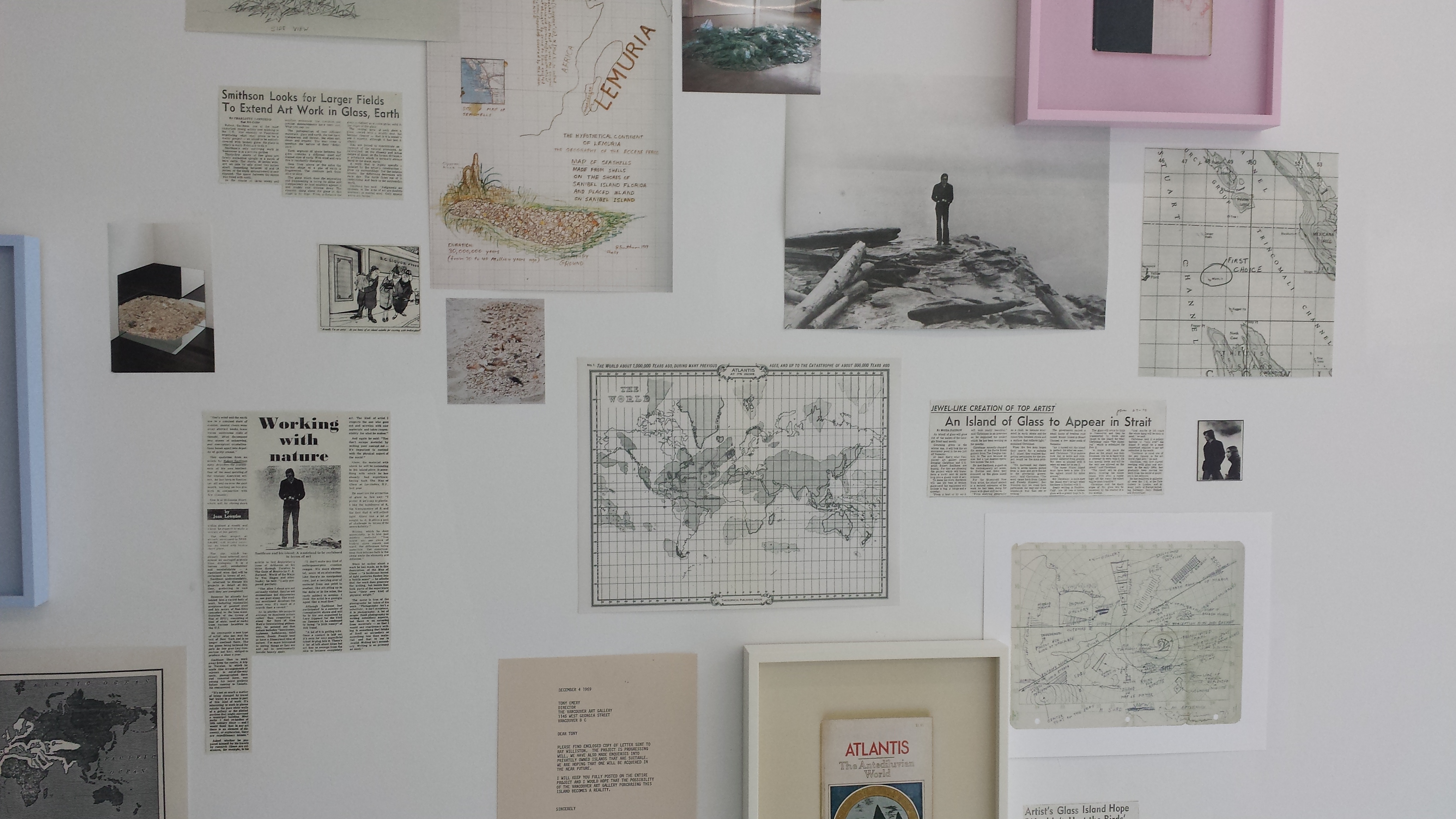
As part of the artwork Elise Rasmussen declares that the myth of Atlantis “serves as a metaphor for the artistic practice.”  Within this context she presents some fascinating fragments of a Robert Smithson piece that was never created.

20160514_160955Detail of Fragments of an Imagined Place by Elise Rasmussen
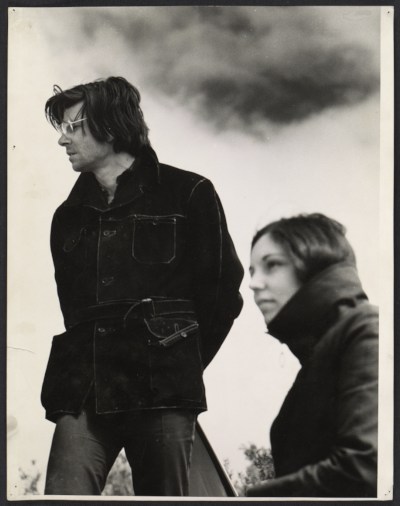
People had a very different appearance in 1970 than they do today.  Within the selection of xeroxed newspaper clippings, cartoons, letters, pamphlets and snapshots is a picture of Robert Smithson posed as a rugged outlaw.  Truly, this artist was onto something new, big and bold and he looks the part.

AAA_smitrobe_38928

Robert Smithson circa 1970

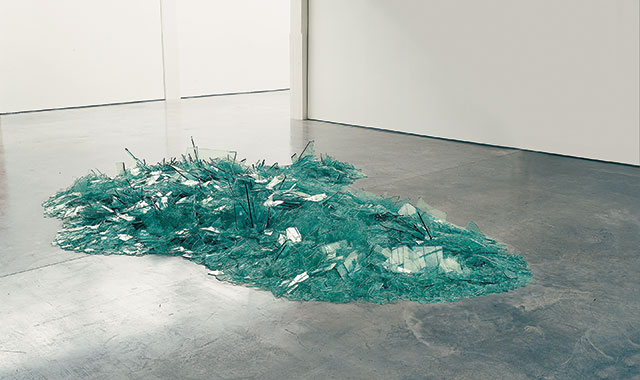
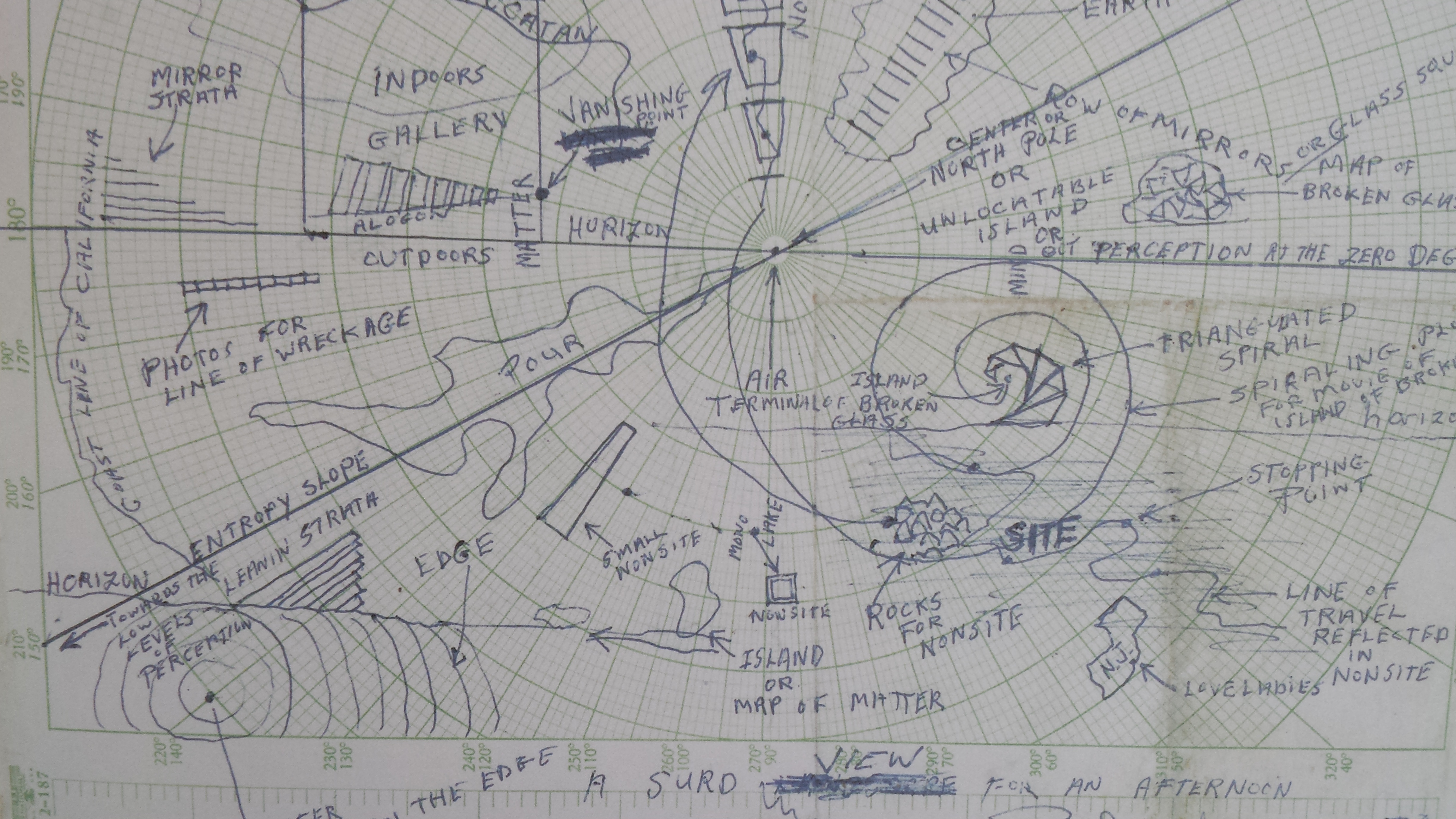
The planned Earthwork was called “Glass Island” and it was to be constructed off the British Columbia coast near Nanaimo.  One hundred tons of broken glass were held at the border and finally sent back to Los Angeles.  Environmentalists opposed the project.

robert-smithson-map-of-broken-glass-atlantis-1969_promo1

Installation view of Robert Smithson’s “Map of Broken Glass (Atlantis),” 1969

Included in this sort of scrapbook-like array are copies of the Robert Smithson drawings for other Earthworks.  It was so startling and refreshing to see these humble drawings on graph paper, efficiently packed with ideas and potential.

20160514_160934

20160514_160812

Detail of Fragments of an Imagined Place by Elise Rasmussen
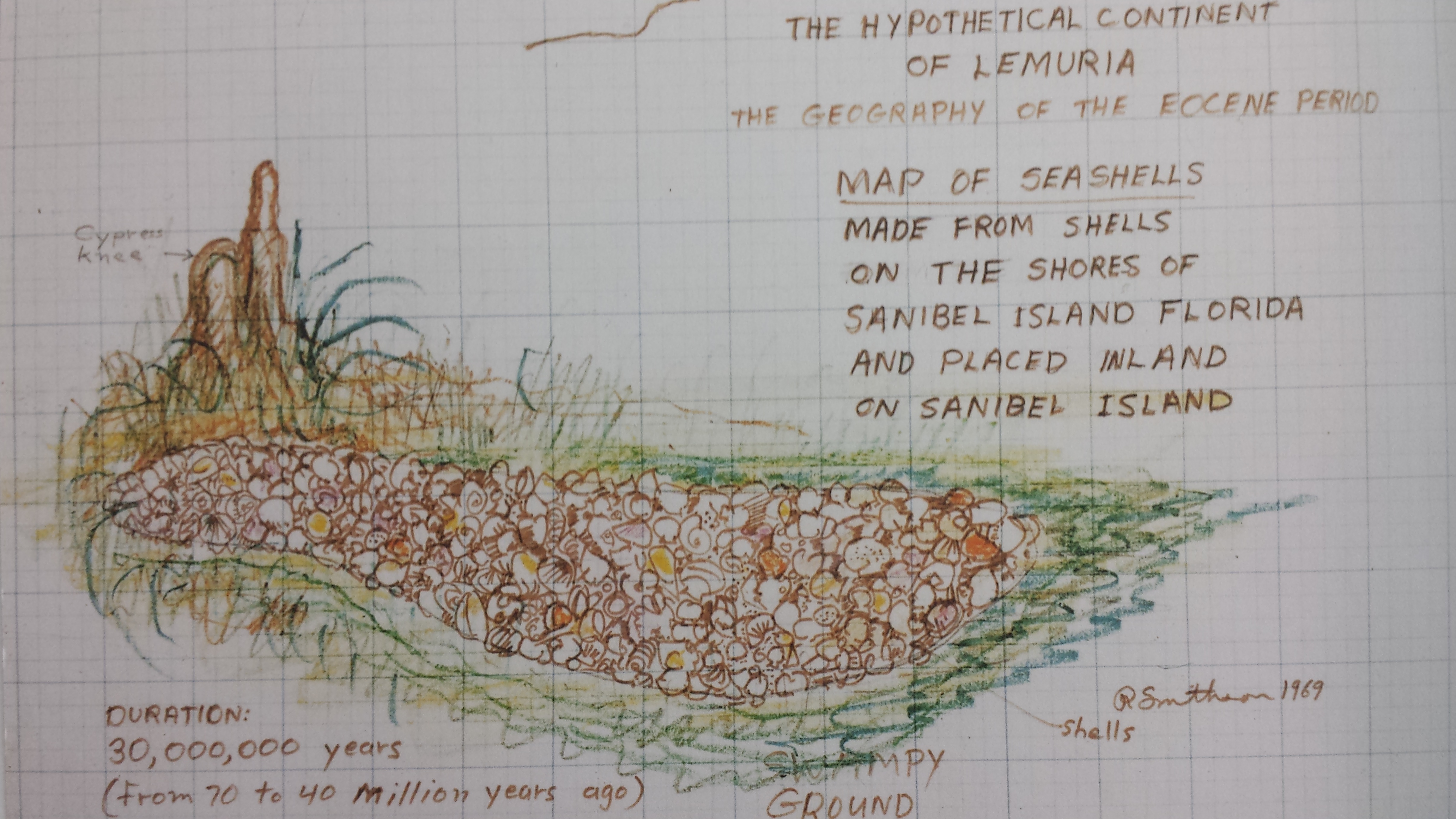
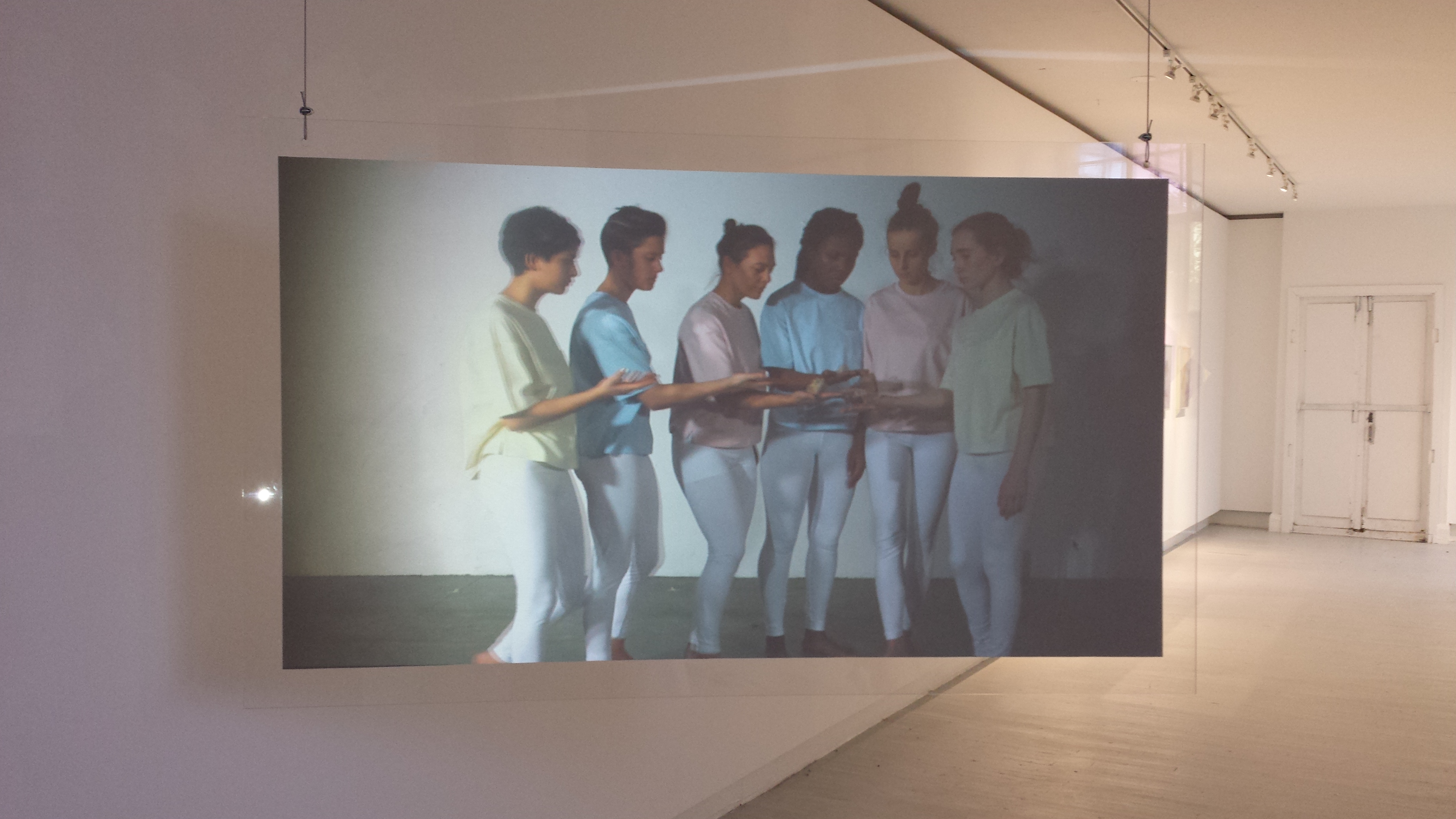
I really liked observing the connection Elise Rasmussen created with Robert Smithson and his beautiful idea of a glass island.   She also produced a video in connection to the unmade piece.  Dancers in white stretchy pants and pastel t-shirts gingerly hold shards of coloured glass move and about in a serious though desultory way.

20160514_161044

Still from Video Fragments of an Imagined Place by Elise Rasmussen
https://player.vimeo.com/video/163575629“>Click here to see a section of the video

I wonder what Robert Smithson would make of the art world today?


April 9, 2016

Lately I have been obsessed with getting to work on time.  If I’m late I might not have a place to sit.  There are always a few latecomers lugging their laptops down to Starbucks to set up shop for the day and I don’t want to be one of them.  I tried working from home – some people (slackers?) seem to love it, but not me.  My home life and my work life start to become one seamless parade with work edging out home until it seems like that’s all I do.  I started going in to the office again, joining the flow of humanity on the TTC, earlier and earlier, 7:30, 7:20, 7:15…And then I remembered:  Looking at Art in Toronto.

Trinity Square Video – Heather Phillipson

Trinity Square Video’s new location is not optimal for viewing.  Skylights wash out the projected video images.  (I was advised they are fixing the problem and custom blinds are on order.)  Fortunately, the inaugural exhibition of the space features work by Heather Phillipson, and the  show, titled “sub-fusc love-feast,” has such a powerful audio component that the diminished visual impact is hardly missed.


2016-04-09 16.20.23

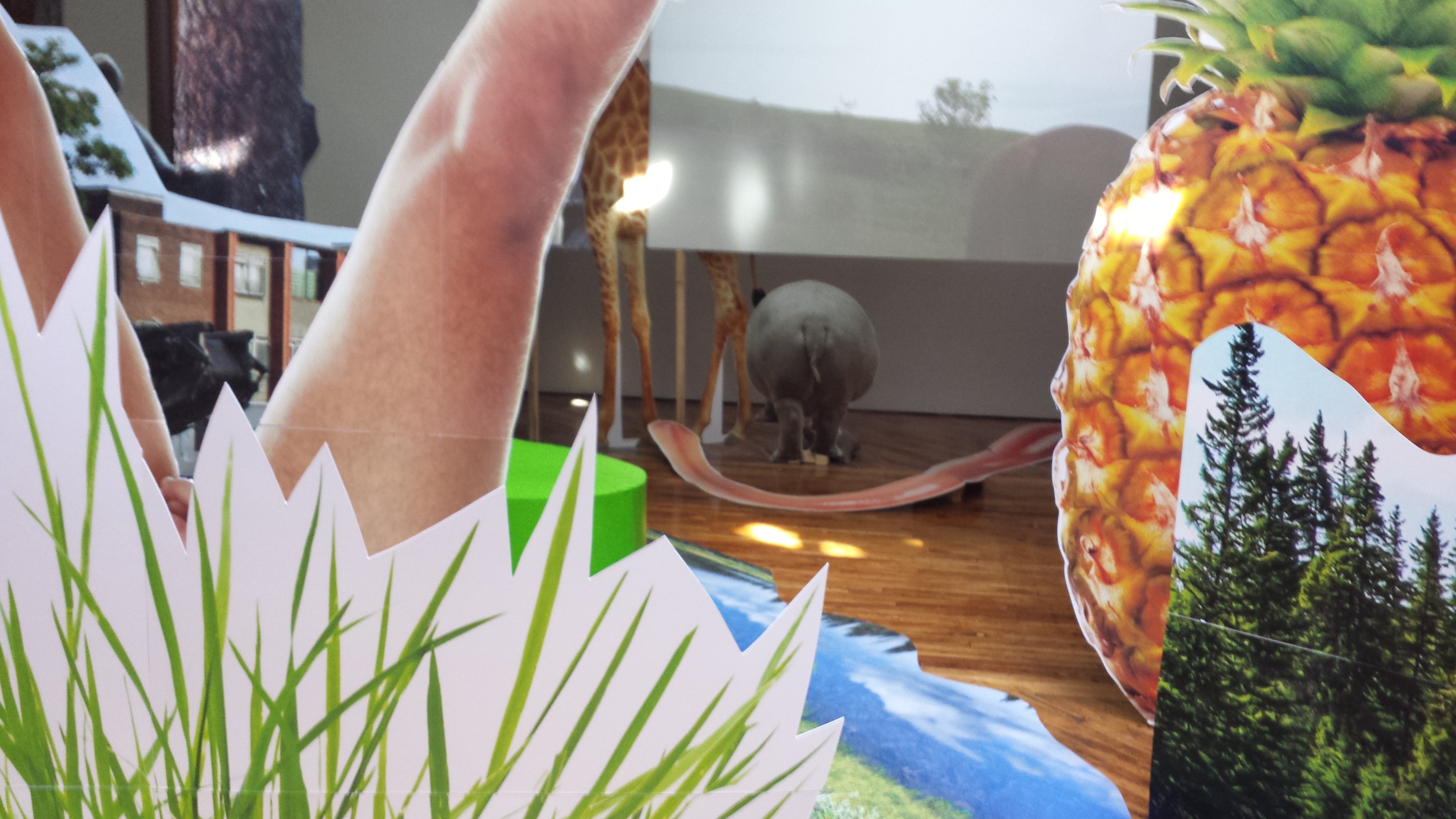
Installation view of sub-fusc love-feast by Heather Phillipson

Also, three video projection screens are tucked into an elaborate installation of cut out photographs.  It’s like walking around in an oversized collage, cut out from cheerful travel postcards and National Geographic magazines.

2016-04-09 16.20.09

2016-04-09 16.12.59

Installation views of sub-fusc love-feast by Heather Phillipson

The layers of sound and music, dominated by a bell-like female voice, are completely absorbing.  Heather Phillipson is a thinker and a poet.  She takes on the slippery task of defining nature in this era of unrestrained production and gives voice to the places, things and animals caught in the terrifying cycles of consumption.

The piece has a plaintive, uncertain feel to it, the sound in particular grows panicky at times and fearful.  This makes sense given the subject matter.  Heather Phillipson explores the grim news that is easier to deny than accept; the scale and finality of the environmental crisis that looms over us all.


Gallery 44 – Sarah Anne Johnson

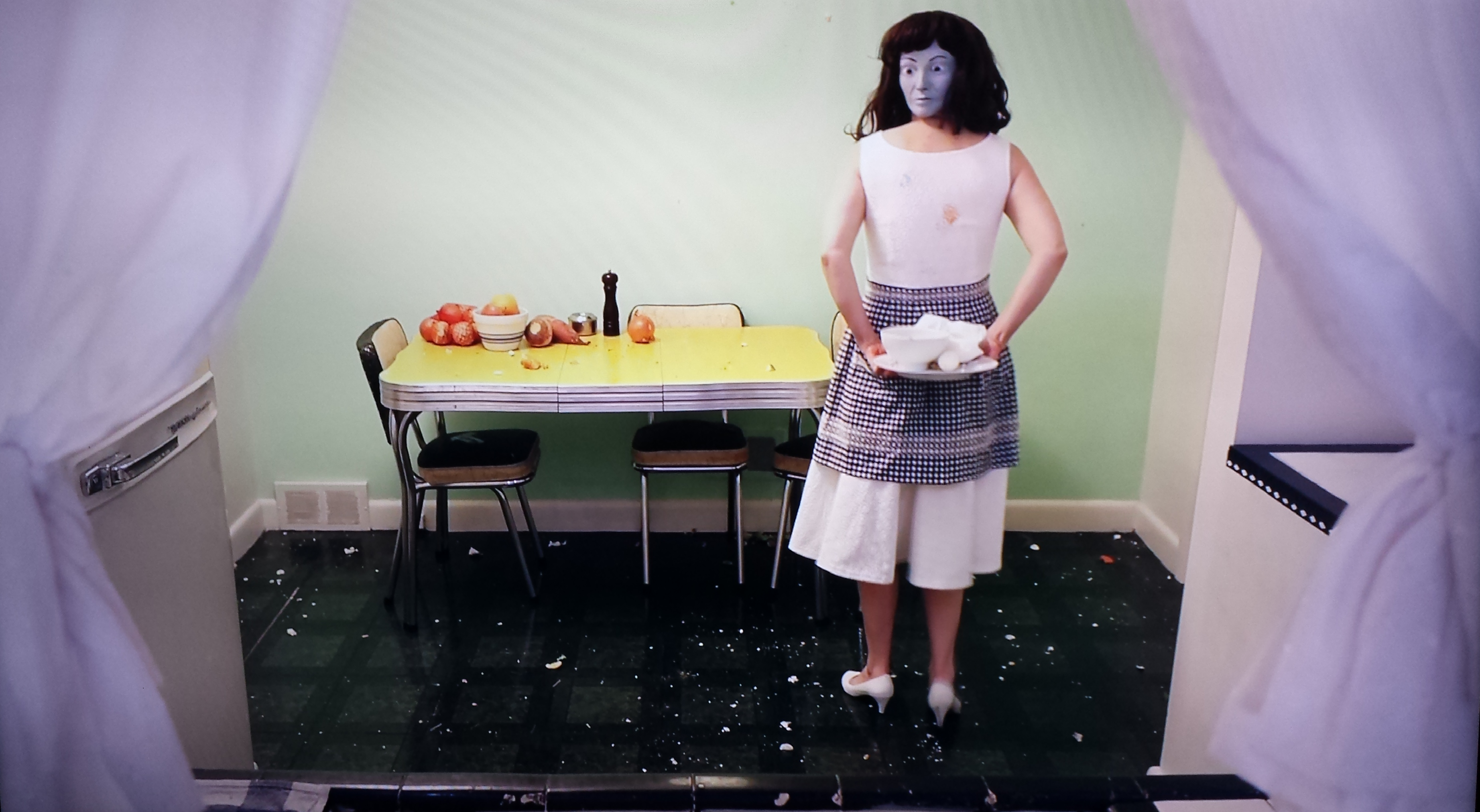
The victim of a medical experiment, perpetrated without the consent or knowledge of patients, Sarah Ann Johnson’s grandmother suffered crippling depression and agoraphobia following her treatment.  Sarah Anne Johnson explores this trauma, which continues to ripple through generations of her family, in a video installation called The Kitchen.


Sarah Anne Johnson 1

Still from The Kitchen by Sarah Anne Johnson

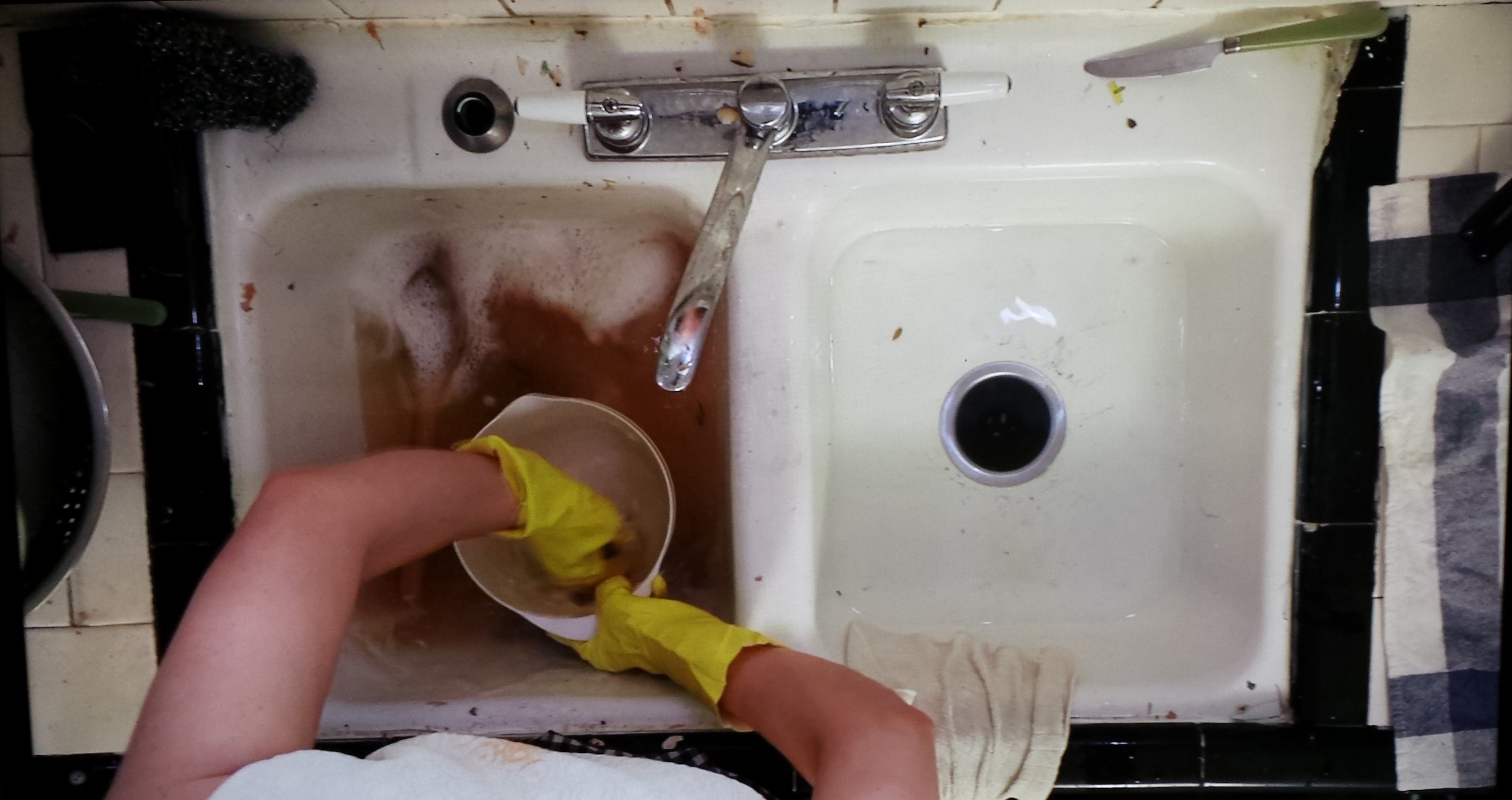
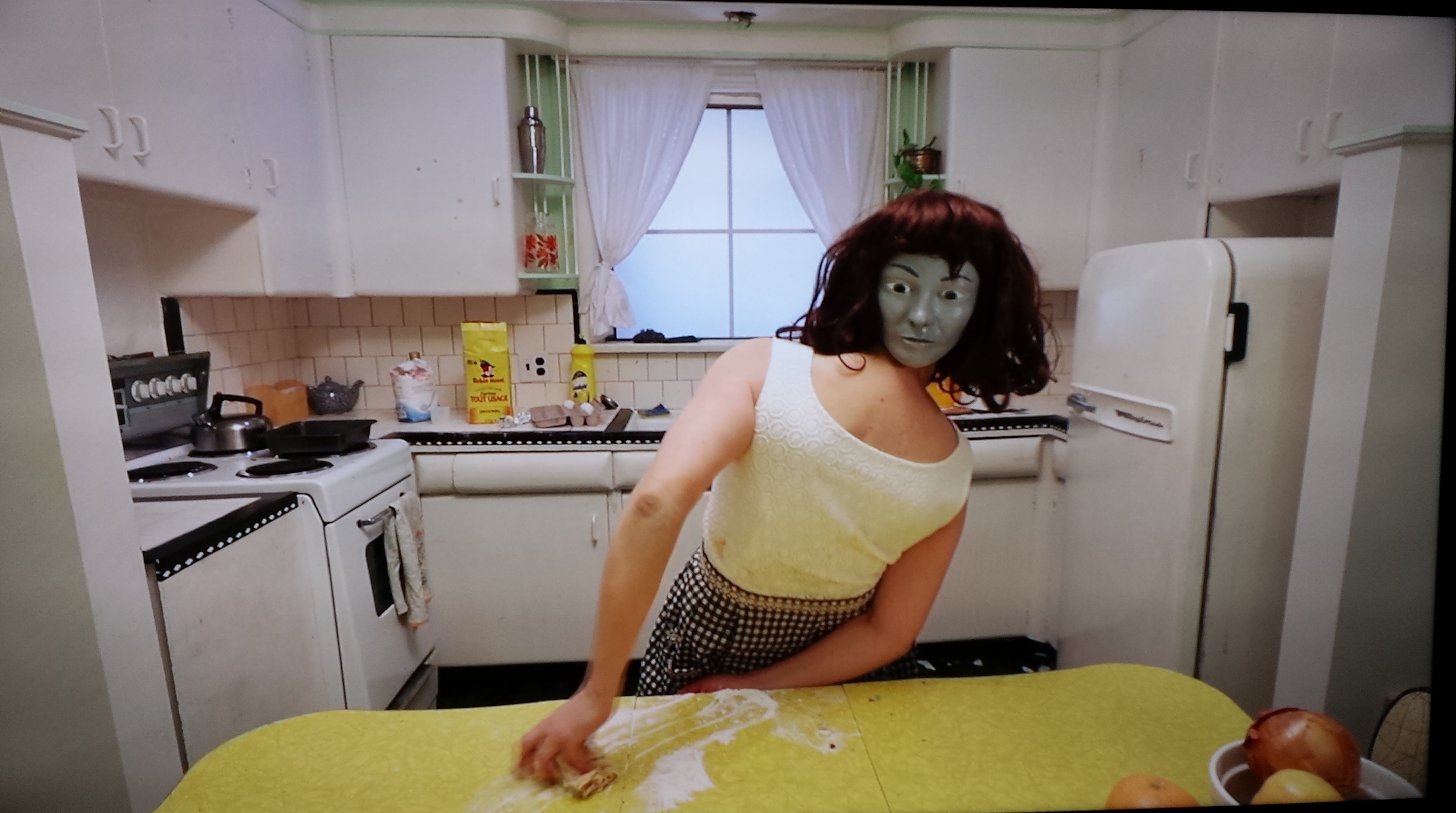
On numerous monitors we watch short loops of a woman, alone, on a kind of stage set which is a kitchen.  The clothes and decor signify the nineteen fifties.  She wears a dress and heels but everything else is wrong.  This woman is strangely afflicted, nuts probably.  A mask is warn on the back of her head and a wig obscures her face.  She carries out her lonely kitchen activities backwards, freakish, awkward, perpetually failing, occasionally crying out in frustration, hurling plates in this filthy kitchen where she seems to be trapped.

Sara Ann Johnson 3

Still from The Kitchen by Sarah Anne Johnson

It’s fascinating to watch the intense and torturous contortions the woman performs to carry out simple tasks as our vision flips back and forth, trying to make sense of the impossible.  And maybe that is what Sarah Anne Johnson is getting at: the misery of trying to succeed in an situation which is impossible.

Sara Ann Johnson 4

Still from The Kitchen by Sarah Anne Johnson

kitchen-screen_shot_web

Still from The Kitchen by Sarah Anne Johnson

In a separate room, a projected video in black and white, shows the same woman.  She is still in the kitchen.  Now she lies on the floor, trundling heavily in an abstract, compulsive manner.

In acting out these moments in the kitchen Sarah Anne Johnson may be re-creating childhood memories or simply seeking to understand her family and herself.  The art work she comes up with has a strange tragic aspect to it, dark and painful.

November 30, 2015

Koffler Gallery – Isabel Rocamora

Yesterday was the last chance to see the Isabel Rocamora show – titled Troubled Histories, Ecstatic Solitudes – at the Koffler Gallery.  The exhibit, dominated by three large-scale video projections, opened way back on September 17, and it is utterly prescient in terms of its grave, unflinching tone and the subject matter it contains.

Rocamora_399_1_web

Still from Body of War by Isabel Rocamora

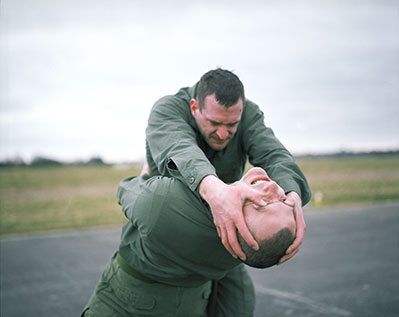
In Body of War Isabel Rocamora probes the phenomenon of close-up brutality.  In an extended sequence the camera warily circles a fight to the death between two anonymous soldiers.  Staged on a barren runway beneath grey skies, this grim, slow battle confusingly becomes a kind of homoerotic dance from which there is no escape.  A soundtrack of medieval-like, choral chanting heightens the sense of ritual and archetype in this piece. Eventually a victor is left standing, panting and jubilant, and the camera turns away to slowly penetrate the opening of a nearby bunker.  The desultory movement toward darkness creates a truly horrifying moment.

Rocamora_399_2_web

Rocamora_399_3_web

Stills from Horizon of Exile by Isabel Rocamora

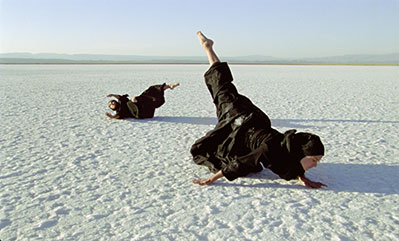
In Horizon of Exile, a two channel video piece, snippets of monologue hint at the reasons a women must leave her home and set off into a barren, windswept desert.  Against an elegiac score and relentless wind, two women then perform a mesmerizing rolling dance, where they are carried like flotsam across a glittering salt flat in a God forsaken plain somewhere.

Rocamora_399_4_web

Stills from Faith by Isabel Rocamora

An Orthodox Jew, a Greek Orthodox Christian and a Sunni Muslim are all engaged in prayer in Isabella Rocamora’s three channel loop called Faith.  Filmed in a craggy desert that reads “holy land” they are united in ancient transcendent practices.  The religious trappings – the robes, the gestures, the pious heavenward gazes, the fervent ritualized murmuring – are remarkably alike.  In fact not much is separating these men of God from one another, and yet, Isabel Rocamora seems to be saying, the superficial similarities are meaningless.  Tradition is terminally unique.

I really liked seeing this show: The stark graphic power, the rich soundscapes, the choreography of the camera and the subjects, and the potent imagery.  Ultimately the work struck me as very dark: The subjects are all unable to break out of age old oppression, each is condemned to endlessly repeat the rituals of the past and passively accept their fate.

Typology – Nicolas Fleming

Fortunately, it is possible to go shopping for handmade items on the third floor of Artspace Youngplace otherwise I would not have trekked upstairs and come across the tiny gallery called Typology.

TH_4971_web-610x407

Installation shot of Moving Right Along by Nicolas Fleming

An installation by Nicholas Fleming called Moving Right Along is about to close.  I’m glad I caught this show.

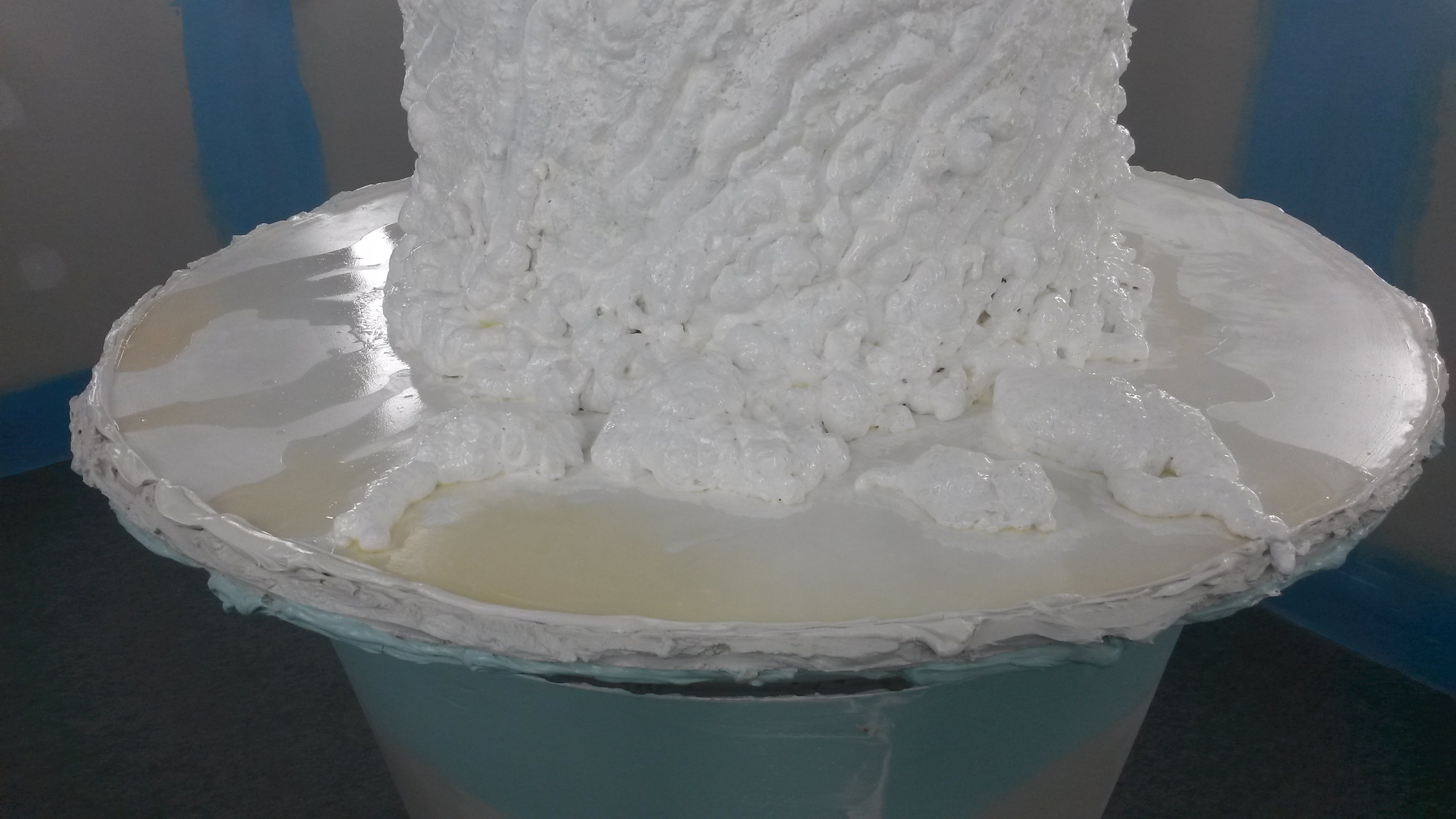
Nicholas Fleming must be a very energetic guy.  He has built an entire room within the gallery, except that it is all delightfully backwards so that drywall, spackling paste, chipboard and insulation foam are on display and the smooth, white gallery walls with crisp corners and subtle lighting are hidden.  It’s kind of like putting a dress on inside out.

An unmistakable Home Depot fragrance wafts into the hallway from Typology.

I really liked looking at the “fountain” in the center of the space.  It has ghastly, poisonous look to it.  Something toxic appears to be weeping from the hardened foam to create a pool, coated in noxious sheen, at its base.

20151129_135023

20151129_135006

Installation shots of Moving Right Along by Nicolas Fleming

No doubt Nicholas Fleming allies himself with Minimalism, Arte Povera and various Conceptual Art branches emerging in the 1970s but what is so interesting about this show to me is the exotic beauty created by these humble materials which leads to the whole idea of the infrastructure of our society and how it is hidden and denied and avoided, with perilous consequences.

April 28, 2015

The Power Plant – John Akomfrah

The Unfinished Conversation, the three channel video installation by John Akomfrah, is so dense with ideas and images that I was obliged to make a return trip to The Power Plant and watch it multiple times.  Projected in a hushed room, on massive screens, and featuring a sound track that is at least as rich and layered as the visual component, I found every viewing of this artwork a rewarding experience.

20150429_120016

Installation view of The Unfinished Conversation by John Akomfrah

The cultural theorist Stuart Hall is the ostensible subject of the piece and his personal and professional life is effectively traced within it.  Visually and structurally, Stuart Hall functions as a fulcrum – around which a kaleidoscope of images swirl – illuminating societal and cultural forces at work, first in his home country of Jamaica, and then in Britain in the 50s, 60s and 70s.  John Akomfrah seemed to have access to the BBC archives as these distant eras are brought to life with so much fascinating material, including TV programming from the time, news footage, photographs and sound recordings.

20150429_122351

Installation view of The Unfinished Conversation by John Akomfrah

Stuart Hall came to the UK as a Rhodes Scholar in 1951.  He produced important academic writings, particularly theories of mass communications and he expanded the idea of cultural studies in the academic world.  But he hardly confined his activities to academia.  He was also a prolific journalist, television personality, champion of the arts, and is often referred to as the “Godfather of Multi-Culturalism” for his work in these various media on immigration, race and the politics of power.  Stuart Hall died in 2014.

20150430_133419

20150429_120356

Stills from The Unfinished Conversation by John Akomfrah

“Identity is an ever unfinished, endless conversation” is a (paraphrased) statement made by Stuart Hall in the video.  His own identity was shaped in the intensely race conscious Jamaica in which he felt an outsider even in his own family.  He longed to be part of the modern world and for West Indians of that era the UK was an escape and a second “home,” to which, he decided soon after his arrival there, he would never belong.

The sixties in the UK were not just about mini skirts, the Beatles and Mandy Rice Davies!

profumo_2443150b

Mandy Rice Davies and Christine Keeler

With a focus on the impact of British colonialism around the world a steady drumbeat of upheaval is referenced in the artwork: Conflicts like the Soviet Invasion of Hungary and the Suez Crisis; social movements like the protests by the Campaign for Nuclear Disarmament, natural disasters of every kind, the 1963 Profumo scandal, workers strikes, the beginning of the wars in Asia, mass immigrations, the travails of the poor in Northern England, Civil Rights demonstrations, the rise of consumerism are all depicted in this piece.  These events affected and changed the individual known as Stuart Hall, along with millions of other individuals.

20150429_122033

Installation shot of The Unfinished Conversation by John Akomfrah

Readings from William Blake, Charles Dickens, Virginia Woolf, Mervyn Peake and others, lectures and personal reminiscences by Stuart Hall, and music, particularly jazz of the era, along with sounds of all kinds are woven together to add much of the emotional resonance of the artwork.  The audio reaches a kind of crescendo at the point where Mahalia Jackson sings an extraordinary version of Silent Night, tears streaming down her face, within a melange of images including an actual birth.

unfinished-conversation-13

Mahalia Jackson in still from The Unfinished Conversation by John Akomfrah

Below is an (incomplete) list of countries and the dates they achieved independence from the United Kingdom.

  • 1922 – Egypt
  • 1932 – Iraq
  • 1947 – India
  • 1956 – Sudan
  • 1957 – Ghana
  • 1958 – Sierra Leone
  • 1960 – Nigeria
  • 1961 – Tanzania
  • 1962 – Uganda, Jamaica
  • 1963 – Kenya
  • 1964 – Zambia, Malawi
  • 1966 – Botswana, Lesotho, Barbados
  • 1967 – Yemen
  • 1970 – Fiji
  • 1971 – Qatar, Bahrain
  • 1974 – The Bahamas
  • 1980 – Zimbabwe

April 19, 2015

A Space Gallery

Hermann Nitsch, the Austrian artist, born in 1938, and famous for his bloody “Aktions,” recently had a planned exhibition in Mexico City cancelled because of the protests of animal rights activists.  Torn apart animal carcasses, buckets of blood and offal, fake crucifixions, ritual animal slaughter are all part of Hermann Nitsch’s performance art.  Numerous volunteers assist in these events which are described as “life affirming mass intoxications.”  Old Hermann Nitsch began to do this work in the 60s as the Theatre of Orgies and Mysteries.  “Splatter paintings” by Hermann Nitsch are exhibited at the Saatchi Galleries in London.

Hermann-Nitsch-2-397x600@1x

Hermann Nitsch

Here in Toronto’s A Space, in an exhibition titled A Non-Space at A Space, by the Art Collective Postcommodity, video documentation of the slaughter of a single sheep is on display.  Relative to a Hermann Nitsch bacchanalia, and its bloody methaphoric stew including the Catholic Church as well as Broadway, this is a simple act.  The sheep is butchered in the bathtub of the Gallup Motel by an attractive woman identified only as a former Miss Navajo beauty contestant.  We see Miss Navajo lead the docile animal from the sunny, southwestern exterior to the motel’s bathtub.  The animal’s throat is slit.  It quickly dies.  The carcass is expertly skinned and the body is rendered into meat.

20150418_153225 20150418_153207 20150418_153505

Stills from Gallup Motel Butchering by Postcommodity

Butchering of livestock is routine and takes place around the world in factories, farms and probably bathtubs. Ms. Navajo’s ancestors in Gallup, would have been slaughtering animals for many thousands of years in this region.  But not sheep.  Sheep are European imports.  Sheep arrived in North America around 1600. (I wrongly identified the animal as a goat in my original post.)  It would have been an entirely different kind of video – more action and adventure – if, for example, an antelope (actually a Pronghorn), indigenous to North America, were brought back to the Gallup Motel.

Pronghorn

Pronghorn (North American antelope)

The event in the motel room was recorded at various angles by at least four cameras.  The images are projected big and on every wall of the rather small space.  It’s oppressive, even alarming.  The viewer is hemmed in by the flashing knife, the gore, the tugging and snapping of bones, tendons, vertebrae as the blood circles the tub’s drain.  It struck me that this profound act, performed in a spirit of cultural empowerment, within the down market motel room, is enough.  The fast edits and multiple supersized screens are superfluous.

20150418_153412

20150418_153434

Stills from video installation by Postcommodity Art Collective

In the room next door the Postcommodity Art Collective presents a two channel surveillance video of residences of the affluent middle class in the Santa Fe area called My Second Home, But I Have a Very Spiritual Connection With This Place.  (I love surveillance video and the quiet dark room was a relief after all the slaughter in the bathtub.)  I guess the point is the houses have that adobe look in historical accord with the surroundings.  I have never been to Santa Fe but oddly enough you can see the adobe look in some of the suburbs of Winnipeg, which takes appropriation to a whole other level.

Winnipeg

Winnipeg interpretation of the Santa Fe style

In the writing that accompanies the exhibition the terms “settlers” and “colonizers” are used.  The show’s curator, Ellyn Walker, in a short bio, is compelled to identify herself as a “settler” of Scottish and Italian descent.  What does this racial identification by the curator mean?  Is this the politically correct end game in which ancestry must be declared and then judgement is passed?  I find this a depressing trend.