Here’s something you may or may not know: say your laptop gets wet, due to an unfortunate incident. You dry it out for a day or two and suddenly it comes back to life. All is well! These things happen, after all. Six months later it won’t turn on and when you take it back to Best Buy you learn it is filled with rust and useless. You have to buy a new one.
The Alison Milne Gallery, tucked away on Osler Street above Bloor, is a cool, stylish oasis in the urban summer and the current show, part of the city-wide CONTACT Photography Festival, brings a note of self-possessed LA glamour to the Junction.
I couldn’t help wondering if Dean West is a made up name. Maybe its because the photographs are all about surface, artifice and style. In this exhibition, titled The Painted Photograph, people and objects populate hyper-art directed environments.
There is not a trace of the messiness of life in these sumptuous art works.
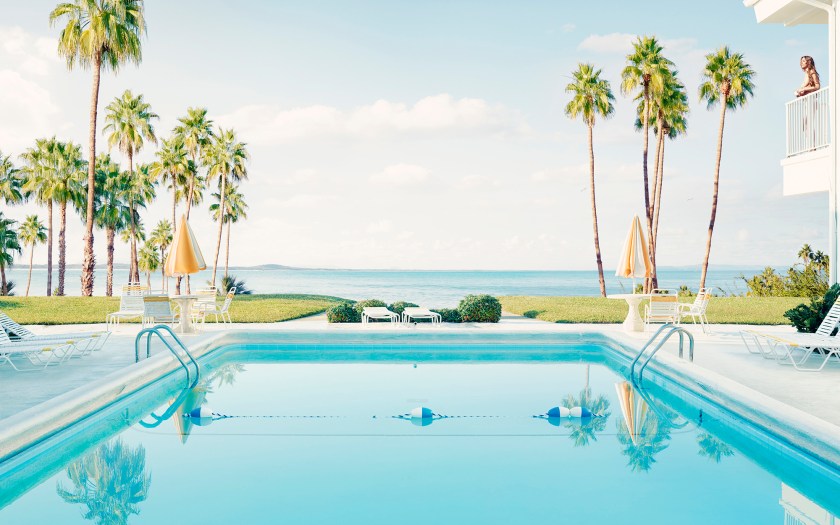
St. Pete Beach by Dean West
This vista is so pristine it does appear to be kicked up a notch on the realness scale and hence painted. Possibly there is an Instagram filter that creates such a vivid blue. Maybe X-Pro II or…Mayfair?
Some colours are owned by certain artists. I guess David Hockney lays claim to this particular shade of aqua, so much so that Dean West placed him poolside, in the photo shown below, looking relaxed, enjoying a smoke and the view.
Palm Springs #2 by Dean West
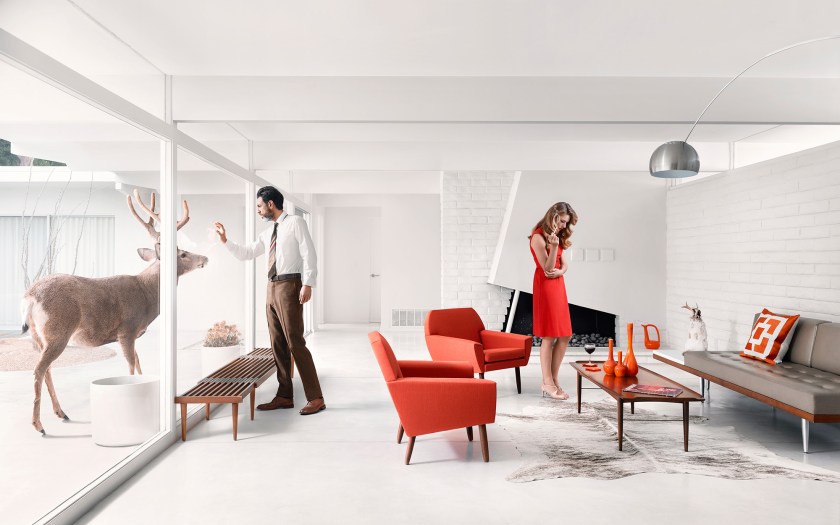
My favourite piece in this show has to be the domestic interior: the red and white, the fireplace, the bizarre presence of a reindeer, the oppressive tension, the eerily disconnected couple, all these elements work together to create a updated Surrealist Christmas card for the moment.
Palm Springs #1 by Dean West
Imagine hanging out with these two, in this sterile room, with a low ceiling. I like the way Dean West takes a fashion shoot type concept it makes it suffocating and ghastly.
Detail of Orient Point Ferry by Dean West
When is a celebrity not a celebrity? I think in this Dean West photograph the celebrity is used more as a signifier of artifice than for any typical celebrity points. (Of course this guy does not present like a standard celebrity. He has a somewhat clownish demeanor. He is overweight and he wears a pained expression rarely seen on a celebrity.) And whereas normally celebrities in art are tiresome in this case it really works. The idea of cast of characters is pumped up to constitute another element along with the colours, the angles of gaze, the perfect light and the flawless sea.
Our culture is so saturated with these larger than life figures that seeing one used in this context was refreshing. But … generally I’m tired of celebrities and their feckless antics and I was happy to read the recent article in the New York Times defending Gawker and their “opposition to the triumph of celebrity culture.” Down with the mono-culture! Long live Gawker!
I was wandering by the Piri Piri Churrasqueira Grillhouse at the corner of Dupont and Campbell and took some time to check out the neighbourhood. Just a few steps north there is a cluster of no-nonsense, newish buildings. They look like the kind of place you might go to pick up parts for, say, a malfunctioning Moccamaster or maybe confer with an insurance broker. But no, in fact, here is a chance to look at art in Toronto.
Speleogenesis, I have just learned, means the origin and development of caves. In the exhibition of paintings by David Clarkson, called Remotes, caves function as formal device, content and metaphor.
Here’s another word you don’t hear often: trippy.
On entering David Clarkson’s show there is a painting by the door. It depicts a rabbit hole, yes, the pathway that Alice took into the discombobulating environment that made no sense. In this painting bunnies, giant gems and a perfect oval looking-glass are bathed in a dreamy blue light. For me this painting set up the whole show with a feeling of philosophical nonchalance. The viewer is free to descend into a labyrinth of ethereal vistas and subconscious triggers without any kind of didactic price to pay.
Detail of Rabbits and Mirrors by David Clarkson
The cave imagery is a constant in the show. Such a potent symbol could be heavy handed but David Clarkson creates unpredictable, droll and imaginative art work that never stumbles into cliche.
Cascade and Curtain by David Clarkson
Looking at Cascade and Curtain the viewer is in utterly unknown territory, gazing outward through the pictorial plane to glimpse what lies beyond the shimmering veil of liquid. Which way is the sinuous sluice spilling? Into the frame or out of it?
The inclusion 0f photographic elements, pop art fragments and tiny renderings of hallucinatory creatures combine to form an otherworldly tableau. But it is the striking formal aspect – the yawning mouth of the cave – that creates such a powerful image.
Moth and Frog by David Clarkson
A sense of claustrophobia dominates the painting above as ice and mist frame a route to open air but no, it is another cave that confronts the viewer, like a maddening hall of mirrors. Life is delicate but relentless in this harsh environment. And consciousness is brutally linked to physical realities.
Statues and Fog by David Clarkson
In Statues and Fog surrealist tropes litter a grim trail to the void. Here the cave is the tough slog of life itself.
Around the corner on Dupont there is an exhibition by Elise Rasmussen called Fragments of an Imagined Place. (…am I detecting a theme…?)
As part of the artwork Elise Rasmussen declares that the myth of Atlantis “serves as a metaphor for the artistic practice.” Within this context she presents some fascinating fragments of a Robert Smithson piece that was never created.
Detail of Fragments of an Imagined Place by Elise Rasmussen
People had a very different appearance in 1970 than they do today. Within the selection of xeroxed newspaper clippings, cartoons, letters, pamphlets and snapshots is a picture of Robert Smithson posed as a rugged outlaw. Truly, this artist was onto something new, big and bold and he looks the part.
Robert Smithson circa 1970
The planned Earthwork was called “Glass Island” and it was to be constructed off the British Columbia coast near Nanaimo. One hundred tons of broken glass were held at the border and finally sent back to Los Angeles. Environmentalists opposed the project.
Installation view of Robert Smithson’s “Map of Broken Glass (Atlantis),” 1969
Included in this sort of scrapbook-like array are copies of the Robert Smithson drawings for other Earthworks. It was so startling and refreshing to see these humble drawings on graph paper, efficiently packed with ideas and potential.
Detail of Fragments of an Imagined Place by Elise Rasmussen
I really liked observing the connection Elise Rasmussen created with Robert Smithson and his beautiful idea of a glass island. She also produced a video in connection to the unmade piece. Dancers in white stretchy pants and pastel t-shirts gingerly hold shards of coloured glass move and about in a serious though desultory way.
Still from Video Fragments of an Imagined Place by Elise Rasmussen
Lately I have been obsessed with getting to work on time. If I’m late I might not have a place to sit. There are always a few latecomers lugging their laptops down to Starbucks to set up shop for the day and I don’t want to be one of them. I tried working from home – some people (slackers?) seem to love it, but not me. My home life and my work life start to become one seamless parade with work edging out home until it seems like that’s all I do. I started going in to the office again, joining the flow of humanity on the TTC, earlier and earlier, 7:30, 7:20, 7:15…And then I remembered: Looking at Art in Toronto.
Trinity Square Video’s new location is not optimal for viewing. Skylights wash out the projected video images. (I was advised they are fixing the problem and custom blinds are on order.) Fortunately, the inaugural exhibition of the space features work by Heather Phillipson, and the show, titled “sub-fusc love-feast,” has such a powerful audio component that the diminished visual impact is hardly missed.
Installation view of sub-fusc love-feast by Heather Phillipson
Also, three video projection screens are tucked into an elaborate installation of cut out photographs. It’s like walking around in an oversized collage, cut out from cheerful travel postcards and National Geographic magazines.
Installation views of sub-fusc love-feast by Heather Phillipson
The layers of sound and music, dominated by a bell-like female voice, are completely absorbing. Heather Phillipson is a thinker and a poet. She takes on the slippery task of defining nature in this era of unrestrained production and gives voice to the places, things and animals caught in the terrifying cycles of consumption.
The piece has a plaintive, uncertain feel to it, the sound in particular grows panicky at times and fearful. This makes sense given the subject matter. Heather Phillipson explores the grim news that is easier to deny than accept; the scale and finality of the environmental crisis that looms over us all.
The victim of a medical experiment, perpetrated without the consent or knowledge of patients, Sarah Ann Johnson’s grandmother suffered crippling depression and agoraphobia following her treatment. Sarah Anne Johnson explores this trauma, which continues to ripple through generations of her family, in a video installation called The Kitchen.
Still from The Kitchen by Sarah Anne Johnson
On numerous monitors we watch short loops of a woman, alone, on a kind of stage set which is a kitchen. The clothes and decor signify the nineteen fifties. She wears a dress and heels but everything else is wrong. This woman is strangely afflicted, nuts probably. A mask is warn on the back of her head and a wig obscures her face. She carries out her lonely kitchen activities backwards, freakish, awkward, perpetually failing, occasionally crying out in frustration, hurling plates in this filthy kitchen where she seems to be trapped.
Still from The Kitchen by Sarah Anne Johnson
It’s fascinating to watch the intense and torturous contortions the woman performs to carry out simple tasks as our vision flips back and forth, trying to make sense of the impossible. And maybe that is what Sarah Anne Johnson is getting at: the misery of trying to succeed in an situation which is impossible.
Still from The Kitchen by Sarah Anne Johnson
Still from The Kitchen by Sarah Anne Johnson
In a separate room, a projected video in black and white, shows the same woman. She is still in the kitchen. Now she lies on the floor, trundling heavily in an abstract, compulsive manner.
In acting out these moments in the kitchen Sarah Anne Johnson may be re-creating childhood memories or simply seeking to understand her family and herself. The art work she comes up with has a strange tragic aspect to it, dark and painful.
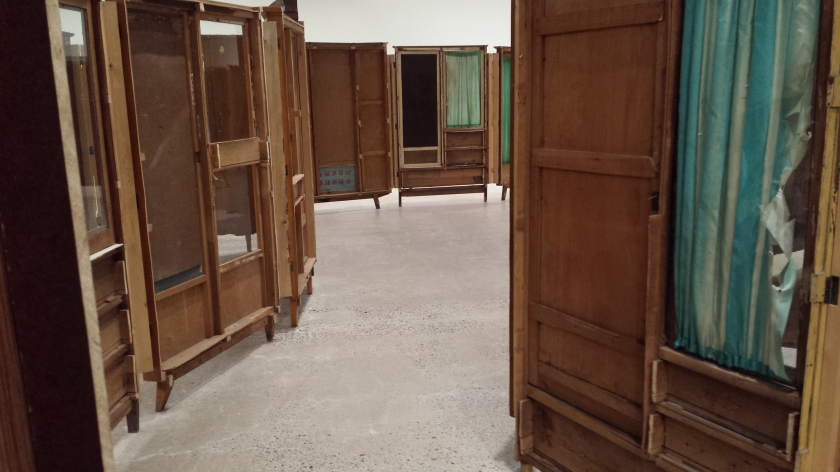
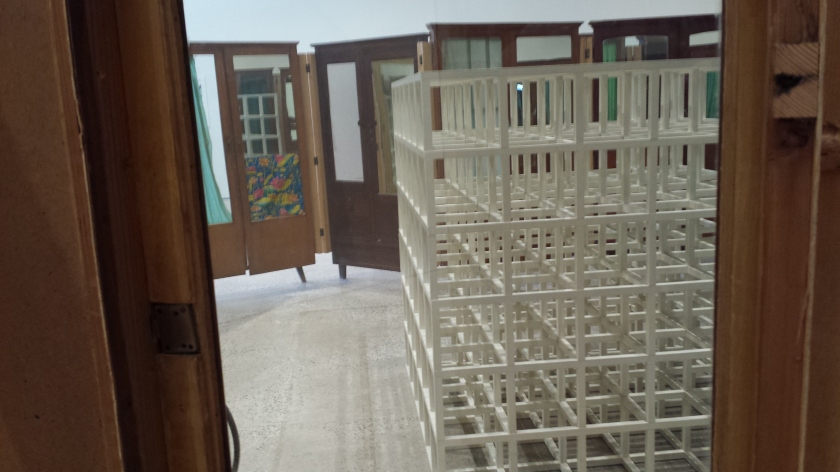
Wisdom of the Poor: Communal Courtyard is the name of the installation by Song Dong at the Art Gallery of Ontario. The piece has the strange effect of slowing down time and creating a consuming sense of melancholy. The viewer steps out of the moment and into a maze, composed of antique wardrobes, and, concurrently, into a bygone era.
Detail of installation by Song Dong
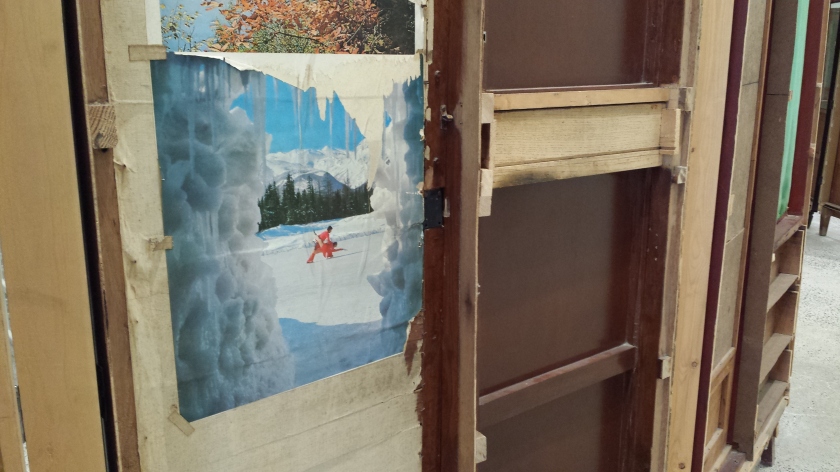
The wardrobes have been dismantled and roughly knocked together to create twisting, labyrinthine passageways. Bits of fabric, modest curtains, broken locks, faded posters and other sentimental items cling to the gutted furniture and add to the sense of forlorn domestic ruin.
Detail of installation by Song Dong
The art piece feels funereal, and there is the lingering presence of ghosts. Glimpses through openings may reveal another viewer wandering hesitantly, an abandoned bicycle or perhaps a rising tower (wait, its the AGO’s Sol Lewitt sculpture and elsewhere is the AGO’s Warhol portrait of Karen Kain.)
Detail of installation by Song Dong
China is famously changing at a breakneck pace despite an increasing public outcry against the demolition of historic neighbourhoods and a gathering preservationist movement. Song Dong taps into a powerful emotional yearning for an idyllic past that is felt apparently all over the world. The object of the loving backward gaze could be the narrow, crowded streets of bygone China or …… Mayberry. In North America this imagery can be baldly manipulative romanticism, covering for a suspect agenda, but what it is in China I do not know.
Mayberry set
Admittedly there are some very appealing aspects to the decades past. For example, long before the rise of Twitter and ISIS (forever linked in my mind) anyone could smoke and drink with abandon, even on airplanes. But is it my actual memories that view these activities fondly or is it the “Mad Men” portrayal of them that I like?
Smoking on airplanes through the eyes of the creator’s of “Mad Men”
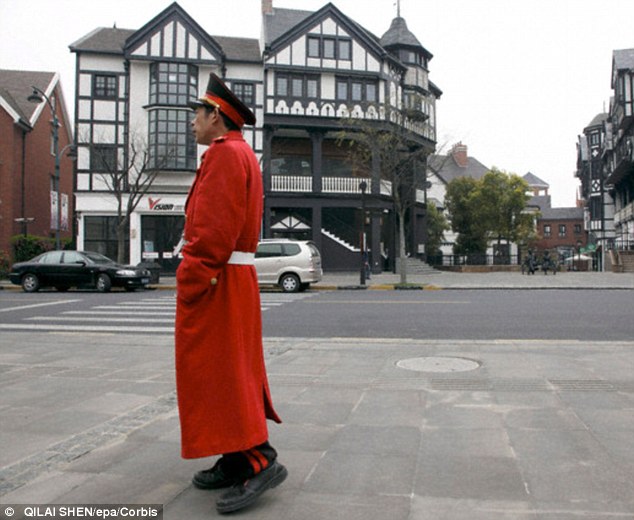
Meanwhile the unrestrained development in China has not only resulted in the spectacular buildings we see in the media but some weirdly manufactured nostalgia, for example Thames Town, built to look like a charming Tudor town in the English countryside.
Thames Town, 19 miles from Shanghai
***
Bau-Xi Photo – Lori Nix
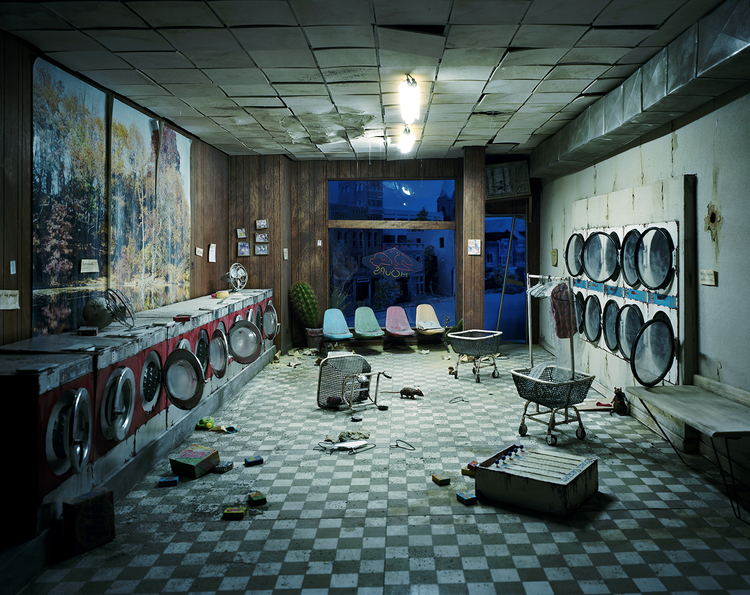
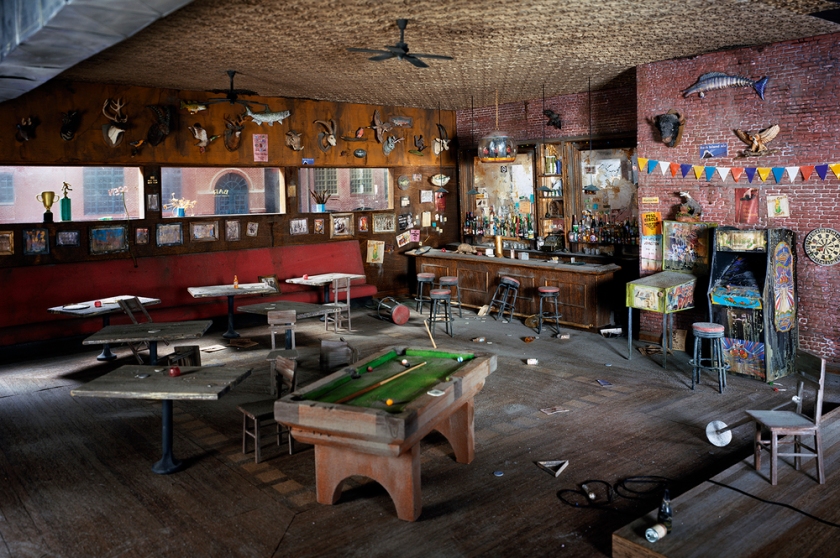
All over North America laundromat seating is the same. I may have known this as a fact before I saw the show of photographs by Lori Nix at Bau-Xi Photo, but to be honest I never really thought about it much. In Lori Nix’s photo of a post-apocalyptic laundromat (shown below) under dreadful fluorescent light, the seats are identical to those at the “Coin Wash” in the vicinity of Dundas and Keele. In fact everything is exactly right, except of course the obvious…
Laundromat at Night by Lori Nix
What I liked about looking at these photographs was noticing the detail and how exacting and precise it is. Lori Nix builds miniatures of scenes she comes across in her daily life and then she photographs them. (To learn how she does this click on the link.)
Lori Nix does not replicate reality. In all her photographs something is off, really off. Something has occurred. Things will never be the same.
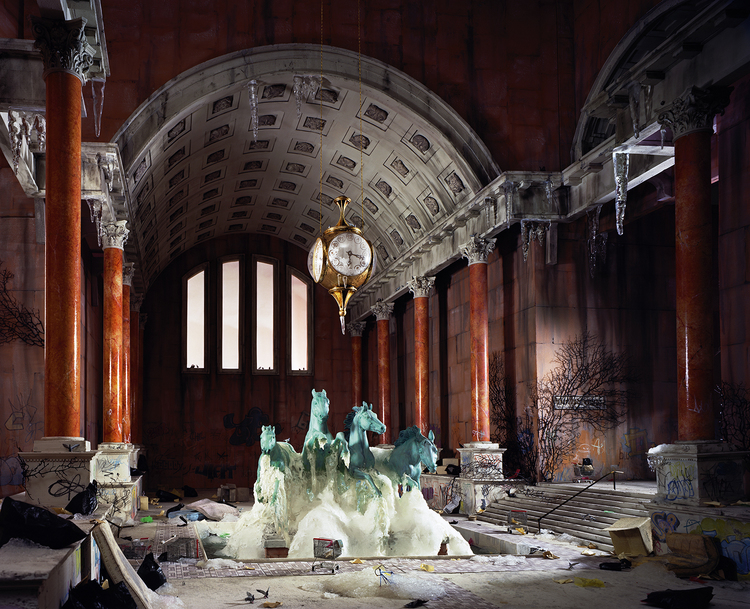
Fountain by Lori Nix
What’s going on in Fountain, the art work shown above? A spectacular public space has been vandalized and then abandoned entirely. The bronze sculptures have deteriorated, maybe because of chemicals in the atmosphere, such as chlorine, sulfur, nitrogen oxides or maybe just rain. Vines have overtake graffiti and then all (hubris) is silenced by cold and ice.
Bar by Lori Nix
Could this be a bar in rural Ontario on any Sunday morning? It does look very familiar … except there is no hockey memorabilia.
Despite visions of catastrophe Lori Nix’s art work transmits a sense of enthusiasm for the places she creates. With meticulous patience she commits these mundane arenas of everyday life to a suspended state of timelessness.
Following an afternoon in NYC and 9 days in British Virgin Islands (BVI) it is clear there is virtually no art in BVI. New York, on the other hand, is stuffed with art. It kind of makes sense if you simply look out the window.
Shown above is the view out the window in BVI.
Shown above is the view out the window in New York.
In New York the radiators hiss and clang and strange cries rise from Second Avenue, four floors below. It is a John Cage symphony here in this overheated loft and time to rush downstairs into the brittle cold and take a walk.
There are two Lehmann Maupin galleries. I dropped into the one on Chrystie Street.
Lehmann Maupin – Catherine Opie
It turns out Elizabeth Taylor was one of those women who exists with a tiny, precious dog on her lap. She was very close to her white, beribboned, silky, toy-like Maltese called Sugar. Elizabeth Taylor’s affections, for animals, people and things are sumptuously revealed in an exhibition of photographs by Catherine Opie at the Lehmann Maupin .
The exhibition is called 700 Nimes Road, which was Elizabeth Taylor’s address in the glamorous Los Angeles neighbourhood known as Bel-Air.
Above: Installation shot of 700 Nimes Road exhibition by Catherine Opie
The photographs have the ability to transport us to this hushed, rarefied retreat where the iconic actress spent her last years in violet tinted luxury. Catherine Obie had access to the home and belongings of Elizabeth Taylor. Despite the fact that she never actually met Elizabeth Taylor the images and the “indirect portrait” they create are filled with tenderness and respectful reverence.
Below, an array of perfect sling back heels in assorted pastels, about size six, stand ready for the return of their owner as Fang strolls by.
“Fang and Chanel” by Catherine Opie
“The Shoe Closet” by Catherine Opie
“The Quest for Japanese Beef” by Catherine Opie
The jewels are photographed as transcendent objects: sometimes glowing, floating, as if glimpsed in a dream-like, delirious haze. Or as above, precious trinkets lovingly arranged.
Photograph by Catherine Opie
Luxurious bags, luggage, sunglasses are maintained in impeccable order, ready for their owner to cast a lovely violet-eyed glance their way. But sadly, Elizabeth Taylor, never returned to 700 Nimes Road. When Catherine Opie began her project in 2010 Elizabeth Taylor was hospitalized and died before it was completed.
Elizabeth Taylor, February 27, 1932 – March 23, 2011
Cheryl Donegan is carrying out a four-month residency at the New Museum. To fill up this immense period of time Cheryl Donegan started a newspaper, opened a store filled with objects she has made and/or repurposed, created an online retail operation of sorts, is planning a fashion show for the Museum in April and continually carries out performances, videos and create more objects. Simultaneously, a selection of her paintings, other works on paper, objects and videos work together to create a more conventional exhibition of the work of this artist at the Museum.
The exhibition is called Scenes and Commercials.
Looking at this work gives me the sense that Cheryl Donegan does not have much interest in tradition and yet the paintings are successful in a traditional sense. They are fun and surprising to look at and create a hectic feeling of rushing and recklessness.
Paintings by Cheryl Donegan
Cheryl Donegan is like the girl next door. She is down-to-earth, hard working and a straight shooter. She uses plaid, Kelly green and cardboard. She is earnest and curious about marketing and commerce.
Details from Concept Store by Cheryl Donegan
The idea of compression is one that Cheryl Donegan frequently references. This concept apparently has an idiosyncratic significance as she observed the gradual flattening of consumer electronics and extends its as a metaphor for society. She speaks about a hovering space of thin layers. Maybe its about the way objects and ideas are quickly used up and disposed of in our mediated world. Since nothing has any depth or substance, we need to only glance at it and move on. Social media, retail items, relationships, events and disasters around the world, beliefs, emotions are all equally shallow, feckless, consumable.
What I really liked about Cheryl Donegan’s work is that she doesn’t let all this diminishment of all things get her down. She seems to embrace the frantic pace of now and injects a joyful absurdity into it. Below is a still from a videotaped performance by Cheryl Donegan in which she paints her ass green and creates shamrock prints.
Magic, Alchemy, Astrology, Kabbalah, Spirituality, spells, Divination, extra sensory perception, trance, Wicca, tarot cards, Kenneth Anger: this exhibition covers the range occult practice and imagery. The title, Language of the Birds, refers to a particular mode of communication available to the initiated.
Although I do occasionally check my horoscope in the newspaper the occult is something I know nothing about. I was looking for some context but it was not there. Is there a current rising interest in these themes? What’s the connection between the paranormal and the normal? Why now? It’s not really clear.
The curator, Pam Grossman, a teacher of magical practice and history, has divided the numerous works into rooms titled Cosmos, Spirits, Practitioner, Alter, Spells. Many phantasmagorical things and images are displayed.
Sirens by Kiki Smith
Touch by Valerie Hammond
Astrological Ouroboros by Paul Laffoley
Could be its all about plumbing the depths of puny human understanding or misunderstanding?
Pomba-gira Maria Mulambo – Grande Circulo de Pontos Riscado [Whirling Dove Maria Mulambo – Great Circle of Scratched Points] by Barry William Hale
It’s great to go to openings for the social aspect. But for looking at art, openings are not the best. I dropped in at a Clint Roenisch gallery opening last week and could not really get a beat on the art shown.
It was so cold in the gallery that people stood outside, around a fire, to warm up.
There was a small display referencing the work of On Kawara, who died on July 10th 2014.
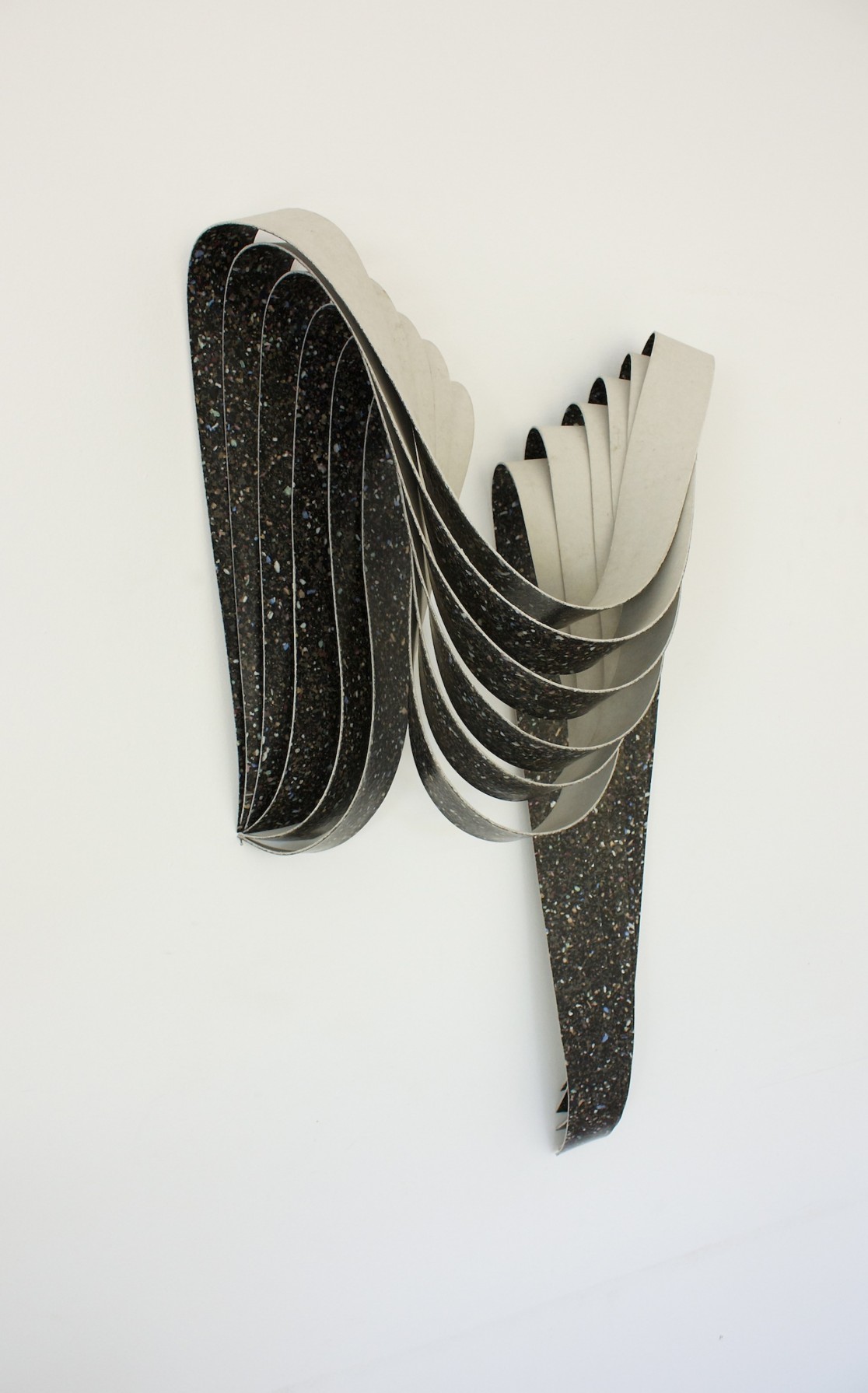
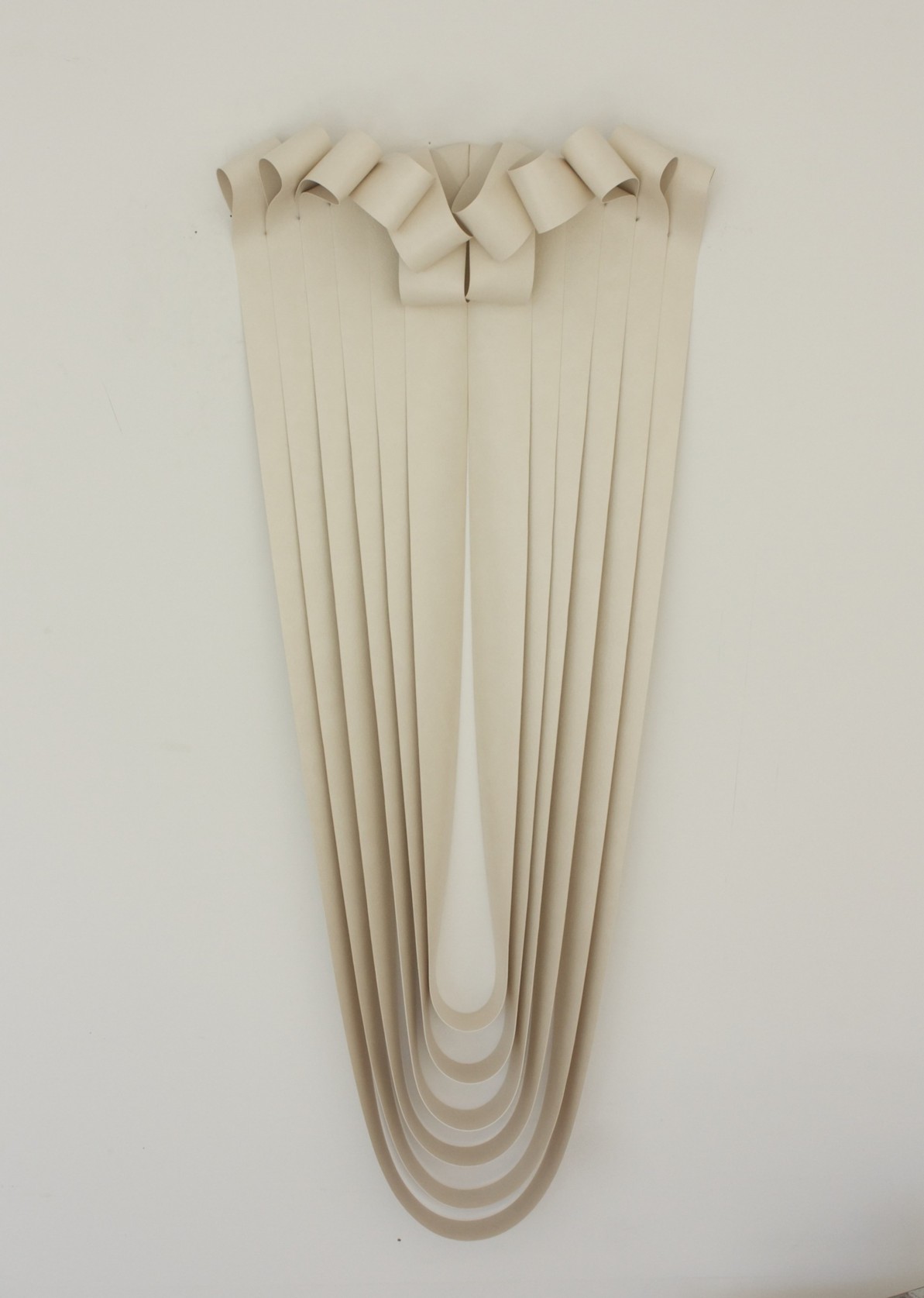
I particularly liked looking at this artist’s sculptures. Vinyl flooring, that generally banal substance, is the material Svea Ferguson uses to create these expressively nuanced three dimensional pieces. (You can almost feel the matte knife slicing through the buttery vinyl!)
“Black Sigh” by Svea Ferguson
“Untitled” by Svea Ferguson
The sculptures swoop, furl and drape with apparently effortless grace. It’s like we are programmed to respond to those elegant curves. It must be in our DNA. The bland beige and industrial black and white add a mood of detached sophistication.
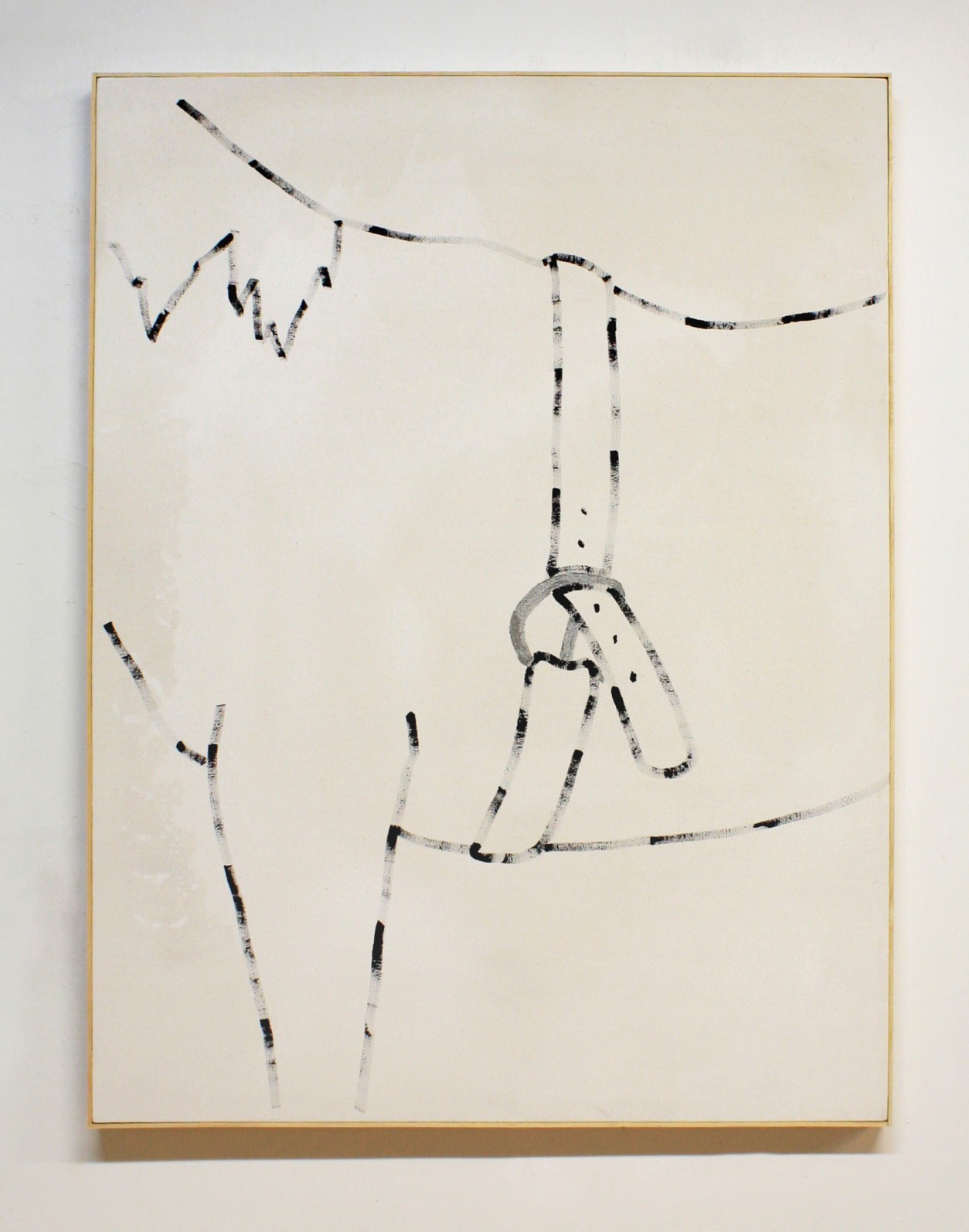
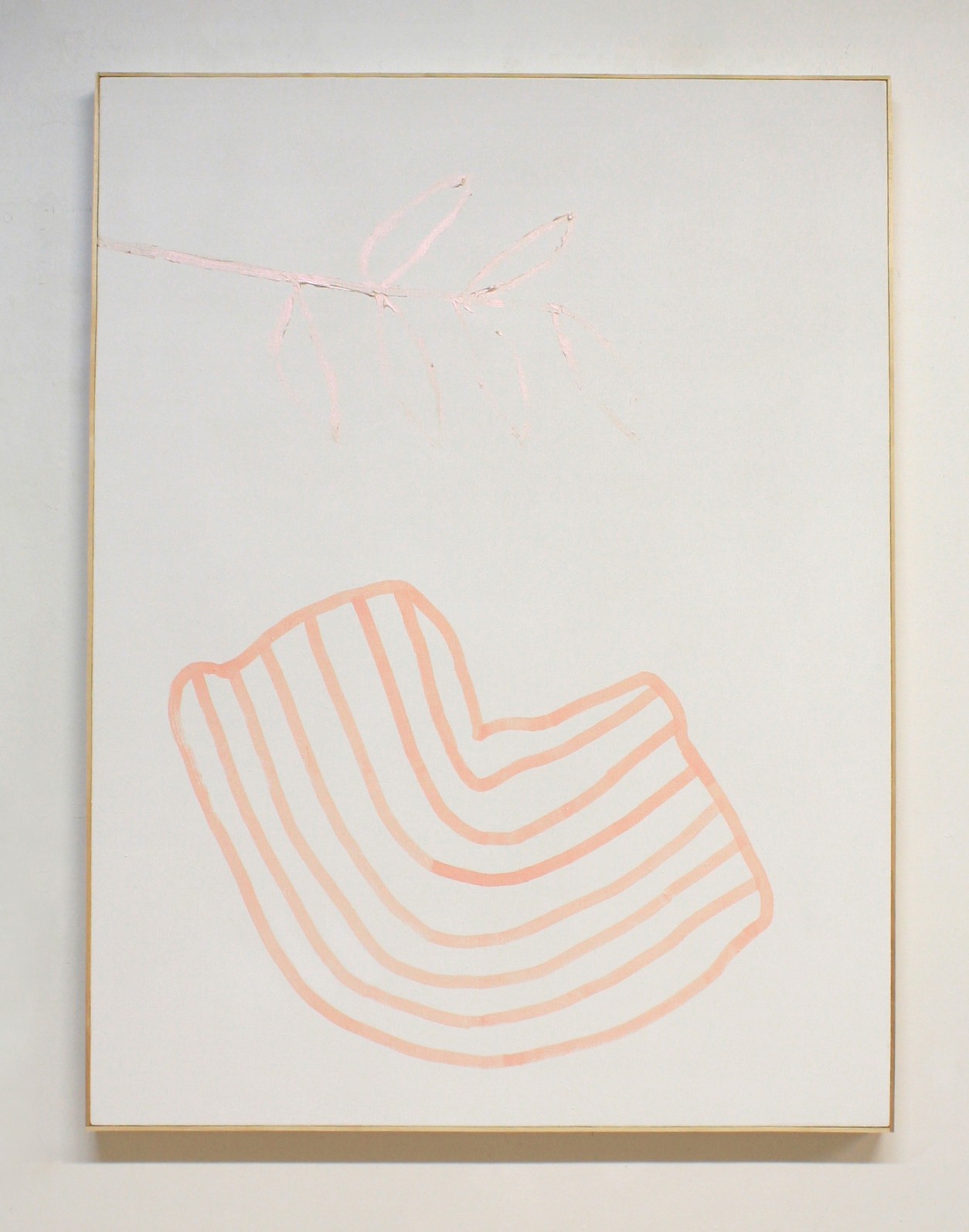
Jillian Kay Ross tells us that these paintings “function together as a collection of reassurances.” The paintings, composed of simple, spare line drawings on a white ground, do create a sense of naivete. Maybe what the artist is getting at is the trusting faith that exists only in childhood? The somewhat primitive renderings of buckled up ponies, nails, dogs and various ambiguous objects – which may or may not be related to childhood – definitely have a fey appeal.
“Like this in West Lodge” by Jillian Kay Ross
“Bent clay 2” by Jillian Kay Ross
Some of the images made me think of those few last “Lucky Charms” slowly dissolving in a bowl of milk. It does takes real faith to blow these fragments up and know that they will hold together as paintings, and they do.
—
Mythology– Wesley Martin Berg, Bryce Zackery and Daniel Boccato
Concurrent to the exhibitions by Svea Ferguson and Jillian Kay Ross is three artist show called Mythology. It’s a big space!
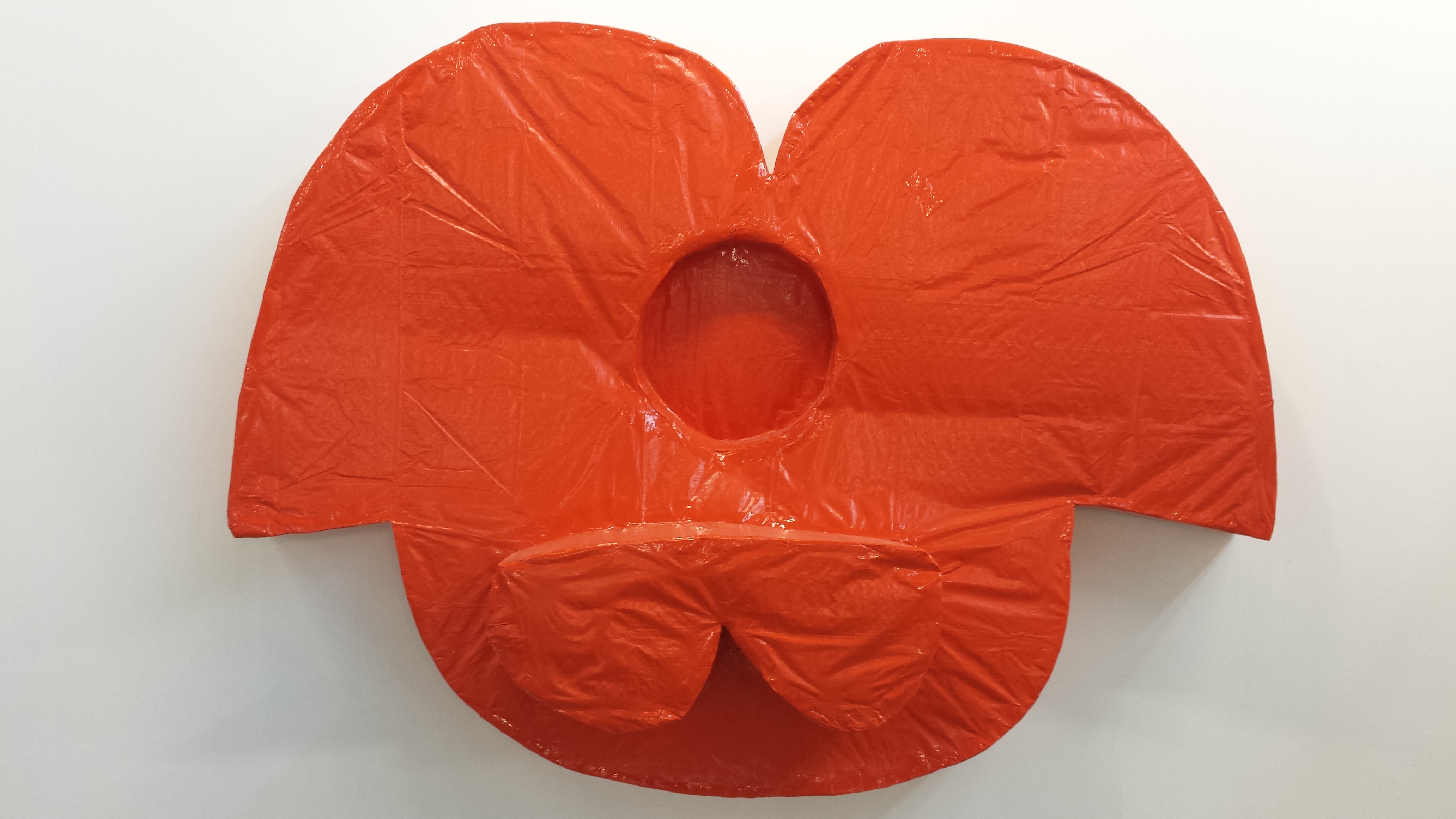
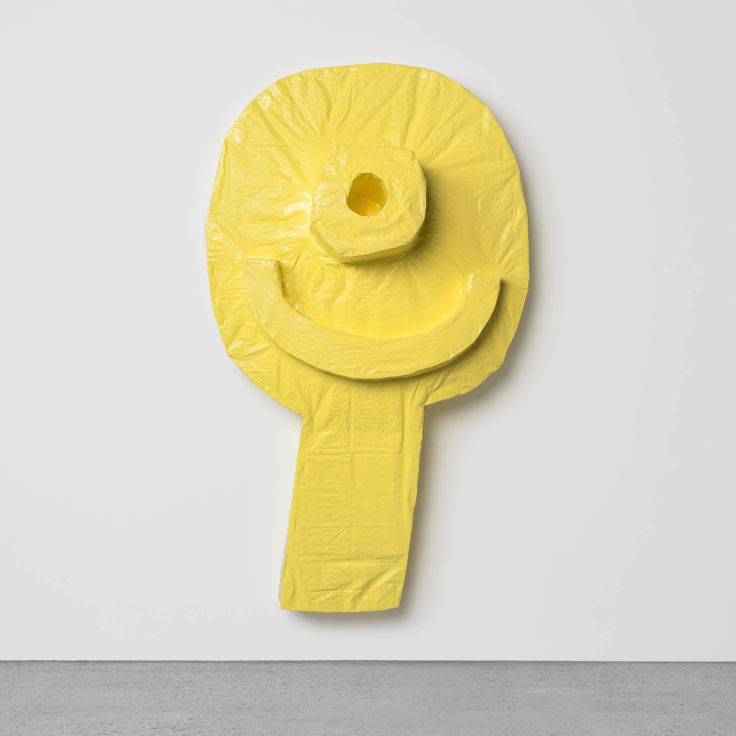
The three-dimensional pieces by Daniel Boccato look like giant, colorful, plastic inflatable toys that have lost a bit of their air and been dragged in from a deserted beach somewhere. I really liked these pieces. They have a joyful eccentricity and bravado that gives a playful feeling to the entire show.
Installation view of Mythology Exhibition
Artwork by Daniel Boccato
Artwork by Daniel Boccato
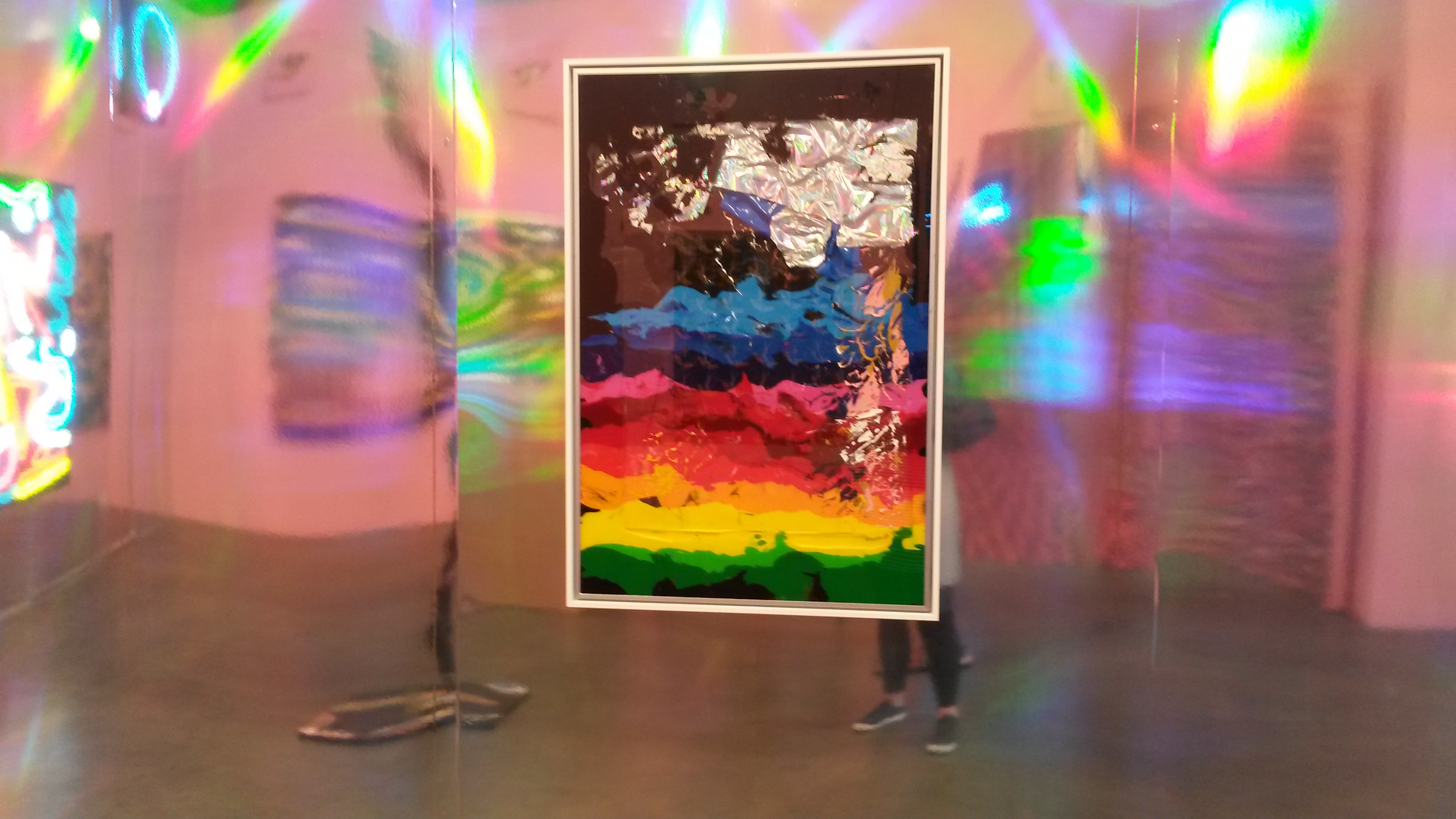
Wesley Martin Berg creates large monochromatic silver or black paintings over relief imagery, and a strange recurring “hobo” sculpture.
Detail of artwork by Wesley Martin Berg
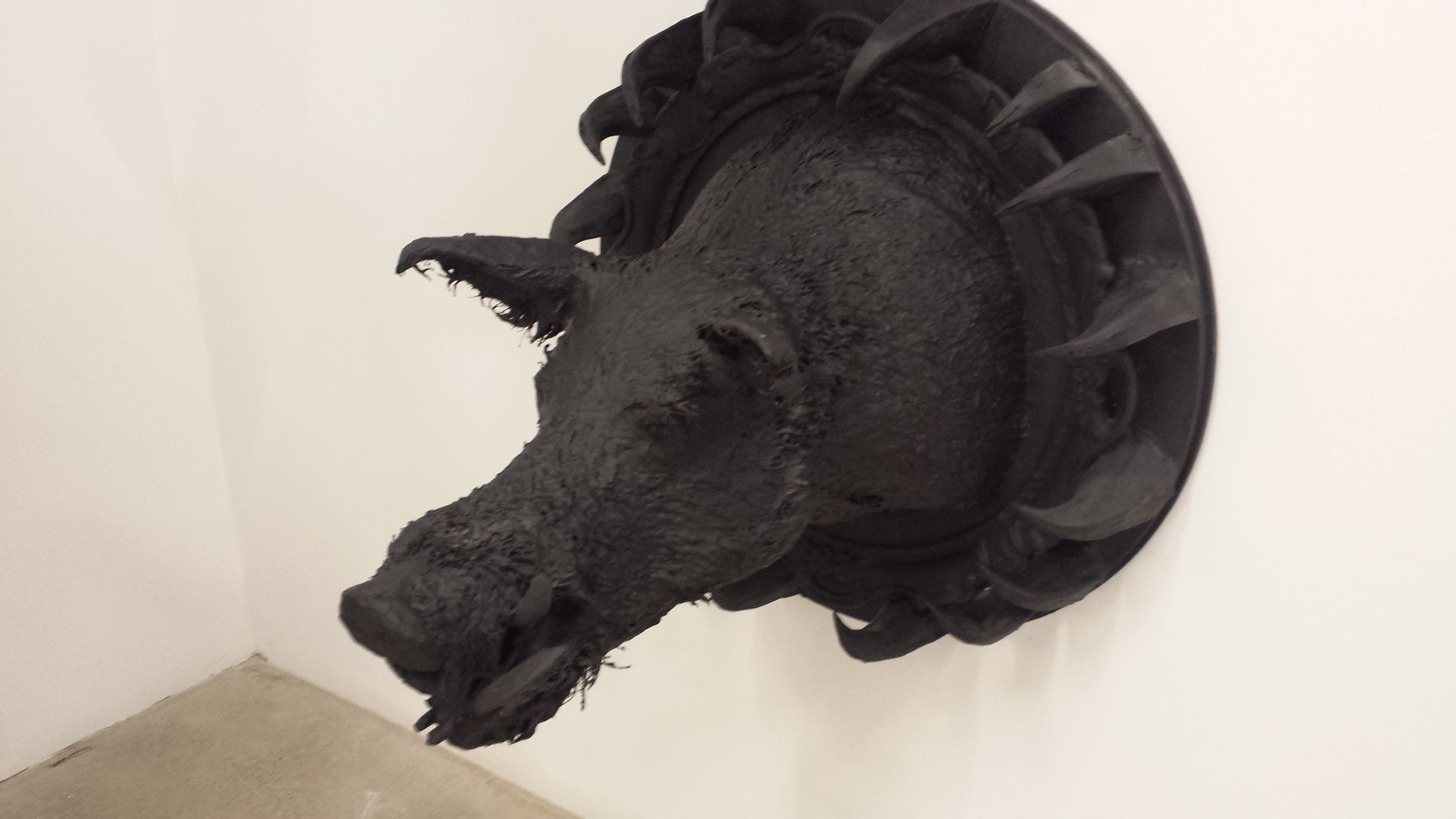
Bryce Zackery must be a fan of heavy metal. His dense black sculptures are encrusted in with nails, chains, found objects and taxidermied creatures.
These days looking at art means traversing the city and facing down the sea of red tail lights in every west bound artery. Is all this frantic activity due to the mild winter and El Nino? No! It was explained to me that the reason it is so hard to get around by car in Toronto these days is because the streets are clogged with swarms of UberX drivers. Endlessly cruising up and down Queen Street, they will not go home. They need the money.
The subject of ‘sex and women’ is fraught with a legion of competing agendas, all the time and everywhere. It’s kind of comforting to know that in a world where women can be stoned to death for sexual transgression, in this country artists (men and women) are free to explore pretty much any sexual subject matter they can come up with. One option is the light touch and the glance of the coquette. Sexish, the title of the (all female) group show at Birch Contemporary largely takes this approach, and like many of the artworks in the exhibition, the title is a bit, well, coy.
Images of tightly crossed knees by Maryanne Casasanta or flouncy skirts by Cathy Daley read as girlish, coltish, kittenish. Sex seems a long way off…although there are hints.
Artwork by Maryanne Casasanta
Two artworks by Cathy Daley
Using hand stitched embroidery on lovely found fabrics Orly Cogan depicts the eroticized domestic realm where home is a place to relax and get high.
“Saturday” by Orly Cogan
“Mirror Mirror” by Orly Cogan
Other artists in the show take on S&M imagery. Fresh, original paintings by Ilona Szalay have a very contemporary feel, although they reference what seems to be a reenactment of Victorian prurience.
“Girl and Graffiti” by Ilona Szalay
Janet Werner‘s painting of the back of woman’s head transmits a subtle shock. First we examine the voluptuous coiffure and then the freakishly attenuated neck and damaged ear. What happened here?
“Jo” by Janet Werner
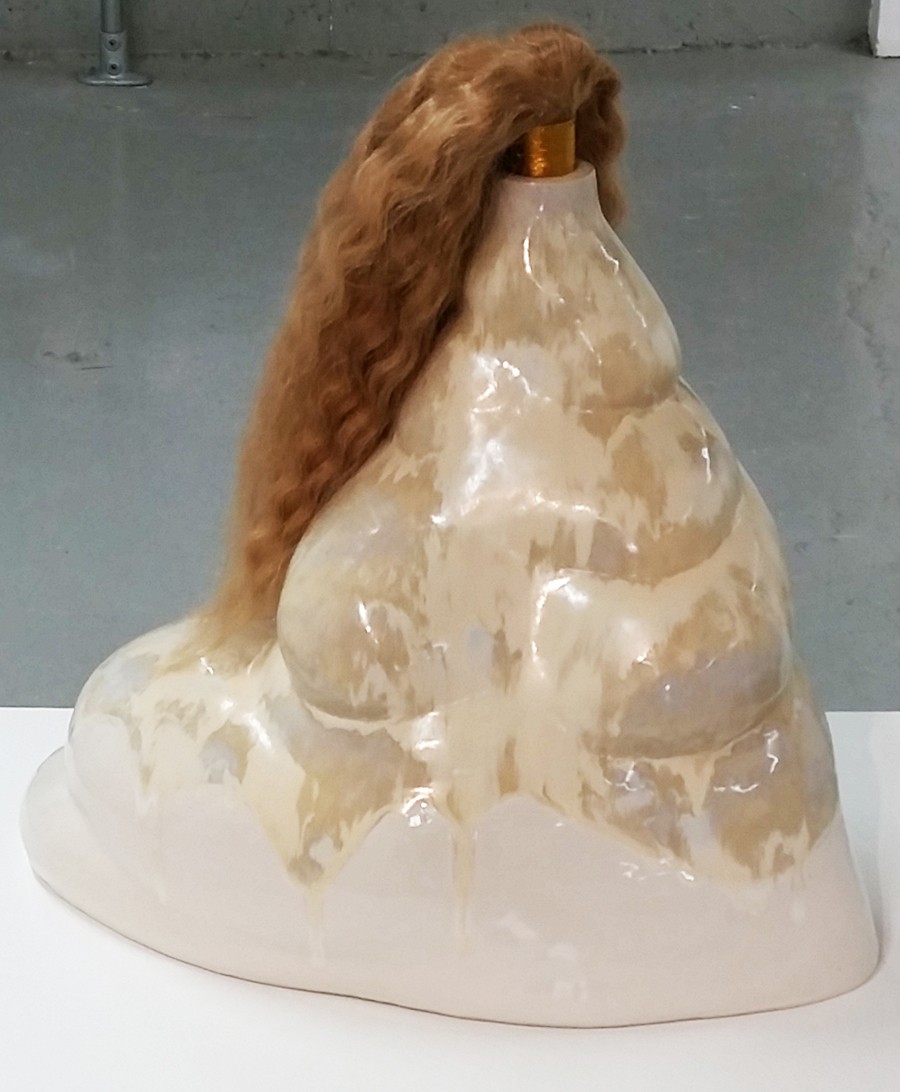
Ceramic pieces by Julie Moon have a way of getting to the core of female attributes in a primal way. I liked the sense of ambiguity in this artist’s work. Hovering between nightmare and goddess the piece shown below holds a potent sexual charge.
“Flesh Pile (Side Pony)” by Julie Moon
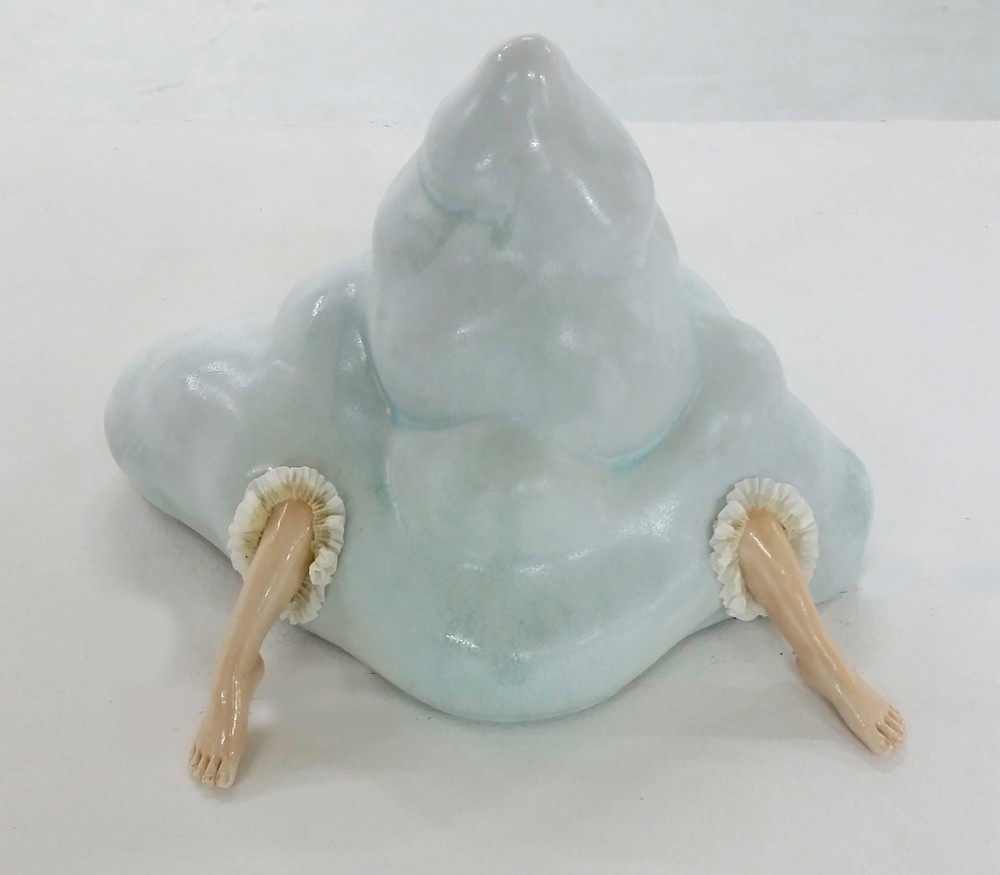
In another ceramic piece with Surrealist antecedents, Julie Moon creates fascinating tension as delicate limbs emerge from a glutinous heap. Ruffles and a tender blue colour add to the horrifying sense of femininity caught in a grotesque trap.
“Bloomers” by Julie Moon
As the Sexish exhibition notes attest ideas about women and sexuality are “continuously evolving and unresolved.” Here the clamorous sex/women issues dominating the headlines are sidestepped or ignored and it makes for a refreshing change.
Yesterday was the last chance to see the Isabel Rocamora show – titled Troubled Histories, Ecstatic Solitudes – at the Koffler Gallery. The exhibit, dominated by three large-scale video projections, opened way back on September 17, and it is utterly prescient in terms of its grave, unflinching tone and the subject matter it contains.
Still from Body of War by Isabel Rocamora
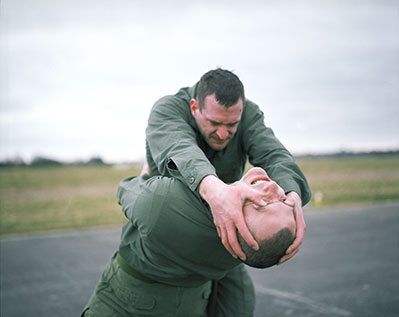
In Body of War Isabel Rocamora probes the phenomenon of close-up brutality. In an extended sequence the camera warily circles a fight to the death between two anonymous soldiers. Staged on a barren runway beneath grey skies, this grim, slow battle confusingly becomes a kind of homoerotic dance from which there is no escape. A soundtrack of medieval-like, choral chanting heightens the sense of ritual and archetype in this piece. Eventually a victor is left standing, panting and jubilant, and the camera turns away to slowly penetrate the opening of a nearby bunker. The desultory movement toward darkness creates a truly horrifying moment.
Stills from Horizon of Exile by Isabel Rocamora
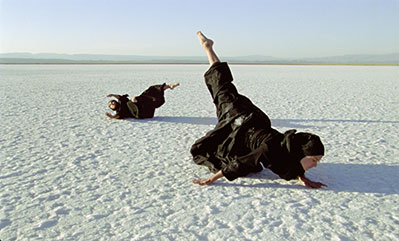
In Horizon of Exile, a two channel video piece, snippets of monologue hint at the reasons a women must leave her home and set off into a barren, windswept desert. Against an elegiac score and relentless wind, two women then perform a mesmerizing rolling dance, where they are carried like flotsam across a glittering salt flat in a God forsaken plain somewhere.
Stills from Faith by Isabel Rocamora
An Orthodox Jew, a Greek Orthodox Christian and a Sunni Muslim are all engaged in prayer in Isabella Rocamora’s three channel loop called Faith. Filmed in a craggy desert that reads “holy land” they are united in ancient transcendent practices. The religious trappings – the robes, the gestures, the pious heavenward gazes, the fervent ritualized murmuring – are remarkably alike. In fact not much is separating these men of God from one another, and yet, Isabel Rocamora seems to be saying, the superficial similarities are meaningless. Tradition is terminally unique.
I really liked seeing this show: The stark graphic power, the rich soundscapes, the choreography of the camera and the subjects, and the potent imagery. Ultimately the work struck me as very dark: The subjects are all unable to break out of age old oppression, each is condemned to endlessly repeat the rituals of the past and passively accept their fate.
Fortunately, it is possible to go shopping for handmade items on the third floor of Artspace Youngplace otherwise I would not have trekked upstairs and come across the tiny gallery called Typology.
Installation shot of Moving Right Along by Nicolas Fleming
An installation by Nicholas Fleming called Moving Right Along is about to close. I’m glad I caught this show.
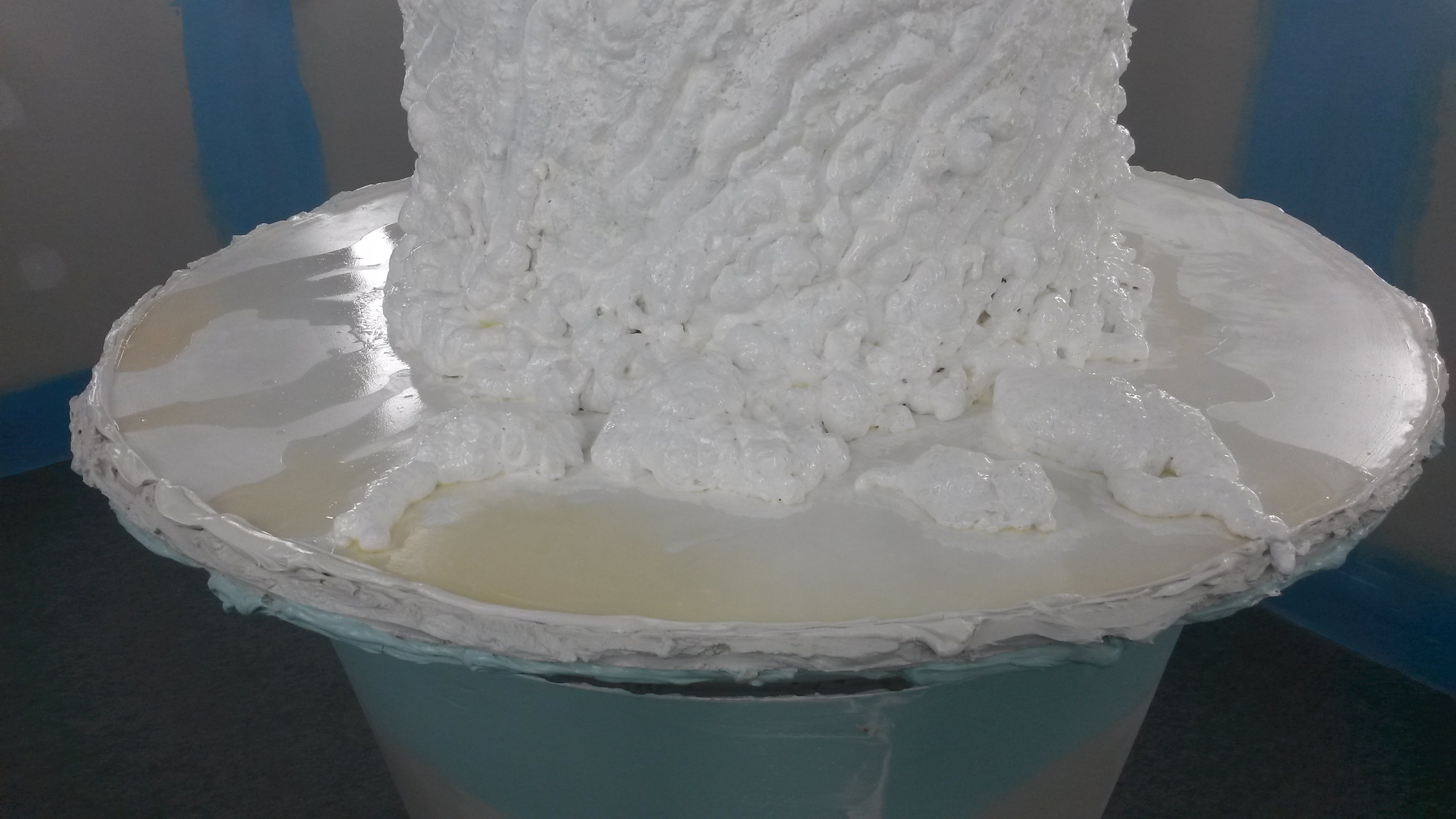
Nicholas Fleming must be a very energetic guy. He has built an entire room within the gallery, except that it is all delightfully backwards so that drywall, spackling paste, chipboard and insulation foam are on display and the smooth, white gallery walls with crisp corners and subtle lighting are hidden. It’s kind of like putting a dress on inside out.
An unmistakable Home Depot fragrance wafts into the hallway from Typology.
I really liked looking at the “fountain” in the center of the space. It has ghastly, poisonous look to it. Something toxic appears to be weeping from the hardened foam to create a pool, coated in noxious sheen, at its base.
Installation shots of Moving Right Along by Nicolas Fleming
No doubt Nicholas Fleming allies himself with Minimalism, Arte Povera and various Conceptual Art branches emerging in the 1970s but what is so interesting about this show to me is the exotic beauty created by these humble materials which leads to the whole idea of the infrastructure of our society and how it is hidden and denied and avoided, with perilous consequences.
Thin, fit, relaxed, tan, friendly: LA people are all that. (So friendly: Many will launch into their life story at the swerve of a skateboard.)
The city is heaving with cars. Red tail lights as far as you can see.
There is a gorgeous fade in the sky from blue to orange.
Malibu…..that haunting word.
I felt particularly “LA” drinking Bulletproof coffee. Who knew that regular coffee (ugh) is infested with mold! The Bulletproof slogan is “Search. Discover. Dominate.” I’m down.
Looking at art was not really on the agenda in LA but I did drop into Bergamot Station and wandered into a few random galleries.
It seemed that LA artists are in thrall of their city. They get to the heart of light, air, artifice, nothingness and the dazzling fade.
Captains of the Dead Sea, the title of an exhibit at Sloan Projects, is a collection of photographs by Alia Malley.
AZ_1164 by Alia Malley
BS_3788 by Alia Malley
DV_7352 by Alia Malley
Some of the photos have a seventies Conceptual Art feel. They achieve the unadorned documentation look so prized in that era.
Alia Malley creates a book from the work and, once assembled, a layer of Hollywood is added to the work. Are we location scouts? Have we stumbled across an abandoned set? We search for the elusive narrative in the title and sequence of images. But there is no story just soft focus, like squinting into the sun on Venice Beach.
The prints by Anish Kapoor joyfully capture the LA buzz.
Mark Katano’s work combines calligraphy and drip painting. I liked reading Mark Katano’s notes about the show: “Each line represents nothing more than its own creation, and each piece finds meaning in the harmony of its own structure.” Got it. I am feeling very West Coast.
Big Head by Mark Katano
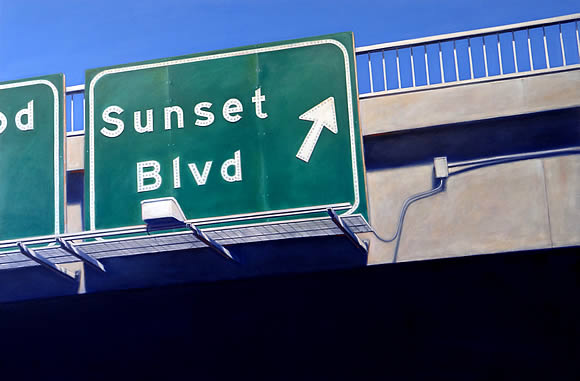
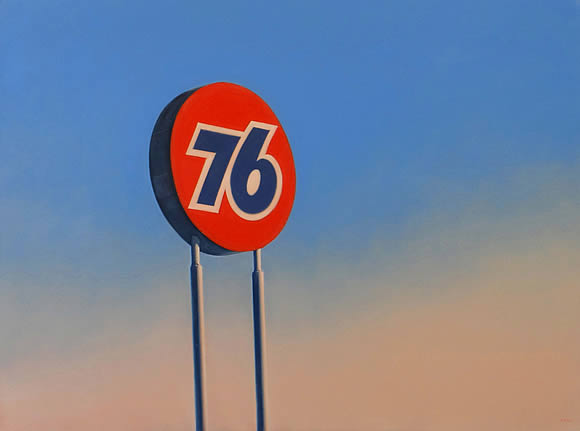
Looking at Eric Nash’s paintings at Skidmore Contemporary Art made me appreciate the icon as subject. It’s all there: the blue and orange fade, the loneliness and alienation, the endless driving and searching, the desperate longing for meaning. (Note: The Sunset Blvd painting at the top of the post is also by Eric Nash)
Sunset 76 by Eric Nash
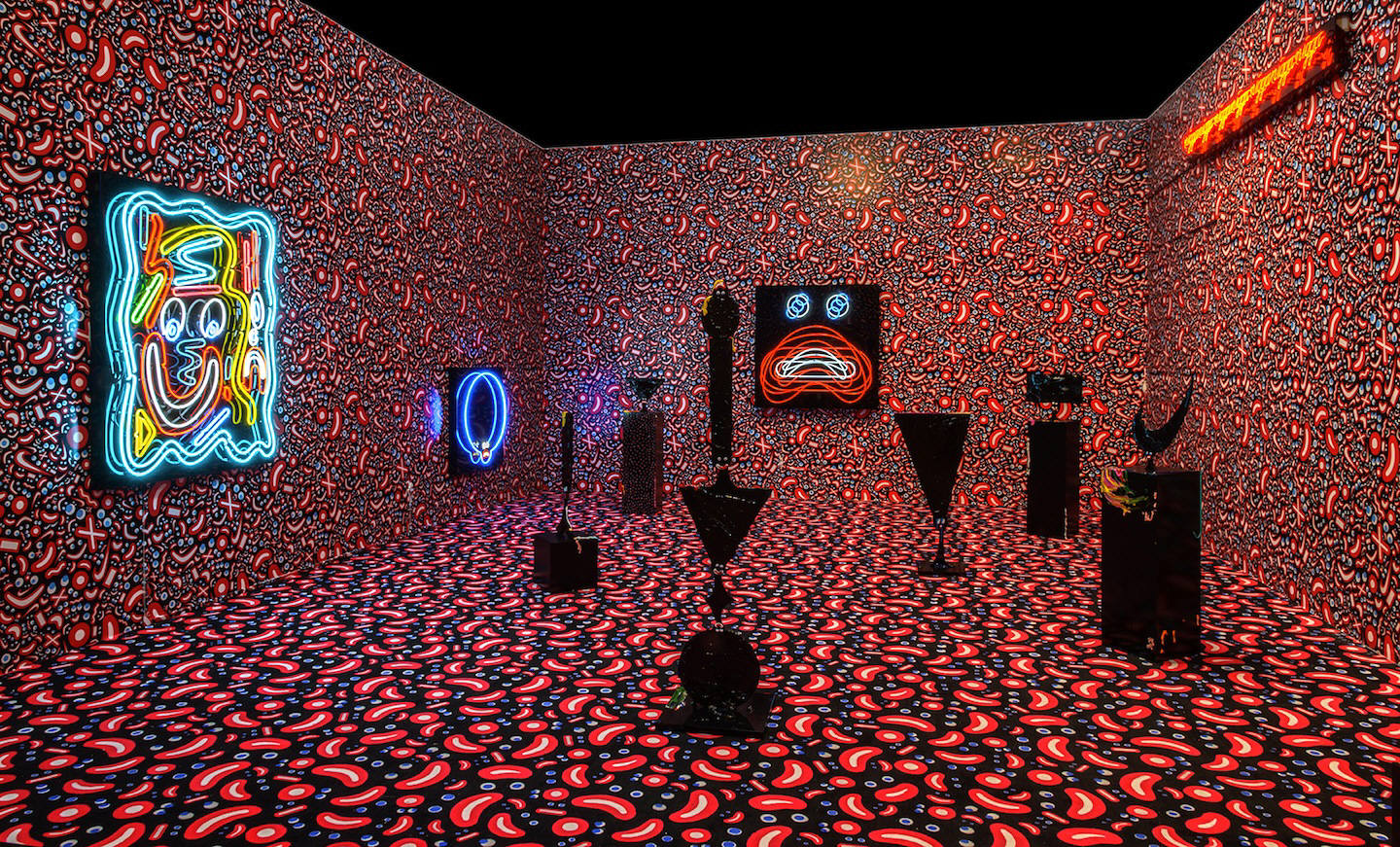
And then I stumbled across the Richard Heller Gallery’s show of work by Devin Troy Strother.
The show is titled They Should’ve Never Given You Niggas Money and it references a comedy sketch about Rick James by Dave Chappelle.
This is an exuberant show that takes on the tropes and stereotypes that dog black youth but it is also a carnival fun house that slams the deadly smugness of the Politically Correct with humour.
Details of Installation by Devin Troy Strother
It was another beautiful day in LA.
The Richard Heller Gallery was full of slim, blonde teenagers taking selfies and outside the sun was shining.
Having lived in the US for a number of years I was somewhat reluctant to participate when my friend insisted we knock on the door of a strange farmhouse in King City, about an hour north of Toronto. Egress to the site of Richard Serra’s earthwork / sculpture Shift was no longer possible from the adjacent subdivision. A passing jogger suggested we try the overland route, which would be trespassing.
“We are pilgrims,” we explained when the farmer opened the door, “looking for the Richard Serra sculpture.”
The farmer was cool (and unarmed) and in fact he recalled the period in the early seventies when the sculpture was created. “Cement trucks arrived every day all one summer,” he said.
Richard Serra was a young artist at the time. He and his girlfriend, Joan Jonas, together visited the site which belonged to art collector Roger Davidson, who commissioned the piece. The artwork references their joint walks around the fields, which have a mildly rolling topography. It apparently traces the natural zigzag path the two would take from the points which were furthest from each other but from which they were still visible to each other. (You have to be there.)
“It will be about a half hour walk,” the farmer told us.
We set off:
We passed various attractive outbuildings, associated with the farm.
..saw water systems, signage…
…and then made a left down the most idyllic path….
…edged by a corn field.
We got lost for a while….
… but met another friendly farmer who directed us onward…
and we then found the landmark below. It’s a…some sort of wood storage device.
We skirted a swamp….
….got covered in burrs, clamored up a muddy hill and there it lay: internationally obscure, audacious, sprawling, precise, stately, playful, supremely confident, enduring, elegant, startling, and big. It is worth the trip.
Shift by Richard Serra
Great afternoon in King City! Although the subdivisions are encroaching, and from time to time a developer insists the artwork be destroyed in the name of progress, the Township of King has seen fit to designate Shift as protected under the Ontario Heritage Act, preventing its destruction or alteration. All the local people we spoke to seemed to have a soft spot for the artwork. My friend (whose idea it was to make the trip) is sure there will be a gift shop and parking for 300 in another decade. In the meantime it was time to go home and get the burrs out.





 Detail of Fragments of an Imagined Place by Elise Rasmussen






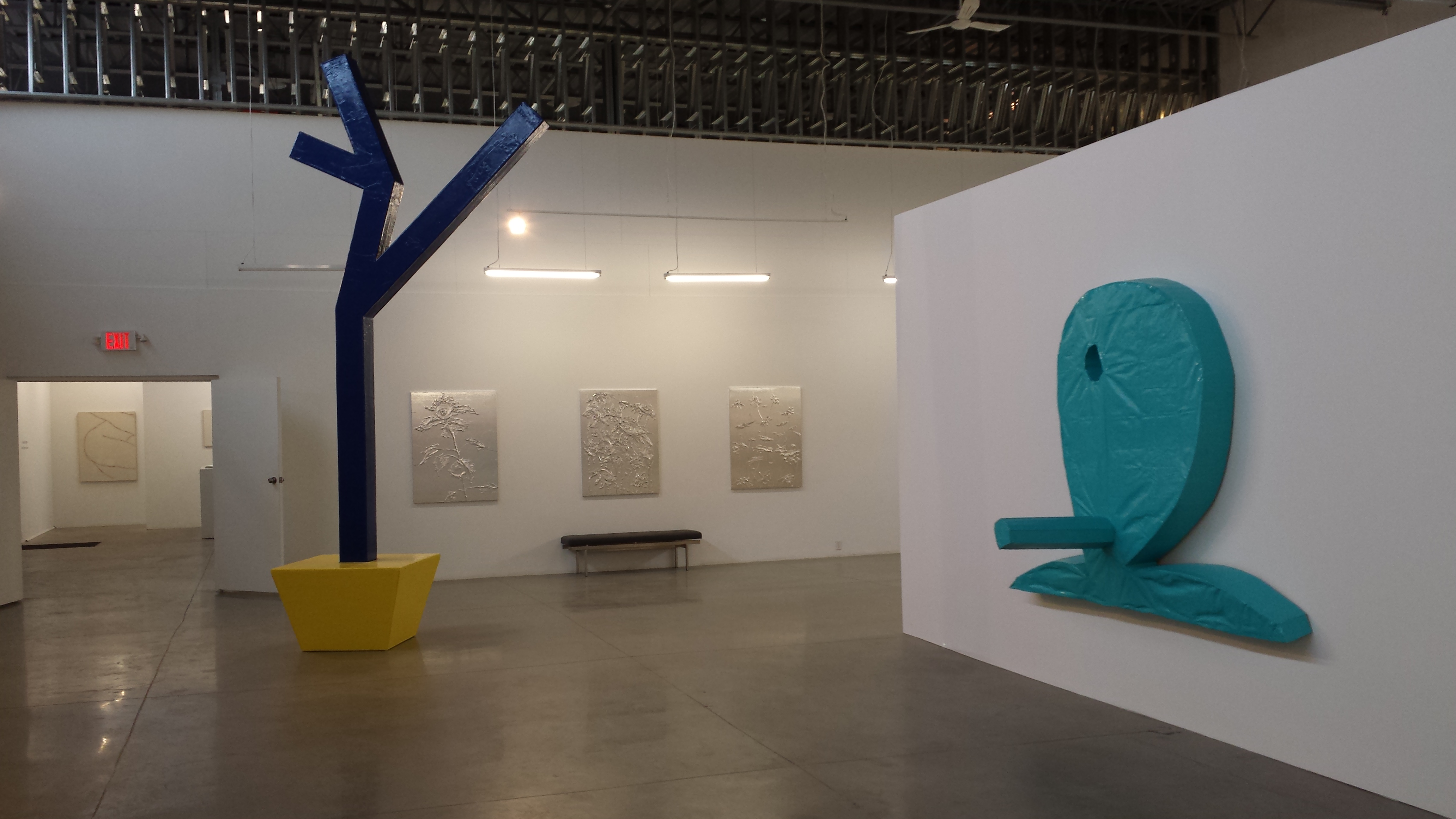
 Artwork by Daniel Boccato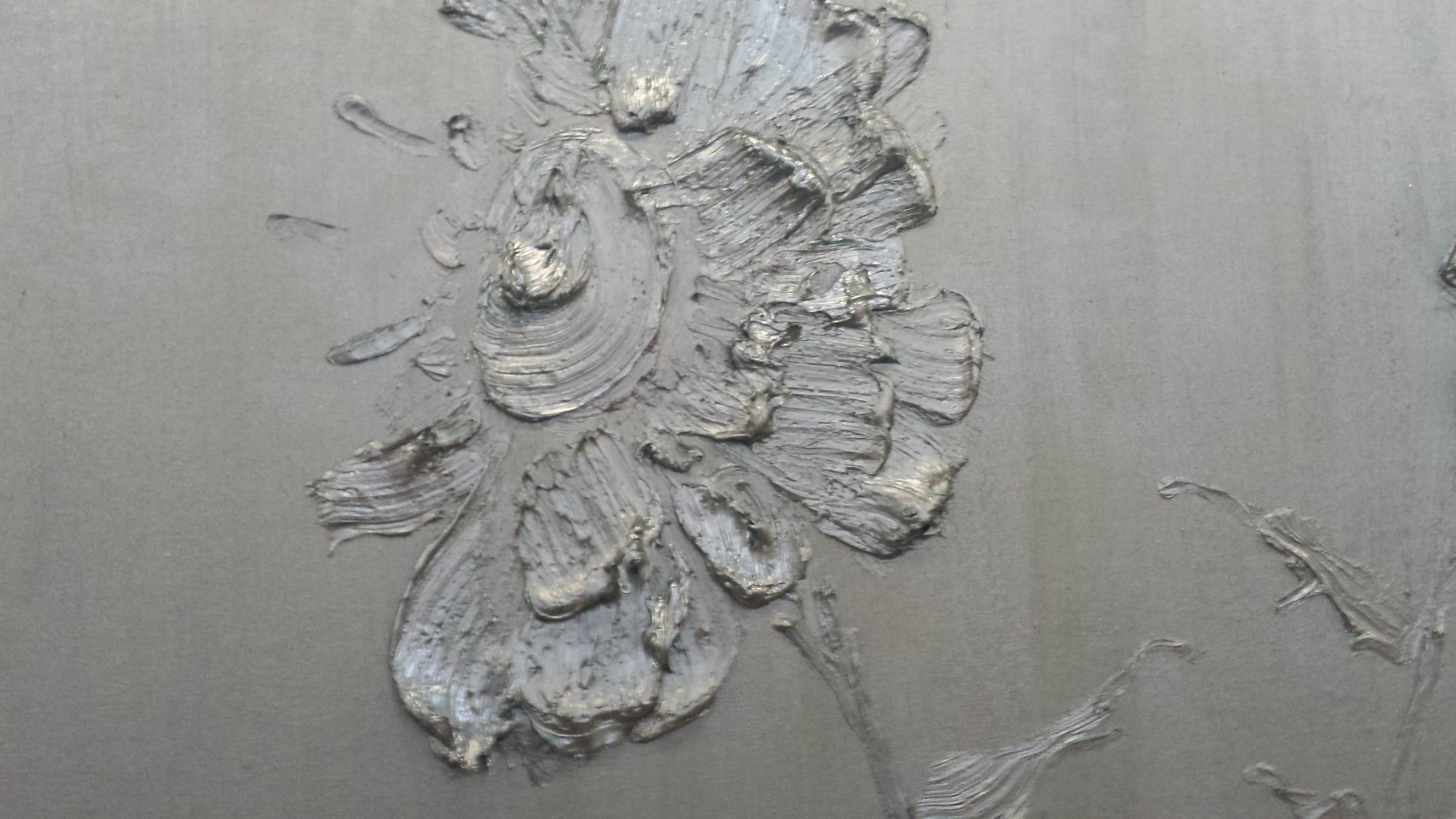



















 annetteandquebec