February 28, 2015

The Dufferin bus was suddenly drenched in a unfamiliar phenomenon: Sunshine!  We looked around, stunned, and blinked weakly.

MKG127 – Liza Eurich

What initially attracted me to drop by MKG127 and take in an exhibition by Liza Eurich was the appealing artist’s statement on the Gallery website. See below (reproduced in its entirety):

Eurich will be presenting work that: emphasizes negative space, is hollow, has a faceted surface, contains other work(s), is concealed, is layered, has multiple components, is not a multiple, is like a drawing, incorporates text, is stationary, has reticent characteristics, is monochromatic, uses straight lines only, references Agnes Martin, is fragile, consists of more than three materials, is made of ceramic, was built, is freestanding, requires a plinth, uses keyholes, uses a French cleat, is in its third iteration, is in a series of three, is positioned adjacently, is architectural, references something from an Ikea catalogue, is functional, is recognizable, does not resemble an animal, was almost omitted.

Based on this text I anticipated hardcore post-conceptual, neo-minimalist works but something about the slightly off-kilter, cannily understated writing assured me it would be fresh, distinctive and droll.

view1-en

Installation view of Liza Eurich exhibition

Just as the writing suggests, the exhibition, titled Either a New or Existing Character, is a collection of unique items with various attributes: is wood, is thin, is freestanding, hangs on the wall, painted white, stained and…. so on.  The art works are diverse but nearly all could be described as spare, restrained, subtle, precise and strangely reminiscent of some carefully crafted maquette or fragment of a maddening Ikea puzzle that just will not fit together.

The delicate piece below is fitted with what could possibly be a tantalizing scrap from an instruction manual.

Eeeee1-en

Eeeee: not for placing by Liza Eurich

I really liked the cool, deadpan industrial look of Liza Eurich’s larger sculptures.  They are so perfectly suited for some mysterious function.  Are they a tribute to the Scandanavian juggernaut on the Queensway?

standingrack-en

Freestanding two sided rack by Liza Eurich

shelving-en

Shelving: six additions by Liza Eurich

Occasionally Liza Eurich adheres some murky graphics to her sculptures.  Apparently these images are from a single book found by the artist.  Possibly medical or antique technological illustrations, these random bits of imagery, placed with such constraint and exactitude, add to the sense of an architectural model but one that references time and atmosphere as well as structure.

3levels1-en

3 levels, pedestal base by Liza Eurich

2components2-en

Two components, layered rectangle by Liza Eurich

Resting on a pedestal is an artpiece initally reminiscent of a vessel of some kind.  It’s made of deep black broken tiles which dip and swerve to encase a naturalistic form.  Mishapen, gnarly, almost expressive, the soft black tiles absorb and reflect light like a big lump of bitumen.

facets-en

facetsdetail1-en

Facets by Liza Eurich

Liza Eurich keeps her ideas on simmer and doesn’t give away too much.  I left the gallery with an appreciation for the subtle feeling of hesitancy and tension that was created.

February 20, 2015

How about those grimy ice hillocks that are lining the streets of Toronto?

I have to keep reminding myself that civilization is not breaking down.  It’s just winter.

Koffler Gallery – Kriistina Lahde

The Koffler Gallery, located in Artscape Youngplace, is the site of an exhibition by Kriistina Lahde titled ULTRA-PARALLEL.

I arrived to see the show in a completely winterized getup. The young woman at the desk immediately sprang into action and rushed up to meet me as I entered the gallery space. It took me a few minutes to figure out why this woman – charming and erudite – was so intent on guiding me around the show. The fact is that much of the work is delicately balanced and perishable. It could be easily destroyed by an unruly toddler ….or a viewer with fogged up dark glasses and a puffer coat. She didn’t want me to accidently wreck something.

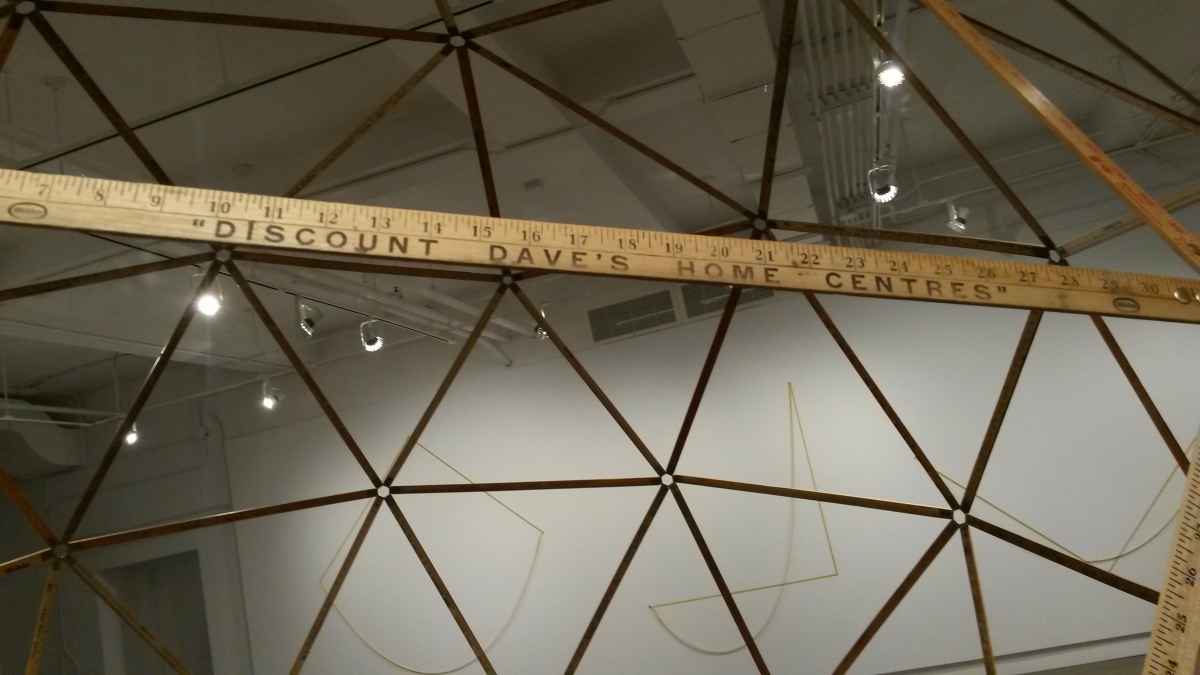
It’s always so satisfying to see an art piece right in the middle of a gallery space. This show has a spectacular sculpture front and center. As light and airy as a dandelion puff ball the work is also structurally engrossing and culturally loaded.

20150219_161345

From a straight line to a curve by Kriistina Lahde

20150219_161411 20150219_162415

Details of From a straight line to a curve by Kriistina Lahde

Geodesic domes must have been around forever but for me they are associated with Buckminster Fuller. He discovered that triangles arranged into a sphere create structures of incomparable strength. He tried to market geodesic domes as dwellings but they did not catch on.  (Civilization is not breaking down!)

The sculpture is made of vintage yardsticks.  Each has a glowing patina and is emblazoned with the name of a long gone hardware store or house paint purveyor.  Even the name “yardstick” is an anachronism and the use of these appealing objects, once so common as to be nearly invisible, softens the piece and adds a melancholy dimension.

Yardsticks are the raw material for another sculpture in the exhibition.  This one, depicted below, glows in a delicious curve as the wooden sticks are arrayed according to hue and balanced in a swoop.

20150219_161852

Slide Rule by Kriistina Ladhe

20150219_161927

Detail of Slide Rule by Kriistina Ladhe

In fact, most of the pieces in the show are created from measuring devices: A chalk reel, surveyors tape measure, vellum, sewer’s measuring tape, and the yardsticks.  Routine, utilitarian, mundane could all be used to describe these objects.  Kriistina Ladhe uses them with grace and wit not so much to transform them as to allow their brilliant versatility and simplicity to be evident in a new context.

20150219_161721

Detail of Parallel Lines by Kriistina Lahde

chalk line

Detail of String and a Box by Kriistina Lahde

velum

Detail of Tool for Making by Kriistina Lahde

20150219_162751

Greater than, less than by Kriistina Lahde

Near the entrance to the exhibition is a mysterious circular piece of steel.  It is a depiction of a meter.   The phrase “Meter: one forty millionth of the circumference of the Earth” is etched along the bottom rim of the object.  This piece has all the marks of serious tool but it is delightfully useless.

20150219_162118(0)

One forty millionth of the circumference of the Earth by Kriistina Lahde

The concept of the meter goes back to the 18th century.  After the French Revolution the French Academy of Science selected this as the standard measurement unit in the new Republic.  It was believed to be one ten-millionth of the length of the meridian through Paris from pole to the equator.  Actually they were a bit off, which is explained in an essay accompanying the exhibition.  Currently, somewhere in Geneva, the meter is defined as “the distance light travels, in a vacuum, in 1/299,792,458 seconds with time measured by a cesium-133 atomic clock which emits pulses of radiation at very rapid, regular intervals.”  Progress, not perfection.

February 12, 2015

I blame Stephen Harper for the punishing Alberta Clipper sweeping down Bloor Street as, gingerly avoiding black ice patches, I hustle toward the ROM.

Royal Ontario Museum – Douglas Coupland

At the last July 1st fireworks display I attended something weird was going on.  I noticed that possibly 60% of the viewers gazed at the brief spectacle through their smart phone screens.  Apparently tons of gun powder exploding in the summer night sky is no longer the pure experiential draw it once was. For many it must be mediated through a screen. A sense of mediation through technology is one idea Douglas Coupland is getting at in his exhibition at the ROM titled everywhere is anywhere is anything is everything.

20150212_152402

Installation view of Douglas Coupland exhibition at the ROM

The title of the exhibit suggests depersonalization, corporatization and content flattening as it raises questions about a new way to experience the world: in comfort and safety through our irresistible, glittering toys.

Some of the paintings don’t make sense at all unless they are viewed through a screen.  The painting below, if viewed without mediation, i.e. IRL (in real life!), is an awkward abstraction.  Through the phone it morphs into the familiar visage of Osama bin Laben.

20150212_150604

Bogeyman by Douglas Coupland

Douglas Coupland’s paintings of the World Trade Center disaster, and another of a drone in flight, below, work the same way.

20150212_151912

Poet by Douglas Coupland

douglas-coupland-03

Drone Attack by Douglas Coupland

Douglas Coupland points to the terrorism threat as one of society’s drivers but one that is in low-gear, moving us steathily to somewhere.  Where?  His sculptural replication of the World Trade center is so banal it is shocking.

20150212_150644

Artwork by Douglas Coupland

References to pop art and media devices are everywhere.  Big, colourful paintings ressurects Ben-Day dots with a Microsoft logo update and Quick Response bar codes that can be read by a smart phone.

douglas-coupland-01

Better Living Through Windows by Douglas Coupland

douglas-coupland-02

I Wait and I Wait for God to Appear by Douglas Coupland

There is a Warholian coolness and disconnection through much of the show.  Douglas Coupland acknowledges his debt to Andy Warhol with a piece containing wigs flattened under glass.  The artwork has the same disturbing creepiness as the famous 1936 Meret Oppenheim fur lined coffee cup.

20150212_150227

Detail of Wigs in the Style of Andy Warhol by Douglas Coupland

Meret Oppenheim

Object by Meret Oppenheim

Douglas Coupland mines the Internet for pithy quotes, advertising hooks and memes of all kinds to create a wall of sentiments about what’s going on right now.  Strangely some of it already seems dated.

20150212_150857

20150212_150813

20150212_151648

Details from Slogans for the 21st Century

For example I happen to know that right now there is nothing more coveted, among the truly style conscious, than a vintage flip phone.

The work also owes a lot to a certain Japanese aesthetic.  Cheerful, cute, bright and shiny with a dark undertow.  Think of Takashi Murakami who switches between designing bags for Louis Vuitton and creating apocalyptic visions of technological blowback.

The piece depicted below, featuring dozens of Japanese cleaning products, contains a Murakami-like ambivalence.  Douglas Coupland explains in the title card blurb that he collected the containers in a Japanese department store and dumped the contents down a drain before returning to Canada.  He then draws a link between subsequent oil spills and the Tsunami and debris from Japan washing up on the BC coast.

.20150212_144843

20150212_144903

Details from Tokyo Harbor by Douglas Coupland

Douglas Coupland’s concrete poetry pieces are also transcultural.   Although mostly in English they have a haiku-like feel and contain a sprinkling of Japanese words.  Shinhatsubai means “new product or new model” in Japanese.

20150212_145843

Artwork by Douglas Coupland

A sculptural artwork sits on a large platform and is encased in glass like an architectural model.  It’s a metropolis right out of Sim City, where for every step forward a price is paid.  It is an immensely intricate piece, glittering, lively and vigorous, but of course the sheen comes from chemicals and oil and the city is dying.

20150212_153539

20150212_152132

20150212_152213

Details from The World by Douglas Coupland

The exhibition is full of thought provoking work about the past and the future and that awkward spot, the present, in which Douglas Coupland, just like all of us, is stuck.  Perhaps that fact makes us myopic, alarmist or both.  Once in a while I like to drop by the Castle Board Games on Spadina, just below College, to get enthused and optimistic about the under 20 set and about how all this will play out.  One of the entrance conditions for this cafe is that you have to turn your phone off.

Meanwhile I slowly make my way to the ROM exit.  There are many distractions.

20150212_154754

Tyrannosaurus

20150212_154619

Sea life

20150212_155815

Bird

20150212_154227

Shrunken head (eyes and lips sewn shut)

January 27, 2015

Biting cold…cruel gusts along Annette Street…broken down Dupont bus…one glove lost…not even February….but the days are getting longer.

Clint Enns, Leslie Supnet

I arrive just in time to catch the beginning of Adventures in Transgression, a screening of videos by Clint Enns and Leslie Supnet at Trinity Square Video. The mood of the crowd is that of cabin fever induced excitement and recklessness that make for an interesting evening, and, TSV has a capacious screening room with a sound system worthy of the ambient industrial tracks to come.

Some of the videos of Clint Enns have a tossed-off larkishness, like the short nostalgic clip called Freddie Mercury Sing-A-Long.

freddie

Still from Freddie Mercury Sing-A-Long by Clint Enns

Others are discomforting, like the superimposed close-ups of an ejaculating penis and vigorous teeth brushing in Gleem  or the tight shot of cataract surgery called Botched Eyeball Operation which is more horrifying than any slasher movie. Let me ASMR you explores the perceptual phenomenon of autonomous sensory meridian response, which is evidently a popular youtube indulgence.

ASMR

Still from Let me ASMR you by Clint Enns

Many of the works have a connection to some earlier film or technology or video art piece.  They are remakes, tributes, recreations, remixes, variants of existing technology or artwork — some more obscure than others — which becomes clear in seeing Andy Warhol, Michael Snow, James Benning, Hans Richter, Chris Burden, Name June Paik and others referenced in the programme notes.  Clint Enns is apparently a student and ardent fan of earlier achievements in moving imagery but he is definitely on his own path.

The videos that are truly spellbinding, for me, are those in which Clint Enns goes for pure image.   Take as a starting point, for example, the scratchy, flaring, generally beat up look of a Guy Maddin film and keep going…and keep going… all the way.  Clint Enns apparently sets outs out to degrade his images until they are virtually abstract.

20150127_203716

Detail of still from Ten Skies by Clint Enns

What happens on the journey to total annihilation is really interesting: not only are the visuals often incidentally gorgeous but also the viewer is obliged to think about the phenomenon of seeing itself.

20150127_20481220150127_204815  20150127_204647

Stills from Spiderman vs. Macrovison by Clint Enns

In Spiderman vs. Macrovision the real time image decay is fast and unsettling.  Macrovision’s “Ripguard” technology, was designed to prevent illegal copying.  In the tape we see antique cartoons repeatedly churn, hesitate and dissolve into a froth of colour only to be reformed momentarily and dissolve again, like a babel of photons struggling for coherence.

Strangely, in these videotapes the emotional content is heightened with increasing abstraction.  The sound design/music (frequently performed by Clint Enns) is a big factor.  In winnipeg stories: sacrificial memories, composed of discarded footage, Clint Enns achieves a fitful, melancholy tone.  The golden glow gives the tape a “trapped in amber” look and the music is wistful, haunting, emotive.

20150127_210215

Still from winnipeg stories: sacrificial memories by Clint Enns

The Everden (which is my favourite) creates a sense of panic and paranoia as the viewer looks deeper and deeper into a bleak urban landscape.  It’s like watching the famous “grassy knoll” footage from Dallas.  Everything is so tantalizingly close, but the resolution just isn’t there and the image breaks up, becomes meaningless, closed and unknowable.

The Everden

Still from The Everden by Clint Enns

The Everden also made me think of the Laura Poitras’ film Citizen Four, in its dark, brooding unease and revelations of betrayal and duplicity.  The sound track of processed ambience and guitar, the unrelenting static, drop out, smear and interference all conspire to create a powerfully tense piece about extreme alienation in this: the age of surveillance.


Leslie Supnet’s work also has a “take no prisoners” approach to materials.  She chooses to hand draw her animations, paint and cut out her sets (with scissors), and shoot in super 8 instead of HD.

first sun

Still from First Sun by Leslie Supnet

Capturing simple, graphic pictures with these erzats techniques Leslie Supnet’s work frequently achieves a sense of elemental imagery.  In pieces like Sun Moon Stars Rain or First Sun the bold images, coupled with a boisterious percussive sound track results in wildly playful pagan joyfulness.

Leslie Supnet’s narrative animations explore themes of depression, anxiety, loss and redemption.  Simple line drawings have an affecting emotive depth and nuance that seems precisely current.

20150127_215414

Still from Fair Trade by Leslie Supnet

Her processed super 8 work also has complex results using simple imagery.   Recurring themes include flocks of gulls, bizarre landscapes, cats, horses.  Last Light Breaking has an other worldly, meditative dreaminess.  Wind and Snow combines startling depictions of classic subjects in flaring, shimmering psychedelic colours.  Less like a documenter of the natural world and more like poet, Leslie Supnet gets at the essence of what’s around her.

20150127_22123020150127_221323wind and snow

Stills from Wind and Snow by Leslie Supnet

January 22, 2015

The weather softened as I traversed Dundas Square and crowds spilled out of the Eaton Centre to mill about aimlessly in the late afternoon light. Rounding the corner, the approach to the Ryerson Image Centre has a gloomy, underpass feel and the clatter of hockey sticks and shouted taunts echoes up and down Gould Street.

20150123_155049

Ryerson Image Centre

Even in the vestibule area of the Ryerson Image Centre glamour is front and center.  The Salah J. Bachir Media Wall continuously plays a loop of thirteen vignettes by Alex Prager.  The piece, commissioned by The New York Times Magazine and called A Touch of Evil, is all high production values and top shelf Hollywood talent as Brad Pitt, Jessica Chastain, George Clooney, Mara Rooney, Mia Wasikowski and others get all campy, ironic and self-referentially post modern to portray peak Noire moments. It’s kind of fun to take in the special effects, lavish colour and tension enducing music, like watching movie trailers or some patische put together for Oscar night, but I couldn’t help feeling that I’m tired of celebrities and their faces.

20150123_155817

20150123_155557

Stills from Alex Prager piece, A Touch of Evil

The world is the playpen of this gang of mega stars and now it seems they have insinuated themselves into every aspect of life; even romping into the art world with a knowing wink. (I wish Tilda Swinton would stop doing performance art too.)

Burn with Desire: Photography and Glamour

Thinking about the fire theme I recalled the Is Toronto Burning? show which opened in September of this year at the Art Gallery of York University.  Whereas the York show, curated by Philip Monk, examined an intense period in the creative history of this city, the show at Ryerson Image Centre, curated by Gaëlle Morel, is a longing gaze mostly at Hollywood.

We all know the lovely goddesses of the past, with arched spines and eyebrows captured in satiny black and white,  especially Marilyn Monroe.  In this show there is definitely a surfeit of Marilyn pictures and yet somehow, new angles and unfamiliar expressions are revealed.  How is that possible when the woman’s image is available in every cut-rate t-shirt shop on Yonge Street?

Manfred Linus

Manfred Linus, Untitled [Marilyn Monroe], date and location unknown. BS.2005.190119/113-1226. The Black Star Collection, Ryerson Image Centre.

We also see Brigette, Sofia, Natalie, Gloria and others, all swanning about in the glory of mid century USA.  (Below is an incendiary Ava Gardner.)

Ava

Burn with Desire: Photography and Glamour (installation view), 2015 © Eugen Sakhnenko, Ryerson Image Centre

Vanity Fair’s celebrated pull-out covers by Annie Liebovitz work the time-tested glamour signals.  With only minor adjustments to old Hollywood style the images capture throngs of interchangeable starlets with bare shoulders, limpid expressions and more satin.
Annie
Burn with Desire: Photography and Glamour (installation view), 2015 © Eugen Sakhnenko, Ryerson Image Centre

The show gets more interesting and the understanding of glamour broadens with the inclusion of a bit of authentic counter culture from the late sixties. The Kenneth Anger film Puce Moment is totally loopy and delightful.  (Click on the link to view it on Vimeo.)

Puce Moment

Burn with Desire: Photography and Glamour (installation view), 2015 © Eugen Sakhnenko, Ryerson Image Centre

There is also a hilarious Richard Avedon film from 1973, actually an ad for a Japanese Fragrance, in which Lauren Hutton, Anjelica Huston. Jean Shrimpton and Avedon himself send up the whole glamour enterprise.  The short piece, which predates MTV by about ten years, has a frothy, giddy excitement to it that might be impossible to achieve in this more cynical era.

The giant colour portraits of black women by Mickalene Thomas add gravitas to the exhibition.  One of the few that are not actual celebrities, the image below depicts an utterly self-absorbed beauty, shimmering and adorned and posed for maximum impact in a kind of trance of narcissism.

Mickalene

Burn with Desire: Photography and Glamour (installation view), 2015 © Eugen Sakhnenko, Ryerson Image Centre


There is picture of Kim Kardashian in the exhibition; nude shots with Barbara Kruger’s trademark red and black bands of confrontational texts strategically placed.  What occurred to me was the following: Why do I know so much about Kim Kardashian?  I have never watched her reality tv show nor really read anything about her and yet…and yet I possess numerous facts and impressions about the woman.  Was it like this when Marilyn was ascendent?  What about the future?   Will the Google glass have a filter?

January 16, 2015

Villa Toronto

Villa Toronto kicked off this week with an opening in the great hall of Union Station. The exhibition was dimly lit and fraught with tripping hazards.  The beauty of the space – the spectacular vaulted ceiling, clerestory windows, touches of Canadiana like the carved city names ringing the hall – was ignored.  Instead a warren of tiny white galleries was installed, apparently in a rush. Unfortunately the place reeked of Cinnabon, which wafted up from the food court below.

On the positive side there was definitely some art to look at.  There were hordes of people and everyone seemed to be having a good time.

20150116_183749 20150116_183621

My friends and I were puzzling over the sculptures and drawings by Joseph Wagenbach.

20150116_181550

20150116_182006

Sculpture by Joseph Wagenbach at Villa Toronto

A multi media kiosk told the story of this artist: his rural childhood near Hannover; the confusion and displacement of the war; some time spent in Paris where he may have met Brancusi; his reclusive life in Canada.  In 2006 he suffered a stroke.  His house was opened and a trove of art works was discovered.

jw_rabbit_s_18_tn

Rabbit by Joseph Wagenbach

jw_string_mouse_02_tn

String Mouse by Joseph Wagenbach

jw_rabbit_skinned_03_tn

Rabbit Skinned by Joseph Wagenbach

Initally we weren’t sure the object above represented a rabbit.  Maybe it was a cat of some kind or a weasel?  A particularly articulate and knowledgeable woman overheard our conversation and emerged from the crowd to explain that a particular rabbit was obtained from a Portuguese butcher and a cast was made of it and that is why this object exists.

Huh?

The woman then went on to introduce herself as Iris Haeussler and confessed that, yes, she created the sculpture and the drawings; dreamed up the biography, the stroke, the discovery and in fact the whole alter ego of fictitious Joseph Wagenbach.

jw_drawing_18_tn jw_drawing_05_tn jw_drawing_in_book_01_tn

Drawings by Joseph Wagenbach

Iris Haeussler went on to tell us how liberating it was to create this work for her alter ego.  Self imposed inhibitions and doubts vanished and she enjoyed a truly creative period.

I mentioned the Scondi Collection and told her it would be interesting if Joseph Wagenbach had actually been acquainted with Isabella Scondi…but with the noise and the Cinnabon I don’t think it quite got through…

January 15, 2015

I walked north from Dupont on Osler and then veered left to take in some of the desolate, windswept beauty of the Junction. All was bathed in a high contrast glare on this bright afternoon in deep January.

20150115_144339 20150115_140733

Jessica Bradley Gallery

It was such a relief to be in the warm, friendly gallery space, filled with laconic poetry, as a succession of trains rumbled by outside.  The show at Jessica Bradley is called Signs & Symbols.

Work by a dozen artists is on display. The delivery methods are diverse but there is a definite coherence to the show: high Concept Art, detached and cool.

20150115_143622

Installation view of Signs & Symbols

The show got me thinking about the material manifestation of ideas and how far ranging that could be among the original Conceptual Artists: From the notion that “if it’s worth doing it’s worth overdoing,” (for example, Robert Smithson literally creating a new landscape) to instances whereby the object part of the art became less and less important until finally, poof!, it was gone (as in Sol LeWitt handing out some instructions).

In this exhibition, one end of the spectrum (the “less is more” end) might be occupied by Jason McLean who jots some practically illegible notes on nice thick paper and then frames them. It’s so deft and effortless, the way these particular text fragments powerfully capture some of the chaos and unmanageability of contemporary life.

20150115_143429

Jan 2112 by Jason McLean

(Since it is a bit hard to read I’ve excerpted a particularly appealing section below:)

loose nuts in bowl
  with kiwi &
    log on log off
      computer
         manual

Jason McLean’s poetry/sign works really well with a photograph by Geoffrey James which is hung next to it. The photograph documents a bit of signage on the exterior of The Matador. The bizarre concoction of letters on dense green paint is like a faint missive from another world, emphasizing the divide between the dull staid society where mail is delivered and the after hours parallel universe where vice and mayhem rule.

20150115_143409

The entrance to the Matador by Geoffrey James

Some of the work seems to be getting at the ineffable. Like a thick black, manufactured oval with glowing white letters by Kelly Mark.  It effectively reminds the viewer that life is short and eternity awaits.

20150115_142854

Nothing is Larger than Everything by Kelly Mark

Yes, yes….there is no time like now! I should buy a Hyundai and some cheap gas!

A piece by Robert Fones, similarly manufactured and glowing, elevates a strangely awkward command.

20150115_142947

What You Don’t See Displayed by Robert Fones

Tricia Middleton’s piece, painted in watery blues, is a quote from Nietzche.  It has a plaintive tone and makes a link between the courage to live life deeply and the by-product of that, which is intense suffering.

20150115_142910

The most spiritual human beings (Nietzshe) by Tricia Middleton

The artist Karl Holmqvist creates an ambitious installation work.  Typewritten sheets completely cover one wall and climb over a platform.  The texts share a visual similarity to the “typings” of Christopher Knowles but unlike that famous autistic artist whose pieces never waver from a single idea, this installation offers a roving commentary on such disparate topics as celebrity culture, advertising, politics, history, religion and so on.  It’s not clear if these are found texts or compositions by the author.  There are a couple of sets of headphone included as part of the installation where one can listen to what sounds like a computer with a deep, male, German accented voice reciting random words.

20150115_14310420150115_143309

20150115_143255

Untitled (MOMA) by Karl Holmqvist

Walking back down Miller Street I had a new appreciation of the workaday announcements plastered on plateglass all around me.  What were the considerations that resulted in the final form?

20150115_144955

January 3, 2015

The festive torpor has come to an end and the galleries along Tecumseh Street are now open.

Sleet.

Birch Contemporary – Janice Gurney, Renee Van Halm

Janet Gurney 1

Punctuation in Translation, (Marcus Aurelius meditation 10.17 translation by Meric Casaubon, 1634) by Janice Gurney

20150103_135430

Artwork by Janice Gurney

The snapshot above actually functions as a continuation of the conceptual art piece, called Translations & Alliances, by Janice Gurney, on display at the Birch Gallery.

And now for the explanation:

Janice Gurney begins with an ancient text by Marcus Aurelius. She isolates the punctuation in various English translation of the text.   She literally makes paintings of the punctuation marks. Then she lends the paintings, framed and under glass, to colleagues. The colleagues place the paintings in offices somewhere and Janice Gurney photographs the original paintings in their new context, including incidental reflections on the glass and adjacent objects. Then the photograph of one of the paintings is included in a show and Janice Gurney photographs the photograph of the original painting in a new context, including incidental reflections on the glass and adjacent objects…..and on and on, like a hall of mirrors.


Janet Gurney 3

Reflection: Production Still (ArtLAB Gallery, 2009) by Janice Gurney

Janet Gurney 2

Meditation in Your Office, (M. C.’s office, University of Toronto, 2006) by Janice Gurney

This piece is initially mystifying and would remain rather opaque without an understanding of the back story.  For example, what are the numbers near the floor, beneath the paintings (and photographs of paintings)?

20150103_135639

In fact 1634 is the date of the translation, the punctuation of which is depicted in the painting.

I found that putting the effort into figuring out this work is worthwhile. Through all the commotion with the photographs, punctuation marks, reflective glass and whatnot a real sense of this haunting piece of poetry and its journey through history emerges. The delicate idea of how a translator hundreds of years ago decides to place a comma stays with me. The words – a meditation – are about the brief and fleeting nature of any one thing. Paradoxically this one thing, an intangible idea, has endured.

The original 1634 translation of the Marcus Aurelius text is below:

XIX. Ever to represent unto thyself; and to set before thee, both the general age and time of the world, and the whole substance of it. And how all things particular in respect of these are for their substance, as one of the least seeds that is: and for their duration, as the turning of the pestle in the mortar once about.

In the handout that accompanies the show Janice Gurney provides complete texts of the subsequent translations through time. Excerpted below are a few examples of various translations of the original “turning of the pestle in the mortar” phrase:

1701 “turning of a Wimble”

1747 ‘”twinkling of an eye”

1862 “turning of a gimlet”

2002 “twist of a tendril”

2009 “one brief turning in air”

I wonder if the band Kansas was thinking about Marcus Aurelius when they wrote their 1978 hit “Dust in the Wind”?

Kansas

Kansas, in the seventies


Concurrently on display at Birch Contemporary is a show of paintings, called Depth of Field, by Renee Van Halm.

It’s an interesting pairing of artists:  Whereas Janice Gurney’s show explores elusive concepts of past and present Renee Van Halm’s paintings are all about the visual  “now.”

Renee 1

Complex Curves by Renee Van Halm

renne 1

Tongue & Groove by Renee Van Halm

The paintings consist of pure, intense swaths of colour enclosed in sensuous curves on a background of fragmented depictions of interiors.  Renee Van Halm is on top of the language of desirable objects and she plays with the fracturing and recombining of those conventions with delicious success.  In fact, I immediately wanted to take one home, hang it over a white Carrara marble fireplace…maybe there would be an Italian greyhound slumbering in front….I’d be wearing Prada and a vintage Jaguar would be parked out front…

Renne 4

Rose by Rene Van Halm

December 30, 2014

Clare Twomey at the Gardiner Museum

George Gardiner, a stockbroker and financier, adhered to the “buy low, sell high” principle in art collecting as well as business.  He initially began collecting ceramics, with his wife Helen, as a hedge against inflation.  The couple went on to amass a spectacular collection and together created the Gardiner Museum, which sits snugly across the street from the ROM at Bloor and Queen’s Park.  Sumptuous, intelligent, preposessing, and optimally-sized are all adjectives that come to mind in thinking about the cultural edifice that is the Gardiner Museum.

20141230_160614

Entrance to the Gardiner Museum with ceramic head by Jan Kaneko

On the third floor, in a very large, dimly lit room of the Museum is a current exhibition and ongoing performance, titled Piece by Piece, by British artist Clare Twomey.

20141230_162224 20141230_163042

Details of Piece by Piece by Clare Twomey

Over 2800 white ceramic figures, 2000 made by Clare Twomey in England and imported for the exhibition, and another roughly 800 produced over the duration of the exhibition by on-site “makers,” are arranged on the dark floor.  This array of expressive figurines is bracketed by a spot-lit work table at one end; at the other stand the original 18th century commedia dell’arte figurines – vividly colored, glazed and brightly lit in vitrines – from which the 2800 ghostly replicas are cast.

20141230_163225

Detail of Piece by Piece by Clare Twomey

My first impression of the art piece is of a swirling, emotive tableau, suggesting a replica of a battle or uprising like the dioramas at Gettysburg.  The spotlights in the darkness create long shadows of the expressive objects on the gleaming floor, adding to the look of tangled narrative within which surely some monumental event is depicted.

20141230_163324 20141230_163334

Details from Piece by Piece by Clare Twomey

In fact Clare Twomey is not recreating an historical episode but is responding to a particular 18th century aesthetic as embodied in ceramic commedia del’arte figurines from the Museum’s collection and raising questions about the purpose of a museum and the difference between cranking out replicas and the exquisite perfection of a priceless original.  The artist refers to this work as an “intervention.”  This “intervention” is very well mannered indeed and functions not only as a striking visual work of art but also as an enhancer of the Museum’s role in society.

Clare Twomey has selected three figurines from the commedia del’arte pantheon: Scaramouch, the roguish clown; Harlequin, the witty acrobat; and Leda, the flighty love object.

On the second floor of the Museum a large collection of 18th porcelain commedia del’arte characters are on display including the following:

20141230_165224 20141230_165238

Pantalone and Dottore, c. 1740 Meissen, Gemany

In commedia del’arte performances intinerant acting troupes performed unscripted performances relying on their understanding of predictable character behaviour to progress the story line.  This is similar to today’s soap opera actors who apparently are not given lines before the director yells “Action!” but are simply advised of what’s going on, for example: “Victor recovers from amnesia and turns up in Nikki’s bedroom.”

victor

Victor and Nikki are reunited

The lower galleries at the Gardiner Museum were virtually deserted as closing time neared.  It was a pleasure to stroll around and privately view these lovely objects made of clay.

20141230_161732

Ballplayer from West Mexico, 500-300 BC

20141230_161048

Apparently by Greg Payce, 1999

20141230_161610

Dish commemorating John Churchill, first Duke of Marlborough, 1702

December 20, 2014

John Player at Pierre-Francois Ouellette Art Contemporain

Because of a trip west and the general nuttiness around this time of year I nearly missed seeing a show of paintings by Montreal artist John Player.  Pierre-Francois Ouellette Art Contemporain is just a few blocks west of St. Lawrence Market, which had a raucous atmosphere on this sunny Saturday afternoon before Christmas, and I was able to slip in to see the show on the last day.

At Art Toronto (Toronto International Art Fair) I saw a couple of John Player’s art works. They stood out as not only visually startling but also loaded with frank, serious content.  I was looking forward to coming across more of these paintings.

Listening Station

Listening Station

This artist has tapped into something entirely current, and that is the culture of surveillance. It’s a fact of life now that surveillance data is captured, stored, analyzed and traded. We all carry tracking devices (cell phones) with us. We identify all our friends and even acquaintances (Facebook) and offer up all there is to know about our habits, thoughts, opinions in texts, Instagram, Snapchats and email.  Its accepted that while working, shopping, driving or just walking around the city we are all in somebody’s crosshairs.  For the most part, we accept it all as an annoying requirement, like security screening at the airport.

JP_Monitoring_Room_2014_thumb

Monitoring Room

JP_Remand_Centre_2014_thumb

Remand Center

John Player’s paintings make us consider the upshot of this obsessive documentation.  His paintings explore fear and its manifestation as a powerful and cold bureaucracy in which listening devices are linked with incarceration structures and drone excursions.

JP_Watch_Floor_2014_thumb

Watch Floor

I recently saw Citizen Four by Laura Poitras and the paintings inspire the same kind of spine tingling unease as the movie.  Whereas the film is shocking in its focus on the few pivotal days in which Edward Snowden “came out” and then fled, the paintings suggest something equally dark but more stable and entrenched; a sprawling, well funded set of infrastructures with their own expotentially expanding agendas.

JP_Containers_2014_thumb

Container

Frequently the mysterious structures, often in desert locales, reference architectural drawings in their replication of space and mass.  The palette is often very subtle, as if the objects are sun-bleached and the viewer has caught the image from a distance, hastily and warily, like the scene of catastrophe or menace.  Some of the interiors have a subterranean, over-lit feeling, as if there is no off switch for the flourescents.  The installations appear deserted yet infused with paranoia and anxiety.  Who exactly is the viewer?  Is John Player trying to turn the tables on the surveillance establishment and watching the watchers?

JP_Tactical_System_2014_thumb

Tactical System

John Player’s paintings also have a rich sensuality.  The painting above, titled Tactical System, depicts some unknowable, militaristic hijinx from the night sky and the ominous view nearly disolves into just paint and colour and shape and light with appealing success.

Meanwhile, although Mr. Obama has assured Americans that the NSA is no longer listening in on their phone conversations (internet data continues to be collected even for US citizens) Canadians and the rest of the world might be interested to know we are still under full monitor.  According to The Guardian that means all phone communication and includes: “a log of every communicative act that you make in cyberspace – where you went; who you emailed or texted; who emailed or texted you; the URL of every website you visited; a list of every web search you’ve ever made; and so on.”  It’s sobering to think about all that scrutiny.  Makes me want to detach from my gadgets and start writing letters again… in disappearing ink.