Anyone who has ever cleared out a house or an apartment, after the death of a parent or grandparent, faces a fact that can be overwhelming: There is a lot of stuff left behind. Best case is the deceased had a will with instructions about where their possessions should go. Some things might be cherished by members of the family. Other items might be donated to charities. Maxsold or Kijiji? Maybe. And then there is that other awful reality: Got Junk.
In the case of a visual artist, especially a painter, the fact expands massively. Things!They are beautiful and interesting! We need to preserve them! In that frame of mind, the usual modes of managing the residue of a life don’t work.
What can be done?
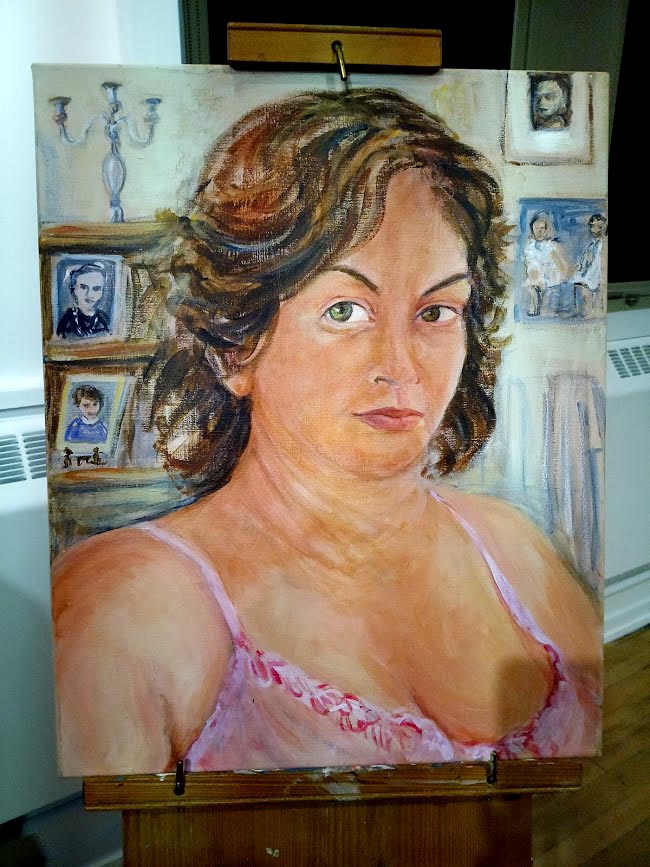
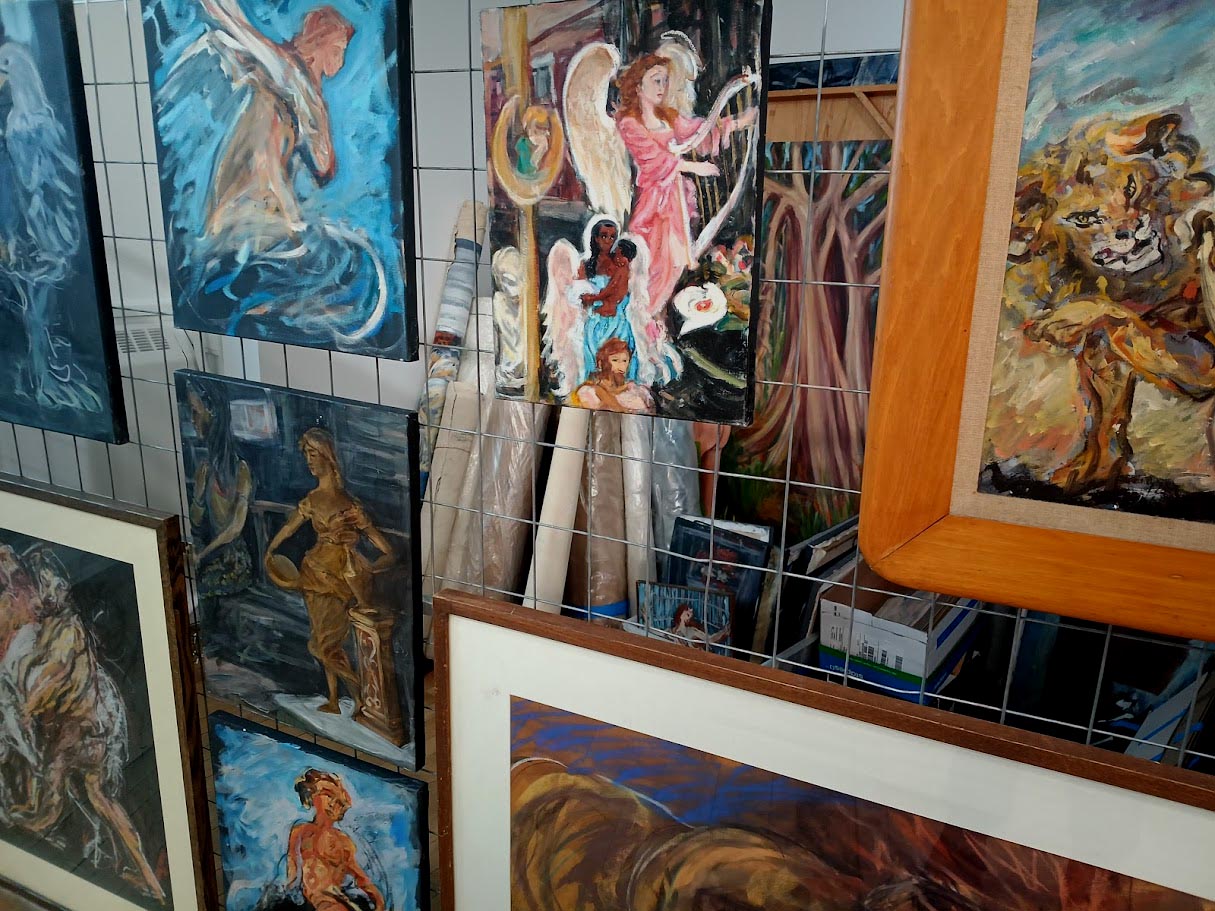
Sybil Goldstein died suddenly in 2012. She left literally thousands of paintings and drawings in this world.
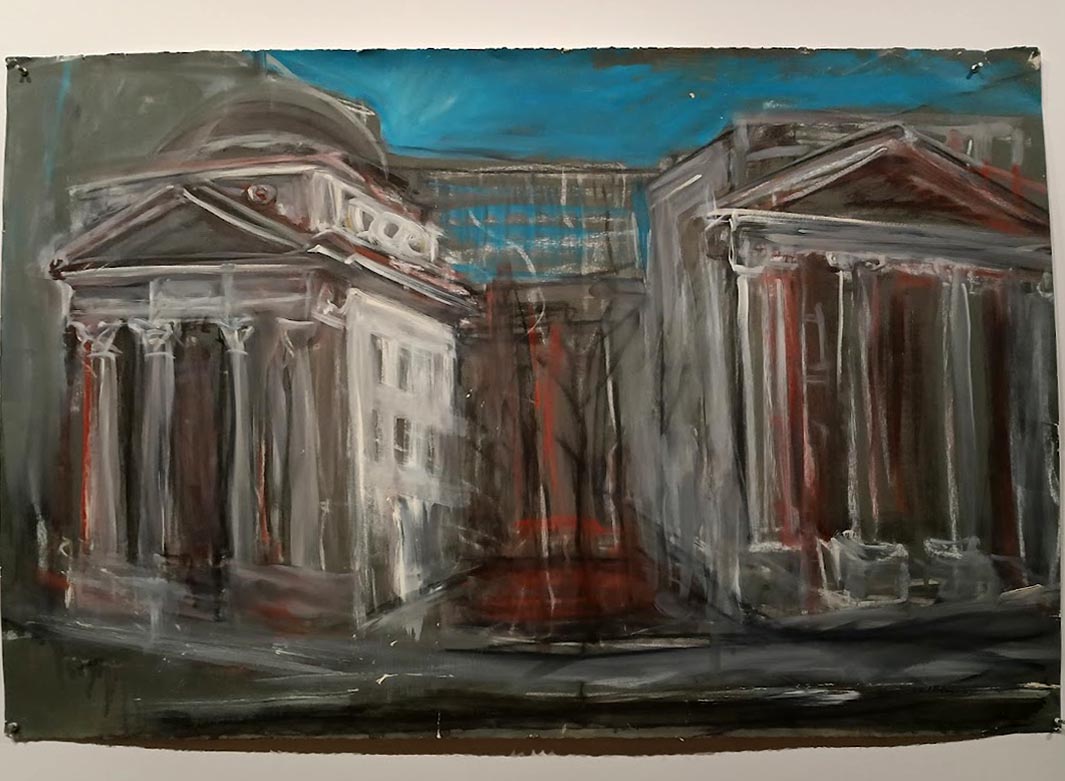
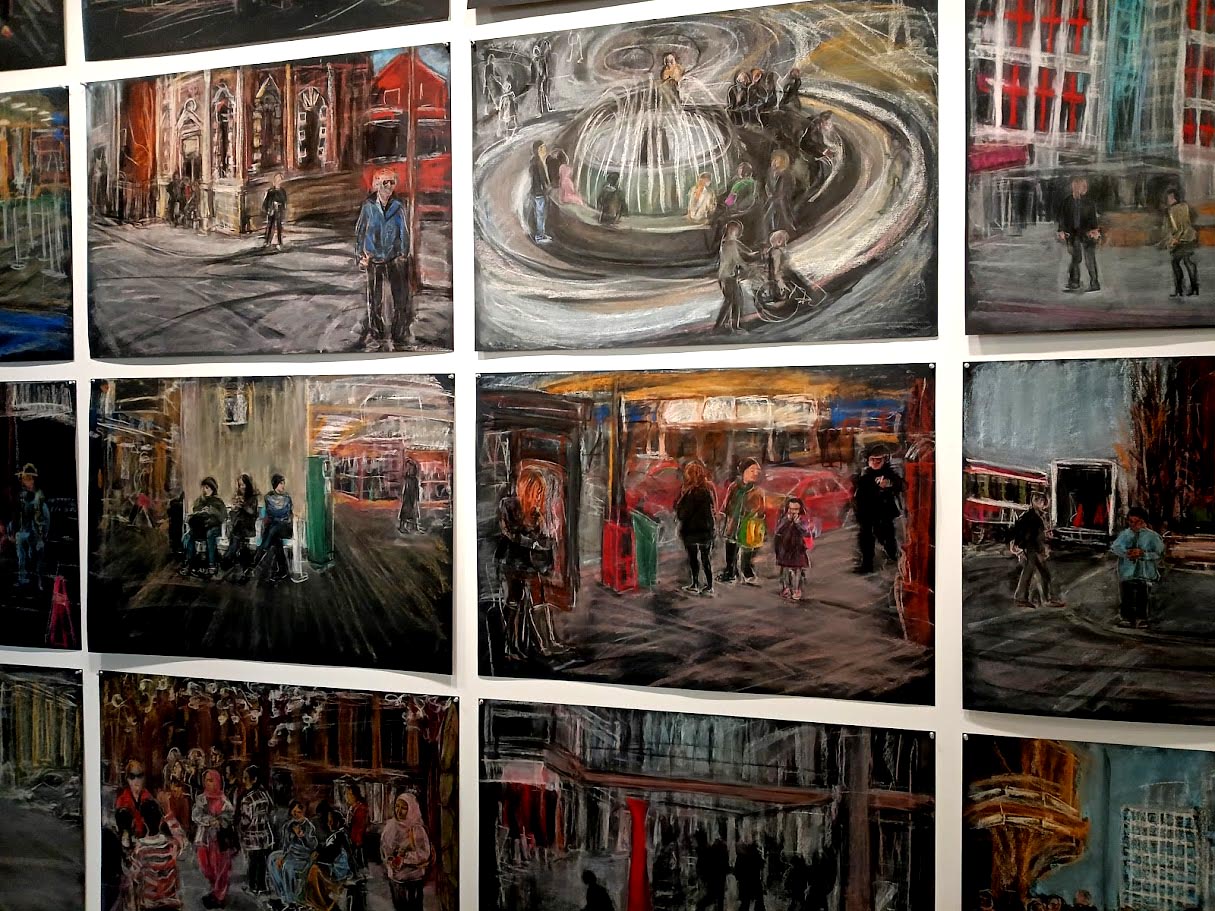
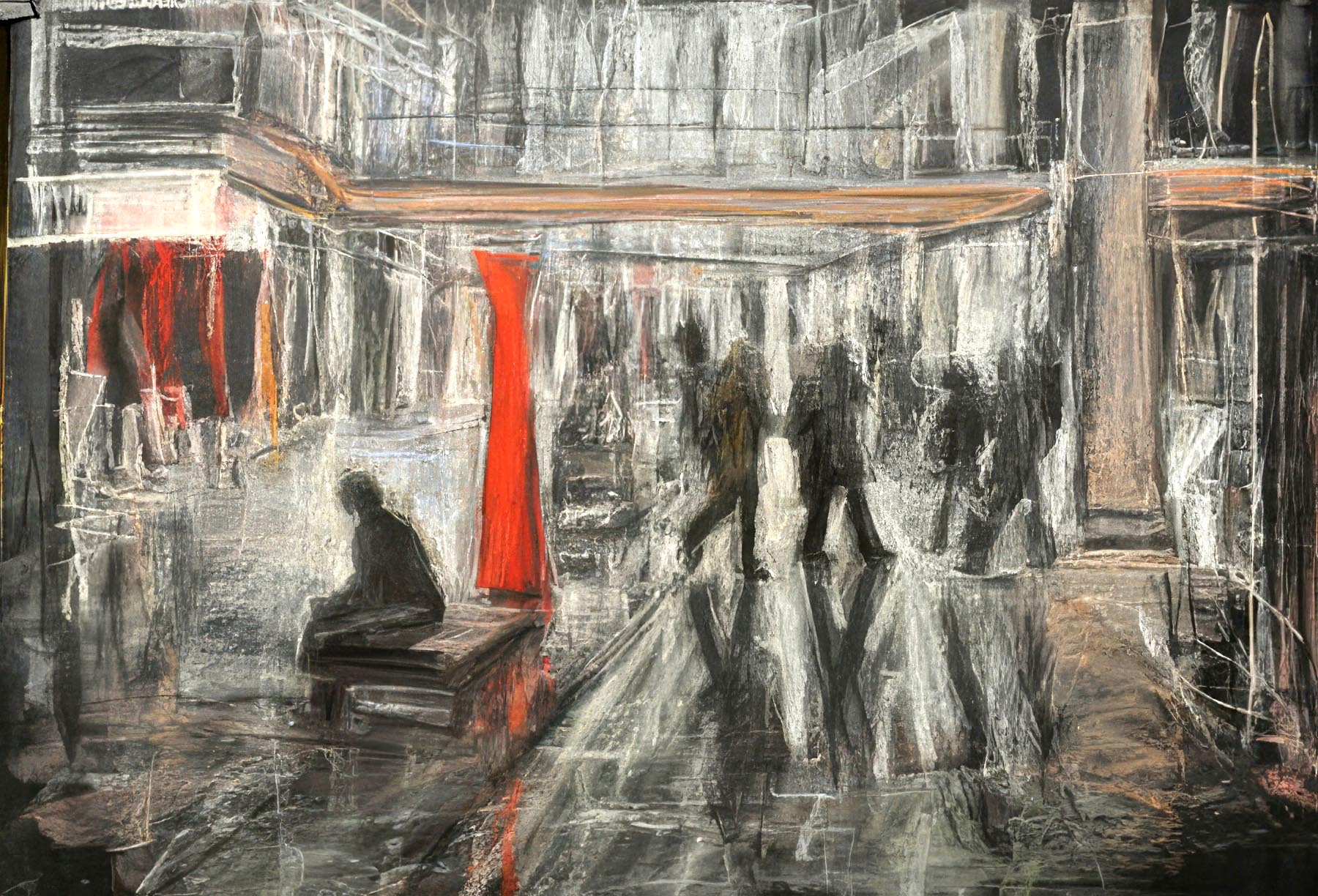
“College Street at 2 am” by Sybil Goldstein
Some of the work was sold at an auction held not long after her death. Anything unsold — the bulk of her creative output — was stored by her family. And now, thirteen years after her death, Sybil’s family has reached out to her friends in the Toronto art world with a plea to find homes for the numerous works of art.
If not, they will have to be destroyed.
Kofflerarts, an organization that supports community, decided to host this posthumous retrospective, including the surprising announcement that “visitors will have the opportunity to take home one of her original artworks once the exhibition closes.”
Artwork by Sybil Goldstein
Sybil Goldstein was a member of ChromaZone. In the early 1980s, as the art world turned away from the barren wastes of Conceptual Art, Minimalism, video art and performance, to the joyful excesses of Neo-Expressionism, ChromaZone hit their stride in Toronto.
What was ChromaZone?
“the celebration of the emergence of a generation that eschewed the increasingly remote and esoteric strains of formalist painting, process-oriented performance and hermetic video art for art in any medium that more actively engaged the struggles, issues, desires and pleasures of the real world.”
quote from “History of ChromaZone” by Sybil Goldstein and Andy Fabo
Artwork by Sybil Goldstein
Neo-Expressionism took off everywhere. It was all about sensuality, vivacity, real world politics, nature, myth and fiction, and also it was about money. Yes, suddenly there were actual objects that could be bought and sold!
It’s exciting to see numerous examples of Sybil Goldstein’s work on display at Kofflerarts, and to think about the heady days of ChromaZone and the surge of painting that flourished around the world at that time.
Installation views of Urban Myths
ChromaZone existed from 1981 to ’86, but Sybil Goldstein continued to paint until her death.
“Eatons Center” by Sybil Goldstein
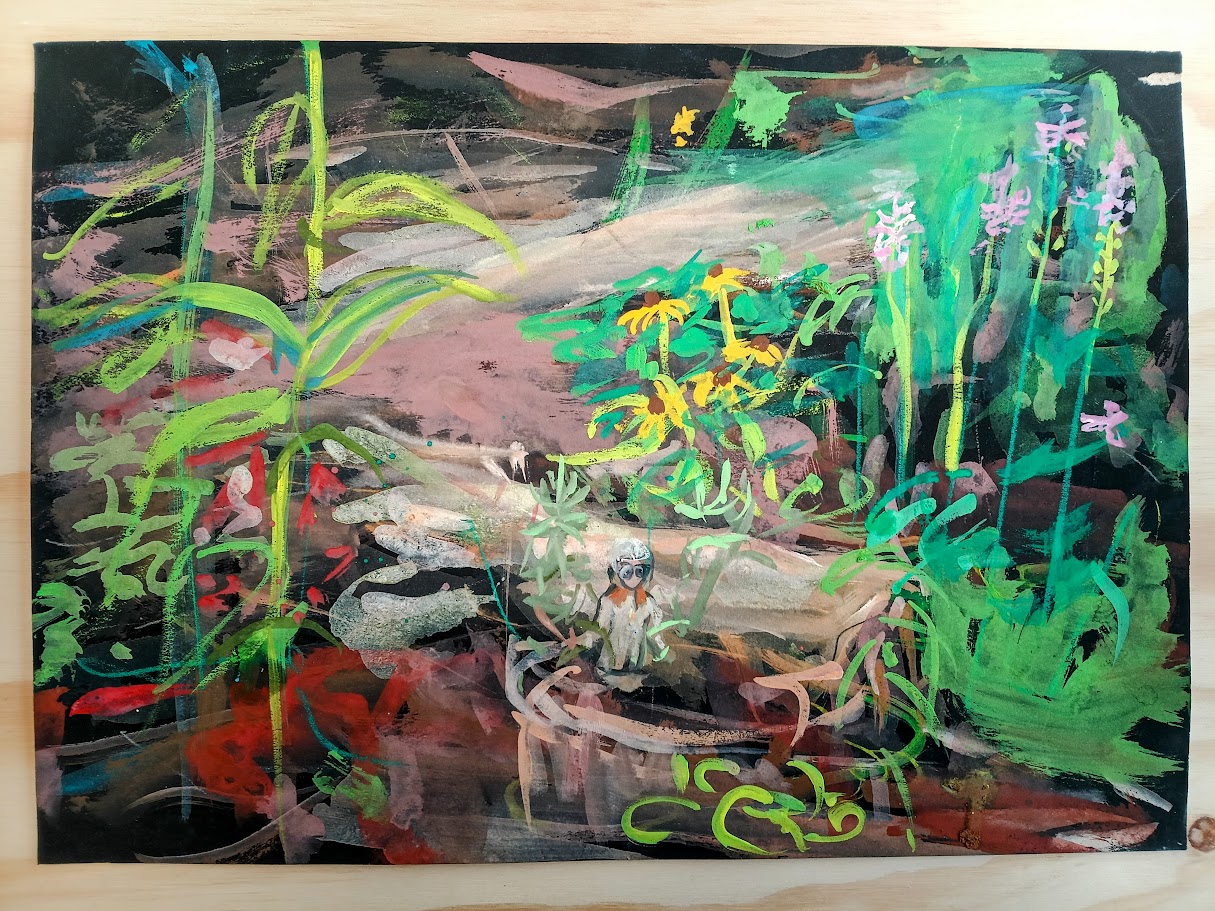
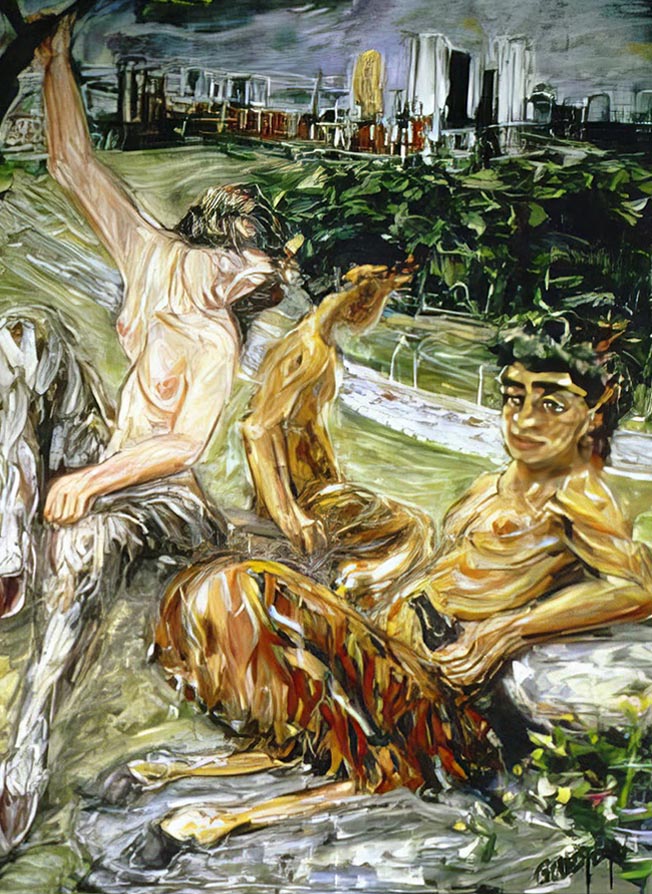
She painted everything: the streetcars and towers that define Toronto; moonlit nights and sunny meadows in the wilderness; rippling, black Ontario Lakes and rivers studded with ancient rocks; real animals and mythical beasts; friends and strangers.
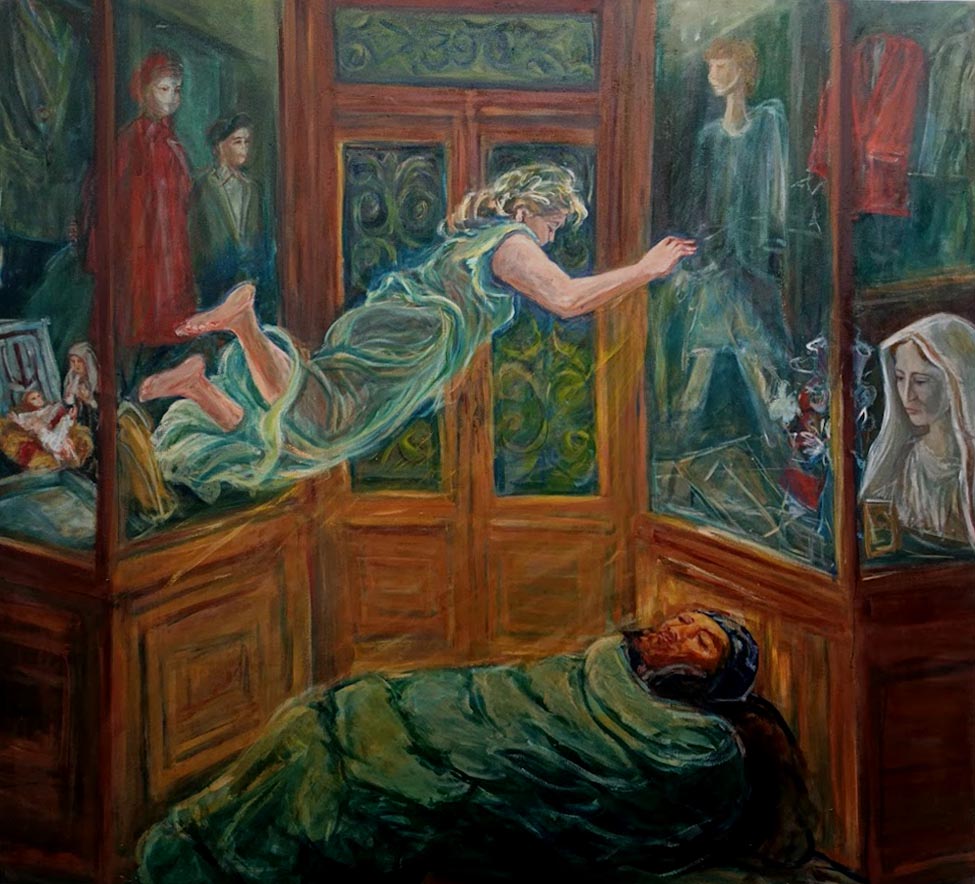
Particularly in her depictions of people, in urban settings, Sybil Goldstein offers compassion. Weary commuters rising on escalators or waiting patiently in line, shoppers at the Eaton Center and the Dufferin Mall, children playing in fountains, or the homeless, just trying to survive. Often there is an angel hovering nearby or a mysterious, dreamy glow so that all seem touched by something alien and graceful, something evoking the divine, something in all of us, even when we are hanging out in the PATH food court, wondering what to have for lunch.
“Satyr Family overlooking the Don Valley” by Sybil Goldstein
MOMENTA, Biennal d’art contemporain, takes place every two years in Montreal. I was lucky to have an afternoon to view at least a sliver of this ambitious event, which features 23 artists from 14 countries.
Each MOMENTA — and this is the 19th edition — has a “critical matrix,” and in 2025 it is the idea of unearthing absent or untold narratives. Titled “In Praise of the Missing Image,” this year’s event displays artworks that were created by rooting around in historical detritus to illuminate an untold story.
Mary, Queen of the World Cathedral is near Place Ville Marie, the temporary location of the Musee d’art contemporain
What was supposed to be a walk-through kept me there for hours. (Three of the five artists on display showed time-based work, in fact, looking through the MOMENTA catalogue it appears that many, if not most, of the exhibits are some incarnation of video.)
Joyce Joumaa
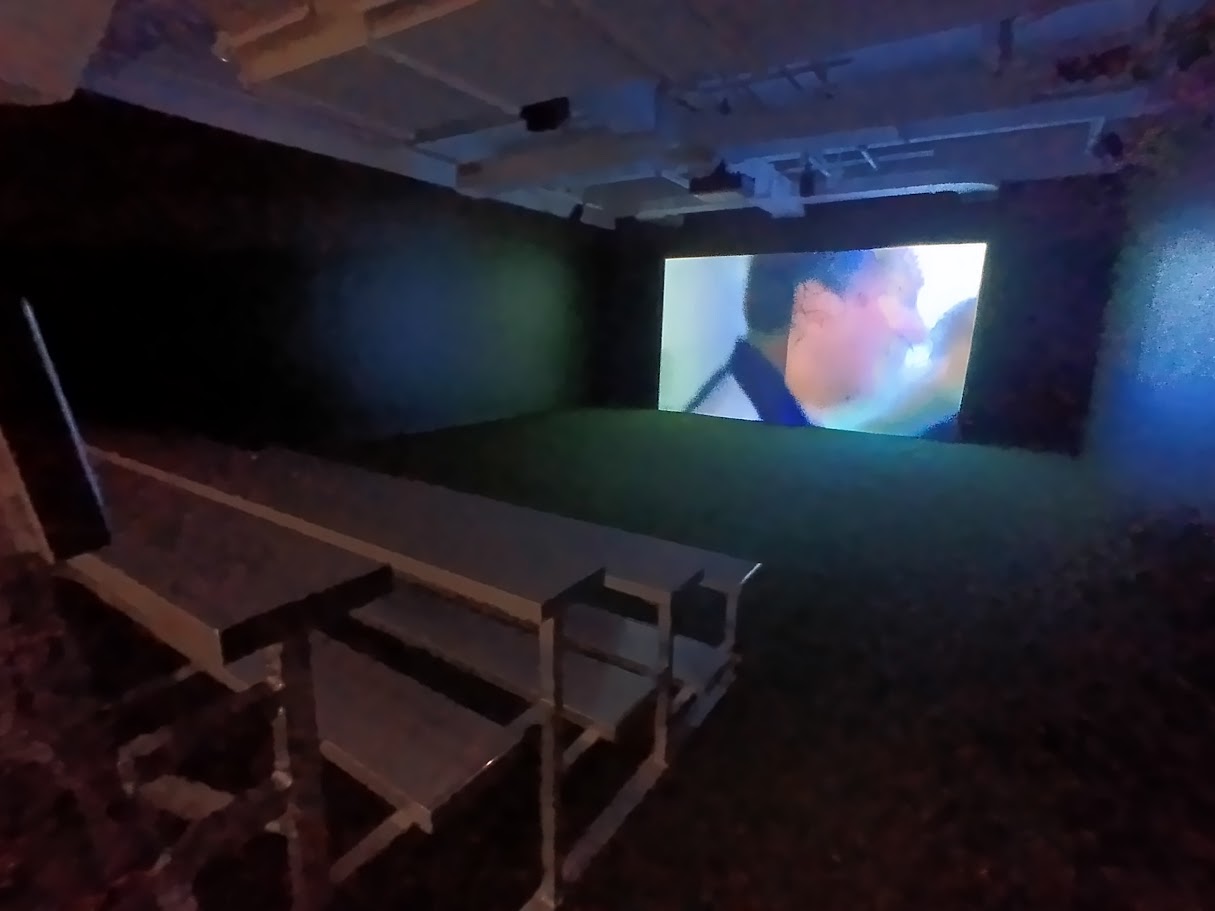
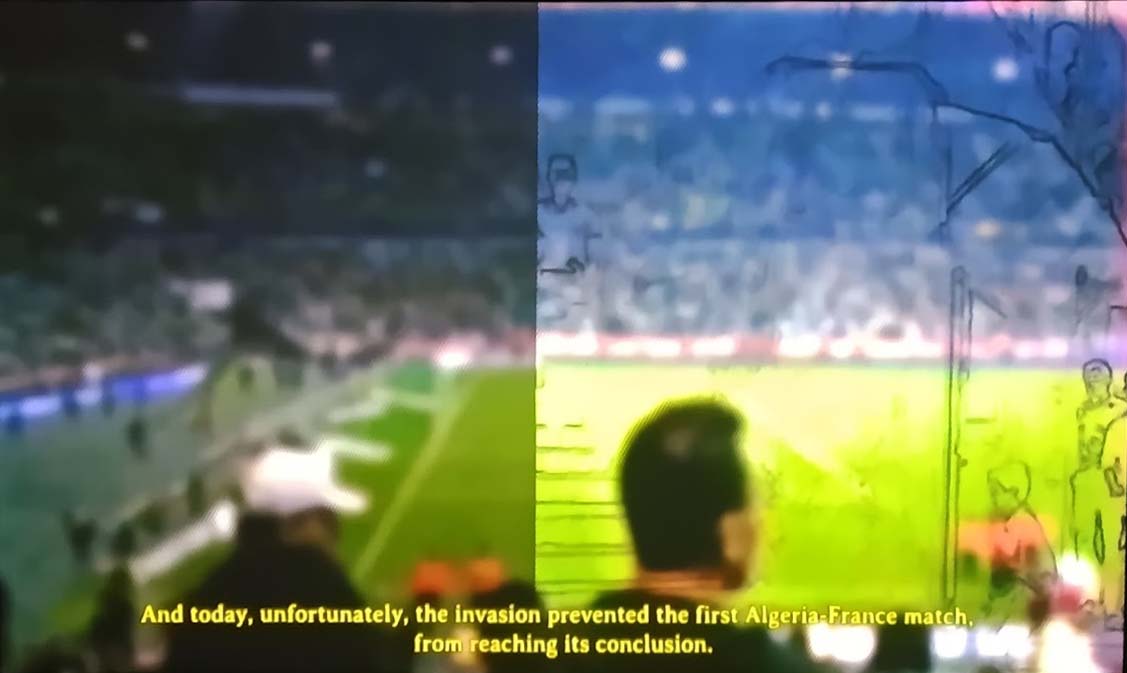
Bleacher style seating has been erected for viewing a video piece by Joyce Joumaa. This makes a lot of sense since the artwork concerns sports, specifically a 2001 soccer match between France and Algeria. On a single large screen in the darkened exhibition space an antique looking, blurry, image of the game is displayed. The broad swaths of vivid green turf are ominously overlaid with ghostly images from “The Battle of Algiers,” the famous film by director Gillo Pontecorvo, released in 1966.
Installation view of video piece by Joyce Joumaa
This particular game was highly symbolic. It was the first time the two countries met on the soccer pitch since 1962. It did not end well. When a group of Algerian marauders stormed the field and disrupted “the beautiful game,” politics crashed the party, somebody called the cops, the match was stopped, and the French press and officials were deeply disappointed.
Still from artwork by Joyce Joumaa. The text reads “And today, unfortunately, the invasion prevented the first Algeria France match from reaching its conclusion.”
A grinding war of independence from 1954 to ’62, in which 1.5M Alergians are said to have died, followed 132 years of vicious French colonial rule. It’s no wonder they didn’t want to play nice.
What’s going on in Algeria now? The country is still recovering from the colonial mess and a subsequent civil war, and also suffering from a continued smouldering insurgency. It does have a large economy, because of oil and gas resources, but Algerian society struggles with crime and corruption.
Sports are an outlet for endless tension and anxiety.
To this day, booing and whistling can be heard when the La Marseillaise is played during French Algerian sporting events.Toronto raptors fans behave similarly when the US National athem is played, but the game goes on.
Iván Argote
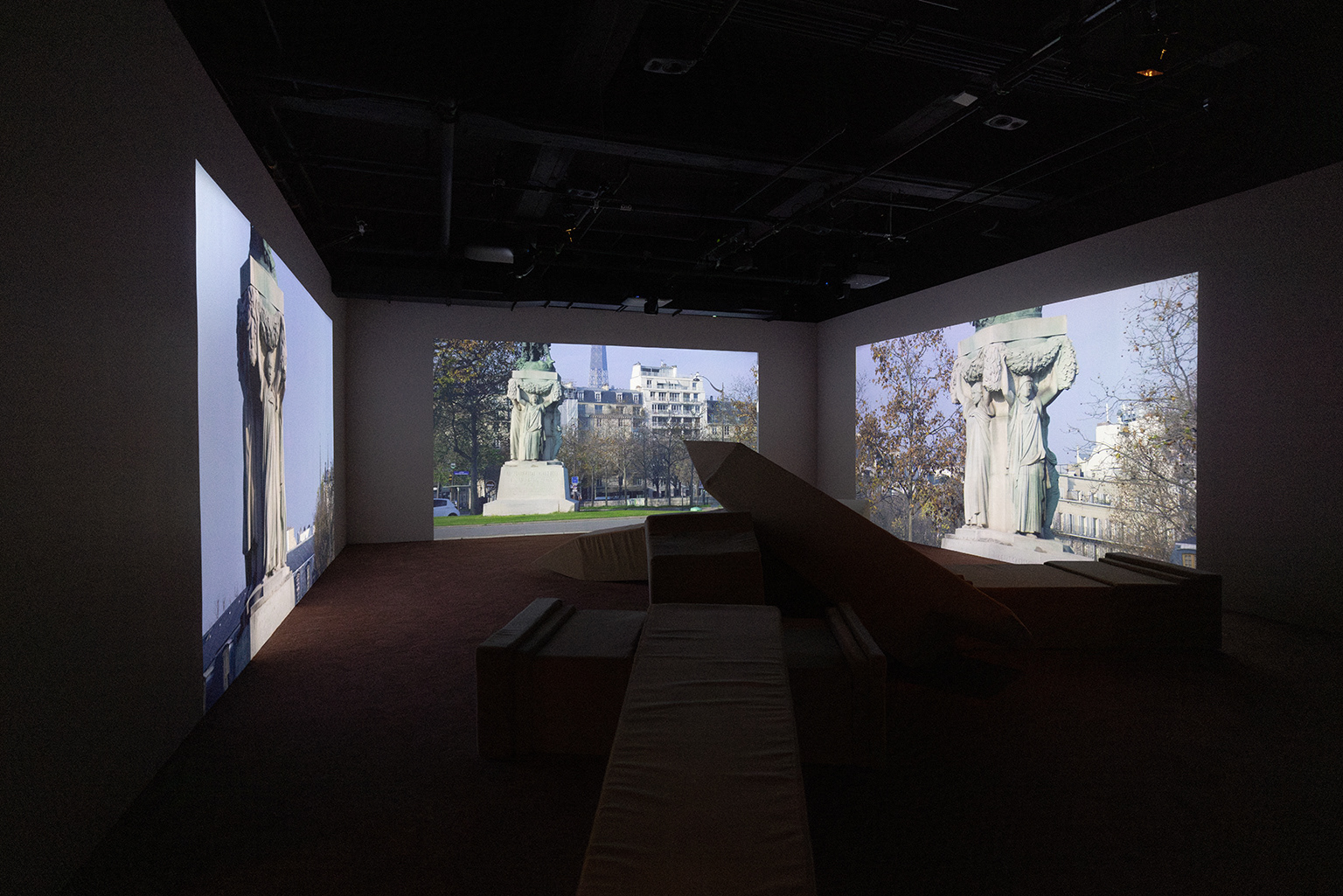
The video work by Iván Argote titled Levitate, contains three interactive channels. These multiple, giant projections surround the viewer, who is afforded a seating environment that’s plush and entirely suitable for comfortable lounging, even though it resembles chunks of shattered stone.
Installation view of Levitate by Iván Argote
The video documents three separate events, referred to as staged interventions. The Flaminio Odelisk is plucked from its historical perch in Rome and dangles from a crane. Similarly a crew arrives, throws up some traffic cones and removes the statue of a notorious French military office Joseph Gallieni, from the spot in Paris where it has stood for more than 100 years. And finally, a giant marble depiction, of Christopher Columbus — one of the defining historics monuments of the city — is driven through the streets of Madrid, on a flatbed truck. In each of these case, mayhem ensues, amid onlookers and social media.
Installation of Levitate by Iván Argote (photo by Michael Patten)
Video of installation by Iván Argote
I really enjoyed watching these famous monuments (supposedly) being toppled! And the extreme reactions.
There was some pithy texts and voiceover that were occasionally evident but they seemed mainly distracting. At this point, we are all too familiar with the looting and pillaging of various national agents and armies, and the erecting of statues to glorify villians. We don’t require a lesson! (In fact, this exhibition does frequently veer into lecturing and moral posturing, and sometimes strikes a tone of art as Sociology.)
Lee Shulman & Omar Victor Diop
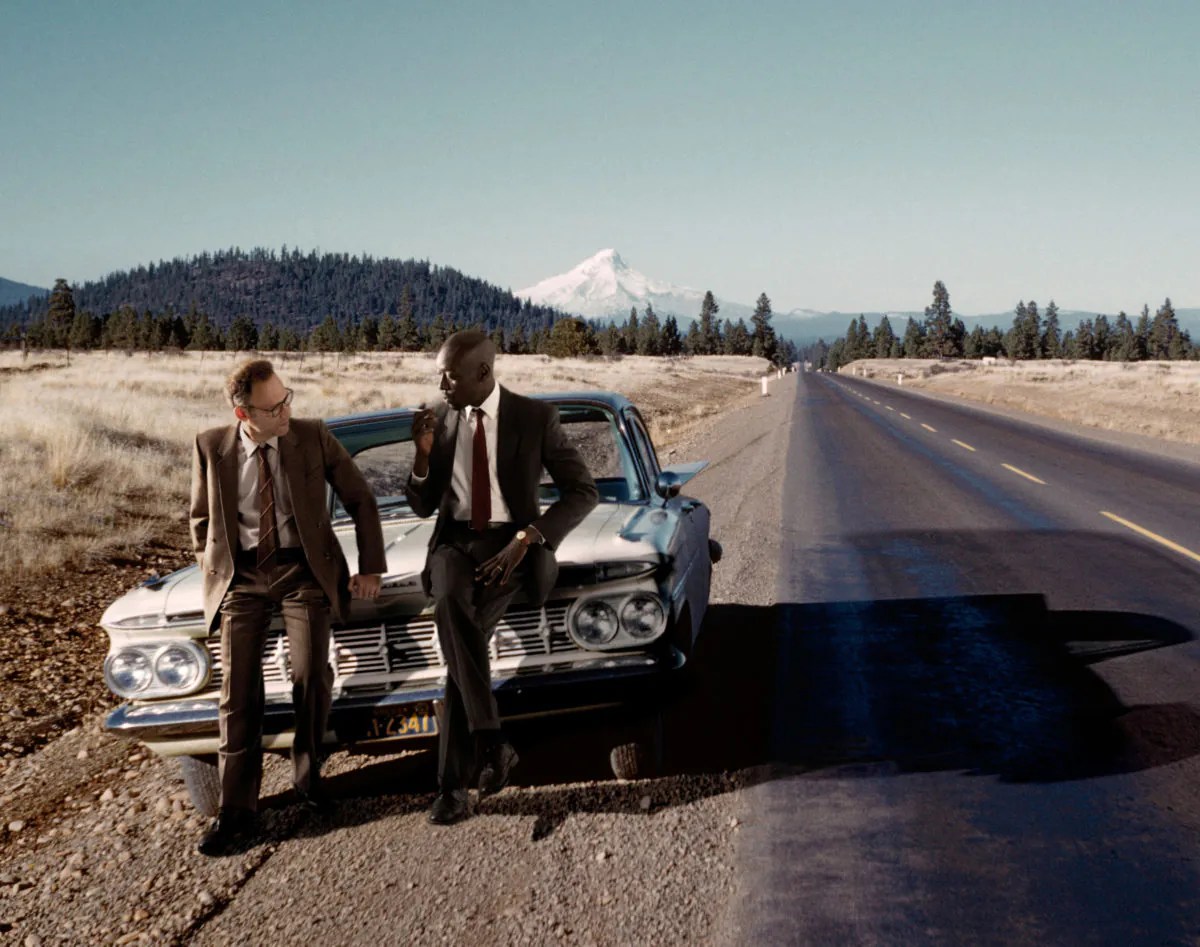
Being There_52-V1 by Lee Shulman & Omar Victor Diop
The photo works by Lee Shulman & Omar Victor Diop have a lighthearted appeal. Maybe its the absurdity itself that creates a somewhat uncomfortable underlying sensation. The big American car from the late 50s, the great outdoors, the road, and the slim elegant black man, conversing intently with his white counterpart. Not impossible, but from what we know of that era, unlikely.
Being There_27 by Lee Shulman & Omar Victor Diop
The photos create a mythic past where racism and exclusion did not exist. Omar Victor Diop, who has skillfully inserted himself into this dreamy Hawaiian vacation from the 1960s (above) looks more than a little surprised to find himself there.
Artwork by Lee Shulman & Omar Victor Diop
All the participants in this casual family photo appear relaxed and content, an idyllic afternoon in the outdoors, circa 1955. Except…
Sanaz Sohrabi
Watching the video by Sanaz Sohrabi, I felt like I should be taking notes or at least I should have done the preparatory reading before the class. I could barely keep up. Her video, called An Incomplete Calendar is densely packed and heavily researched.
Still from An Incomplete Calendar by Sanaz Sohrabi
It focuses on the years between 1950 and 1970: involves a Venezualan choir which toured the OPEC states promoting unity; shows some of the Western modern art housed in Iranian cultural edifices; displays an endless parade of stamps, letters, magazines, posters and other archival materials from the era to demonstrate struggles among the oil producing nations. It’s a little overwhelming.
Still from An Incomplete Calendar by Sanaz Sohrabi
Something included in this video that it was really great to learn about was the sculpture by Japanese artist Noriyuki Haraguchi,which is in the Tehran Museum of Contemporary Art. The sculpture consist of a low-slung rectangular steel structure, filled with thick, opaque waste oil with a glossy surface. Haraguchi exhibited the Oil Pool sculpture at “Documenta 6” in 1977 and it was then acquired by the Museum. I love this piece!
OIl Pool by Noriyuki Haraguchi
In a bizarre incident in 2022 a performance artist Yaser Khaseb, accidently plunged into the pool while performing an aerial exhibition. As a result, the Tehran Museum of Contemporary Art fired its director. The performance artist, although apologetic, was philosophical about the event. “A work of art can be reborn in contact with other works. From the interaction between two works, a new work can be produced,” he said.
Still from An Incomplete Calendar by Sanaz Sohrabi
Weirdly, I noticed the music or sound in all of the video works at the MAC had a startling simularity. I guess you could call it minimalist: a sort of one-note drone, rising and falling subtlely, sometimes featuring emotionless voiceover. I guess the viewer is obliged to hear it as a cue, signifying “this is serious.” Did the trend begin with the Ken Burns Vietnam documentary? Possibly.
I exited the basement gallery, with its many darkened rooms, into the brilliant sunshine of a Sunday afternoon in beautiful Montreal.
September 21, 2025, Montreal
I was just in time to witness a Pro Palestinian demonstration, moving slowly along St. Catherine, as I slipped into my favourite Montreal Cathedral for a last look before my trip back to TO.
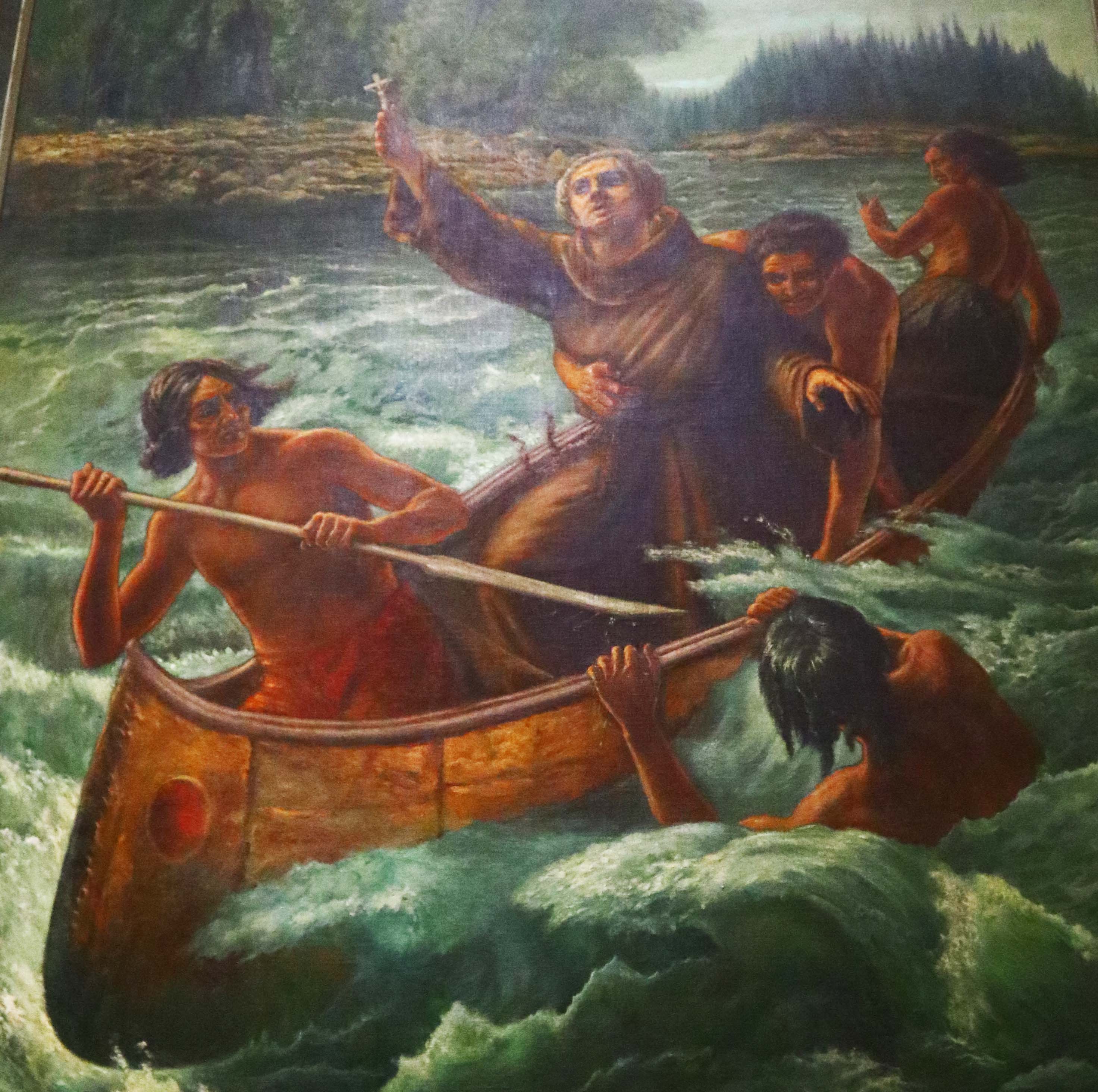
I guess one could call it “living in contradiction,” as is our fate these days, but the paintings in the church appeared to be an extension of the missing images exhibit. Could they have been created by Kent Monkman I wondered? Is this an elaborate ruse?
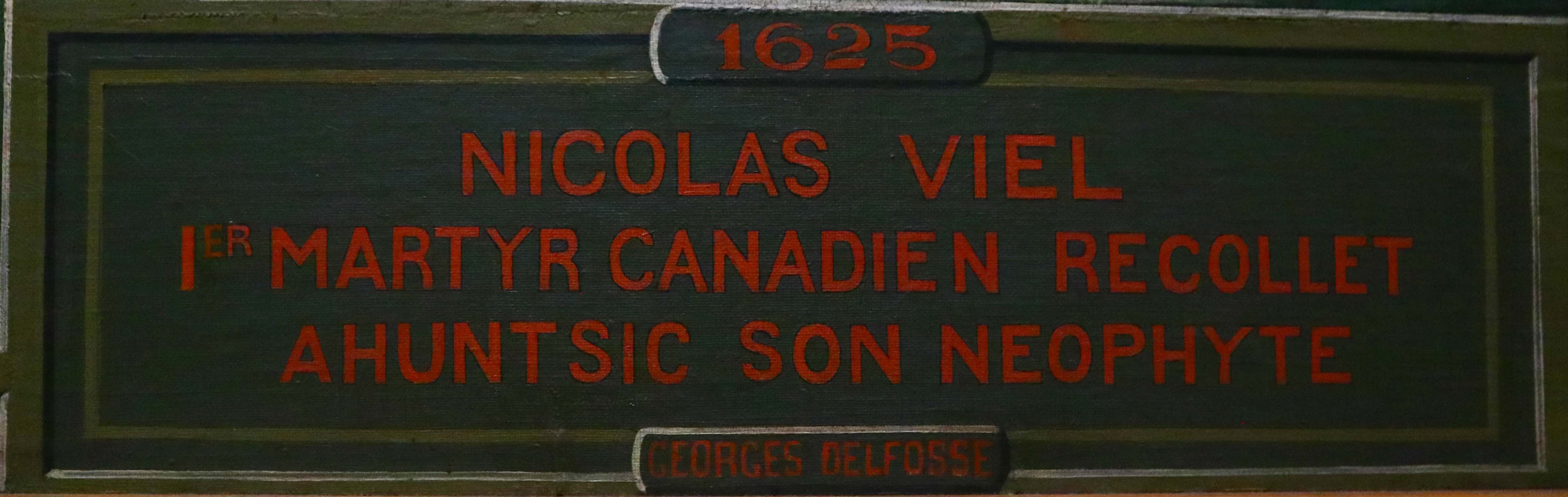
Painting by Georges DelfossePainting by George Defosse
But no, I determined. No, apparently not, they are sociological depictions from another era.
The towering 53rd Street Atrium of the Museum of Modern Art seemed less crowded than during prior visits. The galleries less packed with frantic visitors. In fact, the streets themselves seemed less grid-locked and less raucous. Maybe it’s the “congestion pricing” impact? Or maybe it’s the policies of the current Administration?
Whatever the reason for the relative tranquillity, it was truly uplifting to wander through the show called Jack Whitten: The Messenger without feeling jostled, and to appreciate the achievements of this artist and more broadly, the achievements of so many American artists, caught now — like the rest of us –in this period of fear and dismay.
“Black Monolith II (Homage to Ralph Ellison The Invisible Man),” by Jack Whitten
“Acryclic, onion, eggshell, molasses, copper, salt, herbs, rust, coal, ash, chocolate and razor blade.” These are a list of the substances Jack Whitten used to create the painting “Black Monolith II (Homage to Ralph Ellison The Invisible Man”), shown above. The painting, and many others of this period, is composed of hundreds of tiles, cut from sheets of dried acryclic embedded with varied ingredients and assembled into a painting. Jack Whitten called this invented technique “acrylic tesserae.” “Each tesserae is a piece of light,” he said, “The message is coded into the process.”
A lush jazz soundtrack (John Coltrane, Miles Davis and Thelonious Monk and others) plays throughout the show’s galleries, referencing Jack Whitten‘s love of jazz.
Installation view “Jack Whitten: The Messenger” at the Museum of Modern Art
Many of the tributes and dedications he attached to his work honor the black musicians, writers and artists that impacted him during his six decades of living in New York City and making art, which he invariably viewed as experimental.
“Homecoming for Miles Davis” by Jack WhittenCloser detail of “Homecoming for Miles Davis” by Jack Whitten
Shown above, “Homecoming for Miles Davis” was also made of hardened acrylic tiles, which in this case he spattered with white paint, a la Jackson Pollock, and put together into this dazzling painting, described by the artist as a “cosmic net attempting to capture Miles’ soul.”
“Atopolis: for Eduourd Glissant” by Jack WhittenDetail of “Atopolis: for Édouard Glissant” by Jack Whitten
The tiles in the painting shown above, named for Édouard Glissant, the French writer, poet, philosopher, and literary critic from Martinique, were infused with metallic, phosporescent and organic materials from aluminum to anthracite.
Repeatedly, this artist states he is interested in innovation. He wants to make abstract art that changes the course of painting.
Trained as a cabinet maker, Jack Whitten, made specialized tools to apply paint. He painted standing up for decades, smoothing paint in layers with a rake-like tool which is on display at the Museum.
Tool used by Jack Whitten to paintJack Whitten at work in Studio in the 1970s, using “The Developer”
He called the rake-like tool “The Developer.” He added layer upon layer of paint, raking and merging the color until he had the effect he wanted, which was “sheets of light.”
“Tripping” by Jack Whitten
The photograph above doesn’t convey the startling, glowing, gem-like quality that some of Jack Whitten’s paintings hold. He “combed” the layers of paint to create colours found nowhere else and experimented like an alchemist, adding recycled glass, pulverized mylar, gold dust and numerous other substances to the paint to get the effect he was after.
In some paintings, the artist would bury items into the gallons of paint he poured onto wood panels. These items — bits of wire or wood, staples, insects, floor sweepings — he called “Disruptors,” since through the raking process they disrupted the smoothed surface to reveal transformations below.
Installation view of “Siberian Salt Grinder” by Jack WhittenDetail of “Siberian Salt Grinder” by Jack Whitten
I couldn’t help thinking about the giant squeegee paintings by Gerhard Richter. Like Jack Whitten, Gerhard Richter explored the relationship between painting and ph0tography in his earlier works. Later, the element of unpredictability was major in both of these artist’s big beautiful paintings of sweeping horizontals.
“Abstract Painting (726)” by Gerhard Richter
Political turmoil was a factor in the creative development of both men. Gerhard Richter was born in 1932 in Dresden, Germany, into the mayhem of WWII and its aftermath. Jack Whitten was born in 1939 in Bessemer, Alabama, at the height of Jim Crow. He grew up in Civil Rights movement and the era of political assasinations in the USA and, of course, the Vietnam War.
“Black Table Setting (Homage to Duke Ellington)” by Jack Whitten
I particularly liked looking at Jack Whitten’s paintings of screens, or screen-like images.
“Khee II” by Jack Whitten
The painting above is part of his Greek Alphabet Series. It has a mysterious quality of movement, as remote images seem to shift and rearrange themselves from within, like poor reception in an analog TV screen.
“Gamma Group I” by Jack Whitten
Jack Whitten said every colour carries ” a lot of psychological meaning” and he sought to avoid the “story telling” that automatically occured by using colour. His black and white paintings from the Greek Alphabet series of paintings, resemble a flickering screen, dissolving into abstraction.
I say to people, “Take everything you have ever felt, everything you have ever smelled, every sound you have ever heard, every sensation you have ever had that you have felt through your fingertips. Take all of that and compress it.” You would get an understanding of abstraction. – quote from Jack Whitten in the MOMA exhibition notes.
His sculptural work, on the other hand, tells a lot of stories:
Sculptural works by Jack Whitten
…stories about the African diaspora, the history of art in the Mediterranean, trash and found junk, labour and work and many other topics.
Some of his paintings too, are depictions of fragments of a changing world. His painting shown below, which suggests apps on a screen, was made in honour of Obama’s election.
“Apps for Obama” by Jack Whitten
The showstopper, however, for many of the New Yorkers on that relatively quiet day at the Museum of Modern Art, has to be the painting titled “9.11.01.” Jack Whitten witnessed the World Trade Center’s destruction and produced an enormous painting in honour of the victim’s of that event.
“9.11.01” by Jack WhittenDetail of “9.11.01” by Jack Whitten
I spent some very somber moments in front of this painting, recalling not just the appalling catastrophe of that moment, but the following days and months, when the country, and indeed much of the world, was so unified in the shared shock and horror at that violent act. It seems like a long time ago.
This year’s Art Toronto — the 25th Anniversary event — exuded confidence, sophistication and depth. It was great to wander the vast expanse of the Metro Toronto Convention Center and get lost in the labyrinths and eddies of unfettered display.
There were more than 100 exhibitors. Galleries from across the country were represented. I also noticed some European and South American galleries, as well as a number from our friends in the USA.
There were many people-watching opportunities!
This vivacious, well-dressed group attended last year’s Art Toronto and were expected to return again this year, although, sadly, I did not spot them.
This exhibition has the feeling of an exciting shopping mall. What follows is a tiny and utterly subjective view of the tumult of art and commerce that is Art Toronto.
I was definitely happy to see work by favourite artists, from Toronto and elsewhere.
Carol Wainio, in her signature faded, dreamy palette, continued her exploration of haunting folklore from the distant past.
“Direction Home” by Carol Wainio was presented by Paul Petro Contemporary ArtDetail of “Direction Home” by Carol Wainio
There was some Witch Queer Volcanology on display in the form of one of the spectacular Fastwurms textile pieces.
“Sundoro” by Fastwurms was presented at Paul Petro Contemporary Art
I liked looking at the mysterious weapon, lifting off into the mist, by Wanda Koop.
“Seeway – Green with Lights” by Wanda Koop presented by Blouin Division
There were many artist’s works I had not encountered previously. I had questions.
I was trying to figure out what drew the artist, Nicholas Crombach, to this particular shade of red flocking, in his wildly complex sculptural piece. Maybe its a particular representation of vitality? Or maybe he’s referencing the way precious items are sometimes tucked away in red velvet?
Weisels by Nicholas Crombach
I enjoyed the desolate emptiness created by the painter Ulf Puder, in this large work hovering between geometry and realism.
“Sand” by Ulf Puder, shown by Bonne Choice Gallery
The photo piece below, by Kris Munsya, has a cinematic feel of futuristic mutation occuring in a lush, tropical site. I want to know more!
“Airplane Mode – Genetic Bomb” by Kris Munsya exhibited by Galerie Robertson Ares
I was in awe of this extra large lino cut print, produced on hand-made gampy paper. The giant print, by Alex Kumiko Hatanak, was part of an installation at the McMichael Gallery booth.
“Faultines and Loneliness” by Alex Kumiko Hatanaka Detail of “Faultines and Loneliness” by Alex Kumiko Hatanaka
This photo of a house was fascinating. It looked a lot like a green monopoly piece. I learned it was part of something called the Lenora Drive Project, in which a Willowdale developer allowed artists to get creative with a half dozen condemmed bungalows.
“Title Deed” by An Te Liu presented by Bonne Choice
It took me a while to figure out that An Te Liu, the artist responsible for “Title Deed,” is the same artist who makes the very appealing sculptures, shown at Blouin Division last year.
“Broken Window” by Anahita Norouzi shown by Nicholas Roberts Gallery
Anahita Norouzi‘s photo piece made me want to know more about this barren landscape and the spectacular explosion implanted there.
Detail of “Broken Window” by Anahita Norouzi
There were some special shows put together by individual curators, including a “Focus Exhibition” titled ‘the place to which we return.’ It was described as engaging viewers with ideas of “home” and what that notion means to them.
“Regrounding” by Marigold Santos
The painting above, by Marigold Santos, was part of the “Focus Exhibition.” It was quite stunning to stand before this painting and bask in the field of yellow. The painting of a corpse dissolving into a landscape, although fascinating and intricate, is almost incidental to this powerful sweep of colour.
Detail of “Regrounding” by Marigold SantosArtwork by Renee Condo presented by Blouin Division
Another piece in the Focus Exhibit is this one by Renee Condo. I’d seen the big, beautiful beadwork pieces by Renee Condo before, at the Blouin Division space. They have a joyful, high-octane buzz and effectively pull beadwork into a contemporary space.
“There Are No Footprints Where I go” by Meryl McMaster
In many indigenous cultures crows are valued for their intelligence and spiritual significance. They are seen as messengers from the spirit world, holders of universal wisdom, and protectors against evil forces.
This piece by Meryl McMaster, also part of the Focus Exhibition, has a quiet power and mystery.
Detail of “There Are No Footprints Where I go” by Meryl McMasterDetail of “There Are No Footprints Where I go” by Meryl McMaster
Beleaguered, in decline, challenged, crumbling, struggling…. These are some of the words used in the local press and social media to describe the current state of the Toronto art scene. There are many reasons: the pandemic screwed everything up, capricious corporations pulled funding, everything is turned into a condo tower, money just keeps flowing upwards, and a glass of wine costs twenty dollars. But is there something more fundamental going on, could it be the nature of Late Stage Capitalism!?
Assemblage by Ruth Adler from “DECADE” at Koffler Centre for the Arts
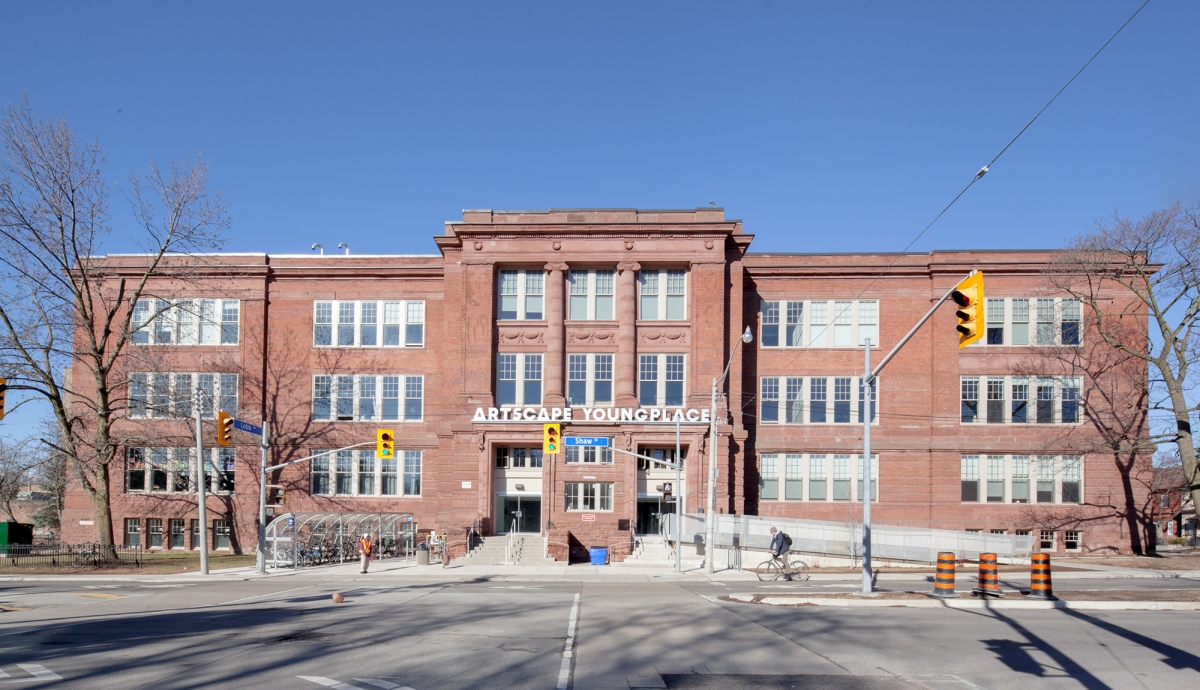
In this context, seeing the exhibition at Koffler Center for the Arts was not just fun, uplifting and hopeful, but also illustrative of the importance of artist’s spaces in this city. The Koffler Center is housed in the Youngplace building, which opened as a cultural center in 2014 and is currently one of the Artscape facilities in Receivership. All the artists in the show are, or were, until recently, part of the Youngplace community.
The stated goal of the exhibition is to shine a light on Youngplace: “this iconic arts hub.”
Assemblage by Ruth Adler
Lining the wall of the entrance to DECADE are fabric and paint assemblages by Ruth Adler. This artwork strikes me as generous, open and approachable. It’s all about surface and shape, colour, pattern and movement. It feels light-hearted and celebratory, and I really like the way this artist repurposes materials.
Ruth Adler has had a studio at Youngplace for 10 years. This fact reminded me of the documentary about Brian Eno I saw this week, at the annual Hot Docs Film Festival. (Actually it was more of a film experience, created using generative technology.) Toward the conclusion of this event Brian Eno talked a lot about the importance of creative ecologies, as opposed to the myth of the solitary genius. I assume this idea of creative community applies to all the artists in this show.
Although she works with many different kinds of materials, Ruth Adler thinks of herself as a painter. Matthew Schofield is another painter in the show. Whenever I see paintings by this artist it feels like he’s tapping into my own memory banks. That’s because he delves into the arena of quirky personal snapshots, family pictures, keepsakes, memorials that are entirely personal, and yet, universal.
Painting and detail by Matthew Schofield
These beautiful paintings are tiny, some just 4″x 4.” They are identical in size to the original snapshots. They have a glittering, gemlike quality which is quite mesmerizing. I want to get closer and closer to them, and peer into the captured moments.
Painting by Matthew Schofield
It was very exciting to see the work of Midi Onodera. This artist has some interesting relationships with machines.
Excerpt from Soliliquy bny Midi Onodera
The excerpt above is a hilarious interaction between the artist and a chatbot named Faux Midi.
There is a lot of literature on line these days about how chatbots and GPT entities are prone to all kinds of malfeasance. They are liars, people pleasers who will say anything just to keep talking. They are prone to hallucinations. They can easily be hypnotised to spout misinformation. In other words, these things can’t be trusted! Some of the exchanges between Midi Onodera and Faux Midi make this fact abundantly clear.
The other piece by Midi Onodera was produced especially for the exhibition and weaves together colorized, moving mages of the corridors and stairways of the Youngplace site at 180 Shaw Street. It was wonderful to look at until I started feeling seasick.
Excerpt of 2397 by Midi Onodera
Speaking of weaving, textiles played a big role in the DECADE show.
I was obliged to read the catalogue to know what I was looking at when I viewed the elegant, attenuated weavings by Shabnam K. Ghazi. In fact, these wall hangings are composed of shredded paper which has been woven into a fragile, delicate fabric. The recombined paper contains screenprinted depictions of the artist’s writings, describing her earliest memories.
Artwork by Shabnam K. Ghazi
In this convoluted, painstaking process the artist has found a way to physically manifest her language and her earliest recollections.
Two pieces by Barbara Astman are in the show. One is a lovely tapestry in muted tones. It takes a while to recognize the fragments of contemporary glamour, fashion and advertising imagery in this piece. The form of tapestry, a traditionally female pursuit, originated in Ancient Egypt. Tapestry weave pieces, using linen, were found in the tombs of both Thutmose IV (d. 1391 or 1388 BC) and Tutankhamen (c. 1323 BC.)
Tapestry by Barbara Astman“Daily Collage” by Barbara Astman
The other piece by this artist is a collage using news feed type imagery. I really like the way Barbara Astman uses the pictures we are relentlessly bombarded with everyday and repurposes them for her own amusement.
Detail of “Daily Collage” by Barbara Astman
Massive quilts by Carolyn Murphy are on display. They take quilting, another so-called feminine art, into the realm of spare and airy abstraction. These quilts have a Russian Constructivist vibe. The very appealling texture is created by the dense stitching which ambles every which way in curving patterns. It was a good move by the Koffler gallery to place a large sign nearby, stating the obvious: Do Not Touch.
Quilt by Carolyn Murphy
Among my favourite artworks in this show were the paintings by Gillian Iles. She has created a sprawling installation composed of about eight separate paintings, produced on Tyvek and other materials, tied and stretched haphazardly. The installation resembles a temporary dwelling or encampment, ramshackle, derelict and unsafe.
“All and Nothing” by Gillian IlesDetail of installation by Gillian Iles
Within this structure, Gillian Iles has strewn intense images: Light blasts a tiny, vulnerable tent under the arch of a heavy black night sky; a wrecked, abandoned vehicle is overgrown with random vegetation; a fire nearly out of control towers over onlookers; and — is it dawn or more flames? — something is blazing fiercely through a hidden path in the woods.
Detail of “All and Nothing” by Gillian IlesDetail of All and Nothing by Gillian IlesDetail of installation by Gillian Iles
David Liss, the esteemed director/curator of MOCCA, curated the exhibition. In a video loop playing in the gallery he talks about how interacting with art — not on line but in real life — is essential to the human experience. He invites visitors to the show to celebrate Artscape Youngplace and the decade since it was founded, and to “consider and imagine what the next decade will look like.”
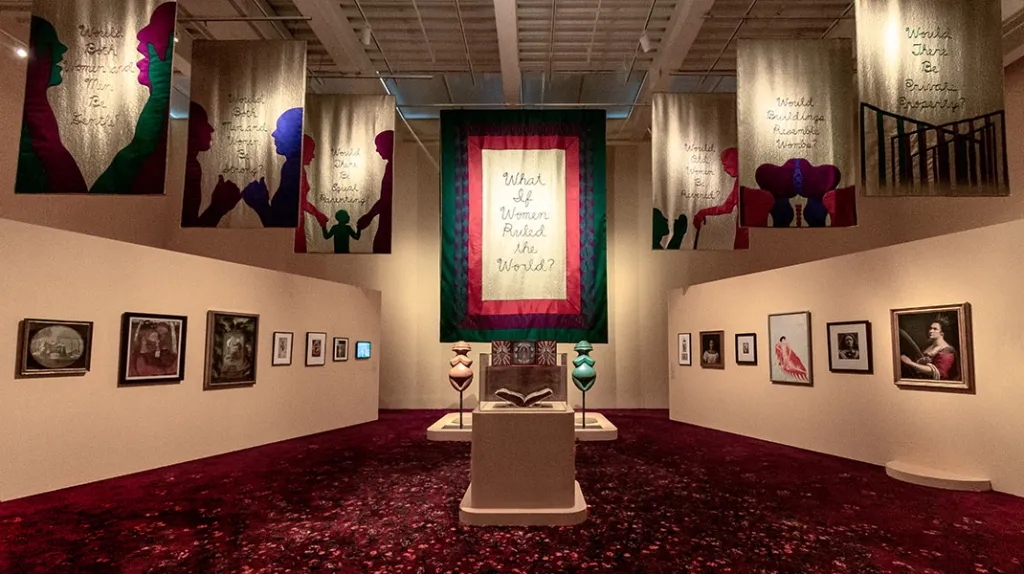
In one of the pieces from her massive retrospective at the New Museum — covering sixty years of art making — Judy Chicago invites us to consider a simple question: What if Women Ruled the World? The responses are compiled in a sprawl of hopeful texts, manifest in needlework, that most feminine of forms.
“There would be no wars.” “The Earth would be saved by humanity instead of being destroyed by it.” “The first step would be to abolish gender norms and deconstruct the entire hetero-patriarchal, racist and classist system that surrounds us.” “Not one mass shooter in the US was female.” “There is no need for violence when we use our hearts.”
In anyone else’s hands this piece might come off as naive or reductive, but there is something about Judy Chicago’s method — what she refers to as “call and response” collaboration — through which she is able to harnass an outpouring of honesty from many participants. The result is that the artwork has a powerful impact. It is urgent and exciting.
Installation view of “What If Women Ruled the World” by Judy Chicago Detail of “What if Women Ruled the World” by Judy Chicago
This is a big show, going all the way back to painted car hoods Judy Chicago produced in the mid sixties.
Installation view of Herstory by Judy Chicago
And then there were the wonderful smoke performances from the seventies.
Immolation by Judy Chicago
But these early artworks are not the reason for Judy Chicago’s giant retrospective at the New Museum.
“Herstory” will showcase Chicago’s tremendous impact on American art and highlight her critical role as a cultural historian claiming space for women artists previously omitted from the canon.
New Museum description of Judy Chicago: Herstory
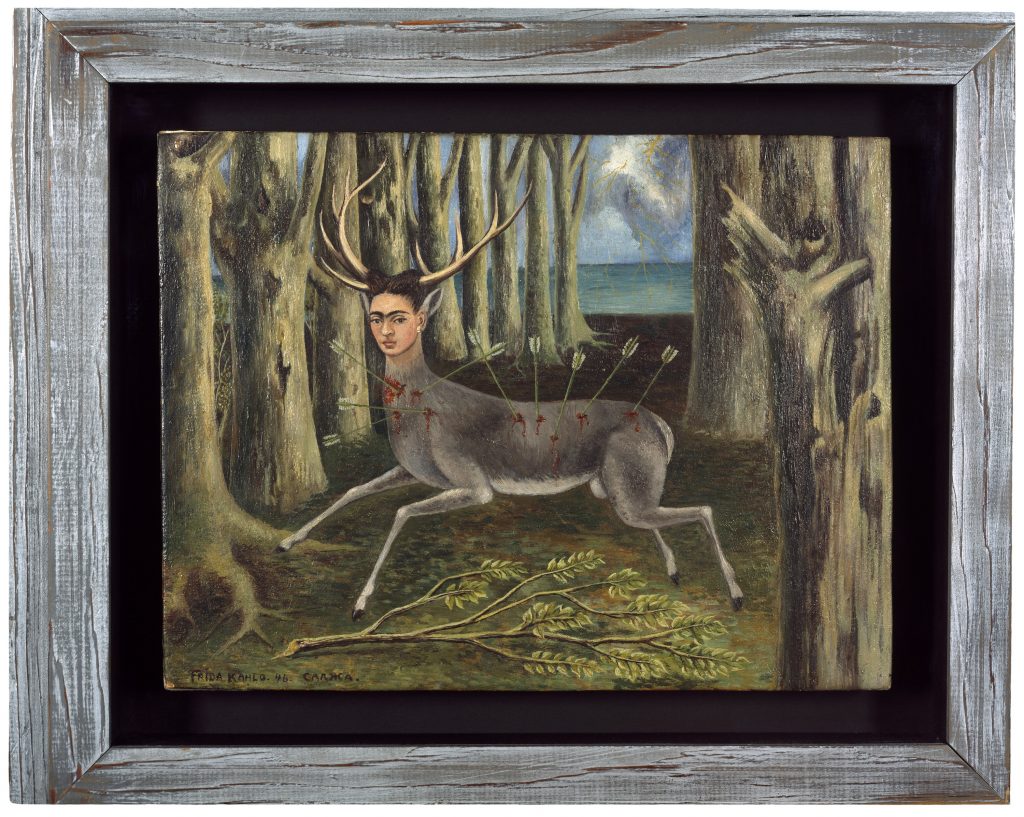
It is this role as a cultural historian which Judy Chicago fully inhabits in her artwork called “City of Ladies.” The piece is a show-within-a-show in which nearly ninety artworks by notable women from history are on display.
Installation view “The City of Ladies” by Judy Chicago Hilma af Klint, Group IX/UW, The dove, no.2 (1915) from “The City of Ladies”Gluck (Hannah Gluckstein), Portrait of Miss E.M. Craig (1920) from “The City of Ladies”
In an interview about “The City of Ladies” Judy Chicago often mentions a certain “Christine.” It took me a while to figure out she meant Christine de Pizan, who wrote “The Book of the City of Ladies” in 1404. Christine de Pizan lived from 1365 to 1430 and is thought to be the author of some of the very first feminist pieces of literature.
From compendium of Christine de Pizan’s works. Shows the author lecturing to a group of men. Created in her scriptorium in Paris in 1413.
A brochure provided by the New Museum is a compendium of the women included in the show, and contains a short but detailed biography of each: Hilma af Klint, Claude Cahun, Leonora Carrington, Elizabeth Catlett, Emily Dickinson, Artemisia Gentieschi, Zora Neale Hurston…among many others.
Wounded Deer, by Frida Kahlo (1946) from “The City of Ladies”
As Judy Chicago says: “If you bring Judy Chicago into the museum, you bring women’s history into the museum.”
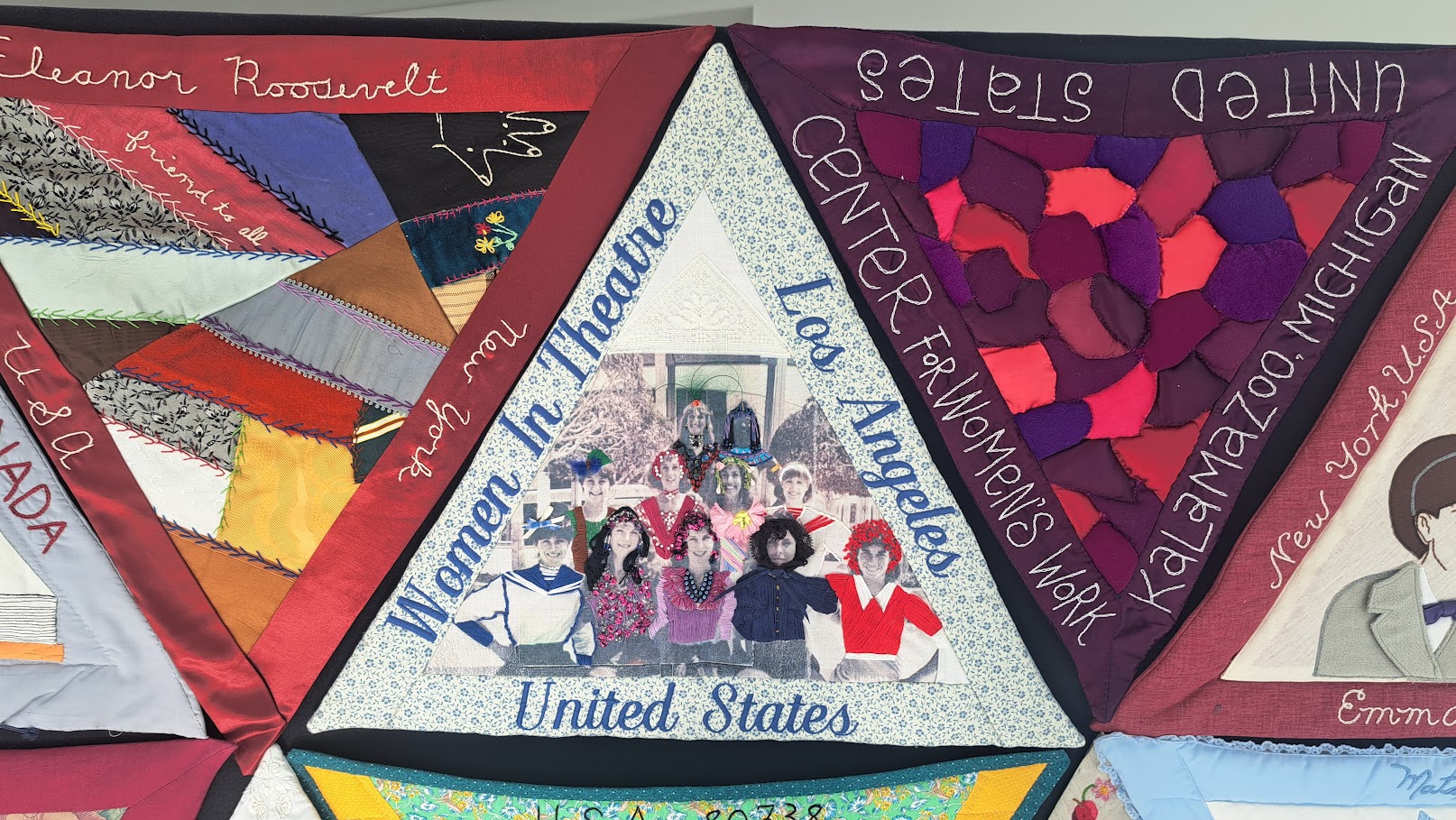
“The International Honor Quilt,” another “call and response” project, is composed of 539 individual triangular quilts, produced by women from around the world. Each triangle celebrates a woman, a women’s group or a feminist issue, and together they create a joyful depiction of global female solidarity.
Installation view “The International Honor Quilt” by Judy ChicagoDetail of “The International Quilt of Honor” by Judy Chicago
Mostly global icons, like Queen Elizabeth II, are represented, but there are also lots of obscure women’s groups and a few mythological, religious, fictional women make the cut, for example: Deborah, Demeter, Eve, Isis, Nancy Drew, Persephone, Virgin Mary and, weirdly, the Loch Ness Monster.
Depiction of Nessie
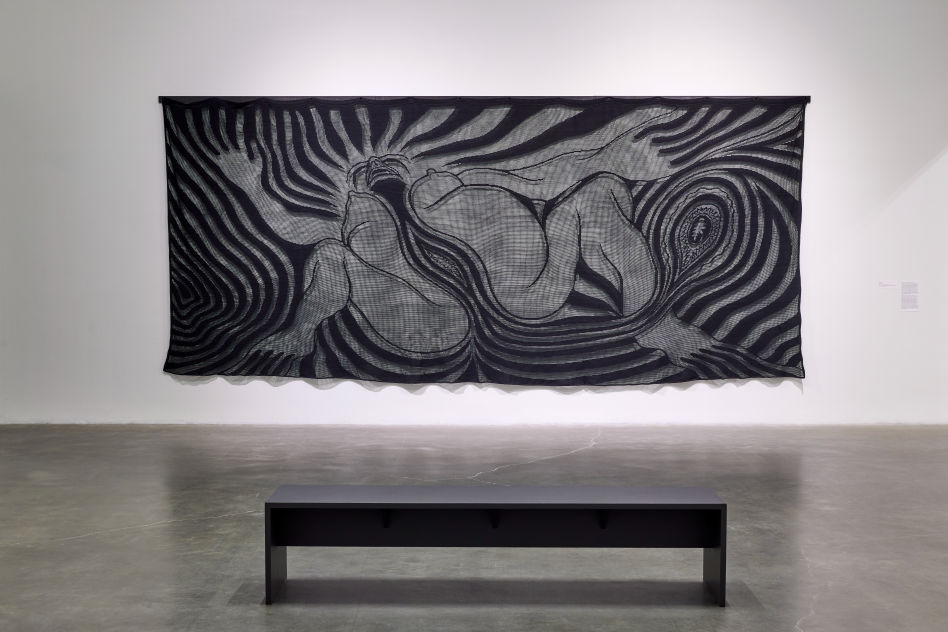
Parts of the show seem too binary. Are all women good because they can give birth and all men are evil warmongers? That part of the show — despite the beauty of the massive collaborative tapestries — struck me as an illustration of the limits of second wave feminism.
Tapestry by Judy Chicago
I prefered looking at her most recent work, where she meditates on death and the climate crisis.
Artwork by Judy Chicago
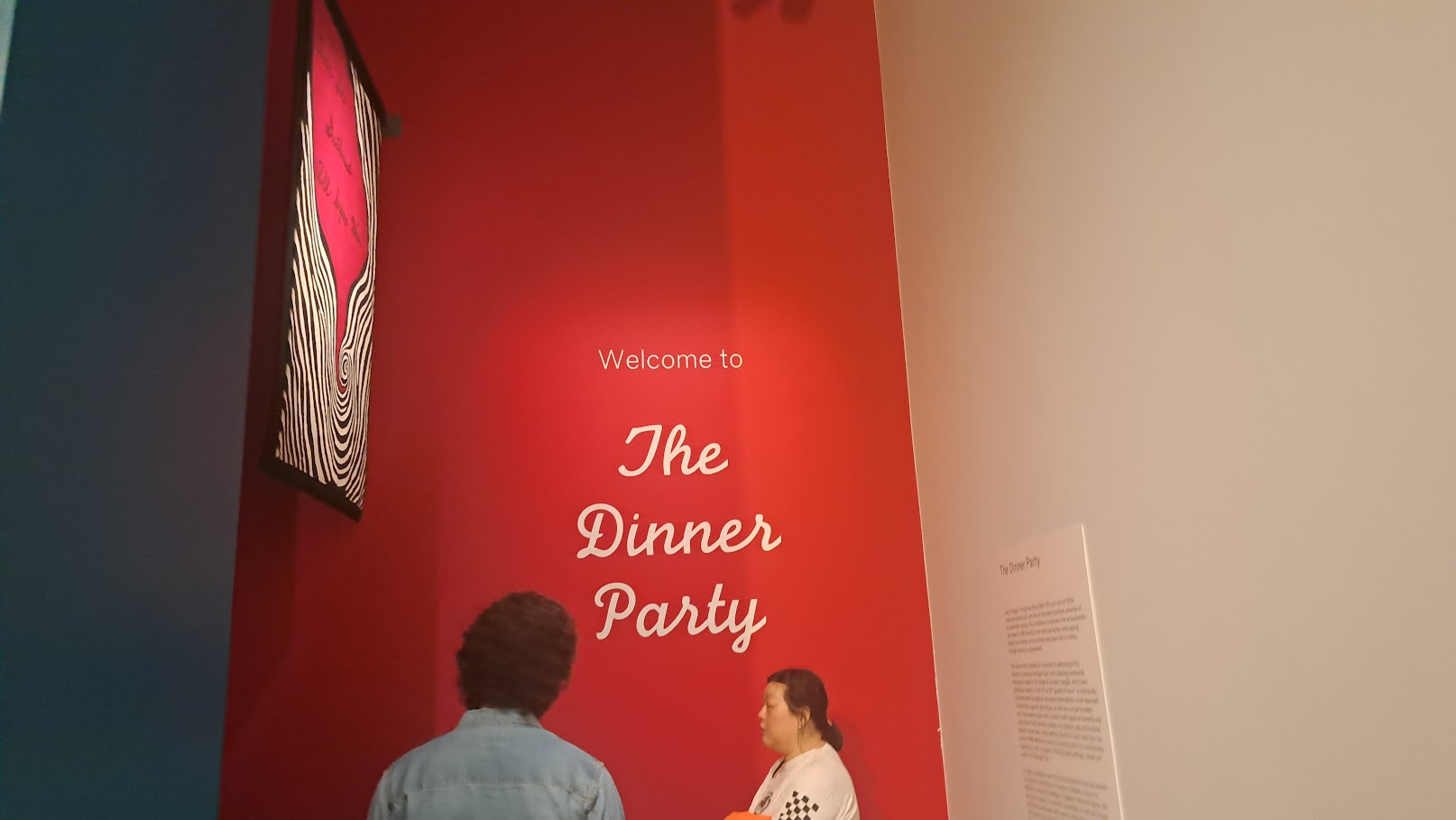
But wait, the big thing, the thing I heard about for decades, the thing that defines Judy Chicago — “The Dinner Party” — was not there. It was a ghostly presence throughout, constantly referenced, but absent.
I was obliged to journey to Brooklyn, change to the 2/3 at Hoyt, past Grand Army Plaza and The Botanic Gardens, onward, to Eastern Parkway and the stately Brooklyn Museum, where Judy Chicago’s famous work is permanently lodged.
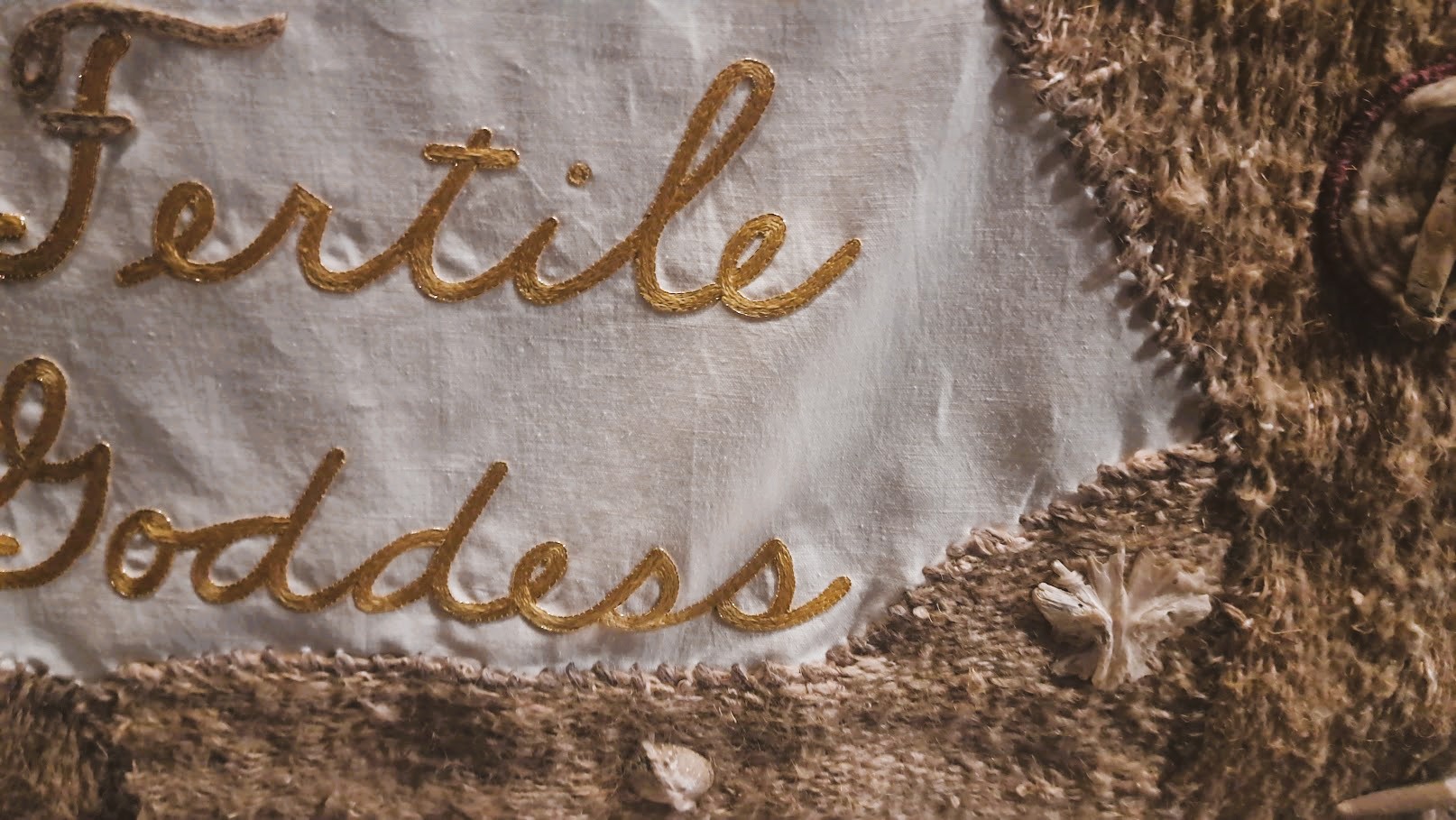
Entrance to “The Dinner Party” by Judy Chicago at the Brookly Museum“The Dinner Party” by Judy ChicagoDetail of “The Dinner Party” by Judy ChicagoDetail of “The Dinner Party” by Judy Chicago
It’s mid-January and winter has arrived on Queen Street. As I round the corner from Ossington and walk east, the scene is windswept, bleak and grey. Not so, however, within Paul Petro Contemporary Art. Paintings and works on paper by Ron Giii are on display, and suddenly I am in an atmosphere suffused with life, heat and light.
“Volume and Heat” by Ron GiiiInstallation view “The Effect of Temperature” by Ron Giii
The title of the exhibition, “The Effect of Temperature,” points to the climate crisis which looms over us all. Many of the names of the small works — The Hot Sun, The Melting Greenland Glaciers, Somali Famine — overtly reference the global menace of our heating planet.
Here’s a quote about the climate threat, from the artist, which is posted on the gallery website:
This exhibit is humbly aware of a greater nature the laws of nature have, and climate change is the reality we have designated. My small paintings cannot cry at the dangers coming amidst the deluge.
Ron Giii
The small works on paper, which have a powerful intensity, make me think of those NASA photographs from the Webb Telescope, of distant suns, dying or being born. On the other hand, they are reminiscent of infinitesimally small things too. Cells for instance or pictures of mitochondria itself.
“Time is the Daughter of Space” by Ron GiiiInstallation view “The Effect of Temperature” by Ron Giii
A few of the small paintings on paper appear to have been ripped apart and put back together with strips of clear tape. According to Paul Petro these artworks “… were destroyed by the artist during a bipolar disorder episode last year following which the artist attempted to repair the works by puzzling them back together and taping the tears. In conversation, it was agreed that these works would be consolidated with archival tapes on the verso, with the assistance of a paper conservator, to stabilize them, and that these works would be shown in order to provide a level of transparency that would welcome his disability into the conversation. Giii has subsequently referenced the Japanese kintsugi concept of repair, and finding the beauty in the broken in this work. He has lived with the challenges posed by bipolar disorder, and an original misdiagnosis of schizophrenia, for most of his adult life.”
“Fusiona” by Ron Giii
In talking about his work Ron Giii acknowledges the influence of various philosophers, of geometry, of his long term interest in quantum physics and, most recently, of the writings of the British evolutionary biochemist Nick Lane.
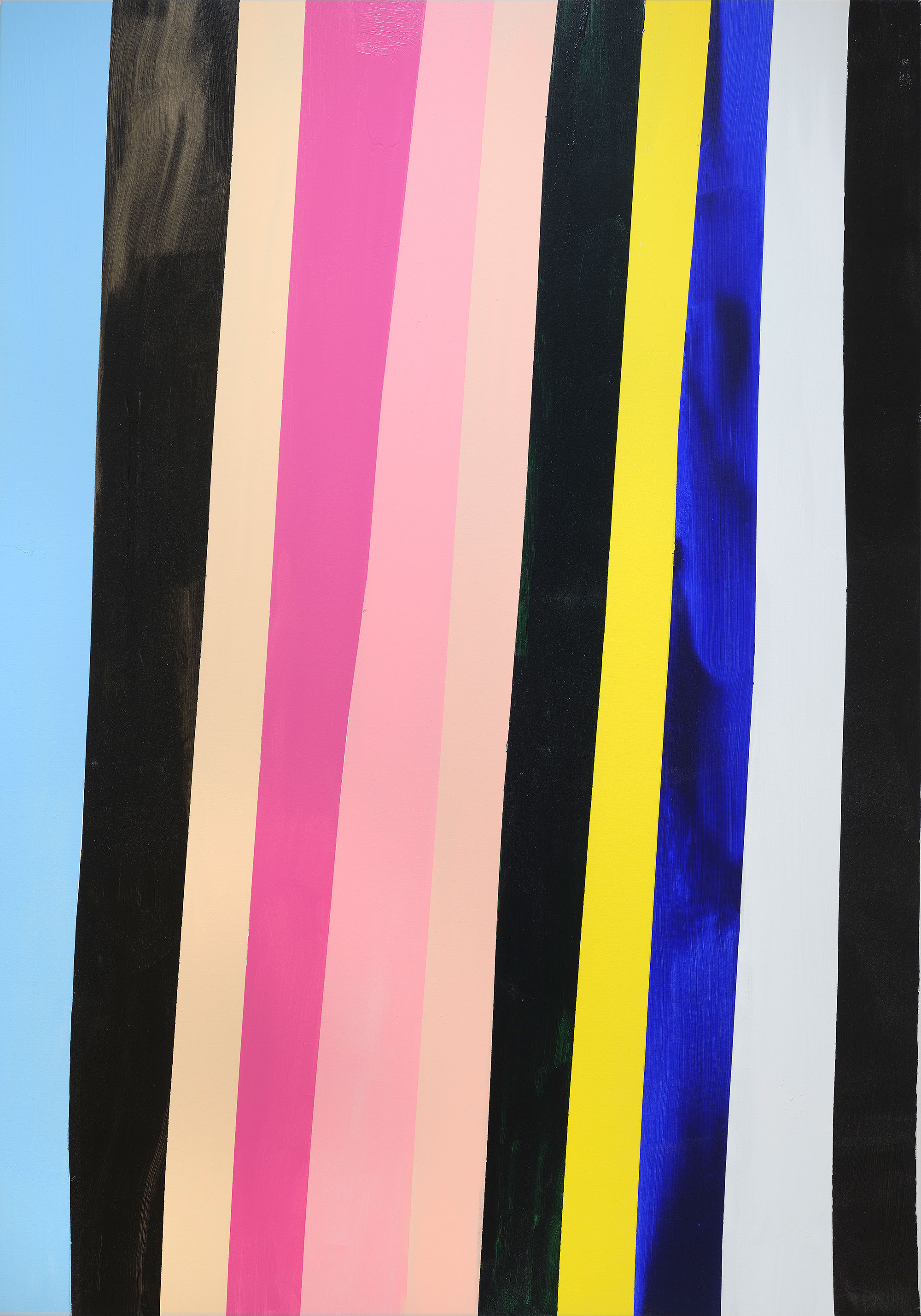
“Parallel Membranes 2” by Ron Giii
For Ron Giii, it was Nick Lane’s research into the origins of life and his descriptions of various electrochemical processes that directly inspired the striped paintings, which he calls parallel membranes, a phrase that turns up in Nick Lane’s book Transformer: The Deep Chemistry of Life and Death.
Stripes are a thing for many artists. Here are just a few examples:
Danel Buren used colored stripes, in site-specific situations, as a way of relating art to its setting. As a Frenchman, he was comfortable with the classic French fabric motif.
“Suspended Painting” by Danel Buren
Canadian artist, Guido Molinari, sought pure abstraction in his work. To that end he completely eliminated the horizontal from his canvases, and thus any suggestion of depth.
“Untitled” by Guido Molinari
Frank Stella was also looking to eliminate by using stripes. In his case, it was emotion. The stripes did it. They got rid of all that messy action painting splatter and opened the door to minimalism.
“The Marriage of Reason and Squalor” by Frank Stella
And just upstairs from the Ron Giii is an exhibition of ink washes by Francesco De la Barra. Here, the artist deploys stripes as a unifying motif in this dreamy suite of sensuous, poolside imagery.





















 annetteandquebec