October 26, 2024

Art Toronto – Canada’s Art Fair

This year’s Art Toronto — the 25th Anniversary event — exuded confidence, sophistication and depth. It was great to wander the vast expanse of the Metro Toronto Convention Center and get lost in the labyrinths and eddies of unfettered display.

There were more than 100 exhibitors. Galleries from across the country were represented. I also noticed some European and South American galleries, as well as a number from our friends in the USA.

There were many people-watching opportunities!

This vivacious, well-dressed group attended last year’s Art Toronto and were expected to return again this year, although, sadly, I did not spot them.

This exhibition has the feeling of an exciting shopping mall. What follows is a tiny and utterly subjective view of the tumult of art and commerce that is Art Toronto.

I was definitely happy to see work by favourite artists, from Toronto and elsewhere.

Carol Wainio, in her signature faded, dreamy palette, continued her exploration of haunting folklore from the distant past.

“Direction Home” by Carol Wainio was presented by Paul Petro Contemporary Art
Detail of “Direction Home” by Carol Wainio

There was some Witch Queer Volcanology on display in the form of one of the spectacular Fastwurms textile pieces.

“Sundoro” by Fastwurms was presented at Paul Petro Contemporary Art

I liked looking at the mysterious weapon, lifting off into the mist, by Wanda Koop.

“Seeway – Green with Lights” by Wanda Koop presented by Blouin Division

There were many artist’s works I had not encountered previously. I had questions.

I was trying to figure out what drew the artist, Nicholas Crombach, to this particular shade of red flocking, in his wildly complex sculptural piece. Maybe its a particular representation of vitality? Or maybe he’s referencing the way precious items are sometimes tucked away in red velvet?

Weisels by Nicholas Crombach

I enjoyed the desolate emptiness created by the painter Ulf Puder, in this large work hovering between geometry and realism.

“Sand” by Ulf Puder, shown by Bonne Choice Gallery

The photo piece below, by Kris Munsya, has a cinematic feel of futuristic mutation occuring in a lush, tropical site. I want to know more!

“Airplane Mode – Genetic Bomb” by Kris Munsya exhibited by Galerie Robertson Ares

I was in awe of this extra large lino cut print, produced on hand-made gampy paper. The giant print, by Alex Kumiko Hatanak, was part of an installation at the McMichael Gallery booth.

“Faultines and Loneliness” by Alex Kumiko Hatanaka
Detail of “Faultines and Loneliness” by Alex Kumiko Hatanaka

This photo of a house was fascinating. It looked a lot like a green monopoly piece. I learned it was part of something called the Lenora Drive Project, in which a Willowdale developer allowed artists to get creative with a half dozen condemmed bungalows.

“Title Deed” by An Te Liu presented by Bonne Choice

It took me a while to figure out that An Te Liu, the artist responsible for “Title Deed,” is the same artist who makes the very appealing sculptures, shown at Blouin Division last year.

“Broken Window” by Anahita Norouzi shown by Nicholas Roberts Gallery

Anahita Norouzi‘s photo piece made me want to know more about this barren landscape and the spectacular explosion implanted there.

Detail of “Broken Window” by Anahita Norouzi

There were some special shows put together by individual curators, including a “Focus Exhibition” titled ‘the place to which we return.’ It was described as engaging viewers with ideas of “home” and what that notion means to them.

“Regrounding” by Marigold Santos

The painting above, by Marigold Santos, was part of the “Focus Exhibition.” It was quite stunning to stand before this painting and bask in the field of yellow. The painting of a corpse dissolving into a landscape, although fascinating and intricate, is almost incidental to this powerful sweep of colour.

Detail of “Regrounding” by Marigold Santos
Artwork by Renee Condo presented by Blouin Division

Another piece in the Focus Exhibit is this one by Renee Condo. I’d seen the big, beautiful beadwork pieces by Renee Condo before, at the Blouin Division space. They have a joyful, high-octane buzz and effectively pull beadwork into a contemporary space.

“There Are No Footprints Where I go” by Meryl McMaster

In many indigenous cultures crows are valued for their intelligence and spiritual significance. They are seen as messengers from the spirit world, holders of universal wisdom, and protectors against evil forces.

This piece by Meryl McMaster, also part of the Focus Exhibition, has a quiet power and mystery.

Detail of “There Are No Footprints Where I go” by Meryl McMaster

See more about crows here.

May 5, 2024

DECADE: 10 Years of Creation at Youngplace

Beleaguered, in decline, challenged, crumbling, struggling…. These are some of the words used in the local press and social media to describe the current state of the Toronto art scene. There are many reasons: the pandemic screwed everything up, capricious corporations pulled funding, everything is turned into a condo tower, money just keeps flowing upwards, and a glass of wine costs twenty dollars. But is there something more fundamental going on, could it be the nature of Late Stage Capitalism!?

Painting by Ruth Adler
Assemblage by Ruth Adler from “DECADE” at Koffler Centre for the Arts

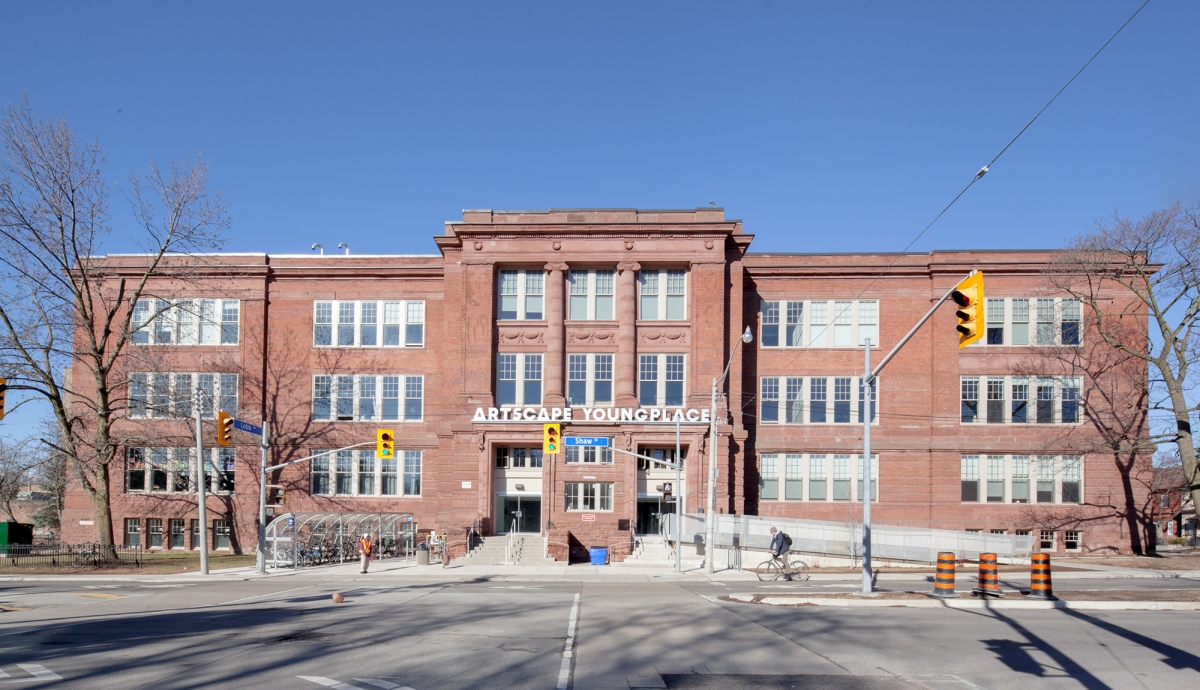
In this context, seeing the exhibition at Koffler Center for the Arts was not just fun, uplifting and hopeful, but also illustrative of the importance of artist’s spaces in this city. The Koffler Center is housed in the Youngplace building, which opened as a cultural center in 2014 and is currently one of the Artscape facilities in Receivership. All the artists in the show are, or were, until recently, part of the Youngplace community.

The stated goal of the exhibition is to shine a light on Youngplace: “this iconic arts hub.”

Painting by Ruth Adler
Assemblage by Ruth Adler

Lining the wall of the entrance to DECADE are fabric and paint assemblages by Ruth Adler. This artwork strikes me as generous, open and approachable. It’s all about surface and shape, colour, pattern and movement. It feels light-hearted and celebratory, and I really like the way this artist repurposes materials.

Ruth Adler has had a studio at Youngplace for 10 years. This fact reminded me of the documentary about Brian Eno I saw this week, at the annual Hot Docs Film Festival. (Actually it was more of a film experience, created using generative technology.) Toward the conclusion of this event Brian Eno talked a lot about the importance of creative ecologies, as opposed to the myth of the solitary genius. I assume this idea of creative community applies to all the artists in this show.

Although she works with many different kinds of materials, Ruth Adler thinks of herself as a painter. Matthew Schofield is another painter in the show. Whenever I see paintings by this artist it feels like he’s tapping into my own memory banks. That’s because he delves into the arena of quirky personal snapshots, family pictures, keepsakes, memorials that are entirely personal, and yet, universal.

Paintings by Matthew Schofield
Painting and detail by Matthew Schofield

These beautiful paintings are tiny, some just 4″x 4.” They are identical in size to the original snapshots. They have a glittering, gemlike quality which is quite mesmerizing. I want to get closer and closer to them, and peer into the captured moments.

Painting by Matthew Schofield

It was very exciting to see the work of Midi Onodera. This artist has some interesting relationships with machines.

Excerpt from Soliliquy bny Midi Onodera

The excerpt above is a hilarious interaction between the artist and a chatbot named Faux Midi.

There is a lot of literature on line these days about how chatbots and GPT entities are prone to all kinds of malfeasance. They are liars, people pleasers who will say anything just to keep talking. They are prone to hallucinations. They can easily be hypnotised to spout misinformation. In other words, these things can’t be trusted! Some of the exchanges between Midi Onodera and Faux Midi make this fact abundantly clear.

The other piece by Midi Onodera was produced especially for the exhibition and weaves together colorized, moving mages of the corridors and stairways of the Youngplace site at 180 Shaw Street. It was wonderful to look at until I started feeling seasick.

Excerpt of 2397 by Midi Onodera

Speaking of weaving, textiles played a big role in the DECADE show.

I was obliged to read the catalogue to know what I was looking at when I viewed the elegant, attenuated weavings by Shabnam K. Ghazi. In fact, these wall hangings are composed of shredded paper which has been woven into a fragile, delicate fabric. The recombined paper contains screenprinted depictions of the artist’s writings, describing her earliest memories.

Wall hangings
Artwork by Shabnam K. Ghazi

In this convoluted, painstaking process the artist has found a way to physically manifest her language and her earliest recollections.

Two pieces by Barbara Astman are in the show. One is a lovely tapestry in muted tones. It takes a while to recognize the fragments of contemporary glamour, fashion and advertising imagery in this piece. The form of tapestry, a traditionally female pursuit, originated in Ancient Egypt. Tapestry weave pieces, using linen, were found in the tombs of both Thutmose IV (d. 1391 or 1388 BC) and Tutankhamen (c. 1323 BC.)

Tapestry
Tapestry by Barbara Astman
“Daily Collage” by Barbara Astman

The other piece by this artist is a collage using news feed type imagery. I really like the way Barbara Astman uses the pictures we are relentlessly bombarded with everyday and repurposes them for her own amusement.

Detail of “Daily Collage” by Barbara Astman

Massive quilts by Carolyn Murphy are on display. They take quilting, another so-called feminine art, into the realm of spare and airy abstraction. These quilts have a Russian Constructivist vibe. The very appealling texture is created by the dense stitching which ambles every which way in curving patterns. It was a good move by the Koffler gallery to place a large sign nearby, stating the obvious: Do Not Touch.

Quilt by Carolyn Murphy

Among my favourite artworks in this show were the paintings by Gillian Iles. She has created a sprawling installation composed of about eight separate paintings, produced on Tyvek and other materials, tied and stretched haphazardly. The installation resembles a temporary dwelling or encampment, ramshackle, derelict and unsafe.

“All and Nothing” by Gillian Iles
Detail of installation by Gillian Iles

Within this structure, Gillian Iles has strewn intense images: Light blasts a tiny, vulnerable tent under the arch of a heavy black night sky; a wrecked, abandoned vehicle is overgrown with random vegetation; a fire nearly out of control towers over onlookers; and — is it dawn or more flames? — something is blazing fiercely through a hidden path in the woods.

Detail of “All and Nothing” by Gillian Iles

Detail of All and Nothing by Gillian Iles
Detail of installation by Gillian Iles

David Liss, the esteemed director/curator of MOCCA, curated the exhibition. In a video loop playing in the gallery he talks about how interacting with art — not on line but in real life — is essential to the human experience. He invites visitors to the show to celebrate Artscape Youngplace and the decade since it was founded, and to “consider and imagine what the next decade will look like.”