September 18, 2023

Liz Magor at MOCA: “The Separation”

What about all the forgotten items? What about the stacks of coffee lids, the candy wrappers, the plastic bags in soft pastels, the crenillated foil cups, and sparkly bits of paper stuffed in a gift bags, the trays — presenting so many things! — artfully coated in silver or gold? What about the big gulp holders — the really big ones — with plastic straws poking out the top? What about the hard — infuriating, practically unbreakable — plastic encasements for purchased items? What about the cigarette butts, the liquor bottles, the beer cans, the unwanted toys, empty bottles, scattered gravel, moldy cookies, moth eaten blankets, matted fake fur, dead animals, shells, gum, junk, garbage, trash?

We’re talking about the metier of Liz Magor, in her exhibition titled The Separation, on view at MOCA.

On entering the exhibition the viewer is faced with an expanse of shiny, hard mylar boxes. The boxes are brightly lit from above. They sparkle. They attract.

Installation view of “The Separation” by Liz Magor

The lighting fixtures are kind of hilarious and create a bit of a fun house atmosphere.

Details of installation by Liz Magor

I wander through the box array, anticipating. I don’t know what exactly — but something — something that is going to be exciting, in some way. And that is where everything starts to slow down.

Detail of installation “The Separation” by Liz Magor

Liz Magor presents the material that slips by us moment to moment, all the stuff that we ignore. As she does that, we are obliged to consider a lot of things, but mostly transience and permanence, and, as strange as it may sound, the whole idea of time rushing by.

Detail of installation “The Separation” by Liz Magor

Many of her sculptures, protected in their big, clear boxes, are casts of the original objects they represent. They are facsimiles, removed from their original function, context and incidental narrative, to exist in another realm altogether. Maybe that’s what she is referring to in the exhibition title (“The Separation.”) She has removed these bits of our material lives and “separated” them from their predictable stream of existence.

Artwork by Liz Magor
Art work by Liz Magor

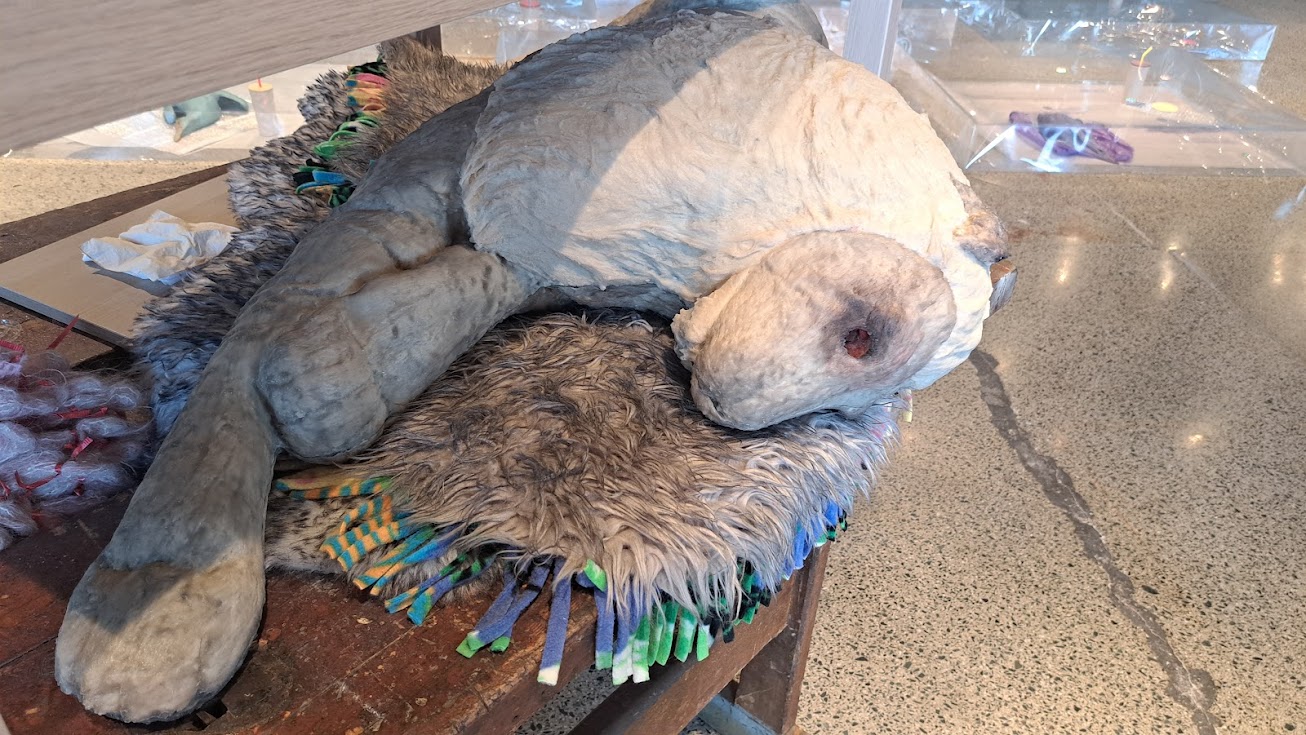
There are a few structures on the pheriphery, — hammered together Ikea and antique, worn work tables — holding cast sculptures of stuffed (or sometimes just dead) animals, lying in sympathetic poses, insisting on our attention.
Art work by Liz Magor

(In fact, I may have won this lion creature, above. It was some years ago, at the ex, prior to the pandemic. Yes, it was a shooting game! Oh god, look at him now.)

Artwork by Liz Magor
Details of sculpture by Liz Magor
Artwork by Liz Magor

There are lots of video’s online featuring Liz Magor talking about her work. She has a very calm, amused presence, although she always seems to be talking about being a “worrier.”

Something I got from watching one of the videos is her connection to minimalism. She is drawing our attention to particular objects. Don’t start looking for some allegory, metaphor or moral. She’s not hectoring us about being consumers, urging us the Save the Whales, or read Wittgenstein. She’s all about: “What you see is what you see,” as Frank Stella famously said.

The videos are worthwhile. I definitely liked watching her make stuff and talk about her interest in death.

Liz Magor at Susan Hobbs: “Style”

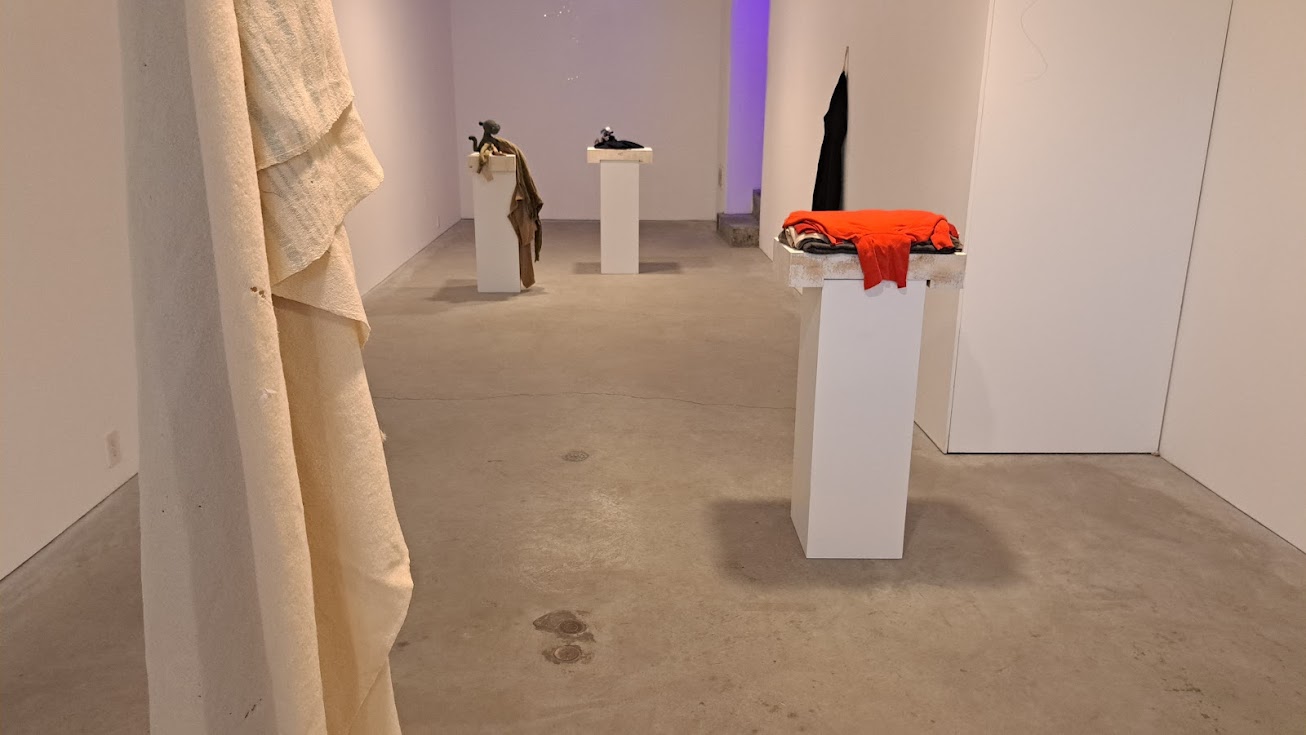
More work by Liz Magor can be seen at Susan Hobbs. The show, titled “Style,” is really beautiful and concise, comprised mainly of clothes slightly eaten by moths. Found objects — mostly stuffed animals, also possibly moth eaten — attend the garments, embrace them and present them for our viewing.

Sculpture by Liz Magor
Installation view of Liz Magor show “Style” at Susan Hobbs

The gallery has helpfully provided some instructions on dealing with moths. I know from experience this has been a problem over the past few years in my Toronto neighborhood.

Clean your closet, combine sunlight with vigorous brushing, heat-treat woollen items in an oven set to the lowest heat, freezing (but only if the change from warm to cold is abrupt) for at least 72 hours, hide the rest of your clothes in compression bags. In executing some of the solutions above, the garment is stripped of its function and tended to as an object that needs our intervention. Our attempt to fix the problem only adds to our conception that we hold control, but all things have a lifespan with and without us.

from Susanhobbs.com
Details of sculpture by Liz Magor

The artwork of Liz Magor strikes me as so efficient! As in “The Separation” at MOCA, in viewing “Style” we are obliged to consider the limits of our possessions, the past and future of our prized wearable items, and so too of our own limits. Hmmmm.

Sculpture by Liz Magor

June 8, 2020

In Toronto and elsewhere, the lack of distracting activities like movies, concerts and sports is contributing to profound events. The real world is changing so fast, as people get focused and rise up. Meanwhile, in the cultural domain, time and place, and, openings and closings, don’t really matter. Many cultural products have become digital and are therefore on demand, untethered by time constraints. Time itself can be compressed to almost nothing or drawn out and made to last.

2020 Scotiabank CONTACT Photography Festival

Ho Tam at Paul Petro Contemporary Art

For example, the 2020 Scotiabank Contact Photography Festival, which normally takes place throughout the city in the month of May, was largely postponed, except for the bits and pieces of it which can still be seen, either online or, in a few instances, as outdoor public installations (in the real world.)

In a 25-year-old video by Ho Tam, which was exhibited at Paul Petro Contemporary Art as part of CONTACT, Godzilla is the opening act. The video, titled “The Yellow Pages”, has a lightness and playfulness that belies its serious content.

The Yellow Pages by Ho Tam

Silent and less than eight minutes long, Ho Tam’s video is an illustrated alphabet of racial cliches and assumptions. A is for “Asian Crimes,” B is “Butterfly”, C is “Chinatown,” D is “Dogmeat.” The artist has a very graceful way of layering one cliche upon another. E is for “Enter the Dragon” but instead of Bruce Lee we are treated to a clip of a painfully decrepit Mao Zedong meeting (possibly) Soviet dignitaries sometime in the early 70s. Everything feels so weighted with meaning. Maybe that’s why the piece is so delightful to watch. The cliches are off, and, therefore unsettling.

Uniformly bathed in sepia, the images diverge wildly: “Head Tax” is a ghastly heap of skulls documenting the reign of the Khmer Rouge, “Ninja Turtles” refers to a group of elderly Tai Chi practitioners, and the “Asian Crimes” section — the first letter — introduces the endearing yet ruinous antics of Godzilla. I’m not sure if Godzilla is punishing “Asian Crimes,” or maybe Godzilla himself is the crime, unleashed upon the world.

According to social theorists, since the first Japanese movie featuring Godzilla debuted in 1954, the giant lizard has effectively tapped into our fears and preoccupations. He embodies nuclear weapons, catastrophic bio-hazard, global environmental degradation, cross-species virus transmission and whatever comes next. That’s why we love him!

Toho Studio

Dawit L. Petros at Power Plant

On the CONTACT Festival website I was advised there was a public installation currently On View at The Power Plant. I rode my bike down to Queen’s Quay to have a look. The Power Plant was closed. But, I did get to see the giant, outdoor banner, art piece by Dawit L. Petros, erected as part of the 2020 CONTACT festival.

Installation view of Artwork by Dawit L. Petros titled “Untitled (Overlapping and intertwined territories that fall from view III)

Reading the accompanying text makes clear that this is a scene of current and historic misery. A man is holding a large photograph, which conceals his identity. The man is named Moktar. He is described as one of the millions of migrants who have embarked on dangerous journeys all over the world. Coming from Eritrea, Moktar traveled through Sudan, Egypt, Libya, and across the Mediterranean to a new life in Italy. He was photographed at an unspecified location.

Detail of installation view of Artwork by Dawit L. Petros titled “Untitled (Overlapping and intertwined territories that fall from view III)

The photograph Moktar is holding is “a reproduction of an etching by Georgina Smith, an eyewitness to the sinking of the transatlantic steamship SS Utopia. In a tragic accident on March 17, 1891, the SS Utopia—used frequently to transport European immigrants to the United States—collided with a battleship off the shores of Gibraltar and sank quickly, killing over 500 passengers, many of whom were poor southern Italians seeking better lives across the Atlantic Ocean.”

Detail view of installation by Dawit L. Petros titled “Untitled (Overlapping and intertwined territories that fall from view III)

Looking closely at the photograph of the etching, the detailed image of the terrible event can be seen.

The migrant experience, quickly forgotten by subsequent generations, is perilous today, as it was in 1891.

View of Lake Ontario from southern facade of the Power Plant.

The view southward from the art installation appears serene. Queen’s Quay, normally thronged with tourists during the summer months, is deserted. The lake is very calm in the sudden summer heat.

Museum of Contemporary Art

MOCA closed on March 14th, right in the middle of a exciting moment in the Museum’s brief history. Exhibits by four celebrated artists —Shelagh Keeley, Megan Rooney, Carlos Bunga and Sarah Sze — at various points in their respective career — made the building feel suddenly packed with bold endeavour. What a letdown when the pandemic wrapped things up way too soon!

Since that time, MOCA, like so many other cultural institutions, has tried to figure out ways to retain their audience and foster engagement.

Toronto’s Museum of Contemporary Art is located at 158 Sterling Road
Ben Rahn/A-Frame/A-Frame

During the lockdown, each week the Museum presents a new time-based work, frequently in collaboration with another local cultural organization. This week you can watch an experimental play, which is particularly relevant to the Black Lives Matter events of the moment. It is titled On Trial: The Long Doorway, by Deanna Bowen, and it can be seen on MOCA’s Shift Key platform.

Meanwhile, the real exhibits, which were scheduled to run to mid-May, languish in the silent halls of the Museum. Hesitancy and confusion about when shows start and end constitute more pandemic fallout. (So many changes in the world right now: I really like the fact that Grind Culture is taking a hit during this global episode! Slow the hell down!)

Guided virtual tours, by MOCA curators, are provided in connection to some of the works inside, including a tour of An Embodied Haptic Space which is the title of Shelagh Keeley’s exhibition of site specific wall drawings and photographs. Tarp paintings from 1986 and a fascinating video are also in the exhibition.

Installation view of drawings at MOCA by Shelagh Keeley

Watch a guided tour of the exhibition here.

Shelagh Keeley, “Fragments of the Factory / Unfinished Traces of Labour”, 2020. MOCA Toronto. Photo by Toni Hafkenscheid

The washed out greens and purples in the drawings multiply the feeling of decay and putrescence seen in the photographs, themselves part of the visual wall, which the artist took, when the site at 158 Sterling Road was still unrenovated.

The sense of intuitive confidence, so evident in the beautiful drawings, was also at work in the video part of the exhibition. The text accompanying the video, titled The Colonial Garden, explains that this place, now largely shuttered and in disrepair, was part of the 1940 Portuguese World Exhibition, where it functioned as a kind of human zoo, exhibiting native people from Portugal’s colonies. Shelagh Keeley’s video, creates a growing sense of the sinister, as it takes the viewer on a slow tour of the shambolic garden.

Still from The Colonial Garden by Shelagh Keeley